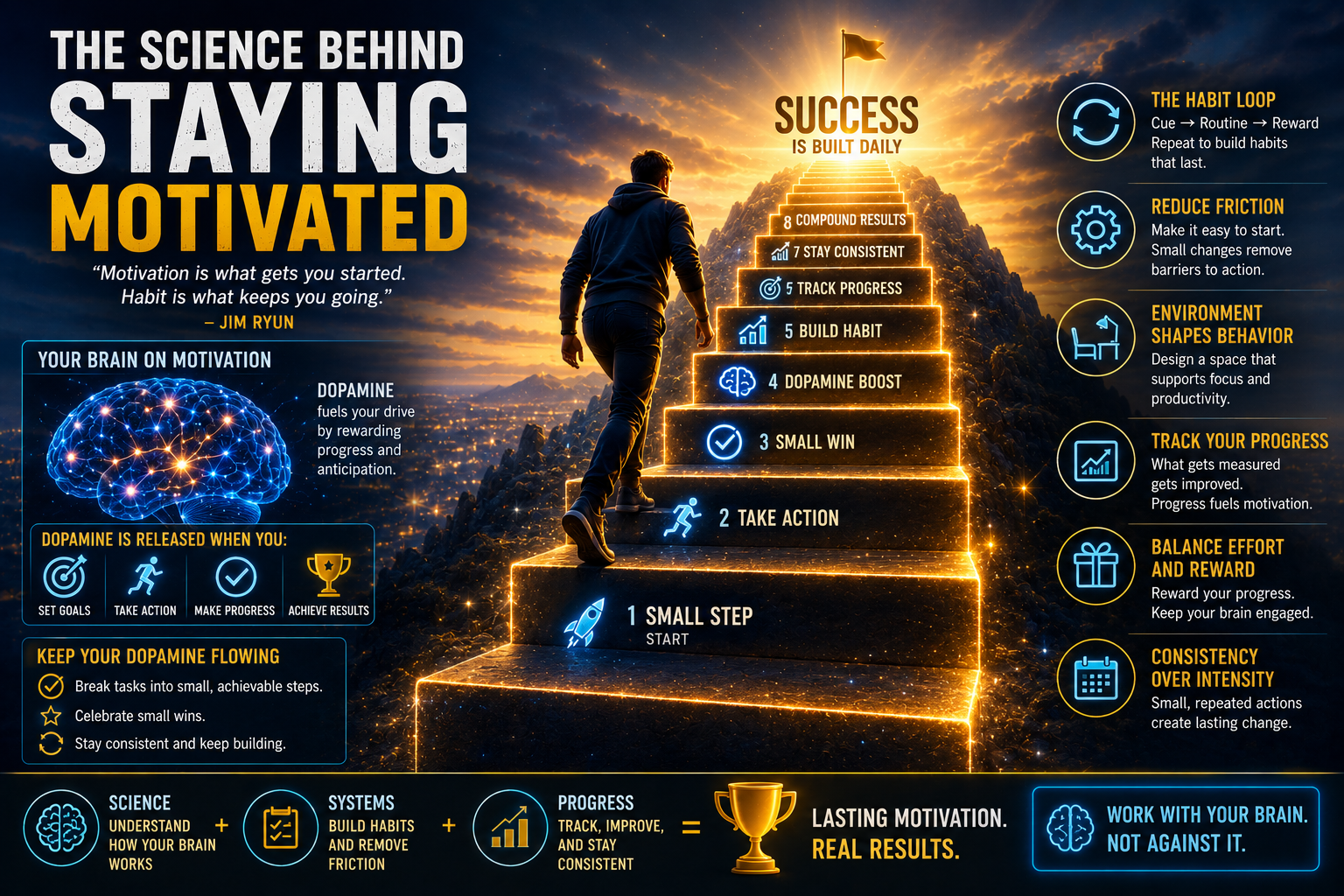


“Motivation is what gets you started. Habit is what keeps you going.” – Jim Ryun
Disclaimer: This blog may contain affiliate banner advertisements. If you click on these ads or make purchases through them, we may earn a small commission at no additional cost to you. These commissions help support our work and allow us to continue providing valuable content.
Introduction: Motivation Isn’t Just Willpower
Introduction: Motivation Isn’t Just Willpower
Motivation is often misunderstood as something you either have or you don’t. Many people believe that successful individuals simply possess more willpower, greater self-discipline, or an endless supply of determination. As a result, when motivation fades—as it inevitably does—they assume something is wrong with them or that they lack what it takes to succeed. The truth is far different. Motivation is not simply a matter of mental toughness or personal character. It is a complex process influenced by the way your brain works, the habits you develop, the environment you create, and the rewards that reinforce your behavior.
Modern research has shown that motivation is closely connected to the brain’s reward and learning systems. Every time you make progress toward a meaningful goal, complete a task, or experience a sense of accomplishment, your brain reinforces those behaviors, making it more likely that you will repeat them in the future. This is why achieving even small milestones can create momentum and increase your desire to continue. Rather than being powered solely by willpower, motivation is strengthened through repeated experiences of progress, purpose, and positive reinforcement.
This also explains why motivation naturally rises and falls. It is unrealistic to expect yourself to feel inspired every day. Stress, fatigue, setbacks, distractions, and changing circumstances all influence your mental and emotional state. Waiting until you “feel motivated” before taking action often leads to inconsistency because those feelings are temporary. The most successful people understand this reality and build habits, routines, and systems that help them continue making progress even when motivation is low.
Understanding the science of motivation changes the way you approach your goals. Instead of relying on bursts of inspiration, you begin designing your daily life in ways that encourage consistent action. Breaking large goals into smaller milestones, celebrating daily wins, reducing unnecessary obstacles, creating positive habits, and surrounding yourself with supportive environments all work with your brain rather than against it. These strategies make it easier to stay engaged because they provide regular experiences of progress and accomplishment.
This scientific perspective also removes much of the guilt people feel when they struggle with motivation. Losing motivation from time to time does not mean you are lazy, incapable, or destined to fail—it simply means you are human. The key is not to depend on motivation alone but to create systems that keep you moving forward regardless of how you feel. When positive habits become automatic and meaningful routines are established, progress continues even on days when enthusiasm is in short supply.
Ultimately, understanding the science behind motivation empowers you to take a smarter approach to personal growth. Instead of hoping motivation will appear, you learn how to cultivate it through intentional actions, consistent habits, and environments that support success. By combining this knowledge with discipline and purposeful action, you create a sustainable path toward achieving your goals—one that is based not on fleeting emotions but on proven principles that help you continue moving forward, day after day, regardless of the challenges you encounter.
How Your Brain Drives Motivation
## How Your Brain Drives Motivation
Motivation is not simply an emotional feeling—it is deeply connected to the way your brain processes goals, rewards, and progress. One of the most important chemicals involved in this process is **dopamine**, a neurotransmitter that plays a significant role in motivation, learning, and the brain’s reward system. While dopamine is often referred to as the brain’s “feel-good” chemical, its role is much broader than simply creating pleasure. It helps encourage you to pursue goals by reinforcing behaviors that move you toward meaningful outcomes.
One of the most fascinating aspects of dopamine is that it is released not only when you achieve a goal, but also when you anticipate making progress toward it. In other words, your brain responds to the expectation of success as well as the success itself. This anticipation creates a sense of excitement and encourages you to take the next step. Whether you’re working toward finishing a project, learning a new skill, completing a workout, or reaching a personal milestone, your brain begins motivating you before you actually arrive at the finish line.
This helps explain why breaking large goals into smaller milestones is so effective. Every time you complete one step, your brain recognizes that progress has been made, reinforcing your desire to continue. Rather than waiting months or years for one major accomplishment, you create multiple opportunities to experience progress along the way. These frequent moments of achievement strengthen your motivation, build confidence, and make it easier to stay committed over the long term.
Dopamine also plays an important role in habit formation. When your brain connects a positive feeling with a productive behavior, it becomes more likely to repeat that behavior in the future. This is why consistently completing small daily tasks, celebrating milestones, and recognizing your progress can be so powerful. Each positive experience reinforces the habit of taking action, gradually making productive behaviors feel more natural and automatic.
Understanding how your brain works also reveals why motivation sometimes fades. If a goal feels too large, too distant, or impossible to achieve, your brain may struggle to maintain the same level of anticipation and engagement. Without regular experiences of progress, enthusiasm naturally declines. This is why it’s so important to create meaningful milestones, celebrate small victories, and focus on what you can accomplish today rather than becoming overwhelmed by how far you still have to go.
The encouraging news is that you can work with your brain instead of against it. By setting achievable goals, tracking your progress, creating consistent routines, and acknowledging even small successes, you continually reinforce the mental pathways that support motivation. Over time, your brain begins associating productive action with positive outcomes, making it easier to stay focused and committed.
Ultimately, motivation is not something that appears by chance. It is a process influenced by the way your brain responds to progress, purpose, and achievement. When you understand that motivation grows through anticipation, small wins, and consistent action, you gain the ability to create an environment where motivation becomes more reliable. Instead of waiting to feel inspired before taking action, you learn that taking action itself is one of the most effective ways to strengthen motivation and build lasting momentum toward your goals.
The Role of Dopamine
The Role of Dopamine
Dopamine plays a central role in the way your brain creates and sustains motivation. While it is often called the brain’s “reward chemical,” its primary function is not simply to make you feel good after achieving a goal. Instead, dopamine helps drive your desire to pursue goals by reinforcing behaviors that lead to progress and success. It encourages you to keep taking action by reminding your brain that your efforts are worthwhile and that continuing forward may lead to future rewards.
One of the most interesting aspects of dopamine is that it responds not only to achieving results but also to making progress along the way. Every time you complete a meaningful task, check an item off your to-do list, solve a problem, or reach a small milestone, your brain recognizes that progress has been made. This creates a feeling of satisfaction and accomplishment that motivates you to continue. In many ways, your brain is constantly encouraging you to repeat behaviors that move you closer to your goals.
This is why small wins are so powerful. Large goals often take weeks, months, or even years to accomplish, and if you wait until the very end to experience a sense of achievement, it becomes much harder to stay motivated. By breaking your larger objectives into smaller milestones, you create regular opportunities for your brain to recognize progress. Each completed step provides another moment of accomplishment that keeps your motivation active and your momentum growing.
For example, imagine writing a book. Focusing only on the finished manuscript may feel overwhelming because the goal seems so distant. However, if you celebrate completing one chapter, writing five hundred words, or outlining a new section, your brain receives regular signals that meaningful progress is occurring. Those repeated experiences of accomplishment make it easier to return to your work the next day because your mind has begun associating the process with positive reinforcement rather than frustration.
The same principle applies to every area of life. Completing a workout, learning a new concept, saving a small amount of money, organizing your workspace, or accomplishing one important task at work may seem like modest achievements, but each one reinforces productive behaviors. Over time, these repeated moments of progress strengthen your habits and make consistent action feel more rewarding.
Understanding dopamine also highlights an important truth about motivation: waiting until you feel motivated before taking action often works against you. In many cases, action comes first, and motivation follows. Completing even a small task creates a sense of progress that encourages you to continue, making it easier to tackle the next challenge. This creates a positive cycle where action generates progress, progress reinforces motivation, and motivation inspires further action.
By intentionally creating frequent opportunities for small wins, you work with your brain’s natural reward system instead of against it. Breaking goals into manageable steps, tracking your progress, celebrating milestones, and acknowledging your accomplishments all help maintain engagement and build lasting momentum. Over time, these practices strengthen your motivation, reinforce productive habits, and make it easier to remain committed even when challenges arise.
Ultimately, dopamine reminds us that motivation is not something we must wait for—it is something we can actively cultivate. Every meaningful step you take, no matter how small, reinforces your brain’s desire to continue progressing. By consistently creating opportunities for achievement, you build a powerful cycle of motivation that supports long-term growth, sustained effort, and lasting success.
Why Small Wins Matter
Why Small Wins Matter
One of the most effective ways to stay motivated is to break large goals into smaller, achievable steps. When a goal feels too big or too far away, your brain can perceive it as overwhelming, making it easier to procrastinate or lose motivation before you even begin. By dividing a major objective into smaller tasks, you create clear and attainable milestones that make progress feel realistic. Instead of focusing on everything that remains to be done, you direct your attention to the next meaningful step, making it much easier to take action.
These small wins are important because they provide your brain with frequent experiences of progress. Every time you complete a task, solve a problem, or reach a milestone, your brain recognizes that forward movement has occurred. This sense of accomplishment activates the brain’s reward system, reinforcing the behavior that led to the success and increasing your desire to continue. Rather than waiting for one major achievement months in the future, you experience regular moments of satisfaction that help sustain your motivation over time.
This is one of the reasons successful people often focus on progress rather than perfection. They understand that completing a series of small tasks consistently is far more effective than waiting for the perfect moment to accomplish something extraordinary. Each completed action creates momentum, making the next step feel more manageable. Over time, these repeated successes build confidence because you begin seeing yourself as someone who follows through and makes steady progress toward meaningful goals.
Small wins also reduce the mental burden of large projects. Imagine trying to climb a mountain by focusing only on the summit. The distance may seem discouraging, making the journey feel impossible. However, if you concentrate on reaching the next marker along the trail, each step becomes achievable. Before long, those individual steps accumulate, and you find yourself much closer to the top than you ever imagined. The same principle applies to personal growth, business, education, health, and every other area of life.
Another advantage of small wins is that they help establish productive habits. When you consistently complete manageable tasks, your brain begins associating effort with positive outcomes. Over time, this strengthens your routines and makes productive behaviors feel increasingly automatic. What once required significant willpower gradually becomes part of your daily lifestyle, allowing you to continue making progress even on days when motivation is lower than usual.
Perhaps most importantly, small wins remind you that progress is happening even when the final goal still seems far away. Every completed task, every lesson learned, and every positive choice represents another investment in your future success. These moments reinforce the belief that your efforts matter and that each day provides another opportunity to move forward.
Ultimately, the power of small wins lies in their ability to keep your brain engaged, motivated, and focused on progress. By breaking large goals into manageable steps and celebrating each milestone along the way, you create a continuous cycle of action, accomplishment, and renewed motivation. Over time, these seemingly small victories accumulate into remarkable achievements, proving that lasting success is built not through one giant leap, but through countless small steps taken consistently and with purpose.
The Habit Loop
The Habit Loop
One of the most effective ways to make motivation more reliable is to stop depending on it altogether and instead build strong habits. Unlike motivation, which naturally rises and falls, habits allow you to take consistent action with much less mental effort. Once a behavior becomes a habit, you no longer have to convince yourself to do it every day—it becomes a natural part of your routine. This is why successful people often rely more on habits than on inspiration. They understand that consistent systems produce consistent results.
At the center of habit formation is a simple process known as the habit loop, which consists of three key components: cue, routine, and reward. Understanding how this loop works allows you to intentionally create habits that support your goals instead of leaving your behaviors to chance.
The first component is the cue. A cue is the trigger that tells your brain it is time to perform a particular behavior. It can be a specific time of day, a location, an emotion, another habit, or even an object in your environment. For example, waking up in the morning may become the cue to exercise, finishing lunch may become the cue to read for fifteen minutes, or sitting at your desk may signal the beginning of focused work. The more consistent your cues become, the easier it is for your brain to recognize when it’s time to take action.
The second component is the routine. This is the actual behavior or habit you want to develop. It could be writing for thirty minutes, taking a walk, studying a new skill, practicing gratitude, or working on an important project. At first, performing the routine requires conscious effort, but with repetition it gradually becomes more automatic. The key is to make the routine realistic and sustainable so that you can repeat it consistently over time.
The third component is the reward. After completing the routine, your brain receives some form of positive reinforcement. Sometimes the reward is external, such as checking a task off your list or enjoying a short break. Other times the reward is internal, such as the satisfaction of making progress, feeling healthier, or knowing you’ve kept a promise to yourself. These positive experiences strengthen the connection between the cue and the routine, making it more likely that you will repeat the behavior in the future.
As this loop repeats day after day, the habit becomes increasingly automatic. Eventually, the cue alone begins preparing your brain for the routine, reducing the amount of willpower required to get started. What once felt difficult gradually becomes part of your normal daily life. This is why habits are so powerful—they reduce decision fatigue, conserve mental energy, and make consistent action easier even when motivation is low.
You can intentionally design your own habit loops by connecting new habits to routines you already have. For example, if you already drink a cup of coffee every morning, you might use that as the cue to spend ten minutes planning your day. If you always finish dinner at the same time, that moment can become the cue to read, exercise, or work on a personal goal. Pairing new habits with existing routines makes them easier to remember and more likely to become permanent.
It’s also important to make the rewards meaningful. A sense of accomplishment, checking off a completed task, tracking your progress, or simply recognizing your consistency can all reinforce positive behavior. Over time, the habit itself often becomes rewarding because you begin to enjoy the confidence, progress, and sense of control that come from following through on your commitments.
Ultimately, the habit loop demonstrates that lasting motivation is not something you have to chase every day. By creating consistent cues, repeating productive routines, and reinforcing those behaviors with meaningful rewards, you build habits that continue working even when your motivation fluctuates. Over weeks, months, and years, these habits become the foundation of long-term success, proving that extraordinary results are often the product of ordinary actions repeated consistently through well-designed systems.
Reducing Friction
Reducing Friction
One of the simplest ways to increase motivation and consistency is to reduce the amount of effort required to get started. Often, the hardest part of completing a task is not the task itself—it’s taking the first step. When something feels complicated, time-consuming, or inconvenient, your brain is more likely to delay it in favor of activities that require less effort. This is known as friction—the small obstacles that make taking action more difficult than it needs to be. By identifying and removing these obstacles, you make it much easier to build positive habits and stay consistent over time.
Reducing friction begins by making your desired behavior as simple and accessible as possible. If you want to exercise in the morning, lay out your workout clothes the night before. If your goal is to read more, place a book where you’ll naturally see it instead of leaving it tucked away on a shelf. If you plan to write each day, have your computer, notes, or writing materials ready before you begin. These small preparations eliminate unnecessary decisions and reduce the excuses that can keep you from getting started.
Your environment also plays a significant role in reducing friction. A cluttered workspace, constant notifications, or frequent interruptions can make it difficult to focus and increase the mental effort required to begin meaningful work. Creating a clean, organized, and distraction-free environment helps your brain associate that space with productivity. Even simple changes, such as turning off unnecessary notifications, organizing your desk, or keeping only the tools you need within reach, can make a noticeable difference in your ability to concentrate and maintain momentum.
Another effective strategy is to simplify your process. Instead of telling yourself that you need to complete an entire project, commit to working for just five or ten minutes. Rather than aiming to read an entire chapter, begin with one page. Instead of thinking about writing an entire report, focus on creating the first paragraph. Breaking tasks into smaller starting points reduces the mental resistance that often prevents action. Once you’ve begun, you’ll frequently find that continuing is much easier than you expected.
Reducing friction also means eliminating unnecessary obstacles that interfere with your progress. If you know certain distractions consistently pull you away from your work, take steps to minimize them before you begin. Prepare what you need in advance, establish a consistent routine, and make productive choices the easiest choices available. The fewer barriers standing between you and your goals, the more likely you are to follow through consistently.
One of the greatest benefits of reducing friction is that it strengthens your habits over time. When positive behaviors become easier to start, you perform them more often. As those behaviors are repeated, they gradually become automatic, requiring less motivation and willpower. What once felt difficult becomes part of your normal routine, allowing you to maintain steady progress even on days when your energy or enthusiasm is lower than usual.
Ultimately, success is not always about working harder—it is often about making it easier to do the right things consistently. Small adjustments to your environment, routines, and preparation may seem insignificant, but they can dramatically improve your ability to take action. By reducing friction and removing unnecessary barriers, you create conditions that support consistency, strengthen positive habits, and make long-term progress feel more natural. Over time, these simple changes compound into meaningful results, proving that sometimes the smallest improvements have the greatest impact on your success.
Environment Shapes Behavior
Environment Shapes Behavior
Your environment has a powerful influence on your daily choices, often affecting your behavior without you even realizing it. While many people believe that success depends primarily on motivation or willpower, the reality is that the spaces you live and work in, the people you spend time with, and the routines you establish all shape your habits in significant ways. Every environment sends subtle signals to your brain about what behaviors are expected, encouraged, or discouraged. By understanding this influence, you can intentionally create surroundings that make positive choices easier and negative habits less appealing.
A cluttered, disorganized, or distracting environment can make even simple tasks feel more difficult. Constant notifications, unnecessary noise, visual clutter, or an unorganized workspace compete for your attention and increase mental fatigue. The more distractions your brain must process, the harder it becomes to focus on meaningful work. Over time, these small interruptions reduce productivity, weaken motivation, and make it more likely that you’ll procrastinate or abandon important tasks.
On the other hand, a well-organized and supportive environment naturally encourages productive behavior. A clean workspace, a quiet area for focused work, easily accessible tools, and a consistent daily routine all reduce mental friction and make it easier to begin important tasks. When everything you need is prepared and within reach, your brain spends less energy overcoming obstacles and more energy making progress. These seemingly small improvements create conditions that support concentration, efficiency, and consistency.
Your social environment is equally important. The people you spend the most time with influence your mindset, expectations, and habits. Surrounding yourself with individuals who encourage growth, demonstrate discipline, and support your goals can increase your own motivation and confidence. Their attitudes, behaviors, and encouragement often inspire you to aim higher and remain committed during difficult times. Conversely, spending significant time in environments filled with negativity, constant criticism, or unhealthy habits can gradually affect your thinking and make it more difficult to maintain positive behaviors.
The information you consume also becomes part of your environment. The books you read, podcasts you listen to, videos you watch, and conversations you engage in all shape your beliefs and attitudes. Filling your mind with educational, inspiring, and encouraging content reinforces the mindset you are trying to develop. At the same time, being intentional about limiting excessive negativity, distractions, and unhealthy comparisons helps protect your focus and emotional well-being.
Designing your environment intentionally is one of the smartest ways to support your goals. If you want to read more, keep books where you’ll see them every day. If your goal is to exercise, prepare your workout clothes in advance and make them easy to access. If you’re working toward a business goal, organize your workspace so that beginning your most important tasks requires as little effort as possible. Every small adjustment reduces barriers and increases the likelihood that you’ll consistently take positive action.
The beauty of a supportive environment is that it reduces your reliance on willpower. Instead of constantly fighting distractions or trying to force yourself into productive behavior, your surroundings begin working in your favor. Good choices become easier, habits become more automatic, and consistency becomes much more sustainable. Over time, these environmental improvements compound, helping you build routines that align naturally with the person you want to become.
Ultimately, your environment is either helping you move toward your goals or pulling you away from them. By intentionally designing your surroundings to support focus, growth, and positive habits, you create a powerful foundation for long-term success. Small changes in your environment can lead to significant changes in your behavior, proving that lasting transformation often begins not with greater willpower, but with creating an environment that makes success the easiest choice.
The Power of Progress Tracking
The Power of Progress Tracking
One of the most effective ways to maintain motivation is to make your progress visible. When you are working toward a long-term goal, it is easy to become discouraged because meaningful results often develop gradually. Day-to-day improvements can be so small that they are difficult to notice, causing you to feel as though you are standing still even when you are making steady progress. Tracking your progress solves this problem by providing clear, tangible evidence that your efforts are producing results. Instead of relying on memory or emotion, you can look back and see exactly how far you have come.
Progress tracking also works with your brain’s natural reward system. Every completed task, checked-off habit, or recorded milestone represents another small victory. These visible reminders of success reinforce your motivation because they remind you that your actions are making a difference. Seeing a growing list of accomplishments creates a sense of momentum, making it easier to stay committed to your goals and continue taking action.
There are many effective ways to track progress, and the best method is the one you will consistently use. Some people prefer a simple checklist where they mark completed tasks each day. Others use journals to record lessons learned, personal reflections, and daily achievements. Habit trackers allow you to monitor streaks of consistent behavior, while digital apps can provide reminders, graphs, and statistics that help visualize long-term progress. Regardless of the method you choose, the purpose remains the same—to create a visible record of your growth.
Tracking is valuable because it shifts your attention from perfection to progress. Instead of becoming discouraged by everything you still have left to accomplish, you begin recognizing the meaningful steps you’ve already taken. This perspective builds confidence because it demonstrates that even small, consistent actions are adding up over time. On days when motivation is low, looking back at your previous accomplishments can remind you of your commitment and encourage you to keep moving forward.
Another important benefit of progress tracking is accountability. When you record your actions each day, you become more aware of your habits and choices. It’s much harder to convince yourself that you’re making consistent progress if your tracker shows long periods of inactivity. At the same time, seeing a streak of completed habits or a growing list of accomplishments encourages you to maintain your momentum. The record becomes a quiet commitment to yourself, reminding you that your future success depends on the choices you make today.
Progress tracking also provides valuable feedback. Over time, you can identify patterns in your behavior, recognize what strategies are working, and discover areas that need adjustment. Perhaps you notice that you’re most productive during certain times of the day, or that specific habits consistently lead to better results. These insights allow you to refine your routines, eliminate ineffective approaches, and continue improving with greater intention.
It is also important to celebrate the milestones you record, no matter how small they may seem. Every completed workout, every chapter read, every project finished, every dollar saved, and every positive habit maintained deserves recognition. These moments reinforce the idea that success is not built through occasional breakthroughs but through consistent daily progress. Acknowledging your achievements keeps your motivation strong and reminds you that each step forward is bringing you closer to your larger goals.
Ultimately, progress tracking transforms invisible effort into visible achievement. It provides proof that your hard work matters, strengthens your commitment, and helps you remain focused during the inevitable ups and downs of any meaningful journey. Whether you use a notebook, planner, spreadsheet, or mobile app, the act of recording your progress creates accountability, reinforces positive habits, and reminds you that every small step contributes to lasting success. Over time, those recorded moments of progress become a powerful testimony to your consistency, perseverance, and personal growth.
Balancing Effort and Reward
Balancing Effort and Reward
One of the most important principles of maintaining long-term motivation is learning how to balance effort with reward. While meaningful goals often require hard work, persistence, and patience, your brain also benefits from regular experiences of accomplishment along the way. If every task feels difficult, exhausting, and endlessly delayed before any reward is experienced, motivation naturally begins to decline. Your brain starts associating the work with constant effort but very little satisfaction, making it increasingly difficult to stay engaged. Creating a healthy balance between effort and reward helps sustain your energy, reinforce positive habits, and make long-term progress feel more enjoyable.
This does not mean rewarding yourself only after achieving a major goal. In fact, one of the most effective strategies is to celebrate progress throughout the journey. Every completed task, every milestone reached, and every positive habit maintained deserves recognition because each one represents meaningful movement toward your larger objective. These moments of acknowledgment provide your brain with positive reinforcement, making it more likely that you will continue repeating the behaviors that led to your success.
The rewards you choose do not need to be expensive or elaborate. Often, the simplest rewards are the most effective because they reinforce the habit without becoming a distraction. You might take a short walk after completing an important project, enjoy a favorite cup of coffee after finishing a focused work session, spend time on a hobby after reaching a milestone, or simply check a completed task off your list and take a moment to appreciate your progress. Even pausing to recognize your accomplishment can provide a meaningful sense of satisfaction that encourages continued effort.
It is also important to ensure that your rewards support your goals rather than undermine them. For example, if your goal is to improve your physical health, rewarding yourself with habits that work against your progress may weaken the positive behaviors you are trying to build. Instead, choose rewards that reinforce your commitment, improve your well-being, or provide healthy enjoyment. The goal is to create positive associations with consistent effort, not to undo the progress you have made.
Balancing effort and reward also helps prevent burnout. Working continuously without taking time to recognize accomplishments or recover mentally and physically can leave even the most motivated person feeling exhausted. Scheduled breaks, moments of reflection, and celebrations of progress remind you that success is a journey, not a race. Giving yourself permission to pause and appreciate your achievements helps restore your energy and prepares you to continue moving forward with renewed focus.
Another important aspect of this balance is learning to appreciate the process itself. While external rewards can be helpful, one of the strongest forms of motivation develops when you begin finding satisfaction in becoming more disciplined, learning new skills, and seeing yourself grow. As your habits become stronger, the work itself often becomes rewarding because you recognize that every effort is shaping the person you are becoming.
Ultimately, your brain responds best when it experiences a healthy cycle of effort, progress, and reward. Consistent work moves you closer to your goals, regular rewards reinforce productive behaviors, and those positive experiences encourage you to continue taking action. Over time, this cycle becomes self-sustaining, making motivation more reliable and helping you remain committed even during challenging seasons. By intentionally balancing hard work with meaningful rewards, you create an environment where progress feels both achievable and enjoyable, allowing you to build lasting habits and achieve long-term success with greater consistency and satisfaction.
Consistency Over Intensity
Consistency Over Intensity
When it comes to achieving long-term success, consistency will almost always outperform intensity. Many people begin pursuing a goal with tremendous enthusiasm, investing long hours and pushing themselves to the limit. While this burst of energy can produce short-term progress, it is often difficult to maintain. Eventually, motivation fades, fatigue sets in, and the intense effort becomes unsustainable. As a result, many promising goals are abandoned not because they were impossible, but because the approach relied too heavily on temporary motivation instead of sustainable habits.
Consistency takes a different approach. Rather than asking you to give everything you have for a few days or weeks, it encourages you to show up regularly and make steady progress over time. The focus shifts from dramatic achievements to dependable action. Completing one meaningful task each day, practicing a skill for a short period, reading a few pages of a book, or exercising consistently may not seem extraordinary in the moment, but these repeated actions accumulate into remarkable results over weeks, months, and years.
One of the greatest advantages of consistency is that it builds momentum. Every time you follow through on your commitment, you strengthen the habit of taking action. Your brain begins to recognize these behaviors as part of your normal routine, making them easier to repeat in the future. What once required significant effort gradually becomes automatic because repetition reduces the amount of mental energy needed to get started. Instead of constantly relying on motivation, you rely on established habits that continue carrying you forward even when your enthusiasm naturally fluctuates.
Consistency also reduces the pressure to be perfect. Many people believe that if they cannot give one hundred percent effort, there is little value in trying at all. This all-or-nothing mindset often leads to procrastination or discouragement after a single missed day. A consistent mindset recognizes that progress is built through persistence rather than perfection. Missing one workout, one writing session, or one productive day does not erase your progress. What matters most is returning to your routine and continuing to move forward.
Another important benefit of consistency is that it protects you from burnout. Intense effort without adequate balance can lead to exhaustion, frustration, and loss of motivation. Sustainable routines, on the other hand, allow you to maintain progress while preserving your physical and mental well-being. By choosing a pace that you can realistically maintain, you make it possible to continue working toward your goals for months and years instead of only a few weeks.
Consistency also strengthens your confidence. Every time you keep a promise to yourself, you build trust in your ability to follow through. These repeated experiences reinforce the belief that you are dependable, disciplined, and capable of achieving meaningful goals. Over time, this self-trust becomes one of your greatest sources of motivation because you no longer question whether you can stay committed—you have already proven it to yourself through your daily actions.
Perhaps the most powerful lesson is that extraordinary success is rarely created by extraordinary effort on a single day. It is built through ordinary actions repeated with extraordinary consistency. Every page you write, every workout you complete, every lesson you learn, and every small task you finish contributes to something much larger than the individual action itself. These small efforts accumulate, creating momentum that eventually leads to achievements that once seemed impossible.
Ultimately, motivation is not about doing everything perfectly or accomplishing everything at once. It is about continuing to show up, even when progress feels slow, and trusting that each small action is moving you closer to your goals. By choosing consistency over intensity, you create sustainable habits, strengthen your discipline, and build lasting momentum. In the end, it is not occasional bursts of effort that transform your life—it is the simple, repeated decision to keep moving forward, one purposeful step at a time.
Conclusion: Use Science to Your Advantage
When you understand how motivation works, you can work with your brain instead of against it.
By creating systems, building habits, and focusing on progress, you can stay motivated even when challenges arise.
Motivation isn’t magic—it’s a process. And once you understand that process, you can use it to your advantage every day.
Daily Action Steps to Stay Motivated
- Break tasks into smaller, achievable steps.
2. Create a consistent routine.
3. Track your progress daily.
4. Reward yourself for completing tasks.
5. Design your environment to support focus and action.