
Affiliate Disclosure
Some of the links on this page may be affiliate links. This means that if you click through and make a purchase, The Shopping Plaza may earn a small commission at no additional cost to you.
These commissions help support the operation of this website and allow us to continue creating free content, contests, rankings, and entertainment features like Sitcom Showdown.
We only recommend products, services, and merchandise that we believe may be of interest to our readers. Your support through these affiliate links is greatly appreciated and helps keep The Shopping Plaza growing.
Thank you for supporting The Shopping Plaza!
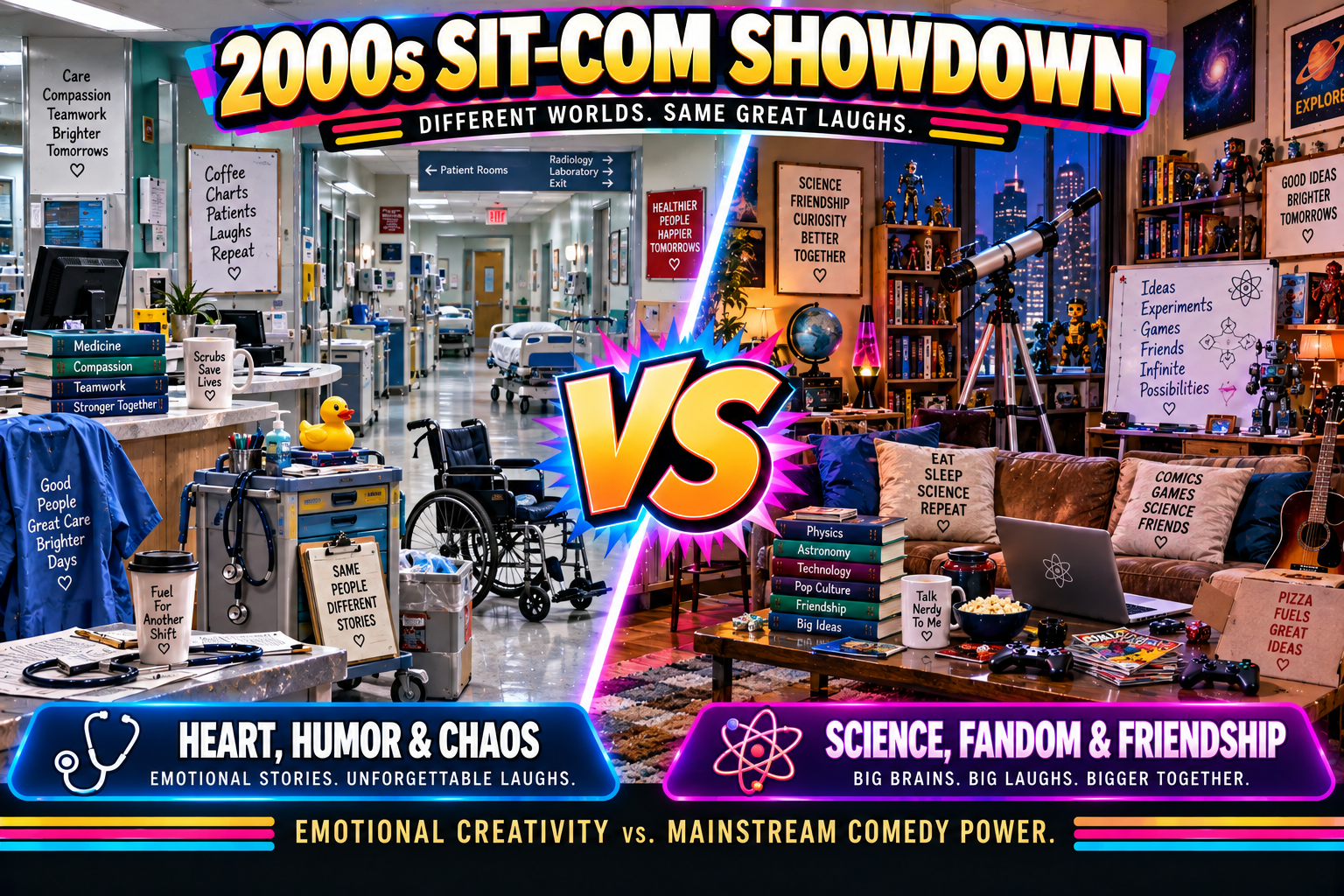
Our 2000s Sit-Com Showdown continues with two comedies that turned highly specialized worlds into mainstream entertainment: Scrubs and The Big Bang Theory. Scrubs entered the halls of Sacred Heart Hospital and blended absurd fantasy, rapid-fire comedy, friendship, romance, and unexpectedly serious stories about illness, death, and the emotional cost of medicine. The Big Bang Theory built its world around brilliant scientists, comic books, science fiction, gaming, relationships, and the social challenges of a group whose intellectual confidence often exceeded its interpersonal skills.
Scrubs was anchored by J.D., Turk, Elliot, Carla, Dr. Cox, Dr. Kelso, and the mysterious Janitor. Its unusual style allowed J.D.’s imagination to interrupt reality at any moment, giving the series a comic identity unlike most medical shows. The Big Bang Theory centered on Leonard, Sheldon, Penny, Howard, and Raj before expanding its ensemble through Amy and Bernadette, turning a small group of socially awkward scientists into one of the biggest network sitcom casts of its era.
This matchup presents a fascinating contrast. Scrubs was more experimental and emotionally unpredictable, while The Big Bang Theory achieved extraordinary mainstream popularity and longevity. One could make viewers laugh and then abruptly confront mortality; the other turned scientific language, fandom, and nerd culture into prime-time comedy for twelve seasons. Eight Legacy Showdown categories will decide which series advances.
The Legacy Showdown Rules
- Comedy Quality
- Character Chemistry
- Cultural Impact
- Longevity & Replay Value
- Iconic Moments
- Supporting Cast
- Era Difficulty
- Legacy Endurance
Round 1: Comedy Quality
The Big Bang Theory developed a dependable comic formula from the contrast between extreme intelligence and ordinary social life. Sheldon’s rigid routines, Leonard’s insecurities, Howard’s early overconfidence, Raj’s awkwardness, Penny’s practical perspective, and later Amy and Bernadette created multiple sources of conflict. Scientific references, comic-book debates, relationship problems, roommate agreements, and recurring rituals gave the show a recognizable rhythm that could sustain a huge episode library.
Scrubs was less predictable and more stylistically adventurous. J.D.’s fantasies could turn a conversation into a musical number, visual metaphor, movie parody, or completely absurd scenario before snapping back to reality. Dr. Cox’s elaborate rants, Turk and J.D.’s friendship, the Janitor’s schemes, Kelso’s bluntness, and physical comedy gave the show several different comic gears. It could also use comedy to make a serious emotional turn hit harder. The Big Bang Theory was remarkably consistent, but Scrubs’ creativity gives it the edge.
Winner: Scrubs.
Round 2: Character Chemistry
The Big Bang Theory’s chemistry improved substantially as its ensemble expanded. Leonard and Sheldon’s roommate dynamic formed the original comic foundation, while Leonard and Penny supplied a long-running romantic storyline. Howard and Raj had their own close friendship, and the arrivals of Amy and Bernadette created new pairings while allowing the original characters to mature. By the later seasons, the group convincingly functioned as an extended family.
Scrubs was built around relationships that could move between ridiculous comedy and genuine emotional intimacy. J.D. and Turk’s friendship was the heart of the show, but Turk and Carla’s marriage, J.D. and Elliot’s complicated relationship, and Dr. Cox’s reluctant mentorship of J.D. added depth. Even Kelso and Cox gradually became more complicated than simple authority figures. The characters frequently irritated one another, failed one another, and still showed up when it mattered. The emotional range of those relationships gives Scrubs the narrow victory.
Winner: Scrubs.
Round 3: Cultural Impact
Scrubs influenced the way comedy and drama could coexist inside a half-hour television format. Its medical setting allowed it to discuss death, grief, professional burnout, insecurity, mentorship, and failure while still embracing cartoonish fantasy sequences. The show developed a passionate audience and remains frequently cited for episodes that unexpectedly shifted from comedy into emotional seriousness.
The Big Bang Theory had the larger mainstream cultural footprint. Sheldon Cooper became one of the most recognizable sitcom characters of the 21st century, phrases such as “Bazinga!” became closely associated with the series, and the show brought conversations about physics, engineering, comic books, gaming, conventions, and science-fiction fandom into one of television’s most-watched comedies. Its success also generated Young Sheldon and extended the franchise beyond the original series.
Winner: The Big Bang Theory.
Round 4: Longevity & Replay Value
Scrubs produced a substantial library and remains highly rewatchable because many episodes combine self-contained medical stories with continuing character development. The friendship between J.D. and Turk, Dr. Cox’s mentorship, hospital absurdity, and emotional patient stories give viewers different reasons to revisit the series. Its distinctive early seasons in particular retain a strong identity.
The Big Bang Theory ran for twelve seasons, allowing the characters to evolve from a mostly single group of friends into marriages, careers, parenthood, and major professional achievements. Its familiar apartments, comic-book store, university settings, takeout meals, and recurring group routines create strong comfort-viewing appeal. The enormous episode count and broad syndication history give it a clear advantage in this category.
Winner: The Big Bang Theory.
Round 5: Iconic Moments
The Big Bang Theory has many instantly recognizable signatures: Sheldon’s spot on the couch, the roommate agreement, “Soft Kitty,” knocking three times on Penny’s door, “Bazinga!,” the elevator, comic-book-store gatherings, costumes, and the group’s debates over science fiction and superheroes. Major relationship milestones and Sheldon’s professional achievements added emotional memories to the recurring jokes.
Scrubs produced fewer catchphrases with the same mass-market reach, but its strongest moments could be unforgettable. J.D. and Turk’s elaborate friendship rituals, Dr. Cox’s rants, the Janitor’s bizarre vendetta, fantasy sequences, musical experimentation, and episodes involving devastating patient outcomes gave the show unusual tonal power. Some of its most memorable scenes work precisely because the comedy suddenly disappears and the characters are forced to confront loss. For sheer widespread recognizability, however, The Big Bang Theory takes the round.
Winner: The Big Bang Theory.
Round 6: Supporting Cast
The Big Bang Theory expanded impressively beyond its original five characters. Amy eventually became essential to Sheldon’s development, Bernadette transformed Howard’s story, and recurring figures such as Stuart, Mary Cooper, Beverly Hofstadter, Wil Wheaton, and various colleagues gave the central group a larger world. The show also used notable scientific and entertainment guest appearances to reinforce its connection to geek culture.
Scrubs had an exceptionally deep hospital bench. Dr. Cox, Carla, Kelso, and the Janitor could all dominate episodes, while Ted, Todd, Jordan, Laverne, Doug, and other Sacred Heart regulars developed recognizable comic identities. Because the hospital naturally brought patients, interns, doctors, and administrators through the story, even short-term characters could make an impact. Scrubs wins because its supporting ensemble was woven so thoroughly into the show’s everyday comic machinery.
Winner: Scrubs.
Round 7: Era Difficulty
Scrubs entered a television landscape where medical dramas were familiar but a surreal single-camera medical comedy was far less conventional. It had to convince audiences that absurd fantasies, slapstick, romance, serious patient stories, and emotional narration could coexist. It also moved through network and production changes while maintaining a distinctive voice for most of its run.
The Big Bang Theory faced a different challenge. Its original premise revolved around scientists and deeply committed fans of comics, science fiction, and gaming at a time when those interests were becoming more mainstream but could still be treated as niche television material. The series transformed that premise into a massive broadcast hit and sustained it through a period when viewing habits were rapidly shifting toward cable, streaming, and fragmented audiences. Slight edge to The Big Bang Theory for achieving blockbuster network scale as the traditional broadcast sitcom audience was becoming harder to hold.
Winner: The Big Bang Theory.
Round 8: Legacy Endurance
Scrubs retains a devoted legacy because its combination of comedy and emotional storytelling remains unusual. Its strongest episodes continue to be discussed for how effectively they portray friendship, grief, medicine, mentorship, and growing into adulthood. J.D., Turk, Dr. Cox, and the Sacred Heart world remain beloved by viewers who connected with the show’s mixture of silliness and vulnerability.
The Big Bang Theory possesses the broader enduring franchise. Twelve seasons created a huge catalog, Sheldon Cooper became an enduring television character, and Young Sheldon extended the fictional universe to another major audience. The original show remains strongly associated with modern network sitcom history and with the period when geek culture moved decisively into mainstream entertainment. Scrubs has passionate endurance, but The Big Bang Theory has the larger overall legacy footprint.
Winner: The Big Bang Theory.
Final Verdict
This matchup finishes closer than the cultural size of The Big Bang Theory might initially suggest. Scrubs wins Comedy Quality, Character Chemistry, and Supporting Cast because its creative style, emotional relationships, and unusually rich Sacred Heart ensemble give it strengths that raw ratings or longevity cannot capture. At its best, Scrubs could be ridiculous, heartfelt, and devastating within the same episode.
The Big Bang Theory wins Cultural Impact, Longevity & Replay Value, Iconic Moments, Era Difficulty, and Legacy Endurance. Its twelve-season run, enormous mainstream audience, instantly recognizable characters and recurring jokes, and expansion into a larger television franchise make its overall footprint difficult to overcome.
With a competitive 5-3 victory, The Big Bang Theory advances deeper into the 2000s Sit-Com Showdown bracket. Scrubs exits as one of the tournament’s most distinctive comedies – a series whose emotional ambition and inventive style make the final score considerably closer in spirit than it appears on paper.
Audience Challenge
Do you agree with the 5-3 result? Should Scrubs’ creativity, emotional depth, and character relationships have pushed it past The Big Bang Theory, or do twelve seasons, massive cultural recognition, and the enduring Sheldon Cooper franchise make The Big Bang Theory the rightful winner? Cast your vote, defend your favorite, and keep following Legacy Showdown as the 2000s Sit-Com Showdown bracket continues.