

Affiliate Disclaimer: This post may contain affiliate links. If you make a purchase through one of these links, The Shopping Plaza may earn a commission at no additional cost to you.
When Halloween Fun Starts Feeling Like a Deadline
Halloween costumes are supposed to be fun. They give children and adults a chance to become a favorite character, invent a new identity, make people laugh, or simply participate in the playful spirit of the season. Yet costume planning can quickly become one of the most stressful parts of Halloween.
The costume someone wanted last week is suddenly unacceptable. The right size is sold out. An accessory disappears. A homemade idea becomes more complicated than expected. A package is delayed. A child changes their mind three days before Halloween. Meanwhile, adults are balancing work, school schedules, household responsibilities, parties, and other seasonal expenses.
Under that pressure, it is easy to lose patience over something that was supposed to create joy.
The solution is not creating the perfect costume. It is managing expectations, time, money, and emotions well enough that the costume remains part of the celebration instead of becoming the center of a family crisis.
A successful Halloween is not measured by whether every costume detail was flawless. It is measured much more meaningfully by whether everyone was able to enjoy the experience.
Identify What Is Actually Causing the Stress
Before solving costume stress, identify its real source.
Are you worried about money? Are you running out of time? Is a child repeatedly changing their mind? Are you comparing the costume with elaborate versions online? Is the costume uncomfortable, unavailable, or more difficult to make than expected?
Different problems need different solutions.
Financial pressure may require a simpler design or using items already at home. Time pressure may mean abandoning a complicated homemade costume for something easier. Indecision may require setting a deadline for choosing. Comparison may require stepping away from social media and remembering that Halloween is not a costume competition unless you deliberately entered one.
When several frustrations blend together, everything can feel like one enormous problem. Naming the specific issue makes it manageable.
Instead of saying, “This costume is driving me crazy,” try saying, “We are missing one important piece and only have two days to solve it.” The second statement gives you a problem you can actually address.
Set a Costume Decision Deadline
One of the simplest ways to reduce last-minute stress is to establish a reasonable deadline for choosing a costume.
Children may naturally change their minds as Halloween approaches. They see another character, talk with friends, or discover a new idea. Adults can do the same thing.
Give everyone time to explore possibilities, but eventually the decision needs to become final.
Explain the deadline calmly: after a certain date, changes must use items already available or remain within whatever budget and time are left. This creates a boundary without making the process unnecessarily rigid.
A decision deadline also gives you time to order, shop, borrow, create, test, and adjust.
The goal is not to remove creativity. It is to prevent creativity from turning into an emergency on October 30.
Choices become easier when everyone understands that brainstorming has an ending point.
Give Yourself Permission to Choose Simple
Costume culture can make simple ideas feel inadequate. Online photos show detailed makeup, handmade armor, custom props, coordinated family themes, and costumes that look ready for a movie set.
Those costumes can be wonderful. They are not requirements.
A recognizable costume made from ordinary clothing and one or two strong accessories can be just as enjoyable. A classic ghost, witch, vampire, athlete, detective, scarecrow, or other familiar idea does not need dozens of pieces to work.
Simple can also mean more comfortable, affordable, and practical.
If creating an elaborate costume brings you genuine joy, enjoy the process. If it is making you angry, exhausted, or financially strained, simplifying is not failure.
Halloween does not award extra happiness for the number of hours spent assembling a costume.
Separate Your Expectations From Your Child’s Experience
Parents and caregivers can become emotionally invested in a costume because they spent money, time, or effort creating it. That investment can make a child’s last-minute complaints especially frustrating.
Try to separate your effort from their experience.
A costume may look fantastic but feel itchy, hot, tight, heavy, frightening, or difficult to walk in. A child may also become self-conscious once it is time to wear something they enthusiastically chose weeks earlier.
That does not mean every complaint requires immediately replacing the costume. It means listening before reacting.
Ask what specifically is wrong. Sometimes a small adjustment solves the problem: remove an uncomfortable accessory, add a layer underneath, change shoes, loosen something, or allow the child to carry rather than wear part of the costume.
The goal is not winning an argument about who was right when the costume was chosen. The goal is helping Halloween remain enjoyable while maintaining reasonable boundaries.
Test the Costume Before Halloween
Many costume emergencies can be prevented with one simple step: try everything on early.
Do not wait until it is time to leave the house.
Check whether the costume fits, whether the shoes are comfortable, whether the mask allows adequate visibility, and whether accessories stay in place. Make sure the person can walk, sit, use the restroom, and move safely.
If the costume will be worn outdoors, consider the weather. A costume that works perfectly indoors may need layers underneath on a cold evening.
Testing early turns surprises into manageable adjustments.
It also reduces stress on Halloween because everyone already knows how the costume works.
A ten-minute trial several days beforehand can prevent a thirty-minute argument when everyone is trying to get out the door.
Create a Backup Plan Before You Need One
A backup costume may sound unnecessary until the original plan fails.
Packages can arrive late. Homemade pieces can break. Weather can change. Children can suddenly refuse a mask or accessory.
Your backup does not need to be another complete costume. It can be a simple combination of clothing and accessories already at home.
The purpose is psychological as much as practical. Knowing there is another option reduces the feeling that every problem must be solved immediately.
When the original plan becomes impossible, you can say, “That did not work, so we are using Plan B.”
Backup plans protect patience because they replace panic with a decision that was already made.
Do Not Turn a Costume Problem Into a Character Judgment
Stress can change the way we speak.
A child changes their mind and we say, “You are impossible.” Someone loses an accessory and we say, “You never keep track of anything.” A partner waits until the last minute and we say, “You always do this.”
The costume problem is temporary. Character labels can linger.
Describe the behavior or situation instead. “We agreed on this costume, and there is not enough time to buy another one.” “The accessory is missing, so we need to decide whether to look for ten minutes or go without it.”
Specific language keeps the disagreement focused.
Halloween should not become the occasion for turning a plastic sword, missing hat, or costume change into a much larger argument about someone’s personality.
Use a Pause Before Your Patience Runs Out
When you feel yourself becoming angry, create a brief pause if the situation is safe enough to allow one.
Stop searching for the missing item for a moment. Take a drink of water. Step into another room. Count slowly. Decide what actually needs to happen next.
A pause does not magically fix the costume. It prevents frustration from choosing your words.
Ask yourself whether the current problem will matter tomorrow. Some problems do require action, but the emotional intensity may be much larger than the actual consequence.
If the cape is missing, Halloween can continue. If the makeup is imperfect, pictures can still be taken. If the costume is different from the original plan, the night is not ruined.
Perspective can restore patience surprisingly quickly.
Set a Spending Limit and Keep It
Costume stress becomes worse when every new problem requires another purchase.
Set a costume budget before shopping and communicate the limit clearly when appropriate.
If a last-minute change is requested, decide whether it can happen within the existing budget. If not, use what you already have.
Boundaries reduce repeated negotiations.
They also teach an important lesson: creativity can work within limits. A costume does not become meaningful simply because more money was spent on it.
Protecting your finances is part of protecting your peace.
Share the Work Instead of Carrying Everything Yourself
If several people are preparing for Halloween, one person should not automatically carry every costume responsibility.
Age-appropriate children can gather accessories, try on clothing, organize pieces, and help with simple creation. Partners can handle shopping, repairs, makeup, or other tasks.
Even young children can learn that choosing a costume includes some responsibility for keeping track of it.
Sharing the work reduces resentment and makes preparation more collaborative.
It also transforms costume creation from another task on someone’s overloaded schedule into a family activity.
You do not have to personally solve every Halloween problem to prove that you care.
Accept Imperfection in the Final Result
At some point, you have to declare the costume finished.
Maybe the color is slightly wrong. The homemade prop does not look exactly like the picture. The wig refuses to cooperate. One accessory never arrived.
Ask whether the remaining problem truly affects the experience.
Perfectionism can consume the final hours before an event while adding almost nothing to the fun.
A costume can be imperfect and still be recognizable, funny, creative, comfortable, and memorable.
Often the tiny detail bothering you is something no one else will notice.
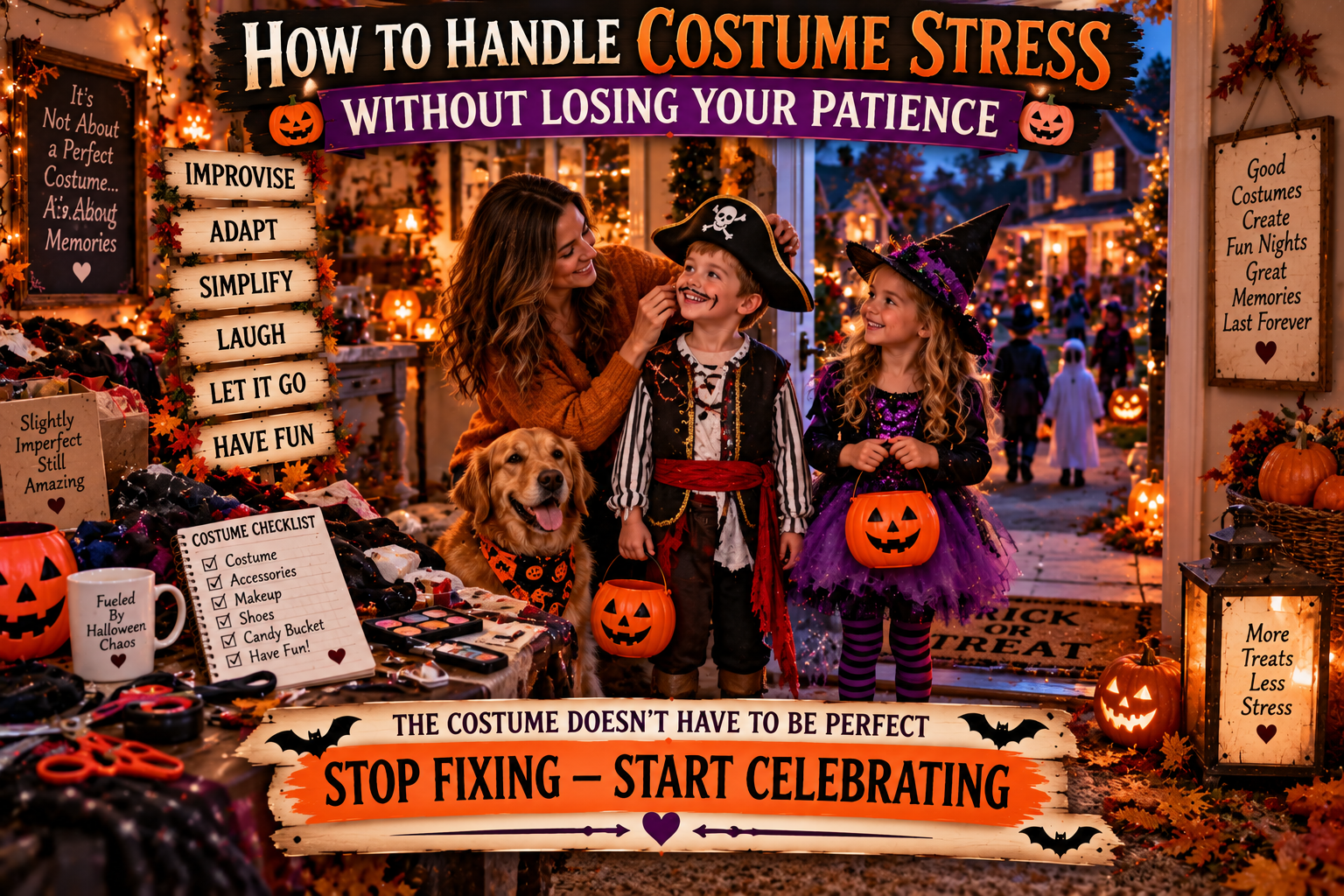
Know when to stop fixing and start celebrating.
Keep Safety More Important Than Appearance
There are moments when changing a costume is not about preference but safety.
Make sure masks do not dangerously block vision, costumes do not create serious tripping hazards, and footwear is suitable for walking. Consider visibility outdoors, weather, and whether props are safe for the setting.
If an attractive costume element creates a genuine safety problem, remove or modify it.
This is one area where patience and good judgment matter more than preserving the original design.
A successful costume is one that allows the person wearing it to participate safely and comfortably.
Remember What Children May Actually Remember
Years from now, children may not remember whether every costume accessory matched. They may remember trick-or-treating with family, laughing with friends, sorting candy, taking pictures, or being excited to become a favorite character.
They may also remember the emotional atmosphere.
If the entire preparation process becomes shouting, rushing, and frustration, the costume can become associated with stress.
This does not mean adults must remain perfectly calm. Real families get tired and frustrated. It means the relationship deserves more protection than the costume.
When you have to choose between preserving a perfect detail and preserving the mood of the evening, the second choice is often more valuable.
Let Halloween Be Fun Again
Costume stress grows when we forget what the costume was supposed to accomplish.
It was supposed to add fun.
So plan early where possible. Set deadlines and budgets. Test costumes before the big day. Keep a simple backup available. Listen when something is genuinely uncomfortable. Share responsibilities. Protect safety. And when a minor detail goes wrong, decide whether it deserves the amount of emotional energy it is receiving.
You can still care about creating a great costume without allowing the process to control the household.
If something breaks, improvise. If an accessory disappears, continue without it. If the plan changes, adapt. If the costume is not perfect, take the picture anyway.
Patience does not mean that nothing bothers you. It means remembering what matters while something is bothering you.
Halloween lasts only a short time. The missing hat, crooked makeup, or last-minute costume change will soon become part of a story you may laugh about later.
Do not let the pursuit of a perfect costume steal the very thing you were trying to create: a happy memory.