
Affiliate Disclosure: This article may contain affiliate links. If you purchase books, museum tickets, collectible replicas, paranormal equipment, Halloween decorations, or other products through links on our website, we may earn a small commission at no additional cost to you. Your support helps us continue creating helpful Halloween resources, historical guides, and seasonal entertainment.
Ghost stories are not always attached to abandoned houses, battlefields, or historic hotels. Sometimes the supernatural reputation follows a physical object that can be carried, displayed, sold, inherited, or locked behind glass.
Dolls, paintings, jewelry, furniture, mirrors, boxes, and ancient artifacts have all become connected to stories of curses and paranormal activity. Some are said to move by themselves. Others supposedly cause illness, accidents, nightmares, financial ruin, or unexplained disturbances for anyone who owns or disrespects them.
There is no scientifically accepted evidence proving that an object can be haunted, possessed, or cursed. Many famous stories grew through folklore, publicity, online auctions, horror movies, personal testimony, and repeated retelling. In some cases, documented history has become deeply mixed with fictional details.
Even so, allegedly haunted objects continue to fascinate people because they make supernatural danger feel portable. You may be able to leave a haunted house, but what happens when the mysterious presence is attached to something sitting inside your own home?
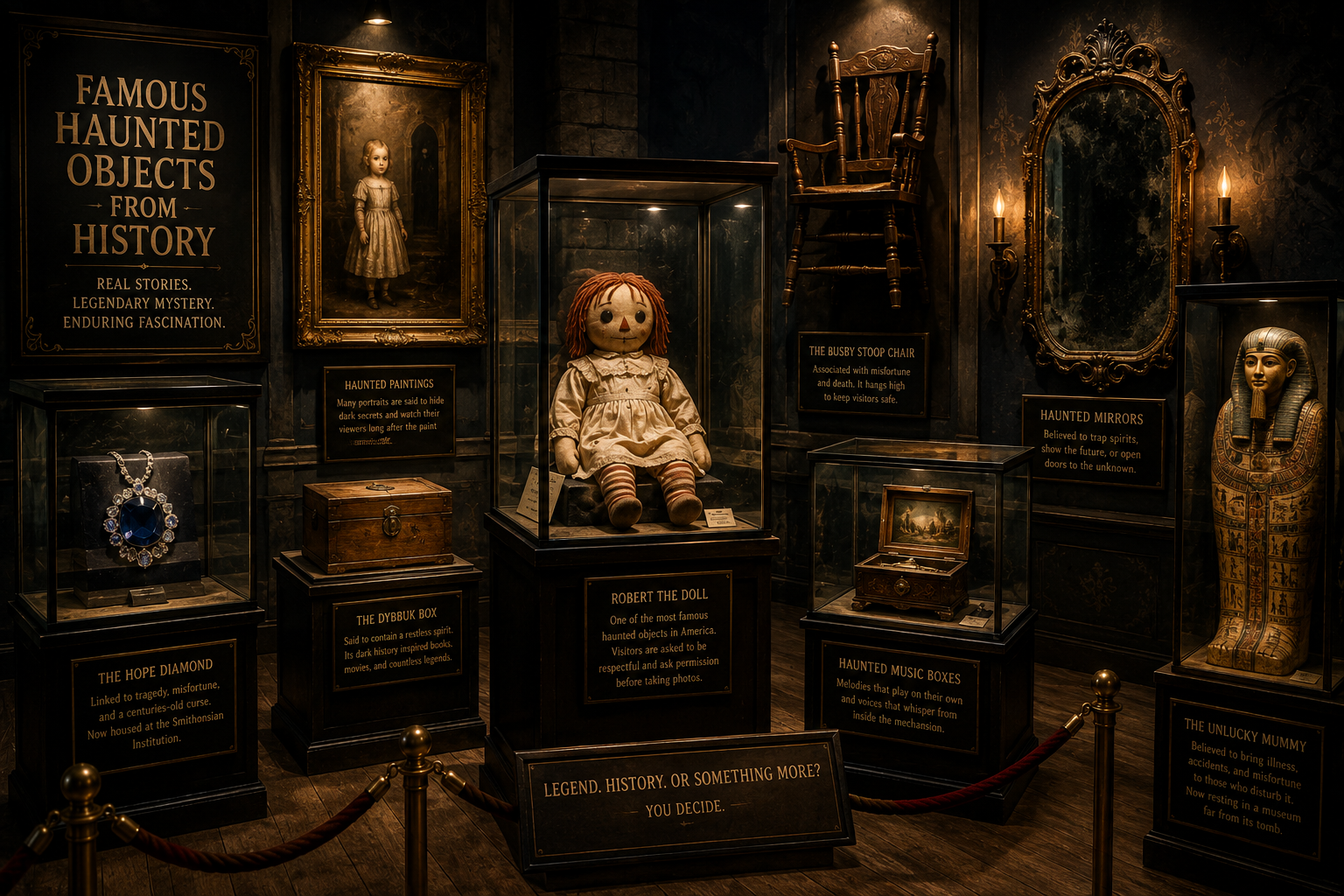
Here are some of the most famous haunted and cursed objects from history, along with the stories that made them legendary.
Why Objects Become Connected to Ghost Stories
An object may become associated with paranormal activity for several reasons.
It may have:
- Belonged to someone who died tragically
- Been present during a crime or disaster
- Passed through several generations
- Come from an unknown location
- Been found inside an abandoned building
- Developed an unsettling appearance
- Been associated with religious or spiritual practices
- Inspired unusual experiences among several owners
Objects also provide something physical around which a story can grow. A person may forget the details of a strange sound, but a doll, painting, chair, or jewel can remain visible for decades.
Robert the Doll
Robert the Doll is one of America’s most famous allegedly haunted objects.
The handmade doll was created around the beginning of the twentieth century and stands approximately 40 inches tall. He is filled with wood wool and dressed in a sailor suit. Robert belonged to Key West artist Robert Eugene Otto, who was known as Gene.
According to legend, Gene treated Robert as a close companion and sometimes blamed the doll when objects were broken or rooms were disturbed.
Later stories claimed that Robert:
- Changed expressions
- Moved between rooms
- Appeared in windows
- Produced childlike laughter
- Interfered with cameras
- Brought bad luck to disrespectful visitors
Some versions claim the doll was given to Gene by a servant who practiced magic and cursed it. That part of the story is difficult to document and may have been added after the legend became popular.
Robert has been displayed at the Fort East Martello Museum in Key West since 1994. Visitors often ask permission before photographing him, while apology letters sent by people who believe they offended him have become part of the exhibit’s mythology.
Whether Robert is haunted or simply surrounded by more than a century of storytelling, he remains one of Florida’s most recognizable supernatural attractions.
Annabelle
The real Annabelle looks very different from the frightening porcelain doll portrayed in the movies.
She is actually a Raggedy Ann cloth doll.
According to accounts promoted by paranormal investigators Ed and Lorraine Warren, a nursing student received Annabelle as a gift in 1970. The student and her roommate reportedly began finding the doll in different positions and claimed handwritten messages appeared inside their apartment.
The Warrens later asserted that the doll was not inhabited by the spirit of a child but was being manipulated by a dangerous nonhuman entity. These claims have never been independently demonstrated and remain part of paranormal folklore.
Annabelle became famous through:
- The Warrens’ lectures and investigations
- Their private occult collection
- Books and television programs
- The Conjuring film universe
- Public paranormal tours
The Warrens’ original museum closed to regular public visits in 2019. A new temporary Haunted Warren Museum in Salem, Massachusetts, is scheduled to open on August 27, 2026, with Annabelle and other artifacts among its exhibits.
The movie version was redesigned as a cracked porcelain doll to make her more visually threatening. The contrast between that fictional design and the real doll’s cheerful appearance has only strengthened the legend.
The Hope Diamond
The Hope Diamond is one of the world’s most famous gemstones—and one of its most famous allegedly cursed objects.
The deep-blue diamond weighs 45.52 carats and is displayed at the Smithsonian’s National Museum of Natural History in Washington, D.C. Its documented history can be traced through European royalty, jewel merchants, wealthy collectors, and jeweler Harry Winston, who donated it to the Smithsonian in 1958.
Over time, stories claimed the diamond brought tragedy to its owners.
Alleged misfortunes included:
- Financial ruin
- Political downfall
- Imprisonment
- Murder
- Accidents
- Family deaths
- Broken marriages
Many of the most dramatic curse stories were exaggerated, invented, or connected to people who never owned the diamond. Publicity surrounding its supposed curse helped make the jewel even more famous.
Smithsonian research confirmed that the Hope Diamond was cut from the larger French Blue, a gemstone that once belonged to the French crown jewels and disappeared during the French Revolution.
Harry Winston did not appear to fear the alleged curse. He famously sent the diamond to the Smithsonian through registered United States mail.
The Hope Diamond remains a perfect example of how genuine history, royal intrigue, marketing, and superstition can combine around one remarkable object.
The Unlucky Mummy
The so-called Unlucky Mummy is one of the British Museum’s most famous cursed-object legends.
Despite its nickname, the artifact is not an actual mummy. It is a painted wooden mummy board that once covered the body of an unidentified Egyptian woman. It dates from approximately 950 to 900 BCE and is cataloged by the British Museum as EA 22542.
Stories later claimed that people connected with the artifact suffered:
- Injuries
- Illness
- Financial problems
- Unexpected deaths
- Family tragedies
- Strange accidents
One of the most persistent legends claimed the mummy board was being transported aboard the Titanic when the ship sank.
That story is false. The artifact remained in the British Museum and was never carried aboard the Titanic.
The British Museum itself discusses the stories connected with the object while distinguishing them from its documented archaeological history.
The Unlucky Mummy demonstrates how public fascination with Egyptian curses grew during the nineteenth and early twentieth centuries, when archaeology, spiritualism, newspaper sensationalism, and colonial collecting all captured popular attention.
The Dybbuk Box
The Dybbuk Box became one of the internet era’s most famous supposedly haunted objects.
The small wooden cabinet was advertised on eBay in 2003 as an antique wine box containing a dangerous spirit from Jewish folklore. Its seller, Kevin Mannis, described a history involving a Holocaust survivor, nightmares, strange smells, illness, and unexplained bad luck.
The story inspired:
- Online paranormal discussions
- Books
- Television programs
- Museum exhibitions
- The 2012 horror film The Possession
However, skeptical investigators found that the object appeared to be an ordinary vintage minibar rather than an ancient Jewish wine cabinet. In 2021, Mannis acknowledged that he had created the Dybbuk Box story as an interactive work of horror fiction.
The box later became part of Zak Bagans’ Haunted Museum collection in Las Vegas.
Although the supernatural backstory was invented, the Dybbuk Box remains historically important as an example of how the internet can transform an ordinary object into a worldwide paranormal legend.
It also shows why cultural and religious traditions should be researched carefully before they are repackaged as entertainment.
The Busby Stoop Chair
The Busby Stoop Chair is one of England’s best-known cursed pieces of furniture.
According to legend, the chair belonged to Thomas Busby, who was convicted of murder and executed in 1702. Before his death, he supposedly cursed the chair and declared that anyone who sat in it would soon die.
Later stories connected the chair to soldiers, workers, travelers, and pub visitors who allegedly died after sitting in it.
The chair eventually became part of the collection at Thirsk Museum in North Yorkshire. It is displayed high on a wall, preventing visitors from sitting in it. The museum presents the chair and the legend surrounding Thomas Busby as part of its local-history displays.
There is little reliable evidence connecting the chair to the numerous deaths attributed to it. Some historians have also questioned whether the displayed chair is old enough to have belonged to Busby.
Nevertheless, the idea of a chair so dangerous that it must be suspended beyond reach has made it an enduring cursed-object legend.
The Hands Resist Him Painting
The Hands Resist Him is often called the haunted eBay painting.
Artist Bill Stoneham created the work in 1972. It depicts a young boy and a doll-like girl standing before a glass-paneled doorway while numerous hands press against the other side.
Stoneham explained that:
- The boy was based on a childhood photograph of himself.
- The doorway represented a boundary between ordinary reality and another realm.
- The doll served as a guide.
- The hands represented alternate lives or possibilities.
The painting became a paranormal sensation after it was listed for sale on eBay in 2000. The sellers claimed that the figures moved at night and appeared to leave the painting. They also included photographs supposedly documenting the changes.
The auction drew widespread attention, and the painting sold for more than its original asking price.
Stoneham has encouraged people to remain skeptical of the supernatural claims. The painting’s unsettling imagery, combined with the dramatic auction description, helped create one of the earliest viral haunted-object stories of the internet age.
The Conjuring Mirror
A mirror associated with Ed and Lorraine Warren’s collection became known as the Conjuring Mirror.
According to paranormal lore, the mirror had supposedly been used in rituals intended to summon or communicate with spirits. Later owners claimed to see figures, shadows, or disturbing reflections within it.
The mirror became connected to the same larger collection as Annabelle and other allegedly dangerous artifacts. It is among the objects announced for the 2026 Haunted Warren Museum exhibition in Salem.
Mirrors frequently appear in supernatural traditions because they:
- Reflect spaces behind the viewer
- Distort images in dim lighting
- Create unexpected movement
- Symbolize boundaries or portals
- Encourage people to stare at their own faces for long periods
Low light, peripheral vision, reflections, and expectation can make an ordinary mirror feel surprisingly unsettling.
The Black Orlov Diamond
The Black Orlov is a dark diamond surrounded by stories of theft, suicide, and a curse.
According to popular legend, the stone was stolen from a statue of the Hindu god Brahma in India. Later owners were said to have experienced severe misfortune, with several women allegedly dying after possessing it.
The diamond was eventually recut into smaller stones, supposedly in an attempt to break the curse.
Historians have questioned major parts of this story, including whether the named owners existed as described and whether the diamond had any genuine connection to an Indian temple.
Like the Hope Diamond, the Black Orlov’s reputation demonstrates how rare gemstones attract legends involving greed, stolen wealth, royalty, and punishment.
The Crying Boy Paintings
During the 1980s, British newspapers reported a series of house fires in which prints of paintings showing crying children supposedly survived with little damage.
The images became known collectively as the Crying Boy paintings.
The legend claimed that:
- Homes displaying the paintings were more likely to burn.
- The prints remained undamaged after fires.
- Firefighters refused to keep them.
- The children depicted had tragic histories.
- Destroying the paintings could end the curse.
Thousands of prints had been sold, so it was unsurprising that some appeared inside homes affected by fire.
Possible explanations for their survival included the materials used in the prints, fire-resistant coatings, and the way framed pictures fell face-down during a blaze.
The story became so popular that newspapers organized public events where readers could surrender or destroy their prints.
The Anguished Man
The Anguished Man is a disturbing portrait depicting a screaming or tormented face.
The painting became famous after its owner, Sean Robinson, shared videos and stories claiming that it caused unexplained activity inside his home.
Reported incidents included:
- Doors moving
- Unexplained noises
- Shadowy figures
- A man crying
- The painting falling
- Family members experiencing nightmares
One legend claimed the artist mixed blood into the paint before dying by suicide. That dramatic history has not been independently verified.
The painting’s frightening appearance naturally encourages viewers to expect something disturbing. Once a person knows its reputation, ordinary household noises may feel connected to the image.
The Haunted Wedding Dress
Some museums and historic homes display wedding dresses associated with women who died tragically or never completed their marriages.
One frequently repeated legend concerns a wedding dress said to move inside its display case, especially near the anniversary of its owner’s death.
Stories involving haunted clothing often include:
- Fabric moving without wind
- Mannequins changing position
- Unexplained perfume
- Figures wearing the clothing
- Photographs showing strange shapes
Historic garments may shift because of air circulation, building vibrations, changing humidity, or movement within old display fixtures.
The emotional symbolism of a wedding dress—hope, love, loss, and an interrupted future—makes it especially powerful material for ghost stories.
Cursed Mirrors
Numerous antique mirrors have developed haunted reputations.
Common stories claim that mirrors:
- Hold the spirits of former owners
- Display people who are not present
- Show future deaths
- Cause nightmares
- Open supernatural portals
- Trap reflections after someone dies
In some traditions, mirrors are covered after a death to prevent a spirit from becoming confused or trapped.
Natural explanations for strange mirror experiences may include:
- Low lighting
- Old or uneven glass
- Silvering damage
- Peripheral vision
- Reflections from adjoining rooms
- Fatigue
- Suggestion
Staring into a mirror under dim light can also cause facial features to appear distorted as the brain adapts to limited visual information.
Allegedly Haunted Music Boxes
Music boxes frequently appear in haunted-object collections because they can begin playing unexpectedly.
Stories may involve:
- Music starting without anyone touching the box
- A melody connected to a deceased child
- The mechanism activating at the same time each night
- Figures or dancers moving unexpectedly
- The box appearing in different rooms
Old mechanical music boxes can activate because of:
- Partially wound springs
- Temperature changes
- Loose mechanisms
- Vibrations
- Movement of furniture
- Previous handling
The soft, childlike quality of their music can feel especially eerie in an otherwise silent house.
Allegedly Cursed Jewelry
Jewelry often becomes the center of curse stories because it passes between owners and survives longer than the people who wore it.
Legends frequently involve:
- Diamonds
- Rings
- Brooches
- Crowns
- Necklaces
- Royal jewels
A piece connected to several wealthy or politically powerful owners may naturally become associated with deaths, divorces, betrayals, and financial ruin.
Because historical elites often lived during periods of war, illness, political conflict, and short life expectancy, later storytellers can easily construct a sequence of apparent misfortune around a jewel.
Why Haunted-Object Stories Spread So Easily
These legends have several qualities that make them easy to share.
They usually involve:
- A visible physical object
- A mysterious former owner
- A tragic event
- A warning
- A series of coincidences
- A dramatic consequence
- The possibility that the object could be sold again
Online marketplaces and social media have made these stories even easier to spread.
An ordinary antique can become “haunted” through:
- A dramatic listing
- Unusual photographs
- Anonymous testimony
- Viral videos
- Influencer coverage
- Horror-film adaptations
- Museum publicity
Once the reputation is established, later experiences are often interpreted through the existing legend.
Suggestion and Confirmation Bias
Knowing that an object is supposedly cursed can influence how people interpret ordinary events.
A person may become more aware of:
- Headaches
- Bad dreams
- Power failures
- Misplaced items
- Arguments
- Financial setbacks
- Household noises
Confirmation bias occurs when people notice events that support a belief while overlooking those that do not.
For example, someone may connect a broken appliance to a haunted doll while ignoring the dozens of normal days during which nothing unusual happened.
This does not mean people are deliberately inventing their experiences. Expectation can shape perception and memory without conscious intent.
Can an Object Absorb Emotional Meaning?
Objects can become emotionally powerful even without a supernatural explanation.
Family possessions may represent:
- Grief
- Love
- Trauma
- Childhood
- Marriage
- War
- Loss
- Identity
A person may feel uncomfortable around an object because of the story attached to it rather than anything physically happening.
Museums and collectors often recognize that an artifact’s emotional history can influence how visitors respond to it.
Buying Allegedly Haunted Objects Online
Online marketplaces sometimes advertise dolls, jewelry, paintings, boxes, and mirrors as haunted or possessed.
Before purchasing, remember:
- The story may be fictional.
- The seller may be using fear as marketing.
- The price may be inflated.
- The object may be damaged or unsafe.
- Antique materials may contain lead, mold, dust, or sharp components.
- Paranormal claims cannot be guaranteed.
- Cultural or religious traditions may be misrepresented.
Purchase an item because you appreciate it as art, history, or a collectible—not because a seller promises supernatural activity.
Handling Antique Objects Safely
Old objects can present genuine physical hazards.
Possible concerns include:
- Lead paint
- Mold
- Mercury
- Asbestos
- Sharp metal
- Broken glass
- Insect damage
- Deteriorating fabric
- Toxic pigments
- Unstable construction
Wear protective gloves when appropriate and consult a professional conservator before
cleaning valuable artifacts.
Never burn or destroy an antique simply because someone claims it is cursed. You could expose yourself to dangerous materials or destroy something historically important.
Visiting Famous Haunted Objects
Some allegedly haunted objects can be viewed in museums or special exhibitions.
Before visiting:
- Confirm current operating hours.
- Review photography restrictions.
- Purchase tickets through official sources.
- Follow staff instructions.
- Respect display barriers.
- Do not touch the object.
- Avoid disturbing other guests.
- Treat cultural artifacts respectfully.
Robert the Doll remains on display at Fort East Martello Museum in Key West. The Hope Diamond is displayed at the Smithsonian’s National Museum of Natural History. The Unlucky Mummy remains part of the British Museum’s collection.
Common Haunted-Object Myths
The Object Changes Position
Possible explanations include vibrations, uneven surfaces, loose joints, pets, other people, or unreliable memory.
Cameras Fail Near the Object
Battery problems, storage errors, low light, autofocus difficulties, and ordinary equipment failure are common.
Bad Luck Follows the Owner
Every person experiences accidents, arguments, expenses, and disappointments. Once an object has a cursed reputation, unrelated problems may become linked to it.
Destroying the Object Releases a Spirit
This is a common horror-movie idea but is not supported by scientific evidence.
The Object Cannot Be Removed
In reality, most famous haunted objects have been sold, transported, donated, exhibited, or placed in storage multiple times.
Frequently Asked Questions
What is the world’s most famous haunted object?
Annabelle is probably the most famous allegedly haunted object because of The Conjuring films. Robert the Doll, the Hope Diamond, and the Dybbuk Box are also internationally recognized.
Is the Hope Diamond really cursed?
There is no scientific evidence that the Hope Diamond causes bad luck. Many curse stories were exaggerated or created through publicity, although the diamond’s genuine history includes political upheaval, theft, and several wealthy owners.
Was the Dybbuk Box proven to be a hoax?
The original seller later acknowledged that he created the story surrounding the box. Skeptical investigation also identified the object as an ordinary vintage minibar rather than the ancient cabinet described in the legend.
Can visitors see Robert the Doll?
Yes. Robert is displayed at the Fort East Martello Museum in Key West, Florida. Visitors should check the museum’s current schedule and photography policies before traveling.
Is there proof that objects can be haunted?
No scientifically accepted evidence currently demonstrates that objects can contain spirits, cause curses, or create paranormal activity. Their reputations are based primarily on folklore, personal accounts, coincidences, and interpretation.
Final Thoughts
Famous haunted objects reveal how easily history, tragedy, superstition, art, and imagination can become attached to physical possessions. Robert the Doll, Annabelle, the Hope Diamond, the Unlucky Mummy, the Busby Stoop Chair, and The Hands Resist Him all began as ordinary objects before stories transformed them into supernatural legends.
Some of those stories grew from genuine historical events. Others developed through newspaper publicity, online auctions, horror movies, museum exhibitions, or deliberate fiction. In every case, the object became more powerful because people continued telling the story.
You do not have to believe that a doll can move, a jewel can destroy its owner, or a painting can come alive to find these legends fascinating. They show how human beings assign meaning to possessions and use objects to preserve fear, grief, mystery, and memory.
The next time you see an antique chair, unfamiliar box, faded portrait, or old doll at a yard sale, there is probably a perfectly ordinary explanation for its history.
Still, it may be wise to ask why the previous owner was so eager to get rid of it.