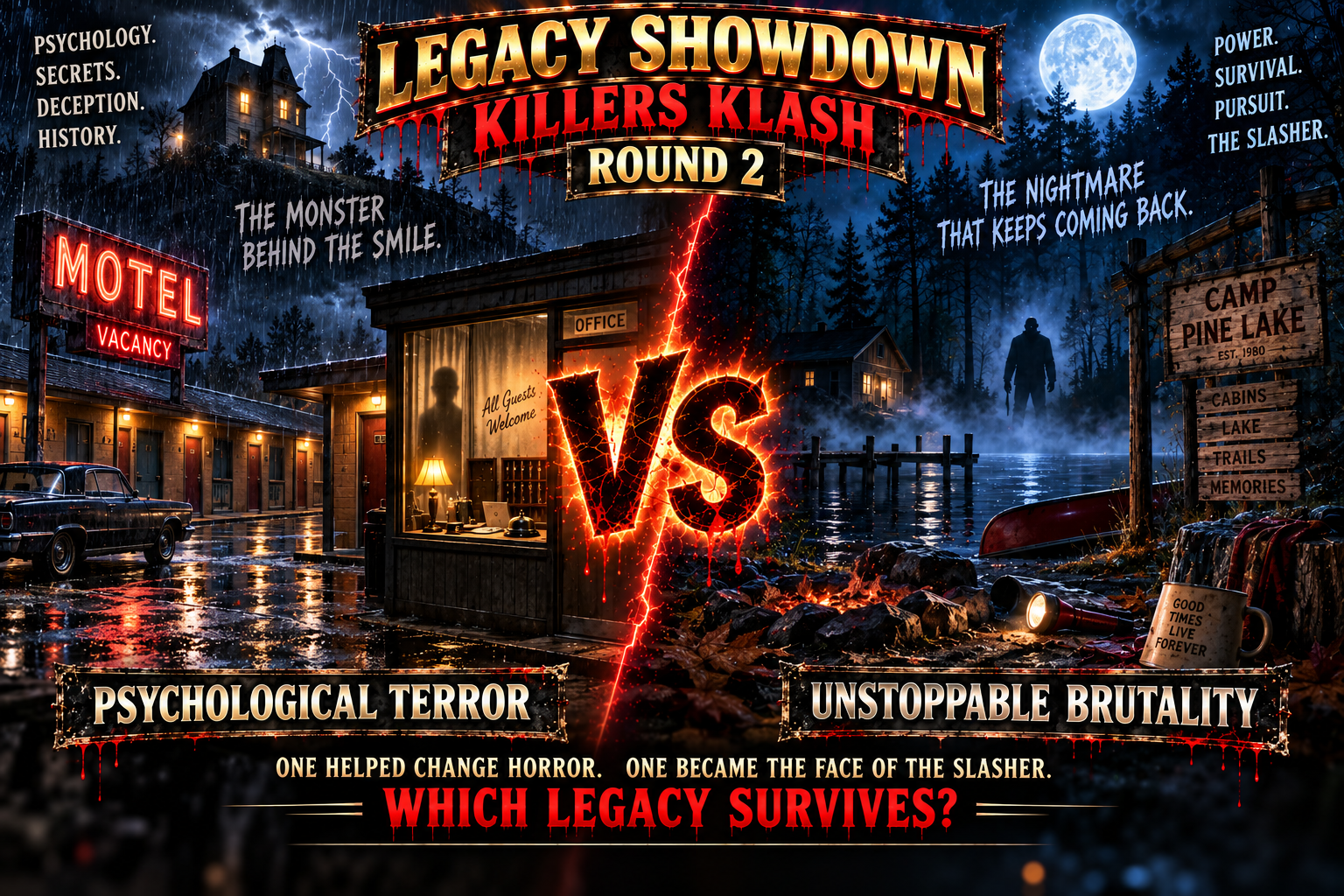


The quiet motel owner who helped redefine psychological horror faces the unstoppable slasher who turned a hockey mask into a symbol of fear.
Welcome back to Killers Klash, where horror’s most terrifying, unforgettable, and iconic characters go head-to-head to determine who possesses the stronger legacy killer instinct. As part of our larger Legacy Showdown series, Killers Klash is not simply asking who would win in a physical fight. The tournament measures the impact, identity, longevity, memorable moments, and lasting horror legacy each character has built.
Round 2 brings together two killers from radically different traditions. Norman Bates emerged from Psycho as a disturbingly human figure whose polite exterior concealed psychological instability, violence, and one of cinema’s most famous revelations. Jason Voorhees became the towering face of the Friday the 13th franchise, evolving from a tragic piece of Camp Crystal Lake mythology into an almost indestructible slasher force.
Norman reached this round after defeating Ghostface in a matchup where Psycho’s historical importance, unforgettable moments, and enduring influence proved decisive. Jason advanced after defeating Patrick Bateman, using his franchise longevity, massive cultural recognition, and status as one of the definitive slasher icons to move forward.
This matchup therefore asks a fascinating legacy question. Does the character who helped reshape horror before the modern slasher era deserve the advantage, or does the killer who became one of the slasher era’s most recognizable symbols possess the stronger overall legacy? Norman Bates vs. Jason Voorhees. Psychological terror against unstoppable brutality. Let the Klash begin.
Affiliate Disclaimer
Affiliate Disclaimer: This blog may contain affiliate links or banner advertisements. If you click on one of these links or advertisements and make a purchase, we may earn a small commission at no additional cost to you. These commissions help support our work and allow us to continue creating entertaining content like Killers Klash and the Legacy Showdown series.
Rules of the Showdown
We evaluate each competitor based on six categories:
- Peak Impact
- Longevity
- Cultural Impact
- Big Moments
- Identity & Style
- Legacy Endurance
1. Peak Impact
Norman Bates:
Norman Bates’ peak begins with one of the most important horror films ever made. Psycho took an apparently mild, nervous motel proprietor and gradually revealed a character whose fractured identity and relationship with his mother created a completely different kind of cinematic monster. Norman did not need supernatural strength or an elaborate costume. His danger came from the possibility that someone who appeared awkward, polite, and harmless could conceal something horrifying.
Anthony Perkins’ performance made Norman unusually sympathetic and unsettling at the same time. His conversations with Marion Crane establish vulnerability, loneliness, defensiveness, and discomfort before the film exposes the truth beneath the Bates Motel. That human dimension helped Norman become more than a murderer; he became a psychological puzzle audiences continued thinking about after the violence ended.
The peak impact of Psycho also reaches far beyond Norman’s own franchise. The film’s structure, perspective shifts, psychological themes, and willingness to destabilize audience expectations influenced generations of thrillers, slashers, and serial-killer stories. Norman’s peak is tied to a genuine turning point in horror history.
Jason Voorhees:
Jason Voorhees did not begin as the central killer of the original Friday the 13th, but once he became the franchise’s monster, his rise was enormous. Across the early sequels, Jason evolved from a lurking killer into a physically imposing slasher whose presence alone could define a film. The hockey mask eventually completed an image that became inseparable from the genre.
At his peak, Jason represented the stripped-down power of the slasher formula: isolated young victims, an infamous location, creative kills, relentless pursuit, and a killer who seemed increasingly difficult to stop. Camp Crystal Lake became his territory, and each return reinforced the idea that Jason could survive almost anything.
The Friday the 13th series became one of the defining franchises of the 1980s slasher boom. Jason’s peak was commercially and culturally enormous, but it came within a genre landscape that Norman Bates and Psycho had already helped make possible.
Edge: Norman Bates
Jason’s peak made him one of the great horror icons, but Norman’s original impact reaches deeper into the development of the genre itself. Psycho did not merely produce a famous killer; it altered expectations about protagonists, violence, psychology, and where danger could come from.
Jason became a defining face of the slasher era. Norman helped build the road that eventually led to that era. Because Peak Impact rewards the height of a character’s importance at the moment that character changed horror, Norman Bates takes Round 1.
2. Longevity
Norman Bates:
Norman Bates has enjoyed far more longevity than someone familiar only with the original Psycho might expect. The character returned in multiple film sequels, with Anthony Perkins revisiting Norman decades after the original. Those later stories explored what happens when a character associated with one legendary twist must continue living with his history.
The Bates mythology also proved adaptable beyond Perkins’ original run. Reinterpretations and the television series Bates Motel introduced Norman and his relationship with his mother to another generation, demonstrating that the character’s psychological foundation could be reworked rather than merely copied.
Norman’s longevity is therefore substantial, especially for a character born in 1960. Yet his appearances are relatively selective, and much of his reputation remains concentrated around the extraordinary importance of Psycho.
Jason Voorhees:
Jason became the engine of an extended horror franchise. Friday the 13th produced sequel after sequel, repeatedly bringing Jason back through changing horror trends, new groups of victims, different creative teams, increasingly supernatural explanations, and eventually settings far removed from the original camp.
He survived the 1980s slasher boom, continued into later decades, entered a crossover with Freddy Krueger, and remained central to games, comics, merchandise, collectibles, Halloween costumes, and fan culture. Even long gaps between films have not erased his visibility.
Jason’s greatest longevity advantage is repetition without loss of recognition. The details around him may change, but audiences immediately understand the basic promise when the mask appears. That durability across a long franchise gives him the round.
Edge: Jason Voorhees
Norman has endured impressively across film and television, but Jason’s entire identity is built around returning. The Friday the 13th franchise repeatedly found reasons to bring him back, and the character survived changing tastes because his visual simplicity and physical threat could be adapted to many versions of slasher storytelling.
Norman’s longevity is historically remarkable. Jason’s is structurally central to his legacy. For decades of sequels, reinventions, crossover appearances, and continuing franchise recognition, Jason Voorhees takes Round 2.
3. Cultural Impact
Norman Bates:
Norman Bates occupies a foundational place in horror and thriller culture. The Bates Motel, the looming house, the idea of ‘Mother,’ and Norman’s nervous politeness have become permanent pieces of cinematic language. Psycho also helped make psychological disturbance and seemingly ordinary human killers central sources of horror.
Norman influenced countless later characters who hide violence behind normality, charm, awkwardness, or social respectability. His legacy can be felt in psychological thrillers, serial-killer dramas, slasher films, and stories that ask audiences to spend uncomfortable amounts of time inside a killer’s perspective.
His cultural impact is enormous, but it often operates through the film’s influence and the ideas associated with Psycho rather than through Norman as a merchandising or Halloween figure.
Jason Voorhees:
Jason is one of those rare horror characters whose silhouette can function almost like a logo. The hockey mask, machete, large frame, and association with Camp Crystal Lake are understood even by many people who have never watched a Friday the 13th film.
The hockey mask became broader cultural shorthand for a slasher killer. Jason appears in costumes, parody, television references, video games, toys, collectibles, artwork, memes, and discussions of horror icons. Friday the 13th itself carries cultural associations that often immediately evoke Jason even though he was not the killer in the original movie.
That level of visual recognition gives Jason a form of cultural reach different from Norman’s historical influence. Norman helped change horror storytelling; Jason became one of horror’s universal visual symbols.
Edge: Jason Voorhees
This is a difficult distinction between influence and iconography. Norman Bates is more historically foundational, and Psycho’s influence on horror culture is almost impossible to overstate. But Cultural Impact in Killers Klash also considers how completely the character himself entered the public imagination.
Jason’s hockey mask became a symbol of slasher horror far beyond his individual films. Norman is one of cinema’s great killers; Jason is one of the images people use to represent horror itself. By the narrowest margin, Jason Voorhees takes Round 3.
4. Big Moments
Norman Bates:
Norman Bates possesses one of the strongest collections of defining moments relative to the size of his franchise. The shower sequence in Psycho is among the most famous scenes in film history, and Norman’s frantic cleanup afterward draws the audience into an unsettling relationship with him before the complete truth is known.
The investigation around the Bates Motel builds toward additional unforgettable images: the house above the motel, the fruit-cellar discovery, the revelation surrounding Mother, Norman’s final psychological collapse, and the chilling closing image in which his internal transformation feels complete.
What makes Norman’s biggest moments so powerful is that they do not depend primarily on spectacle. They depend on revelation, implication, editing, performance, and the audience realizing that its understanding of the story has been manipulated.
Jason Voorhees:
Jason’s franchise contains an enormous number of memorable kills and visual set pieces. His first major adult appearances, the acquisition of the hockey mask, repeated confrontations at Crystal Lake, apparent deaths and resurrections, and increasingly elaborate kills created a highlight reel spanning decades.
Jason’s battles with recurring final girls and survivors helped establish the rhythm of the franchise, while Freddy vs. Jason gave him one of the biggest crossover events in modern horror. His sheer physicality also makes many moments memorable because the audience expects the environment itself to become a weapon.
Few killers can match Jason’s quantity of famous kills. Yet individual moments often matter most within slasher fandom rather than altering the language of cinema as broadly as Psycho’s signature sequences.
Edge: Norman Bates
Jason has far more kills to choose from, and his franchise has produced decades of memorable brutality. Norman, however, owns moments that changed not just his series but film history. The shower sequence, the Mother revelation, and the final image of Norman remain instantly studied, referenced, parodied, and discussed.
Big Moments is not simply a body-count category. It asks which character’s defining scenes carry the greatest legacy weight. Norman Bates takes Round 4.
5. Identity & Style
Norman Bates:
Norman’s style is deliberately understated. He dresses like an ordinary young man, speaks softly, appears uncomfortable in conversation, and initially seems more vulnerable than threatening. The Bates Motel and the house behind it provide much of his visual atmosphere.
His most distinctive identity comes from psychology rather than costume. The relationship with Mother, his shifting behavior, Anthony Perkins’ mannerisms, and the contrast between Norman’s nervous friendliness and hidden violence create a character whose style depends on performance and revelation.
That subtlety is one of Norman’s greatest strengths as a character, but it also means his visual identity is less immediately portable than that of the classic masked slashers who followed him.
Jason Voorhees:
Jason’s identity is brutally simple and extraordinarily effective. A towering frame, hockey mask, machete, heavy movement, silence, and relentless pursuit combine into one of horror’s most recognizable designs.
The hockey mask is especially important because it gives Jason a face without giving him facial expression. Damage, clothing, physical decay, and supernatural evolution can change from film to film, yet the essential silhouette remains unmistakable. He can be identified from a mask, a sound cue, a weapon, or even the outline of his body.
Jason’s style also matches his mythology. He does not need elaborate speeches or psychological explanations during a chase. He is the physical embodiment of the idea that Camp Crystal Lake’s past will keep coming back no matter how many times people believe it has been buried.
Edge: Jason Voorhees
Norman’s identity is psychologically richer, but Jason’s visual style is one of the most efficient pieces of horror design ever created. The hockey mask transformed him from a franchise killer into a universal slasher symbol.
This category rewards the complete package of appearance, behavior, weaponry, atmosphere, and instantly recognizable presentation. Jason dominates that territory. Jason Voorhees takes Round 5.
6. Legacy Endurance
Norman Bates:
Norman Bates has endured for more than six decades because Psycho’s importance has never depended on a temporary horror trend. New generations continue encountering the film through cinema history, horror retrospectives, streaming, academic discussion, remakes, references, and the broader Bates mythology.
The character’s psychological construction also remains relevant because horror continues returning to questions of identity, repression, family trauma, hidden violence, and the danger behind ordinary appearances. Norman can be revisited without requiring the slasher conventions that later characters depend upon.
Bates Motel further demonstrated that the character could support a modern reinterpretation built around relationships and psychological development. Norman’s legacy is not frozen inside 1960; it continues to generate new ways of understanding the character.
Jason Voorhees:
Jason’s legacy is also secure. Even when no new Friday the 13th film is in theaters, the hockey mask remains visible throughout horror culture. Fans continue debating favorite installments, ranking kills, buying merchandise, playing games, wearing costumes, and treating Jason as one of the essential names in the slasher canon.
His basic concept is durable because it requires very little explanation. A group enters the territory associated with Camp Crystal Lake, Jason appears, and survival becomes the central problem. That simplicity makes him easy to revive whenever the franchise returns.
Jason will almost certainly remain one of horror’s permanent icons. The question is whether his endurance is more foundational than Norman’s place in the history of the genre.
Edge: Norman Bates
Jason may be the more visible contemporary horror mascot, but Norman’s legacy has already survived a longer historical journey while retaining enormous critical and cultural importance. Psycho remains essential not simply because it is old or famous, but because its storytelling, psychology, and central character continue influencing how horror is constructed.
Jason represents the slasher at its most recognizable. Norman represents one of the crucial transformations that helped modern horror become what it is. When Legacy Endurance asks which character’s importance seems most deeply embedded in the long history of the genre, Norman Bates earns the final edge. Norman Bates takes Round 6.
Final Verdict: Norman Bates Advances
After six rounds, Norman Bates and Jason Voorhees finish tied 3-3. Norman takes Peak Impact, Big Moments, and Legacy Endurance. Jason takes Longevity, Cultural Impact, and Identity & Style.
A tie feels appropriate because these two characters represent different forms of horror greatness. Jason is the stronger franchise machine and the more instantly recognizable slasher image. His hockey mask, physical presence, sequel longevity, and place in Halloween culture make him one of horror’s definitive icons. Norman cannot match Jason’s decades of repeated on-screen killing or the immediate visual power of that mask.
Norman’s advantage lies deeper in horror history. Psycho’s impact predates the modern slasher boom and helped reshape the possibilities of screen horror. Norman’s most famous moments remain among cinema’s most studied and referenced sequences, and the character’s psychological influence reaches far beyond the Bates franchise.
With the categories tied, Killers Klash requires an overall legacy tiebreaker: which character has the stronger total claim when historical importance, influence, identity, endurance, and the development of horror itself are considered together? Jason may be the more recognizable slasher mascot, but Norman Bates helped change the kind of monster horror audiences were willing to fear.
Norman Bates wins the overall legacy tiebreaker and advances to the next round of Killers Klash. Jason Voorhees leaves the tournament as one of the most iconic slashers ever created, but Norman’s foundational impact gives him the narrowest possible victory.
Round 2 Scorecard
Peak Impact: Norman Bates
Longevity: Jason Voorhees
Cultural Impact: Jason Voorhees
Big Moments: Norman Bates
Identity & Style: Jason Voorhees
Legacy Endurance: Norman Bates
Overall Legacy Tiebreaker: Norman Bates
Audience Challenge
Do you agree with the tiebreaker? Should Norman Bates advance because Psycho’s historical importance, defining moments, and psychological influence helped reshape horror itself? Or should Jason Voorhees win because his longevity, hockey-mask iconography, and enormous place in slasher culture make him the stronger legacy killer? Which category would you change? Cast your vote, defend your killer, and tell us who truly deserves to advance in Killers Klash.