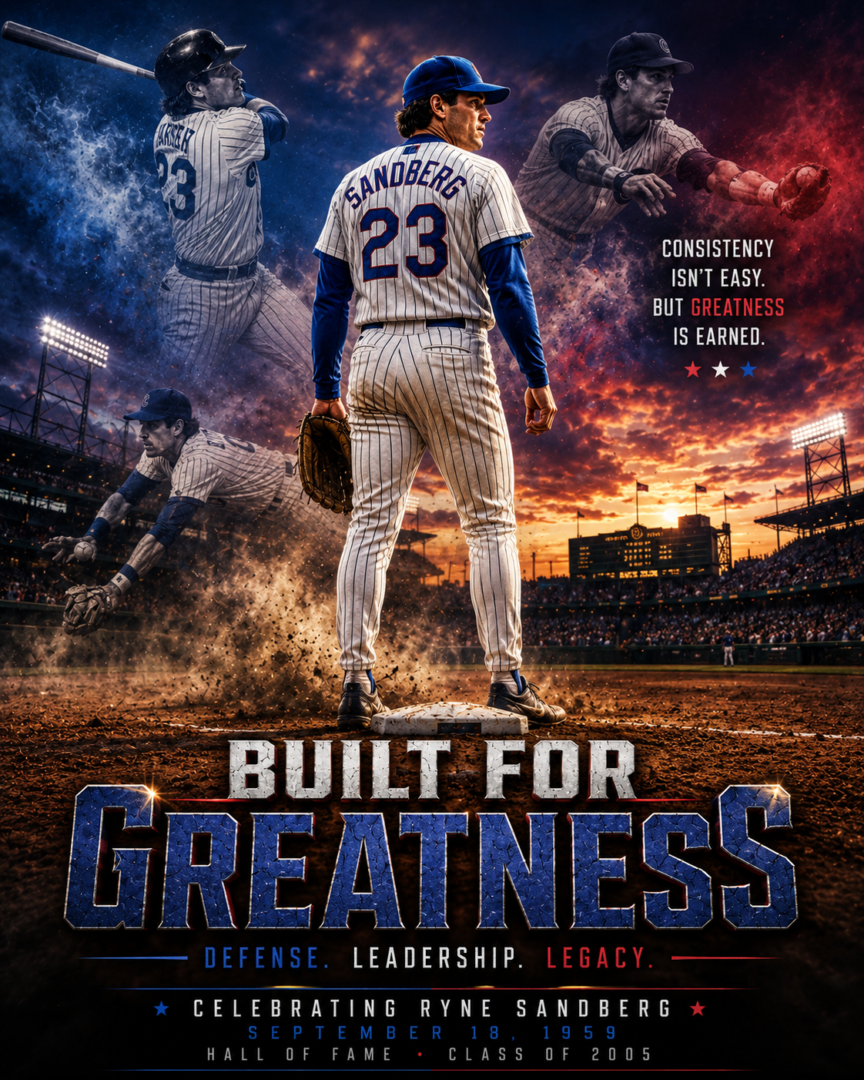

Some players are consistent. Some are elite. And then there are players who define greatness at their position.
Ryne Sandberg is that player.
Born on September 18, 1959, Sandberg built a Hall of Fame career as one of the greatest second basemen in MLB history. On his birthday, fans celebrate not just awards and numbers, but a player who set the gold standard for all-around excellence.
Affiliate Disclosure: This article may contain affiliate links and banner advertisements. If you make a purchase through these links, we may earn a small commission at no additional cost to you. Thank you for supporting our platform.
From Spokane to Wrigley Field
Ryne Sandberg was born in Spokane, Washington, on September 18, 1959, and grew up with a deep appreciation for hard work, discipline, and teamwork. Those qualities became the foundation of a career that would eventually earn him a place among baseball’s greatest second basemen. Unlike many flashy superstars, Sandberg built his reputation through consistency, professionalism, and an unwavering commitment to excellence.
From a young age, Sandberg displayed exceptional athletic ability. He excelled in multiple sports during high school, including baseball, football, and basketball. In fact, his athleticism was so impressive that he received scholarship offers to play college football as a quarterback. Despite his success on the football field, Sandberg chose to pursue his true passion—baseball.
It proved to be the right decision.
His smooth defensive skills, strong work ethic, and natural baseball instincts quickly caught the attention of professional scouts. After graduating from North Central High School, Sandberg was selected by the Philadelphia Phillies in the 20th round of the 1978 MLB Draft.
While many late-round draft picks never reach the major leagues, Sandberg steadily worked his way through Philadelphia’s minor league system. Coaches praised his reliability, baseball intelligence, and willingness to improve every aspect of his game. He wasn’t the loudest player in the clubhouse, but his performance consistently earned respect.
He let his game speak for itself.
Sandberg made his Major League debut with the Phillies in 1981, appearing in a limited role for a veteran team that had recently won the 1980 World Series. Although his opportunities were limited, he gained valuable experience learning from established major leaguers and adjusting to the speed of professional baseball.
His career changed dramatically after the 1981 season.
In one of the most famous trades in baseball history, the Phillies sent Sandberg along with Larry Bowa to the Chicago Cubs in exchange for shortstop Iván DeJesús. At the time, the deal received little national attention.
Years later, it would be viewed as one of the most lopsided trades in MLB history.
The Cubs immediately recognized Sandberg’s versatility and athleticism. Originally developed as a shortstop, he made a seamless transition to second base, where his exceptional range, quick hands, and strong throwing arm allowed him to become one of the finest defensive players in baseball.
More importantly, Chicago gave him the opportunity to play every day.
Sandberg embraced the challenge.
With regular playing time, his offensive game flourished alongside his already outstanding defense. He developed into a complete player capable of hitting for average, driving the ball into the gaps, stealing bases, and producing timely hits in important situations.
His game was built on:
- Outstanding defensive fundamentals, making difficult plays appear routine through exceptional footwork, balance, and anticipation.
- Consistent offensive production, combining contact hitting with surprising power for a middle infielder.
- Exceptional baseball intelligence, always positioning himself correctly and making fundamentally sound decisions.
- Quiet leadership, leading by example rather than seeking attention or headlines.
- Remarkable work ethic, constantly refining his skills and preparing meticulously for every game.
- Durability and consistency, showing up every day with the same professional approach regardless of circumstances.
Sandberg’s calm demeanor became one of his defining characteristics.
He rarely displayed excessive emotion.
He didn’t seek the spotlight.
He simply arrived at the ballpark every day, prepared himself thoroughly, and performed at an elite level.
That steady professionalism made him a favorite among teammates and managers alike.
As his confidence grew, so did his production.
Throughout the early 1980s, Sandberg established himself as one of the National League’s premier all-around players. His combination of Gold Glove defense, offensive consistency, speed on the bases, and outstanding baseball instincts helped transform the Cubs into a legitimate contender.
Fans at Wrigley Field quickly embraced him.
They appreciated his hustle.
They admired his humility.
Most importantly, they trusted that every time Sandberg took the field, he would give everything he had.
One performance in particular helped elevate him to superstar status.
On June 23, 1984, during a nationally televised game against the rival St. Louis Cardinals, Sandberg delivered one of the greatest individual performances in Cubs history. Facing Hall of Fame closer Bruce Sutter twice late in the game, he hit two dramatic game-tying home runs before Chicago ultimately won in extra innings.
The contest became forever known as “The Sandberg Game.”
It announced to the baseball world that Ryne Sandberg had become one of the sport’s brightest stars.
Later that season, he won the National League Most Valuable Player Award, leading the Cubs to their first postseason appearance since 1945. His remarkable all-around play helped restore excitement to one of baseball’s most historic franchises and gave Chicago fans hope that brighter days had finally arrived.
The trade that once seemed routine had transformed the Cubs forever.
Philadelphia had developed him.
Chicago unlocked his greatness.
In Chicago, Sandberg became more than an outstanding player.
He became the face of the franchise.
His professionalism, consistency, and remarkable all-around ability made him one of the greatest second basemen in baseball history and one of the most beloved players ever to wear a Cubs uniform.
He didn’t simply arrive at Wrigley Field.
He became one of its legends.
Get Yours Today: Ryne Sandberg Chicago Cubs Mitchell & Ness Legendary Collage Player T-Shirt – Black
Career Highlights & Achievements
Ryne Sandberg’s résumé reflects elite consistency and dominance:
- National League MVP (1984)
- 10× MLB All-Star
- 9× Gold Glove Award winner
- 7× Silver Slugger Award winner
- Over 2,300 career hits
- 282 career home runs
- Baseball Hall of Fame Inductee (2005)
But numbers only tell part of the story.
Get Yours Today: Ryne Sandberg Chicago Cubs Homage Signature Name & Number Tri-Blend T-Shirt – Stone
The 1984 MVP Season
The 1984 season transformed Ryne Sandberg from an outstanding player into a baseball icon. While he had already established himself as one of the National League’s premier second basemen, his performance that year elevated him into the conversation with the game’s biggest stars.
Sandberg excelled in every phase of baseball.
He hit for average.
He hit for power.
He stole bases.
He played Gold Glove defense.
Most importantly, he consistently delivered when the Chicago Cubs needed him most.
His remarkable all-around season helped lead the Cubs to their first postseason appearance since 1945, ending a nearly four-decade playoff drought and reigniting baseball excitement throughout Chicago.
His MVP campaign featured excellence across the board.
He hit .314, blasted 19 home runs, drove in 84 runs, scored 114 runs, stole 32 bases, and led the National League with 19 triples. Defensively, he continued to showcase the smooth fielding, exceptional range, and dependable hands that had already earned him recognition as one of baseball’s finest second basemen.
Sandberg proved that a player didn’t have to choose between offense and defense.
He mastered both.
His complete game made him one of the most valuable players in baseball because he could influence every inning. Whether making a spectacular defensive play, stealing a crucial base, or delivering a timely hit, Sandberg consistently found ways to help the Cubs win.
The defining moment of his season—and one of the most memorable games in baseball history—came on June 23, 1984.
The Cubs were facing their longtime rivals, the St. Louis Cardinals, in a nationally televised game at Wrigley Field. Standing in their way was Hall of Fame closer Bruce Sutter, one of the most dominant relief pitchers of his era.
With Chicago trailing late, Sandberg stepped to the plate.
He launched a dramatic game-tying home run.
Later, after the Cardinals regained the lead in extra innings, Sandberg faced Sutter once again.
The result was almost unbelievable.
He crushed another game-tying home run.
The Cubs eventually won the game in the 11th inning, but the lasting memory belonged to Sandberg. His two clutch home runs against one of baseball’s greatest closers announced to the nation that he had become one of the sport’s elite players.
The contest would forever be remembered as “The Sandberg Game.”
It became the signature performance of his Hall of Fame career and is still regarded as one of the greatest regular-season games ever played at Wrigley Field.
That unforgettable afternoon changed everything.
Fans across the country who may not have fully appreciated Sandberg’s brilliance suddenly recognized just how complete a player he had become.
His remarkable consistency throughout the season was equally impressive.
Unlike many players who relied on prolonged hot streaks, Sandberg produced at an elite level from Opening Day through the final weeks of the season. He provided stability in the middle of Chicago’s lineup while also serving as the anchor of its infield defense.
His leadership style reflected his personality.
He rarely sought attention.
He wasn’t known for emotional outbursts or dramatic celebrations.
Instead, he led by preparing thoroughly, playing fundamentally sound baseball, and performing at a consistently high level every day.
That quiet professionalism earned enormous respect throughout baseball.
Managers admired his reliability.
Teammates trusted him.
Opponents respected him.
His performance during the 1984 season earned him the National League Most Valuable Player Award, making him one of the few second basemen in baseball history to receive the honor. It also marked the beginning of an extraordinary stretch during which Sandberg established himself as one of the game’s premier players year after year.
The season also helped redefine expectations for second basemen.
Historically, the position had been associated primarily with defense, contact hitting, and turning double plays.
Sandberg proved a second baseman could also be a major offensive force.
He combined power, speed, defense, and consistency in a way that inspired future generations of middle infielders.
Players such as Roberto Alomar, Craig Biggio, Chase Utley, Dustin Pedroia, and many others would later build upon the complete style of play that Sandberg helped popularize.
His 1984 season became more than an MVP campaign.
It became the blueprint for the modern all-around second baseman.
By the end of the year, Sandberg had helped restore the Cubs to prominence, captured the National League MVP Award, and established himself as one of baseball’s brightest stars.
That performance helped cement his status as one of the game’s elite players.
It also secured his place in Chicago sports history.
For Cubs fans, 1984 wasn’t simply the year Ryne Sandberg won the MVP.
It was the year he became a legend at Wrigley Field.
Get Yours Today: Ryne Sandberg 1984 Chicago Cubs Mitchell & Ness Throwback Authentic Jersey – Royal
A Complete Player
What made Ryne Sandberg truly special was his balance. Throughout his Hall of Fame career, he excelled in every phase of the game without relying on one particular strength to define him. While many players became known primarily for their offense or their defense, Sandberg mastered both, making him one of the most complete and dependable players in Major League Baseball history.
He wasn’t simply a great hitter.
He wasn’t simply an elite defender.
He was both.
Night after night, Sandberg found ways to help the Chicago Cubs win. If his bat wasn’t producing runs, his glove prevented them. If the offense needed a spark, he could steal a base or hit for extra bases. If a critical defensive play was needed late in a game, teammates and fans trusted that Sandberg would make it.
His complete skill set made him one of the most valuable players in baseball.
Sandberg excelled because he combined:
- Consistent offensive production, hitting for both average and power while remaining one of the toughest outs in the National League.
- Elite defensive ability, winning nine consecutive Gold Glove Awards through exceptional range, soft hands, and flawless fundamentals at second base.
- Outstanding speed and baserunning, stealing bases intelligently and taking extra bases through excellent instincts rather than relying solely on raw speed.
- Remarkable baseball intelligence, consistently making smart decisions in every phase of the game and rarely beating himself with mental mistakes.
- Durability and reliability, showing up every day and producing at an elite level season after season.
- Quiet leadership, setting the standard through preparation, professionalism, and consistent performance instead of seeking attention.
One of Sandberg’s greatest strengths was his consistency.
Managers never had to wonder what kind of effort they would receive.
Teammates never questioned his preparation.
Fans knew exactly what to expect every time he took the field.
He played the game the same way every day—with discipline, focus, and an unwavering commitment to fundamentals.
Offensively, Sandberg changed expectations for second basemen.
For many years, the position had been viewed primarily as a defensive role occupied by contact hitters. Sandberg demonstrated that a second baseman could also provide significant power without sacrificing defense. He routinely hit double-digit home runs, drove in runs, and remained one of the National League’s most productive hitters while continuing to play Gold Glove-caliber defense.
His offensive production never came at the expense of his fielding.
Defensively, Sandberg made difficult plays appear routine.
His quick first step, exceptional footwork, and outstanding anticipation allowed him to cover tremendous ground. Whether turning a double play, ranging deep into the hole, or charging a slow ground ball, he displayed remarkable smoothness and confidence.
He rarely made spectacular-looking plays.
Because he positioned himself so well, many of his toughest chances looked effortless.
That was the mark of true defensive greatness.
His intelligence also elevated every aspect of his game.
Sandberg understood hitters’ tendencies, anticipated where the ball would be hit, recognized situations that called for aggressive baserunning, and consistently made the fundamentally correct play. His baseball IQ allowed him to maximize every physical tool he possessed.
He played smart.
He played disciplined.
He played winning baseball.
Another remarkable quality was his durability.
Throughout his career, Sandberg consistently answered the bell, appearing in game after game while maintaining a high level of production. Managers valued him because they could pencil his name into the lineup every day with complete confidence that he would perform on both sides of the ball.
His consistency earned the respect of everyone around the game.
Opposing players admired his professionalism.
Managers appreciated his reliability.
Teammates trusted him in every situation.
Even rival fans recognized the excellence he brought to the field every night.
Perhaps most impressive was the humility with which he achieved greatness.
Despite winning the National League MVP Award, earning multiple All-Star selections, collecting Gold Gloves, Silver Slugger Awards, and eventually reaching the Hall of Fame, Sandberg never became known for self-promotion. He remained the same quiet, hardworking player who believed preparation and performance mattered far more than publicity.
His approach became a model for future generations.
Young second basemen studied the way he fielded ground balls.
Hitters admired his balanced offensive approach.
Coaches pointed to Sandberg as the example of how to play the game the right way.
His influence extended well beyond his statistics.
He showed that greatness could be built through consistency rather than flash.
Through discipline rather than drama.
Through complete excellence rather than one extraordinary skill.
His ability to combine power, speed, defensive excellence, intelligence, and professionalism made him one of the finest all-around players baseball has ever seen.
He didn’t have a weakness.
If a game required offense, Ryne Sandberg delivered.
If it required defense, he delivered.
If it required leadership, consistency, or a fundamentally sound play in a critical moment, he delivered again.
That rare combination of skills is why he remains the standard by which many second basemen are still measured today.
Ryne Sandberg wasn’t simply a Hall of Fame second baseman.
He was the definition of a complete baseball player.
Why Cubs Fans Still Revere Him
In Chicago, Ryne Sandberg represents:
- Excellence at second base
- Consistency over a long career
- Leadership by example
- A player who delivered in big moments
For many Cubs fans, he is one of the greatest players in franchise history.
Add to Your Collection: Ryne Sandberg Autographed Rawlings Bat (chicago Cubs) – W/ Coa!
A Birthday Worth Celebrating in Baseball
Ryne Sandberg didn’t just play second base.
He mastered it.
He elevated it.
He defined it.
On September 18, we don’t just celebrate a Hall of Famer.
We celebrate one of the greatest second basemen the game has ever seen.
Happy Birthday, Ryne Sandberg — the gold standard at second base.