

Affiliate Disclaimer: This post may contain affiliate links. If you make a purchase through one of these links, The Shopping Plaza may earn a commission at no additional cost to you.
The Past Has a Way of Following Us
Ghost stories are frightening because they imagine something from the past refusing to stay there. A presence returns. An old event continues influencing the present. Something we thought was finished suddenly appears again.
Our mistakes can sometimes feel the same way.
A poor decision, missed opportunity, failed relationship, embarrassing moment, financial mistake, career setback, or hurtful action can remain in our thoughts long after the event itself has ended. We replay what happened and imagine what we should have said or done differently. We may even allow an old mistake to become evidence about what we deserve in the future.
Reflection can be valuable. Regret can teach us. Responsibility matters when our choices have affected other people. But there is a difference between learning from the past and living inside it.
Moving forward does not require pretending the mistake never happened. It requires deciding that the past can inform your future without owning it. Your inner ghosts may still visit, but they do not have to decide where you go next.
A Mistake Is Something You Did, Not Everything You Are
One of the most damaging ways to respond to a mistake is to turn an action into an identity.
“I failed” becomes “I am a failure.” “I made a bad decision” becomes “I cannot make good decisions.” “I hurt someone” becomes “I am incapable of becoming better.”
This language matters because identities feel permanent. If you believe the mistake defines you, growth can begin to feel dishonest or impossible.
Accountability does not require permanent self-condemnation. You can say, “I handled that badly,” and still believe you can learn to handle similar situations better. You can acknowledge that you failed without deciding failure is your defining characteristic.
Try describing the event as specifically as possible. What did you do? What was the result? What would you change? Specific language gives you something to learn from. Global labels only give you something to feel ashamed of.
You are responsible for your choices, but you are also capable of making new ones.
Stop Replaying the Scene Without Learning Anything New
The mind can replay an old mistake with astonishing detail. We remember the conversation, the missed warning sign, the decision, or the moment everything changed. We imagine alternate versions in which we said the perfect thing or chose the perfect path.
At first, reflection can produce insight. Eventually, repetition may stop teaching us anything.
Ask yourself, “Is this memory giving me new information, or am I simply punishing myself with it again?”
If there is a lesson, write it down. Perhaps you need to communicate earlier, prepare more carefully, set stronger boundaries, ask for help, slow down before making major decisions, or listen to your instincts.
Once the lesson is clear, continuing to replay the event does not necessarily make you more responsible. Sometimes it only keeps the wound open.
You cannot edit yesterday by thinking about it harder. You can only use what yesterday taught you to influence what you do today.
Take Responsibility Without Building a Prison
Moving beyond mistakes should never mean avoiding accountability. If your actions harmed someone, damaged trust, created a problem, or left a responsibility unfinished, growth may require you to address what can still be addressed.
Apologize when an apology is appropriate. Repair what you reasonably can. Pay what you owe. Correct misinformation. Change the behavior. Accept consequences that cannot be avoided.
But accountability should have a purpose: repair and growth.
There is a difference between accepting consequences and sentencing yourself to endless guilt. Once you have taken meaningful responsibility, repeatedly declaring yourself unforgivable does not repair additional damage.
Ask two questions: “What do I owe because of what happened?” and “What do I need to learn so I do not repeat it?”
Those questions move you toward action. Shame alone often keeps you frozen.
You cannot always undo the impact of a mistake, but you can decide what kind of person responds to it.
Understand the Person You Were at the Time
Looking backward gives us information we did not possess when the original decision was made. That can make past choices look unbelievably obvious.
Be careful with hindsight.
Understanding your past self does not mean excusing harmful behavior. It means examining the circumstances honestly. What did you know then? What did you misunderstand? What pressure were you under? What skills had you not developed yet? What warning signs did you ignore, and why?
This kind of reflection can reveal patterns.
Maybe you made decisions to please others because you had not learned to set boundaries. Perhaps you avoided asking for help because you believed independence meant doing everything alone. Maybe impatience, fear, pride, lack of experience, or incomplete information influenced you.
When you understand the conditions that produced the mistake, you can change those conditions. You gain something more useful than shame: a strategy.
Separate Regret From Rumination
Regret says, “I wish I had chosen differently.” Rumination says, “I must keep mentally returning to this until I somehow make the past different.”
Only one of those can help you.
Healthy regret can clarify values. It can reveal what matters, motivate an apology, strengthen future judgment, and encourage us to behave differently.
Rumination repeats the emotional pain without producing a new decision.
When an old mistake returns to your mind, ask what action is available now. Is there something to repair? Is there a lesson to practice? Is there a conversation to have? If so, focus on the action.
If nothing can be changed and the lesson has already been learned, gently remind yourself that remembering is not the same as repairing.
You are allowed to stop holding a trial for a case whose evidence you have already reviewed.
Forgiveness Does Not Mean Pretending It Was Fine
Self-forgiveness can sound like an excuse if we misunderstand what it means. It does not require saying the mistake was acceptable. It does not erase consequences or demand that anyone else forgive you.
Self-forgiveness means refusing to believe that one chapter removes your right to write another.
You can hold two truths at once: “What I did was wrong,” and “I am capable of becoming better.” You can regret a decision and still believe your life can contain meaningful choices afterward.
Forgiveness becomes credible when it is accompanied by change. If you claim to forgive yourself while repeating the same harmful behavior, the lesson has not been integrated. But if you have taken responsibility, changed your actions, and developed greater awareness, endless punishment serves little purpose.
The strongest apology to your future may be becoming someone who would make a different choice today.
Use the Past as a Teacher Instead of a Judge
A judge delivers a verdict. A teacher helps you improve.
When the past functions only as a judge, every memory becomes evidence for the prosecution. You notice every failure and ignore every sign of growth.
When the past becomes a teacher, the questions change. What did this experience teach me about communication? About money? About relationships? About patience? About preparation? About the kind of life I want?
Some of our most valuable principles are born from experiences we would never choose to repeat.
That does not mean you should be grateful for every painful event. It means you can refuse to let the pain be wasted.
Extract the lesson. Carry the wisdom. Leave behind the belief that suffering forever is the only way to prove you understand what happened.
Do Not Let an Old Failure Predict Every New Opportunity
Past mistakes can become dangerous when they start making future decisions for us.
You tried something once and failed, so you never try again. You trusted the wrong person, so you stop trusting everyone. You made a financial mistake, so you become afraid of every investment in yourself. You embarrassed yourself publicly, so you stop sharing ideas.
The past provides evidence, but one experience is not always a universal rule.
Ask what has changed since then. Do you know more? Have you developed new skills? Do you have better support? Can you approach the situation differently? Are the circumstances actually the same?
Growth means that the person facing today’s opportunity is not identical to the person who made yesterday’s mistake.
Use your history to prepare, not to automatically retreat.
Make Amends Where You Still Can
Some inner ghosts remain powerful because something feels unfinished.
If there is a responsible way to make amends, consider it. A sincere apology can acknowledge harm without demanding forgiveness. Correcting an error can demonstrate that your values have changed. Fulfilling an old obligation can close a chapter that has remained open.
However, making amends should respect the other person’s boundaries and well-being. Sometimes contacting someone from the past would be inappropriate or unwanted. In those cases, change can still be expressed through how you live now.
You can become more honest because you once lied. More dependable because you once failed to follow through. More compassionate because you remember what careless words can do.
Not every repair happens by returning to the original scene. Sometimes the repair is becoming different in every scene that follows.
Notice the Evidence That You Have Already Changed
When guilt is strong, we often keep looking backward and fail to notice evidence of growth in the present.
Compare your current choices with the old pattern. Do you communicate differently? Are you more patient? Do you prepare more carefully? Have you learned to ask for help, establish boundaries, manage money, or think before reacting?
Those changes matter.
You do not have to become perfect before acknowledging progress. In fact, recognizing improvement can strengthen it because you begin seeing yourself as someone capable of change.
Keep evidence of growth. Write down difficult situations you handled better than you would have in the past. Notice when you interrupt an old habit. Remember when you make the choice your younger self struggled to make.
Your history contains mistakes, but it may also contain proof that those mistakes taught you something.
Give Yourself Permission to Build New Memories
One of the best ways to loosen the grip of the past is to create more life beyond it.
If one failure dominates your identity, begin building experiences that tell a larger story. Try again with better preparation. Form healthier relationships. Complete a project. Learn a skill. Help someone. Keep a promise to yourself.
New memories do not erase old ones. They place them in context.
A painful chapter can feel like the entire book when nothing has been written afterward. Keep writing.
Over time, the mistake that once seemed enormous may become one event among hundreds of later choices. It may still matter, but it no longer occupies the whole landscape.
You cannot change what happened. You can change how much of your future is allowed to happen after it.
Accept That Growth Does Not Require Forgetting
Moving on is sometimes confused with forgetting. But you do not need amnesia to heal.
Certain mistakes may always make you uncomfortable when you remember them. That discomfort can be evidence that your values have changed. The person you are now recognizes something the person you were then did not understand clearly enough.
The goal is not to erase the memory. It is to reduce its power.
You want to be able to remember without being dragged backward. To acknowledge the lesson without reopening the punishment. To say, “That happened, it mattered, and I chose to grow from it.”
Memories can remain part of your story without remaining in control of your present.
Let Your Future Meet the Person You Have Become
Your past deserves honesty, but your future deserves a chance.
You will never reach a point where every decision behind you was perfect. No one does. A meaningful life includes errors in judgment, missed opportunities, words we wish we could retrieve, plans that fail, and moments when we fall short of our own standards.
What matters is what those experiences produce next.
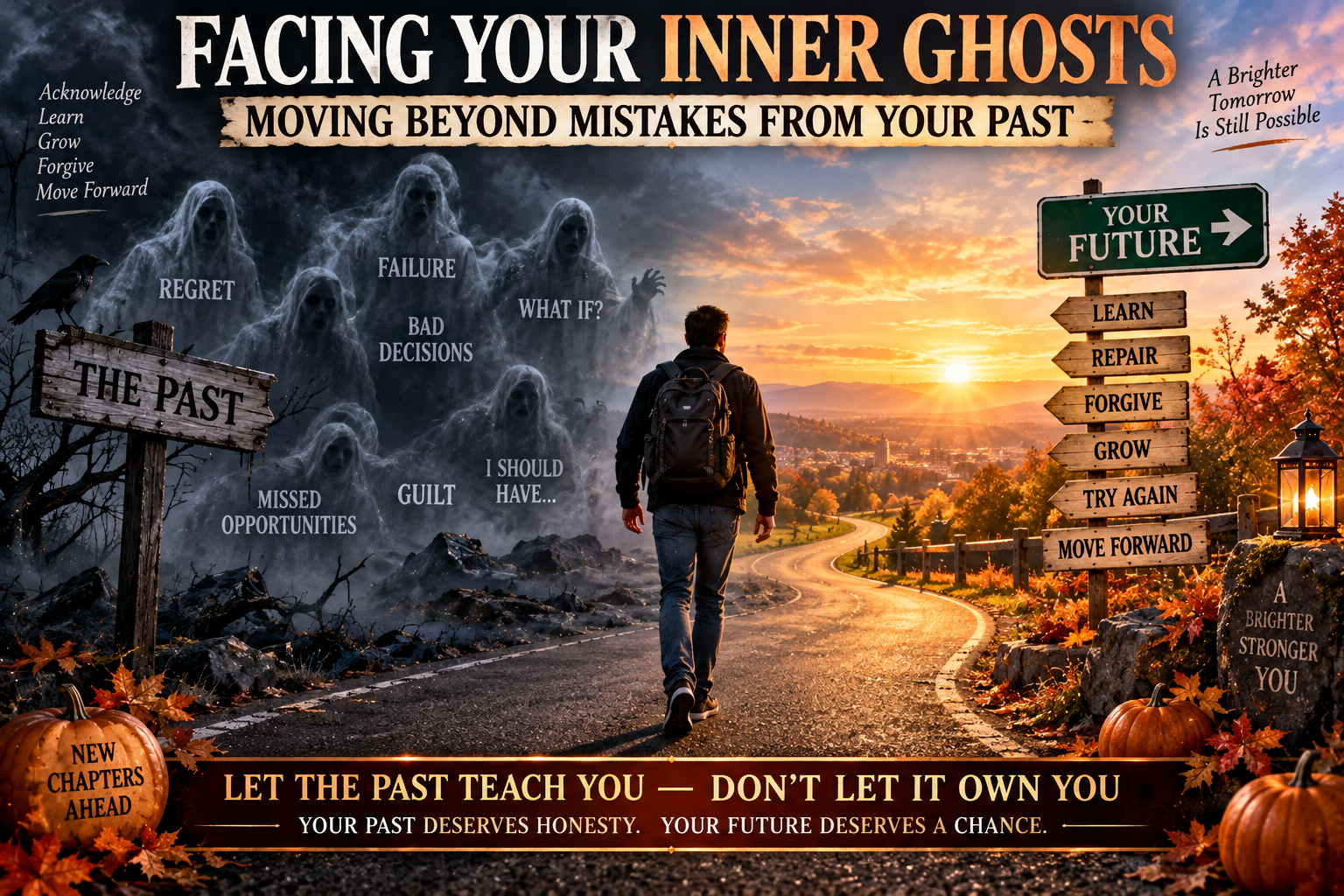
Face your inner ghosts. Name them. Learn what they came to teach. Repair what you can. Accept what cannot be changed. Forgive yourself enough to practice the lessons rather than merely reciting the regrets.
Then turn toward what is still possible.
The person who made the mistake is part of your story, but so is the person who recognized it, took responsibility, learned from it, and chose differently afterward.
Your past can explain some of who you are. It does not get exclusive authority over who you become.
Let the ghosts remind you where you have been. Do not let them convince you that you still live there.