
Affiliate Disclaimer: This post may contain affiliate links. If you make a purchase through one of these links, The Shopping Plaza may earn a commission at no additional cost to you.
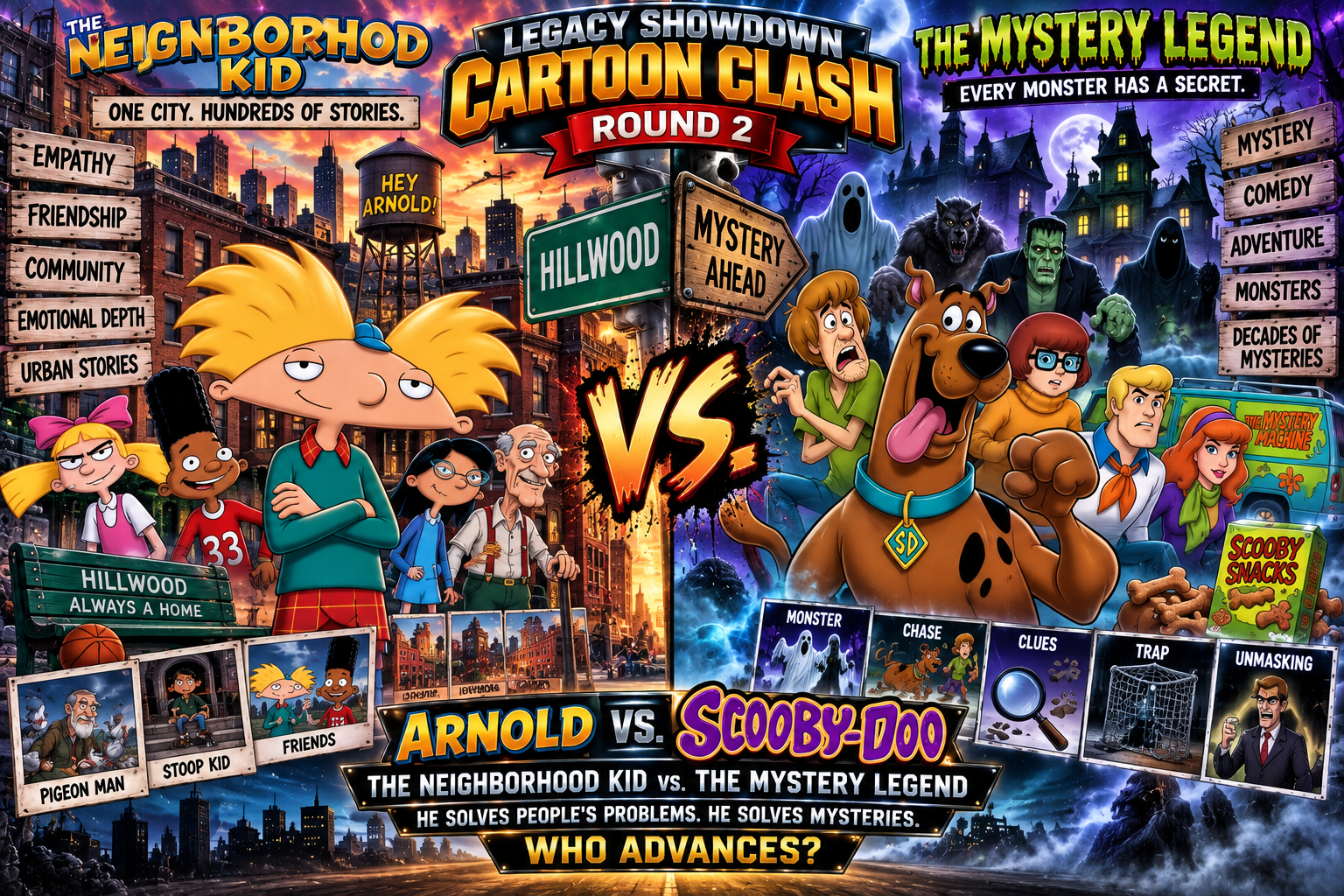
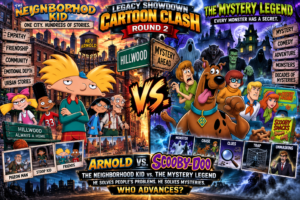
Round 2 of Legacy Showdown: Cartoon Clash continues with a matchup between two characters whose strengths come from very different kinds of storytelling. Arnold enters after surviving a difficult first-round battle through emotional depth, strong relationships, grounded storytelling, and the lasting affection surrounding Hey Arnold! Scooby-Doo arrives after a dominant opening-round performance backed by decades of mysteries, comedy, franchise reinvention, and worldwide recognition. Arnold is the thoughtful neighborhood kid who often solves problems by listening, empathizing, and helping other people see beyond their immediate frustrations. Scooby is the lovable Great Dane who would usually prefer a giant sandwich to a haunted mansion, yet repeatedly finds himself helping expose villains alongside Mystery Inc. This matchup therefore pits character-driven urban storytelling against one of animation’s most durable adventure-comedy formulas. Scooby has the larger franchise, but Arnold has qualities that raw longevity cannot automatically erase. Each of the eight categories must be judged independently before one character earns a place in the next round.
Round 1: Animation Quality
Hey Arnold! developed a distinctive visual identity that separates it from many other 1990s television cartoons. Arnold’s football-shaped head, the unusual silhouettes of his classmates and neighbors, and the dense urban environments give the series immediate personality. The city backgrounds, nighttime lighting, neighborhood streets, boarding house interiors, and occasional dreamlike sequences create atmosphere that supports the show’s emotional storytelling. Scooby-Doo’s animation history is much longer and far more varied. The earliest series used limited television animation effectively, relying on memorable character designs, eerie painted backgrounds, dramatic color, looping chases, and expressive reaction shots. Later productions improved movement, effects, action, lighting, and visual complexity while preserving the core designs of Scooby and the gang. Arnold’s series is artistically distinctive, but Scooby has successfully crossed numerous animation eras and visual styles without losing his identity. That combination of atmospheric classic design and decades of technical evolution gives Scooby the edge. Winner: Scooby-Doo.
Round 2: Character Cast
This is Arnold’s strongest category. Hey Arnold! surrounds its lead with an unusually rich collection of children and adults whose personalities extend far beyond simple supporting roles. Helga is simultaneously bully, secret admirer, poet, and emotionally complicated child. Gerald is Arnold’s loyal best friend and storytelling partner. Grandpa Phil, Grandma Gertie, Phoebe, Harold, Stinky, Sid, Eugene, Rhonda, and the residents of the boarding house all contribute distinct personalities and memorable stories. Many supporting characters receive episodes that reveal family problems, insecurities, ambitions, and unexpected strengths. Scooby-Doo has one of animation’s most recognizable core ensembles: Shaggy, Fred, Daphne, and Velma each fill a clear role, and Scooby’s bond with Shaggy is legendary. The Mystery Inc. chemistry has survived countless adaptations because the group is instantly understandable. Yet Arnold’s world offers greater individual depth across a much larger recurring community. The category rewards personality, development, chemistry, and supporting-character strength, and Hey Arnold! excels at all four. Winner: Arnold.
Round 3: Humor & Entertainment
Arnold’s entertainment value comes from balancing comedy with neighborhood adventures and emotional storytelling. The series can move from schoolyard embarrassment to an urban legend, a friendship conflict, a family problem, or a surprisingly serious character study without feeling like a different show. Arnold himself is often the calm center while more eccentric personalities generate the comedy. Scooby-Doo is built around an entertainment formula that has remained effective for generations: investigate a frightening mystery, encounter a monster, panic, run, improvise, discover clues, and expose the human culprit. Scooby and Shaggy provide physical comedy, appetite-driven jokes, cowardice, disguises, and chaotic chase sequences, while the mystery gives each story forward momentum. The formula is repetitive by design, but its adaptability has allowed the franchise to incorporate celebrities, supernatural twists, comedy, action, and different tones. Arnold offers more emotional variety, but Scooby delivers a broader combination of mystery, adventure, suspense, and comedy with extraordinary accessibility. Winner: Scooby-Doo.
Round 4: Cultural Impact
Hey Arnold! became one of Nickelodeon’s defining 1990s cartoons and remains strongly associated with the era. Arnold’s silhouette is instantly recognizable to fans, Helga’s secret love for him became one of the show’s defining dynamics, and the series continues to inspire nostalgia, discussion, merchandise, and appreciation for its unusually thoughtful treatment of childhood and city life. Scooby-Doo operates on a substantially larger cultural scale. The Mystery Machine, Scooby Snacks, haunted-mansion imagery, villain unmaskings, Scooby and Shaggy’s cowardice, and the basic idea of meddling kids solving mysteries have become part of popular culture. The franchise has been parodied, referenced, imitated, merchandised, and reinvented for decades. Even people who have never followed a particular Scooby series generally understand the characters and formula. Arnold is an important Nickelodeon icon, but Scooby became one of animation’s universal symbols of mystery-comedy. Winner: Scooby-Doo.
Round 5: Iconic Episodes & Moments
Arnold has an impressive collection of episodes remembered for emotional impact rather than spectacle. Stories involving Helga’s home life, Mr. Hyunh’s daughter, Pigeon Man, Stoop Kid, Arnold’s family history, and the many urban legends surrounding his neighborhood helped demonstrate how much depth a children’s cartoon could achieve in a short television format. The show often made seemingly minor neighborhood characters unforgettable through one carefully written story. Scooby-Doo’s iconic moments are more formula-driven but far more numerous across popular culture. Monster reveals, hallway chases, elaborate traps, giant sandwiches, Scooby Snacks, Shaggy and Scooby disguising themselves in the middle of danger, and the final unmasking became recurring rituals recognized across generations. Individual villains and monsters also became famous enough to inspire merchandise and repeated revivals. Arnold may have the more emotionally powerful individual episodes, but Scooby’s defining scenes created an entire vocabulary of cartoon mystery storytelling. Winner: Scooby-Doo.
Round 6: Creativity & Originality
Hey Arnold! deserves major credit for building a children’s animated series around an urban neighborhood that feels populated rather than merely decorated. Arnold is not a superhero or chosen one; he is an observant kid whose greatest ability is often understanding another person’s problem. The series gives attention to adults, classmates, local legends, poverty, loneliness, family tension, immigration, crushes, aging, and community life while still functioning as an entertaining cartoon. Scooby-Doo’s original concept was also remarkably effective: combine teenage mystery solving, horror imagery, comedy, a talking dog, and a rational explanation that usually reveals a human villain behind the supernatural threat. That formula proved so flexible that it generated decades of variations and inspired an entire category of mystery cartoons. Arnold’s approach is more nuanced as character storytelling, but Scooby’s core concept created one of television animation’s most copied and durable formats. By the narrowest margin, the category goes to Scooby for the originality and replicability of the mystery-comedy formula. Winner: Scooby-Doo.
Round 7: Era Difficulty
Arnold emerged during an exceptionally competitive period for television animation. Nickelodeon was developing a strong identity, Cartoon Network was expanding, Disney television animation remained prominent, and the 1990s produced a large number of memorable children’s series. Hey Arnold! had to distinguish itself without relying on superheroes, fantasy powers, or nonstop slapstick, and it succeeded by making ordinary neighborhood life compelling. Scooby-Doo debuted in an earlier television environment shaped by tighter production budgets, Saturday-morning scheduling, network standards, and the need to create a concept that could repeatedly attract young viewers. More importantly, the original series established a formula strong enough to survive after many contemporaries disappeared. Scooby then faced a second challenge: remaining viable as animation tastes changed across the 1970s, 1980s, 1990s, and beyond. Arnold succeeded in a crowded creative era, but Scooby’s ability to emerge from the constraints of early television animation and continually adapt gives him the advantage. Winner: Scooby-Doo.
Round 8: Legacy Endurance
Arnold’s legacy has endured well beyond the original run of Hey Arnold! Fans continued discussing unresolved stories and character relationships long enough for the franchise to receive a later television movie that addressed major questions surrounding Arnold’s parents. Streaming, reruns, merchandise, and 1990s nostalgia have kept the series accessible to new viewers, while its mature writing has encouraged adults to revisit it with a different perspective. Scooby-Doo’s endurance is among the strongest in television animation. The character has remained active through numerous series, direct-to-video films, theatrical and television movies, crossovers, games, comics, merchandise, streaming, and repeated reinterpretations. Different generations often have their own version of Scooby while still recognizing the original Mystery Inc. formula. Few animated franchises have remained so consistently usable for so long. Arnold has a devoted and durable legacy, but Scooby’s multigenerational continuity is overwhelming. Winner: Scooby-Doo.
Final Verdict
Arnold gives Scooby-Doo a more meaningful challenge than the final score initially suggests. His victory in Character Cast is well earned: the children, adults, families, and neighborhood personalities of Hey Arnold! possess a level of individual development that even the famous Mystery Inc. ensemble cannot completely match. Arnold also makes Iconic Episodes & Moments and Creativity & Originality competitive because his best stories deliver emotional depth and grounded subject matter that remain unusual in children’s animation. Scooby-Doo, however, controls the broader tournament résumé. He wins Animation Quality through decades of successful visual reinvention, Humor & Entertainment through an exceptionally durable mixture of mystery, adventure, and comedy, and Cultural Impact through a formula and collection of symbols recognized far beyond the franchise itself. His recurring mysteries and monster reveals take Iconic Episodes & Moments, while the original combination of teen detectives, horror imagery, comedy, and a talking dog narrowly claims Creativity & Originality. Era Difficulty favors Scooby because the franchise emerged from the limitations of early television animation and then repeatedly survived major shifts in audience taste. Legacy Endurance becomes the clearest category of all: Scooby has remained continuously reinventable across generations, while Arnold’s excellent legacy is concentrated around one beloved series and its continuation. Arnold leaves the tournament as a reminder that emotional storytelling and supporting-character depth can challenge even the largest franchises. Scooby advances because his total legacy combines innovation, familiarity, entertainment, and longevity at an exceptional level.
Final Result: Scooby-Doo defeats Arnold 7-1 and advances to the next round of Legacy Showdown: Cartoon Clash. Arnold earns Character Cast and makes several other categories competitive, but Scooby’s cultural reach and extraordinary endurance ultimately separate the two.
Audience Challenge
Is 7-1 too decisive for a matchup involving a series as thoughtfully written as Hey Arnold!? Should Arnold also win Iconic Episodes & Moments because of emotionally remembered stories such as those centered on Pigeon Man, Mr. Hyunh, Helga, and the neighborhood’s many supporting characters? Could Creativity & Originality belong to Arnold because of the show’s grounded urban storytelling, or does Scooby-Doo deserve that category for creating one of animation’s most enduring mystery formulas? Cast your vote, defend your choices, and continue following Legacy Showdown: Cartoon Clash as Round 2 continues.