
Affiliate Disclaimer: This post may contain affiliate links. If you make a purchase through one of these links, The Shopping Plaza may earn a commission at no additional cost to you.
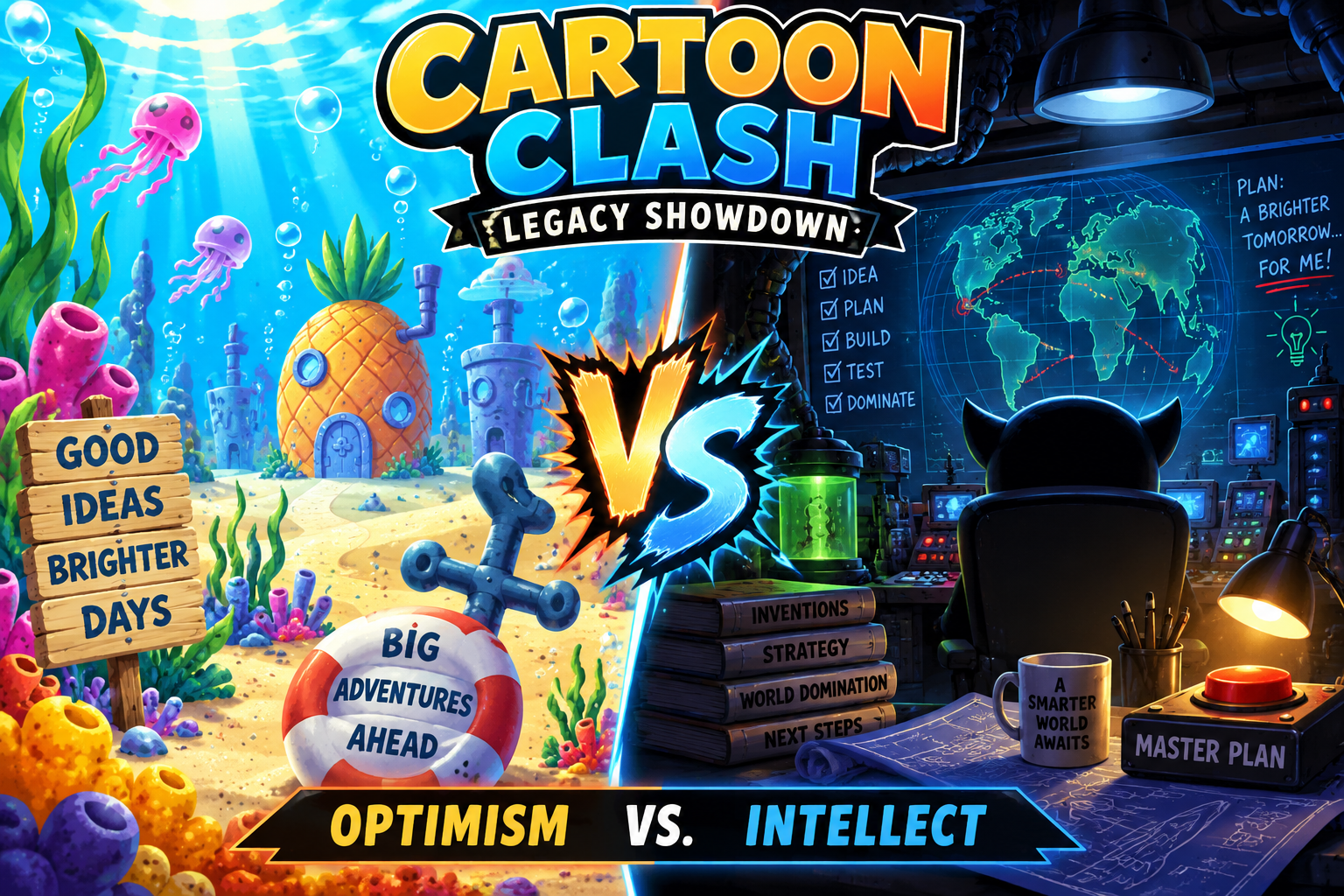
The final first-round matchup in Region A pits one of the most successful cartoon characters of the modern era against one of television animation’s most memorable masterminds. The #2 seed SpongeBob SquarePants enters as a championship contender whose optimism, absurd humor, and worldwide recognition have made him the face of an enormous franchise. Across the bracket stands the #15 seed Brain, the genetically enhanced laboratory mouse whose nightly plans for world domination turned intelligence, ambition, and repeated failure into one of the funniest recurring concepts of the 1990s. This is a clash of personalities as much as legacies. SpongeBob approaches almost every situation with enthusiasm and emotional openness, while Brain treats the world as a puzzle that should logically belong to him once he develops the correct plan. Brain’s partnership with Pinky also gives the underdog one of animation’s great comedic relationships, meaning he cannot be dismissed simply because of his lower seed. Still, SpongeBob brings an unusually complete tournament resume: animation range, ensemble depth, comedy, cultural influence, iconic episodes, and multigenerational endurance. Every category must therefore determine whether Brain’s intelligence and originality can overcome the extraordinary breadth of SpongeBob’s legacy.
Round 1: Animation Quality
SpongeBob SquarePants established a visual identity that is immediately recognizable. Bikini Bottom combines bright underwater colors, unusual architecture, painted backgrounds, surreal cutaways, grotesquely detailed reaction images, and character designs flexible enough for extreme physical comedy. SpongeBob himself can stretch, flatten, tear apart, inflate, reshape, and instantly recover because his sponge body gives animators unusual freedom. Across the franchise’s long run, the animation has evolved while continuing to emphasize facial expressions, energetic movement, and visual gags. Brain also comes from a beautifully designed Warner Bros. television-animation tradition. His oversized head, tiny body, narrowed eyes, and controlled posture instantly communicate intelligence and arrogance, while Pinky’s loose physicality creates a strong visual contrast. Their world-domination schemes also generate machines, costumes, historical parodies, and elaborate situations. Brain’s animation is expressive and polished for its era, but SpongeBob’s visual universe offers greater stylistic range and a much larger vocabulary of surreal and physical animation. Winner: SpongeBob SquarePants.
Round 2: Character Cast
Brain’s supporting world is anchored by Pinky, and that single relationship is powerful enough to make this category competitive. Pinky’s cheerful nonsense constantly disrupts Brain’s logic, yet their partnership contains genuine loyalty beneath the insults and failed schemes. The contrast between Brain’s intellectual seriousness and Pinky’s unpredictable innocence is the engine of the entire concept. Recurring characters and crossover connections broaden their universe, but most stories deliberately focus on the central duo. SpongeBob is surrounded by one of modern animation’s deepest ensembles. Patrick provides absurd friendship comedy, Squidward supplies cynicism and frustration, Mr. Krabs brings greed and workplace conflict, Sandy adds intelligence and adventure, Plankton serves as a persistent rival, and Gary creates a quieter domestic relationship. Characters such as Mrs. Puff, Pearl, Karen, and others can carry substantial stories of their own. Brain may have the more concentrated two-character chemistry, but SpongeBob’s cast creates far more combinations of personalities, conflicts, friendships, and story types. Winner: SpongeBob SquarePants.
Round 3: Humor & Entertainment
Brain’s comedy is unusually intelligent. Each attempt to conquer the world begins with complete confidence, develops through an elaborate plan, and usually collapses because of a flaw Brain failed to anticipate, Pinky’s interference, or the sheer absurdity of the premise. The dialogue can include wordplay, satire, historical references, scientific language, and parodies that reward older viewers as much as children. Brain’s deadpan seriousness makes the failures even funnier because he almost never recognizes how ridiculous his ambitions have become. SpongeBob uses a broader comedic arsenal. The series moves from slapstick and nonsense to character comedy, musical humor, visual absurdity, awkward social situations, parody, and surprisingly emotional storytelling. SpongeBob can be the source of the joke, the victim of it, or the sincere character whose enthusiasm makes everyone else’s reactions funnier. His interactions with Patrick and Squidward alone produce dramatically different styles of comedy. Brain may win on intellectual wit, but SpongeBob’s versatility and ability to entertain across age groups and formats give him the overall advantage. Winner: SpongeBob SquarePants.
Round 4: Cultural Impact
Brain became one of the defining characters associated with the Warner Bros. television-animation renaissance of the 1990s. His repeated question about what he and Pinky would do each night and his unwavering answer about taking over the world became inseparable from the duo’s identity. The character remains widely respected by animation fans and helped demonstrate that children’s television comedy could combine silliness with sophisticated writing. SpongeBob’s cultural reach, however, expanded far beyond the boundaries of animation fandom. His image appears across merchandise, movies, games, theme-park entertainment, music, advertising, internet memes, sports promotions, social media, and everyday cultural references. Individual facial expressions and scenes have become reaction images recognizable even to people who may not regularly watch the series. Bikini Bottom characters have become a shared vocabulary for multiple generations of viewers. Brain is an enduring cult and critical favorite, but SpongeBob became a worldwide popular-culture phenomenon on a dramatically larger scale. Winner: SpongeBob SquarePants.
Round 5: Iconic Episodes & Moments
Brain possesses a remarkably memorable recurring structure. Night after night he develops another plan for world domination, explains it with complete seriousness, and drags Pinky into an adventure that almost inevitably ends in failure. Their exchanges, disguises, inventions, and absurd schemes generated a strong collection of fan-favorite stories. The repetition is part of the appeal because viewers want to see how a familiar objective will be reinvented. SpongeBob, however, has accumulated a much larger catalog of individually recognizable episodes, scenes, songs, quotes, and character moments. Stories involving boating school, Krusty Krab disasters, jellyfishing, SpongeBob and Patrick’s friendship, Squidward’s frustration, Plankton’s schemes, and countless bizarre Bikini Bottom situations continue to be quoted and rediscovered. Some episodes generated jokes that remain common online decades after their original broadcasts. Brain’s formula is iconic, but SpongeBob’s defining moments are more numerous and have achieved broader recognition outside the dedicated fan base. Winner: SpongeBob SquarePants.
Round 6: Creativity & Originality
This is Brain’s strongest category. A genetically enhanced laboratory mouse with extraordinary intelligence who spends every night attempting to conquer the world alongside an affectionate but scatterbrained companion is an inspired comic premise. The concept can parody politics, science, history, popular entertainment, technology, and human ambition while maintaining the same basic objective. Brain’s tiny physical size makes his enormous ego even funnier, and Pinky’s apparent foolishness sometimes produces insights that Brain’s intellect misses. SpongeBob is also highly original. A relentlessly optimistic sea sponge working as a fry cook in an underwater city populated by talking sea creatures is a premise filled with imaginative possibilities, and Bikini Bottom transforms familiar human institutions into absurd aquatic versions. Yet SpongeBob’s originality is distributed across an entire world, while Brain himself embodies the central creative contradiction of his concept: a tiny mouse possessing enormous intelligence and limitless ambition but repeatedly failing to control humanity. Brain earns the upset here. Winner: Brain.
Round 7: Era Difficulty
Brain emerged during an exceptional period of 1990s television animation. He competed for attention amid a wave of distinctive Nickelodeon, Cartoon Network, Disney, Fox, and Warner Bros. productions, many of which developed lasting fan bases. His style of dialogue-heavy, reference-rich comedy had to stand out in a marketplace filled with louder action shows and visually extreme cartoons. Becoming memorable enough to move from a recurring segment into a starring role demonstrates substantial success. SpongeBob arrived near the end of that decade and then faced an even longer challenge. The series had to survive the transition from traditional cable dominance into DVDs, digital media, online video, streaming, mobile entertainment, social media, and increasingly fragmented children’s viewing habits. Rather than merely surviving, SpongeBob became Nickelodeon’s flagship animated property and remained culturally visible while generations of competing shows came and went. Brain faced fierce competition during a celebrated animation era, but SpongeBob’s ability to dominate through multiple major changes in how audiences consume entertainment gives him the stronger overall Era Difficulty case. Winner: SpongeBob SquarePants.
Round 8: Legacy Endurance
Brain has aged extremely well. The character remains recognizable to viewers who grew up during the 1990s, continues to be celebrated in animation discussions, and has benefited from later appearances and renewed interest in the Pinky and the Brain concept. His central joke also remains timeless because ambition, ego, intelligence, and failure are not tied to one technological era. Yet much of Brain’s modern strength is connected to the enduring affection for a classic animated property. SpongeBob’s endurance is more active and continuous. The franchise has remained visible through ongoing productions, movies, spin-offs, games, merchandise, streaming, internet culture, and constant introduction to younger audiences. People who watched SpongeBob as children now share the character with a new generation while still participating in the memes and references themselves. That creates both nostalgia and current relevance at the same time. Brain has a durable legacy, but SpongeBob remains an active global entertainment figure rather than primarily a beloved character from an earlier period. Winner: SpongeBob SquarePants.
Final Verdict
The expanded matchup confirms that Brain is a much more formidable #15 seed than the final score may initially suggest. His intelligence, sophisticated comedy, relationship with Pinky, and endlessly adaptable world-domination premise make him one of the strongest conceptual characters in the bracket. He earns a deserved victory in Creativity & Originality, where the contradiction between his tiny physical form and enormous ambitions creates a uniquely durable comic idea. Several other categories, particularly Humor & Entertainment and Era Difficulty, become more competitive when Brain’s 1990s accomplishments are given full weight. SpongeBob nevertheless owns the more complete legacy. His expressive animation, enormous supporting cast, wider comedic range, global cultural impact, extraordinary catalog of memorable episodes and scenes, survival through major changes in children’s media, and continuous multigenerational relevance give him seven category victories. The score is decisive, but the individual rounds show why Brain remains respected rather than overwhelmed. He loses not because his legacy is weak, but because he drew one of the tournament’s most accomplished all-around competitors.
Final Result: SpongeBob SquarePants defeats Brain 7-1 and advances to the second round of Cartoon Clash. Brain exits after claiming Creativity & Originality and demonstrating that his quest for world domination remains one of animation’s smartest and most enduring comedy concepts.
Audience Challenge
Did SpongeBob SquarePants deserve the commanding 7-1 victory, or should Brain’s sophisticated writing and partnership with Pinky have earned him another category? Would you give Brain Humor & Entertainment or Era Difficulty, or is SpongeBob’s extraordinary range simply too difficult to overcome? Cast your vote, defend your choice, and continue following Legacy Showdown: Cartoon Clash as Region A prepares for the second round.