
Affiliate Disclaimer: This post may contain affiliate links. If you make a purchase through one of these links, The Shopping Plaza may earn a commission at no additional cost to you.
Introduction
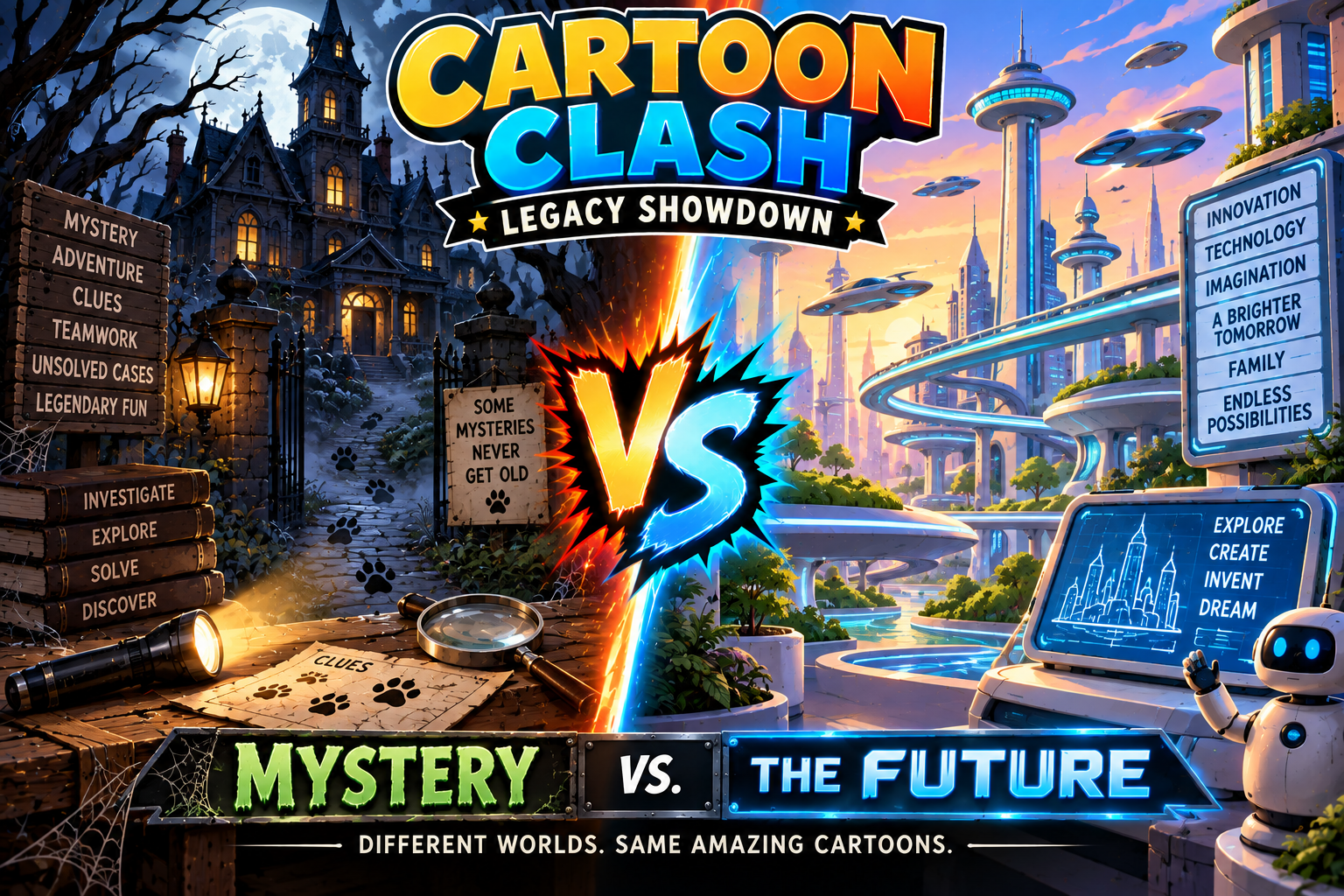
The next Region A matchup features two of the most recognizable cartoon stars ever created. The #6 seed Scooby-Doo enters the tournament carrying decades of mystery-solving adventures, while the #11 seed George Jetson represents one of television animation’s most beloved futuristic families. On the surface, they could hardly be more different. One spends his time creeping through haunted mansions, abandoned amusement parks, spooky castles, and suspicious old buildings. The other lives high above the ground in a futuristic world of flying cars, robotic helpers, push-button conveniences, and technology designed to make everyday life easier – at least in theory.
That contrast is exactly what makes this first-round battle so interesting. Scooby-Doo thrives through a combination of comedy, adventure, mystery, suspense, friendship, and the familiar thrill of discovering what is really hiding behind the monster mask. George Jetson helped introduce generations of viewers to a humorous vision of tomorrow in which advanced technology changes the details of family life without eliminating ordinary frustrations involving work, parenting, money, relationships, and responsibility. Both characters became cultural icons, but they reached that status through very different forms of storytelling.
To decide which character advances, the matchup must go beyond simple name recognition. Each competitor will be judged across the eight official Cartoon Clash categories: Animation Quality, Character Cast, Humor & Entertainment, Cultural Impact, Iconic Episodes & Moments, Creativity & Originality, Era Difficulty, and Legacy Endurance. George’s importance as an early science-fiction television character deserves serious consideration, while Scooby’s extraordinary longevity cannot automatically decide every category. The question is which character builds the stronger overall Cartoon Clash resume when each strength is examined individually.
Round 1: Animation Quality
Both characters emerged from eras of television animation in which studios had to work within tighter budgets and faster production schedules than theatrical animation often enjoyed. The original Jetsons series created a distinctive futuristic visual identity with elevated cities, moving walkways, flying vehicles, automated homes, robotic appliances, and imaginative machinery. Even when movement was limited, the backgrounds and technology helped sell the idea that the audience was looking into a possible future. George’s world needed to feel advanced while still remaining understandable enough for viewers to recognize the familiar family problems underneath all of the gadgets.
Scooby-Doo also began with the limitations of television animation, but the franchise found clever ways to turn atmosphere into an advantage. Dark corridors, foggy graveyards, abandoned buildings, hidden passages, looming shadows, and brightly colored monsters helped create a visual language that audiences could recognize almost immediately. Chase sequences often relied on exaggerated movement, quick cuts, repeated backgrounds, and comic timing to transform limited animation into memorable entertainment.
The biggest advantage for Scooby is the enormous number of later interpretations the franchise has received. Across multiple decades, different series and films have experimented with cleaner digital animation, more stylized designs, darker mystery atmospheres, elaborate action sequences, and updated visual effects while preserving the basic identity of Scooby and the gang. George Jetson’s original world remains visually imaginative, but Scooby has demonstrated greater flexibility across changing animation technologies and styles. Winner: Scooby-Doo.
Round 2: Character Cast
George Jetson is surrounded by a compact but memorable family ensemble. Jane provides a capable counterbalance to George’s anxiety and workplace frustrations. Judy represents teenage interests and social life, while Elroy brings youthful curiosity and intelligence. Astro adds the chaos and affection of a family pet, and Rosie the Robot gives the household both comic personality and one of its most recognizable futuristic conveniences. George’s employer, Mr. Spacely, also plays an important role by turning futuristic employment into a familiar source of stress. The cast works because the technology may be extraordinary, but the family relationships remain recognizable.
Scooby-Doo, however, belongs to one of animation’s most enduring team ensembles. Shaggy and Scooby provide fear, appetite, improvisation, and much of the comedy. Fred traditionally brings leadership and planning, Daphne contributes courage and adaptability, and Velma supplies analytical thinking and a talent for connecting clues. Their personalities create a balanced mystery-solving unit in which each member can contribute something different.
The group also benefits from the unusual strength of its recurring opponents. Ghosts, monsters, suspicious caretakers, corrupt business owners, treasure hunters, and disguised criminals constantly give the gang new mysteries to investigate. Even when viewers know that a supernatural-looking threat may eventually receive a rational explanation, the fun comes from discovering the identity, motive, and method behind the disguise. The Jetson family is an excellent television ensemble, but Mystery Inc. has become one of the most recognizable group dynamics in animation. Winner: Scooby-Doo.
Round 3: Humor & Entertainment
George Jetson’s comedy is built around a clever contradiction: technology is supposed to make the future easier, yet George still finds ways to become overwhelmed by ordinary life. He deals with a demanding boss, family expenses, household confusion, transportation problems, social obligations, and devices that do not always behave as expected. The futuristic setting allows familiar frustrations to be exaggerated through machines, robots, and automated systems. That makes the humor accessible because audiences can laugh at the technology while recognizing the human problem underneath it.
Scooby-Doo has an even broader entertainment formula. A typical adventure can begin as a road trip or ordinary visit before introducing a strange legend, frightening creature, suspicious location, and series of clues. Suspense then mixes with slapstick as Scooby and Shaggy panic, hide, run, eat, accidentally discover evidence, and somehow remain involved despite wanting nothing to do with danger. Fred, Daphne, and Velma keep the investigation moving while the mystery gives the audience something to solve alongside the characters.
That combination allows Scooby-Doo to move between comedy, mystery, light horror, adventure, and friendship without abandoning its central identity. Younger viewers can enjoy the monsters and chase scenes, while older audiences can appreciate the mystery structure, nostalgia, and familiar character chemistry. George remains charming and often clever, but Scooby’s ability to combine several entertainment genres gives him the advantage. Winner: Scooby-Doo.
Round 4: Cultural Impact
The Jetsons made an important contribution to popular culture by helping audiences imagine what everyday life might look like in a technologically advanced future. Flying cars, video communication, robotic household assistance, automated food preparation, moving sidewalks, and push-button conveniences became part of the show’s recognizable vision. Some technologies that once seemed purely futuristic later became easier to compare with real developments, helping keep the series relevant in conversations about how earlier generations imagined tomorrow.
George Jetson is central to that cultural memory because the future is largely experienced through his ordinary working-family perspective. The show did not simply present futuristic inventions; it asked what employment, commuting, parenting, shopping, and household life might look like when surrounded by advanced machines. That combination helped The Jetsons become an enduring shorthand for a cheerful mid-century vision of the future.
Scooby-Doo’s cultural footprint, however, expanded across an even wider range of entertainment. The basic formula of a group investigating an apparently supernatural mystery has become instantly recognizable. The unmasking of a disguised villain, Scooby and Shaggy’s fear-driven escapes, the Mystery Machine, elaborate traps, and the gang’s division of investigative responsibilities have been referenced and parodied throughout popular culture. The franchise has also generated numerous television series, animated and live-action films, games, merchandise, and cross-generational fandom. George helped shape how animation imagined the future, but Scooby became a broader multimedia phenomenon. Winner: Scooby-Doo.
Round 5: Iconic Episodes & Moments
George Jetson has plenty of memorable situations tied to the futuristic world around him. His workplace confrontations with Mr. Spacely, the family’s interactions with Rosie and Astro, problems involving flying transportation, and technological conveniences that create unexpected complications all contribute to the show’s identity. The opening and closing sequences themselves helped establish the Jetson family’s world as a recognizable piece of television history.
Scooby-Doo possesses an enormous collection of recurring moments that became part of the language of cartoons. A mysterious figure appears. Local residents explain a frightening legend. Velma notices a clue. Scooby and Shaggy encounter the monster at exactly the wrong moment. A chase erupts through doors, hallways, tunnels, or rooms. Fred develops a trap that may or may not work as intended. Eventually the creature is captured and unmasked, revealing the person responsible and the motive behind the mystery.
The repetition does not necessarily weaken the formula because each adventure can change the setting, creature, legend, motive, and clues. Haunted mansions, castles, amusement parks, museums, ships, islands, caves, theaters, and other locations give the structure endless variations. The final unmasking became one of the most recognizable recurring payoffs in animated mystery storytelling. George has memorable futuristic comedy, but Scooby owns the stronger collection of instantly recognizable cartoon moments. Winner: Scooby-Doo.
Round 6: Creativity & Originality
Scooby-Doo deserves considerable credit for combining mystery, comedy, light horror, and a teenage ensemble into a formula that proved remarkably adaptable. The decision to make the supposedly supernatural threat understandable rather than genuinely terrifying helped the series create suspense without abandoning its family audience. Scooby himself adds another creative layer because a frightened talking dog becomes both comic relief and an accidental hero.
George Jetson receives the advantage, however, because the world surrounding him represented such an ambitious act of television imagination. The Jetsons did not merely add one futuristic gadget to an otherwise ordinary setting. The entire society was reconstructed around a vision of tomorrow. Transportation, employment, architecture, communication, household chores, entertainment, shopping, and family routines were filtered through futuristic technology.
The creativity becomes even more impressive when considering how many of those ideas became lasting symbols of the future. Flying vehicles and robotic servants may remain science-fiction staples, while video calls, automated devices, and increasingly intelligent household technology feel much less distant than they once did. The show’s predictions were never meant to function as a scientific blueprint, but its imaginative vocabulary influenced how audiences pictured futuristic domestic life. Scooby-Doo created an exceptional entertainment formula; The Jetsons constructed an entire animated future. Winner: George Jetson.
Round 7: Era Difficulty
Scooby-Doo debuted during a period when Saturday-morning television was becoming an increasingly important home for children’s animation. Creating a series capable of standing out in that environment was not easy, and the show’s mixture of mystery and comedy gave it an identity strong enough to generate numerous successors. Its eventual longevity makes that original breakthrough even more impressive.
George Jetson, however, emerged earlier in the development of television animation, when studios were still demonstrating that animated programming could support recurring prime-time or family-oriented television concepts. Producing a convincing futuristic world under the technical and financial restrictions of early television animation required creative efficiency. The artists needed to suggest enormous cities, advanced machines, and a transformed society without the resources available to major theatrical productions or modern digital studios.
The Jetsons also had to make its future immediately readable. A device could look strange, but viewers still needed to understand what it did and why the resulting situation was funny. The series helped establish a visual vocabulary for futuristic television comedy that remained recognizable long after its original era. Scooby-Doo faced significant competition, but George’s success during a more pioneering period of television animation gives him the edge. Winner: George Jetson.
Round 8: Legacy Endurance
George Jetson remains recognizable decades after his original television debut. The Jetsons continues to be revisited because its retro-futuristic vision is both nostalgic and surprisingly useful for discussing how previous generations imagined technological progress. George, Jane, Judy, Elroy, Astro, Rosie, and Mr. Spacely remain familiar figures even though the franchise has not maintained the same constant stream of major new productions as some other animated properties.
Scooby-Doo’s endurance operates on another level. The franchise has repeatedly reinvented itself for new generations without abandoning the core ingredients that made it successful: a close group of friends, a frightening mystery, comedy, clues, pursuit, and a final explanation. Different versions have adjusted the tone from light comedy to more serialized mystery, but Scooby remains immediately recognizable at the center.
More than half a century after the character’s debut, children can encounter Scooby through streaming, television, films, books, games, merchandise, and older episodes that continue circulating alongside newer interpretations. Adults who watched one version can introduce the franchise to children watching another. That ability to survive not simply as nostalgia but as an active entertainment property is extraordinary. George Jetson has enduring historical recognition, but Scooby-Doo has demonstrated stronger continuous multigenerational relevance. Winner: Scooby-Doo.
Final Verdict
George Jetson earns two meaningful victories rather than functioning as an easy first-round opponent. Creativity & Originality belongs to George because The Jetsons constructed one of television animation’s most influential visions of everyday futuristic life. Era Difficulty also goes to George because creating that world during the formative years of television animation required imagination and efficiency under significant production limitations. Those victories reinforce why George remains an important figure in science-fiction animation.
Scooby-Doo, however, wins Animation Quality, Character Cast, Humor & Entertainment, Cultural Impact, Iconic Episodes & Moments, and Legacy Endurance. His franchise has successfully adapted across changing animation styles, his supporting ensemble became one of the medium’s most recognizable teams, and the mystery-comedy formula offers unusual versatility. The cultural language surrounding monsters, clues, traps, chases, and villain unmaskings remains immediately understandable, while decades of reinvention have kept Scooby accessible to successive generations.
The 6-2 score therefore looks decisive, but it should not erase the historical importance of George Jetson. This matchup is really a contest between two different kinds of endurance. George represents an influential vision of the future that helped define early television science fiction. Scooby represents a storytelling formula capable of being rebuilt repeatedly without losing its identity. Across the eight Cartoon Clash categories, that adaptability and breadth produce the stronger overall resume.
Final Result: Scooby-Doo advances to the second round by a 6-2 category victory. George Jetson leaves the tournament as a respected pioneer whose influence on science-fiction animation and popular visions of the future remains significant.
Audience Challenge
Should George Jetson’s futuristic vision have earned additional consideration, or was Scooby-Doo’s mystery-solving legacy simply too powerful to overcome? Would you award George another category for the influence of The Jetsons on popular ideas about technology and the future? Or does Scooby’s extraordinary ability to remain entertaining across generations make the 6-2 result appropriate? Cast your vote, defend your choice, and continue following Legacy Showdown: Cartoon Clash as Region A moves toward its next matchup.