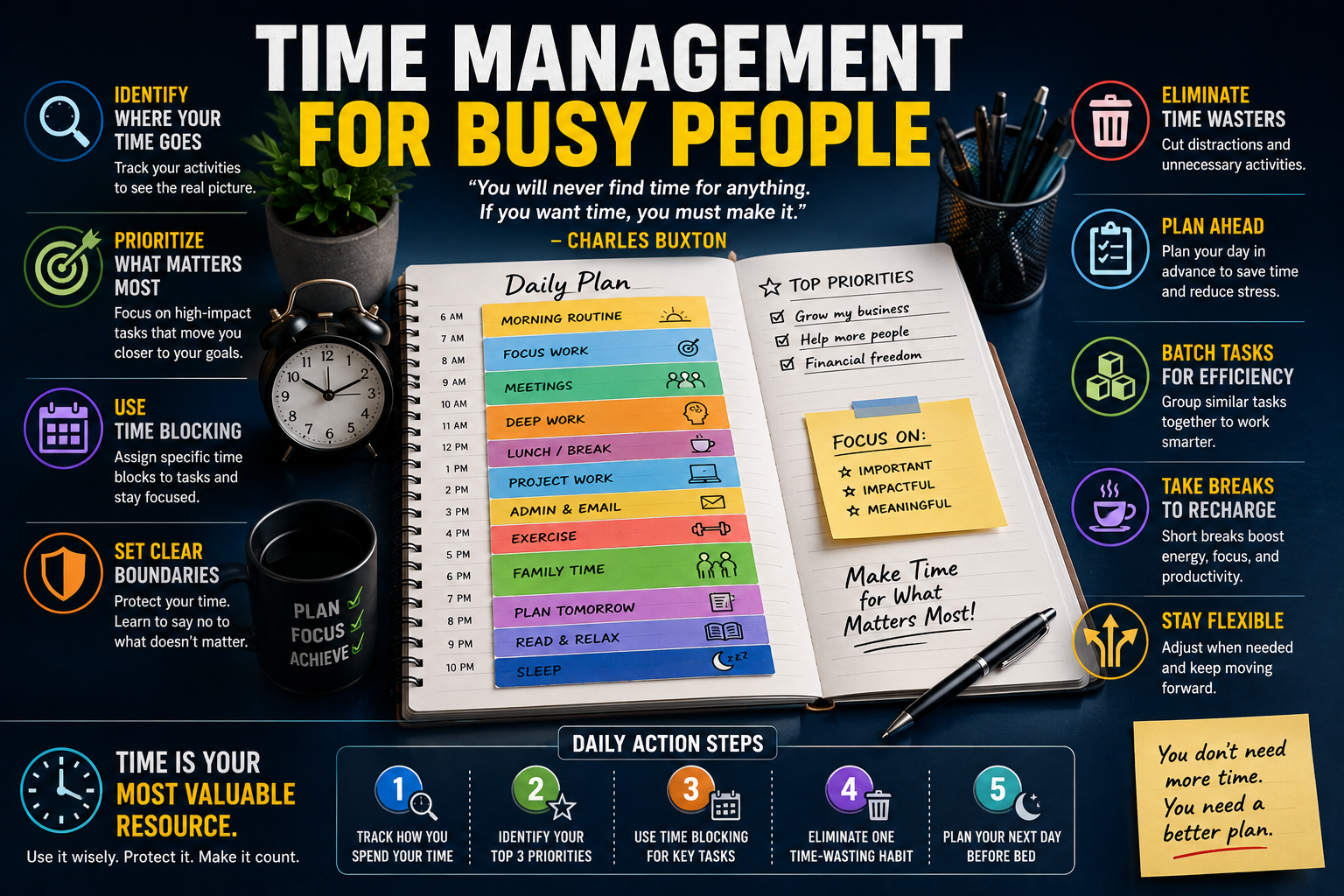

“You will never find time for anything. If you want time, you must make it.” – Charles Buxton
Disclaimer: This blog may contain affiliate banner advertisements. If you click on these ads or make purchases through them, we may earn a small commission at no additional cost to you. These commissions help support our work and allow us to continue providing valuable content.
Introduction: The Myth of Being Too Busy
Introduction: The Myth of Being Too Busy
If you ask almost anyone how they’re doing, one of the most common responses you’ll hear is, “I’m busy.” Modern life is filled with work responsibilities, family commitments, appointments, emails, phone calls, social obligations, and an endless stream of notifications competing for our attention. It can feel as though there are never enough hours in the day to accomplish everything we need to do. As a result, many people assume that being busy automatically means they are being productive. In reality, however, busyness and productivity are two very different things.
Being busy simply means that your time is filled with activity. Productivity, on the other hand, means that your time is spent on activities that move you closer to your most important goals. A person can spend an entire day answering emails, attending meetings, scrolling through social media, responding to messages, and completing minor tasks, yet accomplish very little that creates meaningful progress. Another person may complete only a handful of carefully chosen tasks but make significant progress toward a major objective. The difference is not how much they did—it is what they chose to do.
One of the biggest myths about time management is the belief that successful people somehow have more time than everyone else. The truth is that every person is given the same twenty-four hours each day. What separates highly productive individuals is not the amount of time they possess but how intentionally they choose to use it. They recognize that time is one of their most valuable resources, and they make conscious decisions about where to invest it. Instead of allowing their schedule to be controlled by constant interruptions and low-priority activities, they focus their attention on the work that creates the greatest long-term value.
This shift in perspective is important because it changes the question from, “How can I find more time?” to, “How can I make better use of the time I already have?” The answer is rarely found by working longer hours. Instead, it comes from improving how you plan, prioritize, and protect your time. Small changes in the way you organize your day can produce significant improvements in your productivity without requiring you to become busier.
It is also important to recognize that not every task deserves the same amount of attention. Many people spend large portions of their day reacting to whatever feels most urgent, only to discover that they have neglected the work that truly matters. Urgent tasks often demand immediate attention, but important tasks are the ones that create lasting progress. Learning to distinguish between the two is one of the most valuable time management skills you can develop. By intentionally focusing on high-impact activities, you ensure that your efforts contribute to your long-term goals rather than simply keeping you occupied.
Technology has made this challenge even greater. While smartphones, computers, and digital tools have increased convenience, they have also introduced countless distractions. Notifications, social media, emails, and instant messages constantly compete for your attention, making it easy to mistake constant activity for meaningful work. Without clear boundaries and intentional focus, entire hours can disappear without producing significant results. Effective time management requires learning to control these distractions instead of allowing them to control you.
Another important truth is that productivity is not about squeezing more work into every minute of your day. True productivity includes creating space for rest, reflection, relationships, and personal well-being. Working continuously without taking time to recharge often leads to burnout, reduced creativity, and declining performance. Managing your time effectively means creating a balanced schedule that allows you to work with focus while also protecting your physical and mental health.
Ultimately, the goal of time management is not to become busier—it is to become more intentional. It is about making sure your daily actions reflect your priorities and support the life you want to build. When you stop measuring your days by how busy you were and begin measuring them by the meaningful progress you made, your perspective changes completely. You realize that success is not determined by the number of tasks you complete but by whether those tasks move you closer to your purpose. By learning to manage your time wisely, you gain more than productivity—you gain greater clarity, reduced stress, and the ability to invest your energy where it matters most.
Identify Where Your Time Goes
Identify Where Your Time Goes
Before you can improve the way you manage your time, you first need to understand how you’re currently spending it. Many people believe they have a clear picture of where their day goes, but when they take a closer look, they’re often surprised by the results. Small interruptions, frequent distractions, unnecessary meetings, social media, emails, and unplanned tasks can quietly consume hours without us even realizing it. Because these activities are scattered throughout the day, they often go unnoticed, creating the illusion that there simply isn’t enough time to accomplish what matters most.
One of the most effective ways to gain clarity is to perform a simple time audit. For one or two days, record how you spend your time from the moment you wake up until you go to bed. Write down your activities in blocks of fifteen or thirty minutes, including work tasks, meetings, commuting, meals, exercise, entertainment, social media, phone calls, household responsibilities, and even periods of distraction. The goal is not to judge yourself but to gather accurate information about your daily habits.
When you review your time audit, patterns will begin to emerge. You may discover that you spend far more time checking emails than you realized. You might notice that small interruptions repeatedly break your concentration, making important tasks take much longer than necessary. Perhaps you spend more time on low-priority activities than on the goals that matter most. These discoveries are valuable because they reveal opportunities to make meaningful improvements.
As you examine your schedule, ask yourself a few important questions. Which activities moved you closer to your long-term goals? Which tasks were necessary but could be completed more efficiently? Which activities added little value and could be reduced or eliminated? By honestly evaluating how your time is being used, you gain the ability to make intentional decisions rather than simply reacting to whatever demands your attention.
It is also helpful to distinguish between productive work and busy work. Productive work creates meaningful progress toward your goals, while busy work simply fills your day with activity. For example, planning an important project, learning a new skill, creating content, building relationships, or solving meaningful problems are high-value activities because they contribute to long-term success. Constantly refreshing your inbox, attending unnecessary meetings, or repeatedly checking social media may create the feeling of being busy without producing significant results. Identifying this difference allows you to shift more of your time toward work that truly matters.
Your energy levels are another important part of understanding your time. Notice when you feel most alert, focused, and creative throughout the day. Some people do their best thinking in the early morning, while others are most productive during the afternoon or evening. By recognizing these natural patterns, you can schedule your most important work during your peak energy periods and reserve less demanding tasks for times when your focus naturally declines. Managing your energy is often just as important as managing your schedule.
Another benefit of tracking your time is that it helps you identify recurring distractions. You may notice that notifications interrupt your concentration dozens of times each day, or that switching between tasks causes you to lose valuable minutes repeatedly. Even small interruptions can significantly reduce productivity because every distraction requires time for your brain to regain focus. Recognizing these patterns allows you to create strategies that protect your attention and improve the quality of your work.
Perhaps the most important lesson a time audit provides is awareness. You cannot improve what you do not measure. Once you understand where your time is actually going, you are no longer making decisions based on assumptions—you are making them based on facts. This awareness gives you the power to eliminate unnecessary activities, prioritize meaningful work, and create a schedule that reflects your goals rather than your distractions.
Ultimately, identifying where your time goes is the foundation of effective time management. It allows you to move from simply staying busy to becoming truly productive. By tracking your daily activities, recognizing patterns, and making intentional adjustments, you take control of one of your most valuable resources. Every hour you save and every distraction you eliminate becomes another opportunity to invest your time in the people, projects, and goals that matter most. Over time, these intentional choices transform not only your schedule but also the quality of your work, your relationships, and your life.
Prioritize What Matters Most
Prioritize What Matters Most
One of the greatest challenges in managing your time is not deciding what to do—it is deciding what deserves your attention first. Every day presents countless tasks, requests, responsibilities, and distractions, all competing for your limited time and energy. Without clear priorities, it is easy to spend your day reacting to whatever seems most urgent rather than intentionally focusing on what will create the greatest long-term impact. Effective time management begins with understanding that not every task is equally valuable. Some activities move your life forward significantly, while others simply keep you busy.
Prioritization is the process of identifying the activities that contribute most directly to your goals and ensuring they receive your best time and attention. Rather than trying to accomplish everything at once, productive people focus on the few tasks that will make the biggest difference. They recognize that time and energy are limited resources, and investing them wisely produces far greater results than spreading them thin across dozens of low-value activities.
One of the most helpful ways to prioritize is by distinguishing between urgent and important tasks. Although these terms are often used interchangeably, they represent very different concepts. Urgent tasks demand immediate attention. They often involve deadlines, interruptions, phone calls, emails, or unexpected problems that require a quick response. Important tasks, however, are those that contribute to your long-term goals, personal growth, relationships, health, career, or financial future. They may not always feel urgent today, but consistently working on them creates lasting success.
The challenge is that urgent tasks frequently demand our attention so loudly that important tasks are pushed aside. Responding to emails, attending meetings, solving minor problems, or handling daily interruptions can consume an entire day, leaving little time for strategic planning, learning new skills, exercising, building meaningful relationships, or working on major projects. While urgent tasks cannot always be avoided, allowing them to dominate your schedule often results in staying busy without making meaningful progress.
Successful people intentionally schedule time for important work before urgency takes over. They understand that investing time in planning, preparation, learning, and personal development helps prevent many future problems from becoming urgent in the first place. For example, regularly maintaining your health reduces the likelihood of preventable medical issues. Consistently managing your finances helps avoid financial crises. Planning your workload early reduces last-minute stress and missed deadlines. Prioritizing important activities today often eliminates unnecessary emergencies tomorrow.
An effective way to prioritize your day is to identify the two or three highest-impact tasks that will move you closest to your long-term goals. Ask yourself, “If I could accomplish only three things today, which ones would make the greatest difference?” Focusing on these priorities before turning your attention to smaller tasks ensures that your most valuable work receives your best energy and concentration. Even if unexpected events interrupt your day later, you will know that meaningful progress has already been made.
Learning to prioritize also requires the ability to say no. Every commitment you accept consumes time that cannot be spent elsewhere. Saying yes to activities that do not align with your priorities often means saying no to something more important without realizing it. This does not mean refusing every request for help or avoiding responsibility. Rather, it means being intentional about protecting your time for the work, relationships, and goals that matter most. Setting healthy boundaries allows you to invest your energy where it creates the greatest value.
It is equally important to recognize that priorities may change over time. Different seasons of life require different areas of focus. During one period, your priority may be building a business. During another, it may be caring for family, continuing your education, improving your health, or developing new skills. Regularly reviewing your priorities ensures that your daily actions remain aligned with your current goals and values rather than becoming driven by habit or routine alone.
Ultimately, effective time management is not about doing more—it is about doing what matters most. Every hour you spend is an investment that can never be recovered, making your attention one of your most valuable resources. By learning to distinguish between urgent demands and truly important work, you take control of your schedule instead of allowing your schedule to control you. Over time, consistently investing your time in high-impact activities creates momentum, reduces unnecessary stress, and moves you steadily toward the life and future you are working to build.
Use Time Blocking
Use Time Blocking
One of the most effective techniques for improving productivity and managing your time is time blocking. Instead of simply creating a long to-do list and hoping everything gets done, time blocking assigns specific periods of your day to specific activities. Every important task is given a place on your calendar before the day begins. Rather than wondering what to work on next, you already have a clear plan that tells you exactly where your attention should be. This structure helps eliminate uncertainty and allows you to approach your day with greater focus and purpose.
The biggest advantage of time blocking is that it reduces decision fatigue. Every decision you make throughout the day consumes mental energy. If you repeatedly ask yourself, “What should I work on now?” or “Should I answer emails first or finish this project?” you gradually drain your ability to make good decisions. By planning your schedule in advance, those decisions have already been made. When it’s time to begin a task, you simply follow the schedule instead of negotiating with yourself. This allows you to preserve your mental energy for the work that truly matters.
Time blocking also helps you focus on one task at a time. In today’s world, multitasking is often praised as a valuable skill, but research consistently shows that constantly switching between tasks reduces efficiency and increases mistakes. Every time you interrupt your focus to check a message, answer an email, or begin another project, your brain needs time to refocus. These repeated interruptions can significantly reduce productivity throughout the day. By dedicating a specific block of uninterrupted time to one important activity, you allow yourself to work more deeply, think more clearly, and produce higher-quality results.
A well-designed time-blocked schedule includes more than just work. It creates space for every important area of your life. You might schedule blocks for focused work, meetings, email, exercise, learning, meals, family time, relaxation, and personal reflection. By intentionally assigning time to each priority, you create a balanced schedule that supports both productivity and well-being. This prevents one area of life from constantly taking priority over another and helps ensure that your daily actions reflect your long-term values.
For example, you might begin your morning with thirty minutes of planning, followed by a two-hour block dedicated to your most important project while your energy is at its highest. Later in the day, you could schedule time for responding to emails, attending meetings, completing administrative tasks, exercising, and spending time with your family. Instead of reacting to interruptions as they arise, your day follows a clear structure that keeps you focused on what matters most.
Time blocking is also an excellent tool for protecting your highest-priority work. Many people spend their most productive hours responding to emails, handling small requests, or reacting to other people’s priorities. As a result, by the time they begin working on their own important projects, their energy and concentration have already declined. Time blocking encourages you to reserve your peak energy periods for your most meaningful work. Less demanding tasks can be scheduled during times when your focus naturally decreases, allowing you to make the most of your mental resources.
Another important benefit of time blocking is flexibility. While your schedule provides structure, it should not become a source of unnecessary stress. Unexpected situations will occasionally require adjustments. Meetings may run longer than expected, emergencies may arise, or priorities may change throughout the day. Effective time blocking is not about following a schedule perfectly—it is about having a thoughtful plan that you can adapt when necessary. If one block is interrupted, simply adjust the remaining schedule rather than abandoning your plan altogether.
Time blocking also helps you become more realistic about what you can accomplish. When you assign actual time to each task, you begin recognizing how long activities truly require. This reduces the tendency to overcommit, underestimate projects, or create unrealistic daily to-do lists. Over time, you develop a much better understanding of your workload and become more effective at planning your days with confidence.
Ultimately, time blocking transforms your calendar into a roadmap for success. Instead of allowing distractions, interruptions, and urgent demands to dictate your day, you intentionally decide where your time and energy will be invested. This structured approach reduces decision fatigue, improves concentration, increases productivity, and helps you make consistent progress toward your goals. By giving every important task a designated place in your schedule, you gain greater control over your time and ensure that each day moves you one step closer to the future you are working to create.
Set Clear Boundaries
Set Clear Boundaries
One of the most important yet often overlooked aspects of effective time management is learning to set clear boundaries. No matter how organized your schedule is, your time can quickly become consumed by other people’s priorities if you do not protect it. Every request, meeting, interruption, phone call, email, and unexpected responsibility competes for your attention. While many of these demands may be legitimate, saying yes to everything often means saying no to the goals and priorities that matter most to you. Establishing healthy boundaries allows you to remain focused on what is truly important while maintaining balance in your personal and professional life.
Many people struggle with setting boundaries because they worry about disappointing others or appearing unhelpful. They agree to additional responsibilities, volunteer for extra projects, or accept commitments they don’t have time to fulfill. Although these decisions often come from good intentions, they can lead to stress, exhaustion, and declining productivity. Overcommitting yourself leaves less time and energy for your highest priorities and can reduce the quality of everything you do. Learning to protect your time is not selfish—it is a necessary part of managing your responsibilities wisely.
One of the most valuable skills you can develop is learning to say no respectfully and confidently. Saying no does not mean rejecting people—it means making intentional choices about how you invest your limited time and energy. Before accepting a new commitment, ask yourself a few important questions: Does this align with my goals? Is this the best use of my time? Will saying yes to this require me to neglect something more important? If the answer is no, politely declining may be the most responsible decision you can make.
Setting boundaries also means protecting your focus from unnecessary interruptions. Constant notifications, unplanned meetings, frequent phone calls, and repeated requests can break your concentration and make even simple tasks take much longer than necessary. Consider creating uninterrupted blocks of time for your most important work. During these periods, silence unnecessary notifications, close distracting applications, and let others know that you are unavailable except for genuine emergencies. Protecting your attention allows you to complete high-quality work more efficiently and with less stress.
Healthy boundaries extend beyond work responsibilities. They also include creating dedicated time for rest, family, exercise, hobbies, and personal growth. Without these boundaries, work can gradually expand into every available hour, leaving little opportunity to recharge. Ironically, constantly working often reduces productivity because fatigue weakens focus, creativity, and decision-making. Scheduling time for recovery is not wasted time—it is an investment in maintaining your long-term effectiveness and well-being.
Another important aspect of setting boundaries is communicating them clearly. People cannot respect limits they do not know exist. Whether it’s establishing office hours, setting expectations for response times, or explaining when you are available for meetings, clear communication helps prevent misunderstandings and creates mutual respect. Most people appreciate knowing what they can expect, and consistent boundaries often encourage others to value your time as much as you do.
It is also important to remember that boundaries are not rigid walls—they are flexible guidelines that help you make intentional decisions. There will be times when family emergencies, important opportunities, or unexpected situations require you to adjust your plans. Flexibility is part of healthy boundary-setting. The goal is not to refuse every request but to ensure that your choices reflect your values and long-term priorities rather than being driven by guilt, pressure, or habit.
As you become more comfortable protecting your time, you may notice an unexpected benefit: increased confidence. Every time you make a decision based on your priorities instead of external pressure, you reinforce the belief that your goals matter. This confidence helps you stay focused, reduces unnecessary stress, and allows you to invest your energy where it creates the greatest impact.
Ultimately, your time is one of your most valuable and irreplaceable resources. Unlike money, it cannot be earned back once it has been spent. Every hour you give away is an hour that cannot be recovered. By setting clear boundaries, learning to say no when necessary, and intentionally protecting your time, you take control of your schedule instead of allowing outside demands to control it. Over time, these boundaries create greater focus, stronger relationships, improved productivity, and a life that is built around your highest priorities rather than constant distractions. Treat your time with the value it deserves, and it will become one of your greatest assets in achieving lasting success.
Eliminate Time Wasters
Eliminate Time Wasters
One of the fastest ways to improve your productivity is not by finding more time—it is by eliminating the activities that quietly consume the time you already have. Every day is filled with small distractions and low-value habits that may seem harmless on their own but gradually add up to hours of lost productivity each week. These time wasters often become so routine that we stop noticing them. The key to better time management is identifying these habits, understanding how they affect your progress, and replacing them with behaviors that support your goals.
One of the most common time wasters today is excessive use of technology. Smartphones, social media platforms, streaming services, and constant notifications are designed to capture and hold your attention. What begins as a quick five-minute break can easily turn into thirty minutes or even an hour without you realizing it. While these tools can certainly be useful for communication, learning, and entertainment, they become harmful when they repeatedly interrupt your focus or replace time that could be invested in more meaningful activities.
Another common source of wasted time is unnecessary meetings. Meetings can be valuable when they solve problems, make important decisions, or improve collaboration. However, many meetings are poorly planned, lack a clear purpose, or include participants who do not need to be there. Spending an hour discussing issues that could have been resolved in a short email or a quick conversation drains valuable time and reduces productivity. Before accepting or scheduling a meeting, ask whether it is truly necessary and whether there is a more efficient way to accomplish the same objective.
Frequent interruptions also have a significant impact on productivity. Every phone call, text message, email notification, or unexpected conversation forces your brain to shift its attention away from the task at hand. While each interruption may seem minor, research has shown that it can take several minutes to fully regain your focus after being distracted. When interruptions occur repeatedly throughout the day, they dramatically reduce the amount of meaningful work you are able to complete. Creating uninterrupted periods of focused work can significantly improve both the quality and quantity of your output.
Procrastination is another major time waster, though it often disguises itself as productivity. Instead of beginning an important task, you might reorganize your workspace, repeatedly check your email, browse the internet, or work on easier tasks that feel productive but do little to move your goals forward. While these activities may provide temporary satisfaction, they often delay the work that truly matters. Recognizing when you are avoiding important responsibilities allows you to redirect your energy toward high-impact activities instead.
Multitasking can also waste more time than many people realize. Although it may feel efficient to juggle several tasks at once, constantly switching your attention between different activities reduces concentration, increases mistakes, and often makes each task take longer to complete. Focusing on one important task at a time allows you to work more efficiently, produce higher-quality results, and complete your responsibilities more quickly.
To eliminate time wasters effectively, begin by identifying your own patterns. Perform a time audit and ask yourself which activities genuinely contribute to your goals and which ones simply consume your attention. You may discover that small habits—checking social media several times an hour, responding to every notification immediately, watching television late into the evening, or repeatedly refreshing your inbox—are quietly taking away valuable hours each week. Awareness is the first step toward making meaningful changes.
Once you’ve identified these habits, replace them with intentional alternatives rather than simply removing them. Turn off unnecessary notifications during focused work sessions. Schedule specific times to check emails instead of responding continuously throughout the day. Set limits on recreational screen time. Use waiting periods to read, learn, or plan instead of mindlessly scrolling through your phone. These small adjustments create space for more productive and rewarding activities without requiring dramatic lifestyle changes.
It is also important to remember that not all leisure is wasted time. Rest, recreation, hobbies, and spending time with family and friends are essential parts of a healthy, balanced life. The goal is not to eliminate enjoyment but to eliminate mindless habits that consume time without adding value. Intentional relaxation refreshes your mind and prepares you for productive work, while unintentional distractions often leave you feeling less accomplished and more overwhelmed.
Ultimately, every minute you reclaim from unnecessary distractions is a minute you can invest in your future. Whether that time is spent learning a new skill, building your career, improving your health, strengthening relationships, or pursuing a personal dream, those small investments accumulate over time. By identifying and eliminating your biggest time wasters, you create more space for meaningful work, reduce stress, and take greater control of your daily life. Success is not only determined by what you choose to do—it is also shaped by what you choose to stop doing.
Plan Ahead
Plan Ahead
One of the simplest yet most powerful habits you can develop is planning your day before it begins. Rather than waking up and immediately reacting to emails, phone calls, or unexpected requests, taking a few minutes to create a plan gives your day direction and purpose. Instead of wondering what to do next, you already have a roadmap that guides your decisions and keeps your attention focused on your most important priorities. This small investment of time often saves hours of confusion, reduces unnecessary stress, and significantly improves your productivity.
Planning ahead removes much of the uncertainty that leads to procrastination. When you face a day without a clear plan, your brain must constantly decide what to do next. These repeated decisions consume mental energy, increase decision fatigue, and make it easier to become distracted by less important tasks. A written plan eliminates much of this uncertainty by providing a clear sequence of actions. Instead of asking yourself, “What should I work on now?” you simply move to the next item on your schedule.
One of the greatest benefits of planning ahead is that it allows you to prioritize your most important work before your day becomes filled with interruptions. Every morning brings new emails, phone calls, meetings, and unexpected responsibilities. If you don’t identify your priorities in advance, these urgent demands can easily consume your entire day. By planning first, you ensure that your most meaningful work receives your best attention before less important activities begin competing for your time.
Planning also helps reduce stress by creating clarity. Much of our anxiety comes from trying to remember everything we need to do while worrying that we might forget something important. Writing your tasks down transfers that responsibility from your mind to your planner, notebook, calendar, or digital app. This frees your brain to focus on completing the work instead of constantly trying to remember it. The result is greater mental clarity, improved concentration, and a stronger sense of control over your day.
Your daily plan does not need to be complicated. In fact, simple plans are often the most effective. Many highly productive people begin by identifying three priorities they want to accomplish that day. These are the tasks that will create the greatest progress toward their long-term goals. Once those priorities are scheduled, they add any additional responsibilities around them. This approach keeps the focus on meaningful work instead of creating an overwhelming list of dozens of tasks that may never be completed.
Combining planning with time blocking can make your schedule even more effective. Rather than simply listing your tasks, assign each one a specific time during the day. For example, you might reserve your morning for focused project work, schedule administrative tasks after lunch, and dedicate the late afternoon to meetings or emails. Giving each activity a designated place on your calendar helps protect your time and makes it much easier to stay on track throughout the day.
Planning ahead also gives you the opportunity to prepare for potential obstacles. If you know you have a busy afternoon, you can complete your most important work earlier in the day. If a meeting is likely to run long, you can build extra time into your schedule. If unexpected interruptions occur, you already know which tasks are most important and can adjust your plan without losing sight of your priorities. This flexibility allows you to remain productive even when your day doesn’t unfold exactly as expected.
Another valuable habit is ending each day by planning the next one. Taking ten to fifteen minutes each evening to review what you accomplished, carry forward unfinished tasks, and organize tomorrow’s priorities allows you to begin the next morning with clarity and confidence. Instead of spending your first hour deciding what to do, you can immediately begin working on your highest-priority tasks while your energy and focus are strongest.
It is also important to remember that a plan is a guide, not a rigid set of rules. Unexpected opportunities, emergencies, and changing priorities are part of life. Effective planning is not about following a schedule perfectly—it is about creating a structure that keeps you moving toward your goals while remaining flexible enough to adapt when necessary. The goal is progress, not perfection.
Ultimately, planning ahead is one of the most effective ways to take control of your time instead of allowing your time to control you. A simple to-do list, calendar, or daily schedule provides clarity, reduces stress, improves focus, and ensures that your actions align with your priorities. By consistently planning your days in advance, you create a sense of purpose and direction that makes productive work feel more intentional and far less overwhelming. Over time, this habit becomes a cornerstone of effective time management, helping you accomplish more while enjoying greater peace of mind and confidence in your daily routine.
Batch Tasks for Efficiency
Batch Tasks for Efficiency
One of the simplest ways to increase productivity is to group similar tasks together instead of constantly switching between different types of work. This technique, known as task batching, helps you maintain focus, reduce distractions, and use your time more efficiently. Rather than jumping back and forth between emails, meetings, creative projects, phone calls, and administrative work throughout the day, you dedicate specific blocks of time to completing similar activities. This allows your brain to remain in the same mode of thinking for longer periods, making it easier to work with greater speed and accuracy.
The reason task batching is so effective is that it reduces context switching. Every time you stop working on one task and begin another, your brain needs time to adjust. If you spend ten minutes writing a report, then answer emails, attend a meeting, return to your report, respond to text messages, and then switch to another project, your mind must repeatedly shift gears. These transitions may only take a few minutes each, but over the course of a day they can add up to hours of lost productivity. Frequent mental switching also increases fatigue because your brain is constantly resetting its focus instead of maintaining momentum.
Task batching minimizes these interruptions by allowing you to stay focused on one category of work at a time. For example, instead of checking your email every few minutes, designate two or three specific times during the day to process your inbox. Rather than making phone calls whenever they come to mind, schedule a block of time to complete all of them at once. Administrative tasks such as filing paperwork, organizing documents, or updating records can also be grouped together. By handling similar activities in batches, you reduce the mental effort required to constantly change your focus.
Creative work benefits especially well from task batching. Activities such as writing, designing, brainstorming, problem-solving, or developing new ideas require deep concentration. Once your mind enters a state of focused thinking, it becomes much easier to continue producing quality work. Interrupting that flow with unrelated tasks forces you to rebuild your concentration repeatedly. Protecting uninterrupted blocks of creative time allows you to produce higher-quality work while often completing it in less time.
Task batching is equally valuable in business and personal life. If you run a business, you might dedicate one block of time to customer service, another to content creation, another to marketing, and another to financial management. If you’re managing a household, you might group errands into a single trip, prepare meals for several days at once, or complete multiple household chores during one scheduled session. These small organizational changes reduce unnecessary repetition and help you accomplish more with less effort.
Another advantage of batching is that it helps create momentum. Once you begin working on similar tasks, each completed activity makes the next one easier. Your tools are already available, your mindset is already focused on that type of work, and your brain has adapted to the specific skills required. This continuous rhythm allows you to work more naturally and efficiently than if you were constantly interrupting yourself with unrelated responsibilities.
Task batching also supports better energy management. Different types of work require different levels of concentration and creativity. By grouping demanding tasks together during your peak energy hours, you maximize your productivity when your mind is at its sharpest. Less demanding activities, such as answering emails or completing routine paperwork, can be scheduled during periods when your energy naturally begins to decline. This intentional alignment between your workload and your energy levels helps you accomplish more without feeling overwhelmed.
Of course, flexibility remains important. Unexpected situations, urgent requests, or emergencies may occasionally interrupt your planned schedule. The goal of task batching is not rigid perfection but thoughtful organization. Even if your day does not unfold exactly as planned, returning to your batches whenever possible helps you regain focus quickly and continue making meaningful progress.
Ultimately, task batching is about working smarter rather than simply working harder. By grouping similar tasks together, you reduce mental switching, preserve your focus, and create a smoother workflow throughout the day. Instead of feeling scattered and constantly pulled in different directions, you develop a rhythm that allows you to work with greater clarity, efficiency, and purpose. Over time, this simple habit helps you complete more meaningful work, experience less stress, and build the momentum needed to achieve your long-term goals.
Take Breaks to Recharge
Take Breaks to Recharge
Many people believe that working longer hours without stopping is the key to getting more done. While this may seem productive in the short term, the reality is that our brains are not designed to maintain intense focus for hours at a time without rest. As your mental energy declines, your concentration weakens, decision-making becomes more difficult, creativity decreases, and mistakes become more common. Continuing to push through exhaustion often leads to diminishing returns, where you spend more time working but accomplish less. Taking regular breaks is not a sign of laziness—it is a proven strategy for maintaining high levels of performance throughout the day.
Your brain functions much like any other muscle. Just as your body needs periods of recovery after physical exercise, your mind also requires opportunities to rest and recharge. Short breaks allow your brain to recover from prolonged concentration, helping you return to your work with renewed focus and energy. Instead of viewing breaks as interruptions to productivity, think of them as investments that improve the quality of the work you do before and after each pause.
Research has shown that even brief breaks can significantly improve concentration and mental performance. Stepping away from your work for five or ten minutes every hour or two gives your mind an opportunity to reset. When you return, tasks often seem clearer, problems become easier to solve, and your ability to focus improves. Many people find that they accomplish more during several focused work sessions separated by short breaks than they do during one long period of uninterrupted work.
The quality of your break matters just as much as taking the break itself. Simply switching from work to scrolling through social media may not provide your brain with the recovery it needs. Instead, choose activities that genuinely refresh your mind and body. Stand up and stretch, take a short walk, drink a glass of water, practice deep breathing, listen to calming music, or step outside for a few minutes of fresh air. These simple activities help reduce mental fatigue while increasing alertness and improving your mood.
Physical movement is especially effective during breaks. Sitting for extended periods can lead to muscle stiffness, reduced circulation, and lower energy levels. Even a few minutes of walking or light stretching increases blood flow, delivers more oxygen to your brain, and helps relieve physical tension. Many people notice that after moving around for just a few minutes, they return to their work feeling more energized and mentally refreshed.
Breaks also provide an opportunity to step back and gain perspective. When you spend hours focused on a difficult problem, it’s easy to become mentally stuck. Walking away for a short time allows your subconscious mind to continue processing the information in the background. This is why solutions to challenging problems often appear after you’ve taken a break rather than while forcing yourself to keep staring at the same task. Giving your mind space can often lead to greater creativity and clearer thinking.
Taking regular breaks is also one of the best ways to prevent burnout. Burnout rarely happens because of one difficult day—it develops gradually through prolonged periods of stress, constant pressure, and insufficient recovery. By intentionally scheduling breaks throughout your day, you create a healthier rhythm between focused work and necessary rest. This balance allows you to maintain consistent productivity over weeks, months, and years instead of experiencing repeated cycles of exhaustion and recovery.
It’s important to remember that breaks should be intentional rather than accidental. Instead of waiting until you feel completely drained, schedule your breaks before your energy begins to decline. Many productivity experts recommend working in focused intervals followed by short recovery periods. This structured approach helps you maintain momentum while ensuring that your mental energy remains high throughout the day.
Longer breaks are equally valuable. Taking time for lunch away from your workspace, exercising after work, spending time with family, enjoying hobbies, or getting adequate sleep all contribute to long-term productivity. These larger periods of recovery restore both your physical and mental well-being, allowing you to approach each new day with greater enthusiasm and focus.
Ultimately, productivity is not about working continuously—it is about working effectively. Short, intentional breaks help you maintain energy, improve concentration, reduce stress, and prevent burnout. They allow your brain to recharge so that each period of focused work is more productive than the last. By making rest a planned part of your routine rather than an afterthought, you create a sustainable rhythm that supports long-term success. Remember, the goal is not simply to work harder—it is to work smarter, and sometimes the smartest thing you can do is step away for a few minutes so you can return stronger than before.
Stay Flexible
Stay Flexible
No matter how carefully you plan your day, life will always bring unexpected challenges. Meetings may run longer than expected, emergencies may arise, technology may fail, family responsibilities may change your plans, or new opportunities may suddenly require your attention. These situations are a normal part of life, not a sign that your planning has failed. Effective time management is not about creating a perfect schedule that never changes—it is about having a plan that is strong enough to guide you while remaining flexible enough to adapt when circumstances require it.
Many people become discouraged when their schedule is interrupted because they believe every task must be completed exactly as planned. When one unexpected event throws off the day, they often abandon their schedule altogether and spend the rest of the day reacting to whatever comes next. This all-or-nothing mindset creates unnecessary stress and makes it difficult to regain momentum. Successful people understand that flexibility is not the opposite of discipline—it is an essential part of it. They adjust their plans without losing sight of their priorities.
Think of your schedule as a roadmap rather than a rigid set of rules. A GPS system doesn’t tell you that your journey has failed because you missed one turn. Instead, it recalculates the route and continues guiding you toward your destination. Your daily schedule should work the same way. If an unexpected interruption changes your plans, simply reassess your priorities, reorganize your remaining time, and continue moving forward. The destination remains the same even if the route changes.
Flexibility also helps reduce unnecessary stress. When you expect every day to unfold perfectly, even minor interruptions can feel overwhelming. However, when you accept that unexpected events are inevitable, you respond with greater calm and confidence. Instead of becoming frustrated, you focus your energy on finding solutions. This problem-solving mindset allows you to recover more quickly and continue making meaningful progress despite temporary setbacks.
One practical way to build flexibility into your schedule is by avoiding overbooking your day. Many people make the mistake of filling every hour with planned activities, leaving no room for delays or unexpected responsibilities. As a result, a single interruption creates a domino effect that throws off the entire schedule. By intentionally leaving small blocks of unscheduled time between major tasks or appointments, you create a buffer that allows you to absorb unexpected events without completely disrupting your day.
Flexibility also requires learning to distinguish between urgent interruptions and unnecessary distractions. Not every unexpected request deserves immediate attention. Some situations truly require you to change your plans, while others can be postponed until you’ve completed your current priority. Developing the ability to evaluate interruptions before responding helps you remain in control of your schedule instead of allowing every outside demand to dictate how you spend your time.
Another important aspect of flexibility is adjusting your expectations without abandoning your goals. There will be seasons when your workload increases, family responsibilities demand more attention, or personal challenges temporarily limit your available time and energy. During these periods, it may be necessary to reduce your daily workload or modify your routines. This is not failure—it is wise adaptation. Continuing to make steady progress at a slower pace is far better than becoming discouraged and giving up entirely.
Flexibility also encourages continuous learning. When plans change, you gain valuable experience in problem-solving, prioritization, and decision-making. Every adjustment teaches you something about how to manage your time more effectively in the future. Over time, these experiences make you more resilient and better prepared to handle future challenges with confidence.
Perhaps most importantly, flexibility allows you to recognize and seize unexpected opportunities. Sometimes the interruption to your carefully planned schedule isn’t a problem at all—it is an opportunity for growth. A new project, a meaningful conversation, an unexpected networking opportunity, or a chance to help someone may ultimately prove more valuable than the task you originally planned. Remaining adaptable allows you to recognize these moments without losing sight of your overall priorities.
Ultimately, effective time management is not about controlling every minute of your day—it is about maintaining control of your direction. Unexpected things will happen, plans will change, and challenges will arise. By staying flexible, adjusting thoughtfully, and remaining focused on your long-term priorities, you continue making progress regardless of the obstacles you encounter. A flexible schedule is not a weak schedule—it is a resilient one. It gives you the confidence to adapt, the wisdom to reprioritize, and the determination to keep moving forward no matter what each day brings.
Conclusion: Take Control of Your Time
Time is one of your most valuable resources.
By managing it effectively, you can reduce stress, increase productivity, and make progress toward your goals.
Start small, stay consistent, and take control of your time.
Daily Action Steps for Better Time Management
- Track how you spend your time today.
2. Identify your top 3 priorities.
3. Use time blocking for key tasks.
4. Eliminate one time-wasting habit.
5. Plan your next day before going to bed.