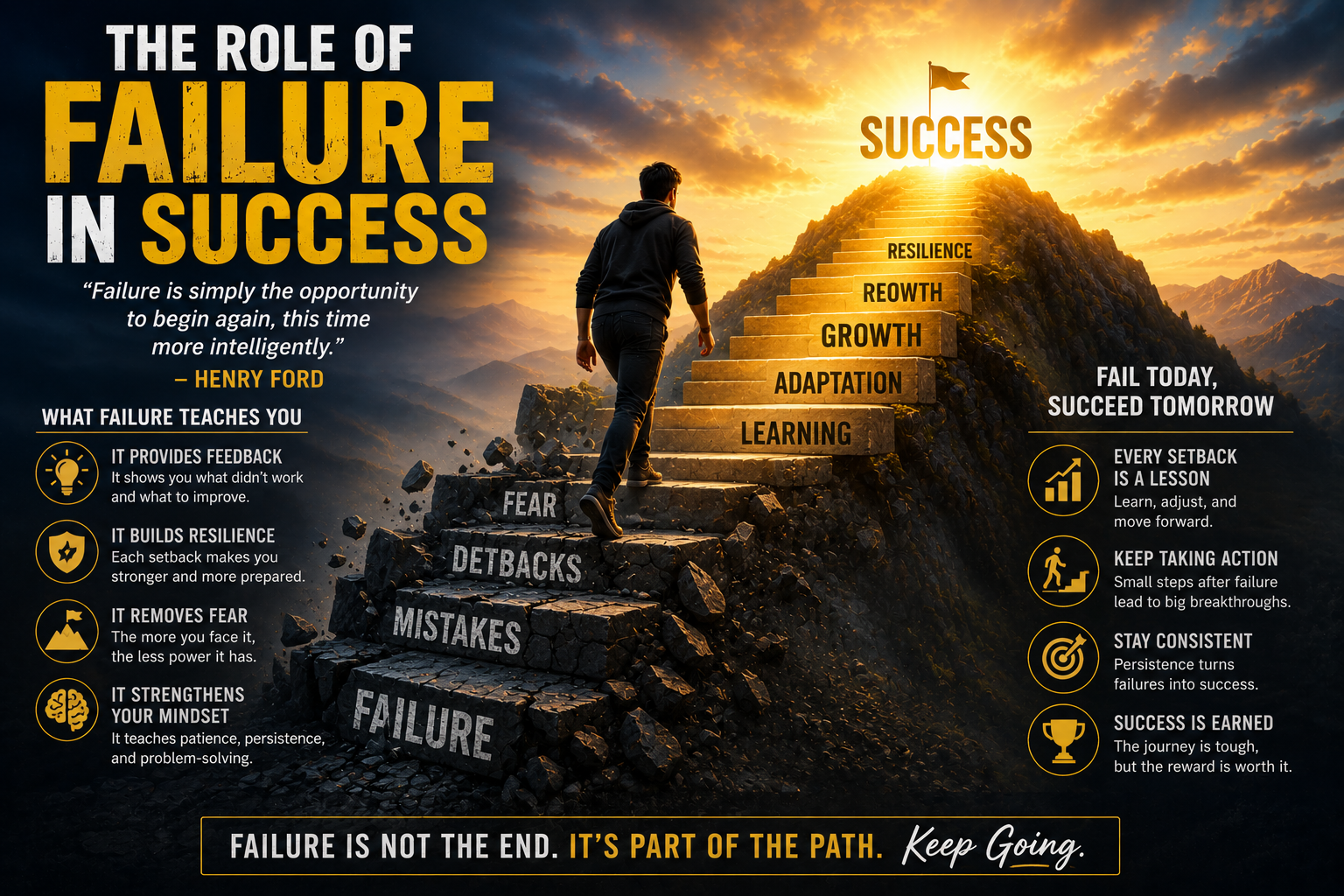

“Failure is simply the opportunity to begin again, this time more intelligently.” – Henry Ford
Disclaimer: This blog may contain affiliate banner advertisements. If you click on these ads or make purchases through them, we may earn a small commission at no additional cost to you. These commissions help support our work and allow us to continue providing valuable content.
Introduction: Rethinking Failure
Introduction: Rethinking Failure
Failure is one of the most misunderstood experiences in life. From an early age, many people are taught to see failure as something to fear or avoid at all costs. Mistakes can feel embarrassing, setbacks can be discouraging, and unmet expectations often leave us questioning our abilities. As a result, many people become so afraid of failing that they stop taking risks, avoid new opportunities, or settle for less than they are capable of achieving. Yet this fear of failure often becomes a much greater obstacle than failure itself.
The reality is that failure is not the opposite of success—it is one of the primary ways success is built. Every meaningful accomplishment is shaped by moments of trial and error, unexpected setbacks, and lessons learned through experience. Whether in business, education, sports, relationships, or personal growth, failure provides valuable feedback that success alone cannot offer. It reveals weaknesses, highlights opportunities for improvement, and teaches resilience in ways that comfort and certainty never can.
When you begin to rethink failure, it changes from something that defines you into something that develops you. Instead of viewing a setback as evidence that you are incapable, you begin to see it as information that helps you make better decisions moving forward. Every mistake becomes an opportunity to refine your skills, strengthen your character, and gain wisdom that prepares you for future challenges. This shift in perspective transforms failure from a stopping point into a stepping stone.
History is filled with examples of individuals who faced repeated disappointments before achieving extraordinary success. Inventors, entrepreneurs, athletes, artists, and leaders have all experienced rejection, mistakes, and moments when success seemed impossible. What separated them from those who gave up was not the absence of failure but their willingness to learn from it, adapt, and continue moving forward. They understood that every setback was part of the learning process rather than proof that they should quit.
This mindset is available to anyone willing to embrace it. Failure does not determine your future—your response to failure does. When you choose to view setbacks as opportunities to grow instead of reasons to give up, you remove much of the fear that keeps you from pursuing meaningful goals. You become more willing to take calculated risks, try new approaches, and continue learning even when the outcome is uncertain.
Ultimately, rethinking failure is about recognizing that every challenge carries the potential for growth. Success is rarely a straight path; it is a journey marked by persistence, resilience, and continuous improvement. By accepting failure as a natural and valuable part of that journey, you free yourself from the fear of making mistakes and gain the confidence to keep moving forward. In doing so, you discover that failure is not the end of the story—it is often the very experience that prepares you for your greatest successes.
Failure as a Learning Tool
Failure as a Learning Tool
One of the greatest values of failure is that it provides feedback that success often cannot. When things go according to plan, it’s easy to overlook weaknesses in your approach or assume that everything you’re doing is effective. Failure, however, forces you to pause, evaluate your actions, and identify areas where improvement is needed. Rather than viewing a setback as proof that you are incapable, you can choose to see it as valuable information that helps you make better decisions moving forward. Every mistake, missed opportunity, or unexpected outcome contains lessons that can strengthen your knowledge, sharpen your skills, and improve your future performance.
When you adopt this perspective, failure becomes a teacher instead of an enemy. Instead of asking, “Why did I fail?” ask questions such as, “What didn’t work?”, “What can I do differently next time?”, or “What lesson can I take from this experience?” These questions shift your focus away from self-criticism and toward personal growth. They encourage curiosity instead of discouragement and transform setbacks into opportunities for learning and improvement.
This approach also helps remove the fear of making mistakes. If every failure is viewed as a chance to gain experience rather than a permanent defeat, you become more willing to take calculated risks, try new ideas, and step outside your comfort zone. Growth almost always requires experimentation, and experimentation naturally involves mistakes. The most successful people understand that they are not expected to get everything right the first time. Instead, they improve by learning from each attempt and using those lessons to refine their approach.
Failure also develops qualities that are difficult to build in any other way. It teaches humility by reminding us that there is always room to learn. It strengthens resilience by encouraging us to recover from disappointment and keep moving forward. It builds patience by showing us that mastery is achieved through repeated effort rather than instant success. Most importantly, it reinforces the understanding that progress is a process, not a single event.
Every setback you experience adds to your knowledge if you are willing to learn from it. The lessons gained through failure often become some of your greatest strengths because they are earned through experience rather than theory. Over time, these lessons accumulate, making you wiser, more adaptable, and better prepared for future challenges.
Ultimately, failure is not a dead end—it is a source of guidance. It reveals what needs to change, highlights opportunities for growth, and points you toward better strategies and stronger decisions. When you begin viewing failure as valuable feedback instead of a final verdict, you replace fear with curiosity, frustration with determination, and disappointment with the confidence that every challenge is helping prepare you for greater success in the future.
Building Resilience Through Failure
Building Resilience Through Failure
Resilience is not something you are born with—it is a quality that is developed through experience, especially during life’s most difficult moments. Every time you encounter a setback, disappointment, or failure and choose to keep moving forward, you strengthen your ability to handle future challenges. Like a muscle that becomes stronger through repeated exercise, resilience grows each time you recover from adversity instead of allowing it to define you. While failure may feel uncomfortable in the moment, it often becomes the very experience that prepares you for greater success in the future.
The first time you experience a significant setback, it can feel overwhelming. Self-doubt, frustration, and uncertainty are common reactions, and it’s easy to question whether you should continue pursuing your goals. However, each time you work through those emotions, learn from the experience, and take another step forward, you prove to yourself that failure does not have the final word. That realization builds confidence because you begin to understand that your strength is measured not by how often you avoid difficulty, but by how consistently you rise after facing it.
Over time, setbacks begin to lose much of their power. Challenges that once seemed impossible become manageable because you’ve already overcome similar obstacles before. Instead of seeing failure as a reason to quit, you begin viewing it as a temporary obstacle that can be worked through with patience, persistence, and the right mindset. This shift in perspective allows you to approach new opportunities with greater courage because you trust in your ability to adapt, recover, and continue growing regardless of the outcome.
Failure also develops qualities that are essential for long-term success. It teaches patience by reminding you that meaningful progress takes time. It encourages humility by showing that there is always something new to learn. It strengthens perseverance by requiring you to continue even when the path is difficult. Most importantly, it helps you develop emotional resilience—the ability to remain steady, hopeful, and focused even when circumstances are challenging.
Every obstacle you overcome becomes evidence of your ability to handle future adversity. These experiences create a growing record of perseverance that reminds you of what you are capable of achieving. Instead of fearing setbacks, you begin trusting that you have the strength and wisdom to navigate them. This confidence doesn’t come from believing that life will always be easy; it comes from knowing that you can face whatever challenges arise and continue moving forward.
Ultimately, resilience is built one challenge at a time. Every failure you learn from, every setback you overcome, and every difficult season you endure adds another layer of strength to your character. As your resilience grows, so does your confidence, adaptability, and determination. Over time, you discover that failure is not weakening you—it is preparing you to become stronger, wiser, and better equipped for the opportunities and challenges that lie ahead.
Removing the Fear of Failure
Removing the Fear of Failure
Fear of failure is one of the greatest obstacles to personal growth and achievement. It has the power to prevent people from pursuing their dreams, trying new opportunities, or stepping outside their comfort zones. In many cases, people don’t fail because they lack ability—they fail to begin because they are afraid of what might happen if they don’t succeed. This fear often creates hesitation, procrastination, and self-doubt, keeping individuals stuck in familiar routines instead of allowing them to pursue the life they truly want.
The irony is that avoiding failure rarely leads to success. In fact, trying to eliminate all risk often limits growth and prevents valuable learning experiences. Every worthwhile goal involves uncertainty, and every successful person has faced moments where the outcome was unknown. The difference is that they chose to move forward despite their fear because they understood that failure was not a sign to stop—it was part of the learning process.
When you begin to accept that mistakes are a natural part of growth, failure loses much of its ability to intimidate you. Instead of viewing every setback as a personal defeat, you begin to see each experience as an opportunity to gain knowledge, improve your skills, and become better prepared for the next attempt. This shift in perspective changes failure from something you fear into something you can use to your advantage. Every mistake becomes a lesson, every setback becomes experience, and every challenge becomes another opportunity to grow.
Accepting failure also removes the unrealistic expectation that you must be perfect from the beginning. Very few people master a new skill, build a successful business, or achieve a major goal without making mistakes along the way. Progress comes through practice, experimentation, and continual improvement. Once you understand this, you no longer feel pressured to get everything right on the first attempt. Instead, you focus on learning, adjusting, and continuing to move forward.
As your fear decreases, taking action becomes much easier. You become more willing to ask questions, try new ideas, take calculated risks, and pursue opportunities that once seemed too intimidating. Even when the outcome is uncertain, you know that there is value in the experience because every attempt teaches you something that can help you improve. This mindset replaces hesitation with curiosity and transforms uncertainty into an opportunity for growth.
One of the most empowering realizations you can have is that failure cannot define you unless you allow it to. A failed attempt is simply an event—it is not your identity. Your character is shaped not by the mistakes you make but by your willingness to learn from them and continue moving forward. Every time you choose action over fear, you strengthen your confidence and prove to yourself that growth is always possible.
Ultimately, removing the fear of failure is about embracing the understanding that mistakes are not evidence of weakness—they are evidence that you are trying, learning, and growing. When you stop expecting perfection and begin accepting progress, you free yourself to take meaningful action with greater confidence and courage. As a result, you open the door to opportunities, experiences, and achievements that would never have been possible if fear had kept you standing still.
Failure Strengthens Your Mindset
Failure Strengthens Your Mindset
Failure has a unique ability to strengthen your mindset because it challenges you in ways that success often cannot. When everything goes according to plan, it is easy to become comfortable and assume that your current approach will always work. Failure interrupts that comfort by forcing you to evaluate your decisions, question your assumptions, and search for better solutions. While this process can be uncomfortable, it is also one of the most effective ways to develop the mental strength needed for lasting success. Rather than weakening your confidence, failure has the potential to deepen it by teaching you that you are capable of overcoming obstacles and adapting to change.
One of the greatest lessons failure teaches is patience. In a world that often celebrates instant results, setbacks remind us that meaningful achievement takes time. They encourage us to trust the process, remain committed to our goals, and understand that progress is rarely a straight line. Instead of expecting immediate success, you begin to appreciate the value of steady improvement and long-term thinking. This patience helps you stay focused even when results are delayed or challenges arise.
Failure also develops persistence. Every setback presents you with a choice: give up or keep going. Each time you decide to continue despite disappointment, you strengthen your determination and prove to yourself that temporary obstacles do not have the power to stop you. Over time, this persistence becomes one of your greatest strengths because you learn that success belongs not only to the most talented individuals but also to those who refuse to quit when things become difficult.
Another important quality that failure develops is problem-solving. When your original plan doesn’t work, you are forced to think creatively, evaluate different approaches, and discover new ways of overcoming obstacles. This flexibility is essential because life rarely unfolds exactly as expected. People with strong mindsets don’t become discouraged when problems arise—they become curious. They ask questions, seek solutions, and continue adjusting their approach until they find a path forward. Every challenge they overcome expands their knowledge and increases their ability to handle future difficulties with greater confidence.
Perhaps most importantly, failure teaches resilience and emotional strength. Each challenge you overcome reminds you that setbacks are temporary and that your value is not determined by a single outcome. You begin to separate your identity from your mistakes, recognizing that failure is something you experience—not something you become. This understanding gives you the confidence to take calculated risks, pursue ambitious goals, and continue growing without being controlled by fear.
The mindset shaped through failure is often stronger than one built through easy success because it is grounded in real experience. It is built on lessons learned, obstacles overcome, and the confidence that comes from knowing you can recover when things don’t go as planned. These experiences prepare you for larger opportunities by giving you the patience to wait, the persistence to continue, the wisdom to adapt, and the courage to face uncertainty with confidence.
Ultimately, failure strengthens your mindset by transforming challenges into opportunities for growth. Every setback adds to your experience, every obstacle develops your character, and every lesson prepares you for greater success. Over time, you begin to realize that failure is not something to fear—it is one of the most valuable tools for building the resilience, adaptability, and determination that lead to lasting achievement.
Learning to Fail Forward
Learning to Fail Forward
Failing forward is the ability to turn setbacks into stepping stones rather than stumbling blocks. Instead of allowing failure to stop your progress, you use it as a source of knowledge, motivation, and growth. This mindset recognizes that every unsuccessful attempt contains valuable lessons that can help you make better decisions, improve your skills, and move closer to your goals. Rather than seeing failure as the end of the journey, you begin to view it as an important part of the path that leads to success.
The difference between failing and failing forward lies in your response. Two people can experience the exact same setback, yet achieve completely different outcomes. One person may become discouraged, lose confidence, and give up. The other chooses to reflect on what happened, identify what can be improved, and try again with greater knowledge and experience. Although both individuals experienced failure, only one used it as a tool for growth. Failing forward means refusing to let a setback become a permanent stopping point.
Every attempt teaches you something valuable. You may discover a more effective strategy, identify a weakness that needs improvement, or gain a deeper understanding of what doesn’t work. These lessons are often impossible to learn through success alone. Each mistake provides information that helps refine your approach, making your next attempt stronger and more informed than the last. In this way, failure becomes less about losing and more about learning.
Failing forward also changes the way you measure progress. Instead of defining success solely by achieving the final goal, you begin to value the knowledge, experience, and personal growth you gain along the way. Even when an outcome isn’t what you hoped for, you can still recognize the progress you’ve made in developing resilience, patience, creativity, and problem-solving skills. This broader definition of success keeps you motivated because you understand that every effort has value, regardless of the immediate result.
Adopting this mindset requires humility and perseverance. It means being willing to admit when something didn’t work, accept constructive feedback, and make adjustments without allowing pride or disappointment to stand in your way. It also requires patience, because meaningful growth often comes through repeated attempts rather than immediate victories. Every time you choose to learn instead of quit, you strengthen your ability to overcome future challenges.
History is filled with individuals who succeeded not because they avoided failure, but because they continued learning from it. Inventors tested countless ideas before making groundbreaking discoveries. Entrepreneurs launched businesses that didn’t succeed before creating thriving companies. Athletes lost competitions before becoming champions. Their achievements were not built despite failure—they were built through it. Every setback provided another lesson that eventually contributed to their success.
Ultimately, learning to fail forward means recognizing that every challenge has the potential to move you closer to your goals if you are willing to learn from it. Each setback becomes another step forward because it increases your experience, strengthens your character, and improves your ability to succeed the next time. When you embrace failure as part of the learning process rather than fearing it as a final outcome, you develop the confidence to keep moving forward with courage, determination, and the belief that every attempt is preparing you for future success.
Examples of Success Through Failure
Examples of Success Through Failure
Some of the most inspiring success stories in history have one thing in common: failure played a significant role in the journey. While we often celebrate the achievements of entrepreneurs, athletes, artists, scientists, and leaders, we rarely see the countless setbacks, disappointments, and unsuccessful attempts that came before their breakthroughs. Looking at these stories reminds us that failure is not an exception to success—it is often one of its greatest teachers.
Consider the world of business. Many successful entrepreneurs launched companies that struggled, experienced financial setbacks, or faced repeated rejection before eventually building thriving organizations. Their first ideas were not always their best ideas, and their early mistakes became valuable lessons that helped them make better decisions later. Instead of allowing failure to define them, they treated each setback as an opportunity to improve their products, refine their strategies, and strengthen their leadership.
The same pattern appears in sports. Championship athletes rarely achieve greatness without experiencing losses, injuries, disappointing performances, or seasons where they fell short of their goals. Every defeat gives them an opportunity to analyze their performance, strengthen their weaknesses, and develop the discipline needed to compete at a higher level. Many of the qualities we admire most in elite athletes—mental toughness, perseverance, resilience, and determination—are developed through overcoming failure rather than avoiding it.
Creative fields offer similar examples. Writers often receive numerous rejection letters before publishing successful books. Musicians spend years refining their craft before reaching large audiences. Actors audition countless times before earning significant roles. Artists create work that is criticized or overlooked before gaining recognition. In each case, persistence through failure becomes just as important as talent. Their willingness to continue improving despite setbacks is what ultimately leads to lasting success.
History also provides countless examples of inventors and innovators whose greatest achievements came only after repeated unsuccessful attempts. Every failed experiment, unsuccessful prototype, or unexpected result brought them closer to discovering what would eventually work. Rather than viewing these attempts as wasted effort, they recognized them as essential parts of the learning process. Each failure eliminated one possibility and moved them one step closer to the solution they were seeking.
What these stories have in common is not extraordinary luck or perfect circumstances. They demonstrate that success is often built through resilience, adaptability, and a willingness to keep learning. The people we admire today are not remarkable because they never failed—they are remarkable because they refused to let failure become the final chapter of their story. They understood that setbacks were temporary, that improvement was always possible, and that persistence would eventually produce results.
These examples offer an important lesson for anyone pursuing meaningful goals. Your setbacks do not make you different from successful people—they place you in the same company as them. Every challenge you overcome, every mistake you learn from, and every time you choose to continue despite disappointment, you are developing the same qualities that have helped countless others achieve greatness.
Ultimately, success is rarely a straight path. It is a journey marked by trial and error, learning and growth, persistence and resilience. The stories of successful entrepreneurs, athletes, creators, and innovators remind us that failure is not the end of the journey—it is often one of the most important steps along the way. When you embrace that truth, setbacks become less frightening and far more meaningful, because you begin to see them not as barriers to success, but as part of the path that leads to it.
Staying Consistent After Failure
Staying Consistent After Failure
One of the most important decisions you will ever make is what you do after experiencing failure. While setbacks are inevitable, they do not determine your future—your response to them does. It is easy to feel discouraged after things don’t go as planned, but one unsuccessful attempt does not erase your abilities, your progress, or your potential. Failure is simply one moment in your journey, not the final destination. The people who eventually succeed are not those who never experience setbacks, but those who choose to continue moving forward despite them.
Consistency becomes especially important after failure because it prevents temporary disappointment from turning into permanent defeat. It is natural to lose some motivation after a setback, but continuing to take small, meaningful actions helps you maintain momentum. Even if your progress feels slower than before, every positive step you take reinforces the habit of perseverance and reminds you that you are still moving toward your goals. Success is rarely built through perfect, uninterrupted progress—it is built by continuing to show up, even when circumstances become difficult.
One of the most valuable things you can do after a setback is to separate the event from your identity. You may have experienced a failure, but that does not mean you are a failure. A mistake is something that happened—it is not a definition of who you are. When you recognize this distinction, you free yourself to learn from the experience without allowing it to damage your confidence or self-worth. Instead of dwelling on what went wrong, focus on what you can improve and what action you can take next.
Consistency after failure also builds resilience. Every time you recover from disappointment and continue working toward your goals, you strengthen your mental toughness and increase your confidence in your ability to overcome future challenges. Over time, setbacks become less intimidating because you have proven to yourself that you can recover, adapt, and keep moving forward. This confidence becomes one of your greatest assets, allowing you to face uncertainty with courage rather than fear.
It is also important to remember that progress after failure does not have to be dramatic. Some days, your greatest victory may simply be refusing to quit. Reading one chapter, making one phone call, completing one workout, writing one page, or taking one small step toward your goal is enough to keep your momentum alive. These small actions prevent discouragement from taking control and remind you that every step forward, no matter how small, still counts.
The journey to success is rarely smooth. There will be moments of progress, moments of frustration, and moments when you question whether your efforts are worthwhile. During those times, consistency becomes your greatest strength. By continuing to show up, applying the lessons you’ve learned, and trusting the process, you position yourself for future opportunities that would never have existed if you had stopped after your first setback.
Ultimately, lasting success belongs to those who refuse to let failure become the end of their story. Every time you choose consistency over quitting, determination over discouragement, and action over fear, you move one step closer to your goals. Your setbacks may slow your progress, but they do not have the power to stop you unless you allow them to. By staying consistent after failure, you transform obstacles into opportunities, strengthen your character, and prove that persistence is often the deciding factor between giving up and achieving extraordinary success.
Changing Your Relationship With Failure
Changing Your Relationship With Failure
The way you think about failure has a profound impact on the way you live your life. If you view failure as something shameful or permanent, you will naturally do everything possible to avoid it. This often leads to playing it safe, avoiding challenges, and passing up opportunities that could help you grow. Over time, the fear of failure can become more limiting than failure itself, preventing you from reaching your full potential. However, when you intentionally change your relationship with failure, you also change the way you approach challenges, setbacks, and personal growth.
Changing your perspective begins with recognizing that failure is not an enemy—it is a teacher. Every setback contains valuable lessons that can make you stronger, wiser, and more prepared for future success. Instead of asking, “Why did this happen to me?” begin asking, “What is this experience trying to teach me?” This simple shift transforms failure from a source of discouragement into a source of education. Rather than feeling defeated, you become curious about what you can learn and how you can improve.
As you develop this healthier relationship with failure, you become more willing to step outside your comfort zone. You no longer expect yourself to be perfect or succeed on every attempt. Instead, you understand that mistakes are a natural part of learning something new. This mindset gives you the freedom to take calculated risks, pursue ambitious goals, and try new approaches without being paralyzed by the fear of making mistakes. You realize that growth is rarely comfortable, but it is always valuable.
This new perspective also builds emotional resilience. When setbacks occur, you recover more quickly because you no longer interpret them as evidence that you are incapable. Instead, you see them as temporary events that provide information for your next attempt. Every challenge becomes an opportunity to strengthen your patience, improve your problem-solving skills, and deepen your confidence in your ability to adapt. Over time, you begin trusting yourself not because you believe you will never fail, but because you know you can learn, recover, and continue moving forward whenever failure occurs.
Changing your relationship with failure also changes your relationship with success. Rather than measuring success only by reaching the finish line, you begin to value the person you are becoming throughout the journey. Every lesson learned, every obstacle overcome, and every act of perseverance becomes part of your success because each experience contributes to your growth. This broader perspective allows you to appreciate progress even when the final goal has not yet been achieved.
Ultimately, embracing failure as part of the growth process removes much of its power to intimidate you. You stop seeing failure as a verdict on your abilities and begin seeing it as a necessary step toward becoming the person you are capable of becoming. Instead of avoiding challenges, you welcome them as opportunities to learn. Instead of fearing mistakes, you use them to improve. And instead of allowing setbacks to stop your progress, you let them strengthen your determination.
When you change your relationship with failure, you change your relationship with success as well. You become more courageous, more resilient, and more willing to pursue meaningful goals because you understand that every setback is not taking you farther from success—it is helping prepare you for it. In that way, failure is no longer something to fear. It becomes one of the greatest tools for personal growth, lasting achievement, and a life defined not by perfection, but by continuous learning and unwavering perseverance.
Conclusion: Failure Is Part of the Journey
Failure is not something to fear—it’s something to learn from.
By embracing failure, you give yourself the opportunity to grow, improve, and ultimately succeed.
Keep going. Keep learning. And trust the process.
Daily Action Steps to Embrace Failure
- Reflect on one recent setback and identify a lesson.
2. Take one new action based on what you learned.
3. Reframe failure as feedback.
4. Stay consistent with your efforts.
5. Remind yourself that growth comes from trying.