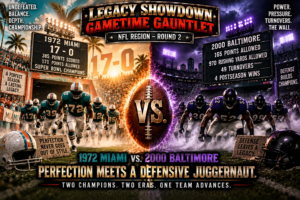
NFL Region — Round 2
Affiliate Disclaimer
This blog may contain affiliate links or banner advertisements. If you click on one of these links or advertisements and make a purchase, The Shopping Plaza may earn a small commission at no additional cost to you. These commissions help support our work and allow us to continue creating free sports content, rankings, tournament features, and Legacy Showdown matchups like Gametime Gauntlet. We only recommend products, services, or merchandise that we believe may be of interest to our readers. Thank you for supporting The Shopping Plaza and Gametime Gauntlet.
Round 2: Perfection Meets a Defensive Juggernaut
The NFL Region enters Round 2 with a matchup built around two of the most intimidating defensive identities in league history. The 1972 Miami Dolphins arrive with an achievement no NFL champion has duplicated: an undefeated and untied season from opening day through the Super Bowl. Don Shula’s club went 14–0 in the regular season and 3–0 in the playoffs, finishing 17–0 after defeating Washington 14–7 in Super Bowl VII. Miami led the NFL in both points scored and fewest points allowed during the regular season, proving that perfection was produced by a complete football team rather than one dominant unit.
The 2000 Baltimore Ravens reached the championship through a very different path. Baltimore went 12–4, finished second in the AFC Central behind Tennessee, and endured a five-game stretch without scoring an offensive touchdown. But Marvin Lewis’ defense became historically overwhelming. The Ravens allowed only 165 points in 16 regular-season games, surrendered just 970 rushing yards and five rushing touchdowns, forced 49 turnovers, and carried a defense-first formula through four postseason victories.
Ray Lewis led a unit featuring Sam Adams, Tony Siragusa, Peter Boulware, Jamie Sharper, Rod Woodson, Chris McAlister, Duane Starks, and Kim Herring. On offense, Jamal Lewis supplied a 1,364-yard rushing season, Shannon Sharpe provided championship experience, and Trent Dilfer stabilized the quarterback position after taking over during the season. Baltimore then allowed only 23 total offensive points across four playoff games and defeated the New York Giants 34–7 in Super Bowl XXXV.
This is not a hypothetical game between 1972 and 2000 rules. Gametime Gauntlet judges each champion relative to its own era across ten consistent categories. Miami brings absolute perfection, balance, coaching greatness, and an unmatched historical distinction. Baltimore brings a more difficult postseason route and one of the greatest defenses ever assembled. Round 2 begins with a legitimate heavyweight argument.
1. Dominance Over Competition
Baltimore’s defensive dominance was extraordinary. The Ravens allowed 165 points, led the league in scoring defense, and finished with a +168 point differential despite an offense that ranked only 14th in scoring. They closed the regular season with seven straight victories and then won four postseason games by an average margin of more than 17 points. Miami, however, dominated across the entire team profile. The Dolphins went 14–0, scored a league-best 385 points, allowed a league-low 171, and posted a +214 point differential in a shorter 14-game schedule. They were the only team in the league without a loss, and their perfection survived three postseason rounds. Miami’s average regular-season margin of victory exceeded 15 points, while the team could win through rushing, defense, special teams, or efficient quarterback play. Baltimore was more extreme on defense, but Miami was more consistently dominant as a complete team. Dominance Over Competition goes to the Dolphins.
Winner: 1972 Miami Dolphins
2. Championship Achievement
The Ravens’ championship run deserves enormous respect because Baltimore entered the playoffs as a wild-card team and had to win four games. The Ravens defeated Denver 21–3, went on the road and beat 13–3 Tennessee 24–10, won the AFC Championship at Oakland 16–3, and then overwhelmed the Giants 34–7 in Super Bowl XXXV. Their defense allowed only one offensive touchdown in the entire postseason. Miami’s achievement remains unique in NFL history. The Dolphins entered the playoffs 14–0, defeated Cleveland and Pittsburgh, and then beat Washington in Super Bowl VII to finish 17–0. Their defense did not allow an offensive point in the Super Bowl; Washington’s only touchdown came from a return of a botched Miami field-goal play. Baltimore had the longer and arguably more difficult postseason route, but Miami completed every competitive obligation placed before it without losing once. Championship Achievement must recognize the uniqueness of perfection. The point goes to the 1972 Dolphins.
Winner: 1972 Miami Dolphins
3. Strength of Competition
Miami’s perfect record came against a schedule that historical rating systems regard as relatively weak, although that criticism can be overstated. The Dolphins still defeated an 11–3 Pittsburgh team in the AFC Championship and an 11–3 Washington club in the Super Bowl. They also had to navigate much of the season without injured starting quarterback Bob Griese, making the unbeaten record more impressive than a simple schedule rating suggests. Baltimore’s 2000 postseason route was deeper and more demanding. The Ravens defeated a Denver team with an explosive offense, then won on the road against 13–3 Tennessee, the team that had beaten Baltimore twice during the regular season. They followed by beating 12–4 Oakland on the road before facing the Giants in the Super Bowl. Baltimore therefore won three postseason games away from home before the neutral-site championship. Miami defeated strong contenders when it mattered, but Baltimore’s layered four-game path against multiple high-quality teams earns Strength of Competition.
Winner: 2000 Baltimore Ravens
4. Star Power
Baltimore’s defense featured elite names. Ray Lewis was a first-team All-Pro and Defensive Player of the Year-level force who became Super Bowl MVP, while Rod Woodson was already one of the greatest defensive backs in NFL history. Shannon Sharpe brought Hall of Fame receiving ability at tight end, Jamal Lewis emerged as a powerful rookie runner, and Peter Boulware was an established pass-rushing threat. Miami’s roster was even more saturated with historically significant talent. Bob Griese, Larry Csonka, Paul Warfield, Larry Little, and Jim Langer all became Hall of Famers, while Nick Buoniconti anchored the No-Name Defense and Jake Scott became Super Bowl VII MVP. Mercury Morris rushed for 1,000 yards, Csonka surpassed 1,100, and Warfield remained one of football’s premier deep threats. Earl Morrall also delivered a remarkable season in relief of Griese and earned first-team All-Pro recognition. Baltimore has the most dominant individual defender in this comparison, but Miami has the broader concentration of elite historical talent. Star Power goes to the Dolphins.
Winner: 1972 Miami Dolphins
5. Depth and Supporting Cast
The Ravens were constructed intelligently around their defense. Sam Adams and Tony Siragusa absorbed blockers in the middle, Peter Boulware and Jamie Sharper created pressure and pursuit from linebacker, and the secondary featured Woodson, McAlister, Starks, and Herring. On offense, Jamal Lewis carried the running game while Sharpe, Qadry Ismail, Jonathan Ogden, and a strong offensive line gave Baltimore enough production to protect its defense. Miami’s depth was tested more severely during the season. When Bob Griese suffered a broken leg and dislocated ankle in Week 5, 38-year-old Earl Morrall stepped in and helped keep the Dolphins undefeated until Griese returned during the postseason. Miami also had the league’s most productive rushing attack behind Csonka, Morris, and Jim Kiick, an outstanding offensive line, Warfield as a vertical weapon, and a defense whose nickname—No-Name Defense—reflected its collective strength more than celebrity. The ability to lose the starting quarterback for most of the regular season and remain perfect is powerful evidence of roster depth. Depth and Supporting Cast goes narrowly to Miami.
Winner: 1972 Miami Dolphins
6. Historical Impact
The 2000 Ravens changed how modern fans discuss defensive greatness. Their 165 points allowed became the record for a 16-game season, their run defense surrendered only 970 yards, and their championship demonstrated that an historically dominant defense could overcome an ordinary offense. The unit became a standard against which later defenses such as Seattle’s Legion of Boom and other elite groups would be compared. Yet the 1972 Dolphins possess one of the most permanent accomplishments in American professional sports. They remain the only NFL team to complete an entire regular season and postseason undefeated and untied. Every time a modern contender remains unbeaten deep into a season, the 1972 Dolphins return to the national conversation. Their achievement has survived schedule expansion, playoff expansion, free agency, salary-cap football, and dramatic strategic changes. The perfect season is not merely a franchise record; it is a league-wide historical landmark. Historical Impact goes to Miami.
Winner: 1972 Miami Dolphins
7. Statistical Excellence
Miami’s statistical résumé is exceptionally balanced. The Dolphins led the NFL with 385 points scored and allowed a league-low 171, producing a +214 differential in 14 games. They ranked first in rushing offense, with Larry Csonka and Mercury Morris each surpassing 1,000 yards, and their defense forced 46 turnovers. Baltimore’s claim rests on defensive numbers that are almost difficult to process. The Ravens allowed only 165 points across 16 games—10.3 per contest—and only 970 rushing yards, an average of 60.6 per game. Opponents scored just five rushing touchdowns all season, and Baltimore forced 49 turnovers. The Ravens’ offense was ordinary and even went five consecutive games without an offensive touchdown, which keeps this category extremely close. But Statistical Excellence can recognize a historically extreme unit when its performance is sufficiently far beyond normal championship standards. Miami was the better statistical team in total balance; Baltimore produced the more extraordinary single-unit statistical achievement. By the narrowest margin, Statistical Excellence goes to the Ravens.
Winner: 2000 Baltimore Ravens
8. Longevity of Greatness
The 2000 Ravens were not a one-year defensive accident. Baltimore had already built a strong defense in the late 1990s, returned to the playoffs in 2001, and retained several important pieces who remained productive for years. Ray Lewis became the centerpiece of a franchise identity that would eventually produce another championship in 2012, although that later team was substantially different. The 1972 Dolphins sit in the middle of one of the NFL’s greatest three-year runs. Miami reached Super Bowl VI after the 1971 season, went 17–0 and won Super Bowl VII, then returned in 1973 and won Super Bowl VIII. Across those three seasons, the Dolphins reached three consecutive Super Bowls and won the final two. The Shula-Csonka-Griese-Warfield core therefore proved its greatness before and after the perfect season. Baltimore’s defense created an enduring organizational identity, but the specific 2000 championship group did not sustain title-level success as long. Longevity of Greatness goes to Miami.
Winner: 1972 Miami Dolphins
9. Clutch Performance
Baltimore repeatedly delivered in high-pressure postseason moments. The divisional game at Tennessee was tied 10–10 entering the fourth quarter before Anthony Mitchell returned a blocked field goal for a touchdown and Ray Lewis sealed the victory with an interception return. The Ravens then won the AFC Championship on the road while allowing Oakland only three points. Miami faced its own severe pressure because perfection made every postseason mistake potentially historic. The Dolphins trailed Cleveland 14–13 in the fourth quarter of the divisional round before Jim Kiick scored the winning touchdown. In Pittsburgh, Miami fell behind 7–0, changed quarterbacks during the game, used a successful fake punt, and rallied to win 21–17. In Super Bowl VII, the defense protected a 14–0 lead and prevented Washington’s offense from scoring at all. Baltimore’s defense was spectacular under postseason pressure, but Miami had to protect an undefeated season through three increasingly consequential games and never failed. Clutch Performance goes narrowly to the Dolphins.
Winner: 1972 Miami Dolphins
10. Legacy Endurance
The 2000 Ravens remain one of the first teams mentioned whenever the greatest defenses in NFL history are debated. Their identity is immediate: Ray Lewis, a record-setting scoring defense, suffocating run prevention, four dominant playoff victories, and a Super Bowl in which the opponent’s only score came on a kickoff return. That legacy is exceptionally durable. The 1972 Dolphins occupy an even more singular place. Their 17–0 record has no exact equal among Super Bowl champions, and the perfect season has become part of the annual rhythm of the NFL. Unbeaten teams are measured against Miami until they lose, and the 2007 Patriots’ 18–0 start only strengthened appreciation for how difficult it is to finish perfection rather than merely approach it. The Dolphins are remembered not only as undefeated but as a balanced champion that led the league in both scoring and scoring defense. Baltimore owns one of football’s greatest defensive legacies; Miami owns a team accomplishment that remains alone. Legacy Endurance goes to the Dolphins.
Winner: 1972 Miami Dolphins
Round 2 Scorecard
- Dominance Over Competition: 1972 Miami Dolphins
- Championship Achievement: 1972 Miami Dolphins
- Strength of Competition: 2000 Baltimore Ravens
- Star Power: 1972 Miami Dolphins
- Depth and Supporting Cast: 1972 Miami Dolphins
- Historical Impact: 1972 Miami Dolphins
- Statistical Excellence: 2000 Baltimore Ravens
- Longevity of Greatness: 1972 Miami Dolphins
- Clutch Performance: 1972 Miami Dolphins
- Legacy Endurance: 1972 Miami Dolphins
FINAL SCORE: 1972 Miami Dolphins 8 — 2000 Baltimore Ravens 2
Final Verdict
An 8–2 final score looks decisive, but it should not be mistaken for a dismissal of Baltimore. The 2000 Ravens present one of the strongest defensive cases in the entire tournament. They allowed only 165 regular-season points, surrendered 970 rushing yards, forced 49 turnovers, and then gave up only 23 offensive points across four playoff games. Baltimore earns Strength of Competition because its wild-card route required three victories away from home before the Super Bowl, and it earns Statistical Excellence because the defense reached a level of numerical extremity that remains historically exceptional.
Miami advances because Gametime Gauntlet measures the whole champion. The 1972 Dolphins were first in the NFL in points scored and first in points allowed, survived the loss of starting quarterback Bob Griese for most of the regular season, and completed every game on their schedule without a loss or tie. Their roster contained elite talent on offense, defense, and the offensive line, and the perfect season was surrounded by Super Bowl appearances in 1971 and another championship in 1973.
The most important distinction is that Baltimore’s historical greatness is concentrated primarily in one side of the football, while Miami’s case stretches across nearly every dimension of team performance. The Ravens could suffocate almost any opponent and proved they could win a championship with defense as the overwhelming engine. The Dolphins combined elite defense with the league’s highest-scoring offense and the NFL’s best rushing attack while carrying the psychological burden of perfection into January. Baltimore makes this a fascinating stylistic comparison, but Miami’s complete résumé wins too many independent categories.
Final Result: 1972 Miami Dolphins advance to the next round by a score of 8–2.
Audience Challenge
Is 8–2 too wide for a matchup involving one of the greatest defenses ever assembled? Should Baltimore’s record-setting run defense and four-game postseason road have earned additional categories? Or does Miami’s 17–0 perfection, league-leading offense, league-leading scoring defense, Hall of Fame talent, and back-to-back championship context make the Dolphins simply too complete? And which achievement is harder to imagine being duplicated: an entire perfect NFL season or a defense allowing only 165 points across a 16-game schedule?