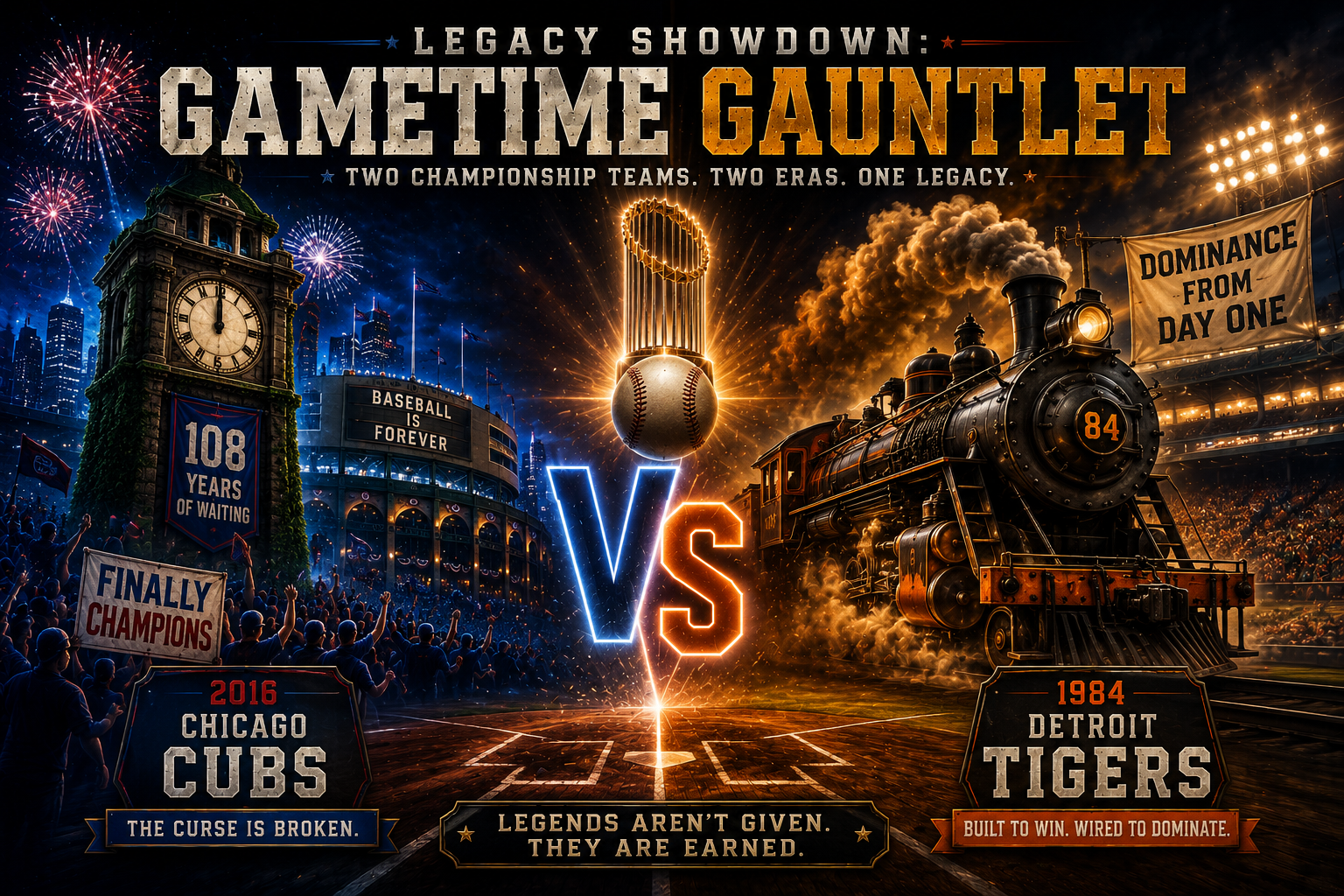

The curse-breaking Cubs collide with Detroit’s wire-to-wire championship machine.
Affiliate Disclaimer
This blog may contain affiliate links or banner advertisements. If you click on one of these links or advertisements and make a purchase, we may earn a small commission at no additional cost to you. These commissions help support The Shopping Plaza and allow us to continue creating free sports content, tournaments, rankings, and features like Gametime Gauntlet and the Legacy Showdown series.
The Matchup
The next first-round matchup in the MLB Region places two unforgettable champions on opposite sides of a fascinating greatness debate. The #7 seed 2016 Chicago Cubs carried more than a century of frustration into October and finally ended a 108-year World Series drought. Their championship season combined elite regular-season performance with a postseason journey filled with pressure, adversity, and one of the most dramatic Game 7 finishes baseball has ever produced.
The #10 seed 1984 Detroit Tigers built their case in a very different way. Detroit exploded out of the gate, established control of the American League almost immediately, and never surrendered its identity as the team everyone else was chasing. With stars across the roster and a dominant championship finish, the Tigers produced a classic wire-to-wire season. Gametime Gauntlet does not ask which team would literally win across eras; it judges which club built the stronger overall legacy of greatness relative to its own time.
1. Dominance Over Competition
Detroit makes its strongest opening statement through the sheer authority of its 1984 season. The Tigers began 35-5, creating immediate separation and forcing the rest of the American League to chase them almost from Opening Day. They finished 104-58, proving that the blistering start was not a temporary surge but the beginning of sustained control. Their success carried into October, where they continued to look like the team that had set the pace all year. Chicago was outstanding in 2016 and won more regular-season games, but Detroit’s wire-to-wire narrative gives its dominance a particularly commanding quality in the original matchup. The Tigers rarely allowed the season to feel as though control of the league had truly changed hands. Under the supplied judging result, Detroit takes Dominance Over Competition.
Winner: 1984 Detroit Tigers
2. Championship Achievement
Both clubs completed championship seasons, and both titles occupy important places in franchise history. Chicago’s victory ended an extraordinary 108-year drought, giving the 2016 championship unmatched emotional weight. Detroit’s case in this category, however, rests on how completely the 1984 Tigers converted a dominant season into a title without allowing the postseason to undo their regular-season superiority. They entered October as a powerhouse and finished October looking every bit like one. That continuity from Opening Day through the World Series strengthens the championship as the culmination of an entire season of control. The Cubs had to survive far more turbulence on the way to their title, which becomes a major advantage for them in later categories. For Championship Achievement as scored in the original bracket, Detroit earns the point.
Winner: 1984 Detroit Tigers
3. Strength of Competition
Chicago’s road through October demanded repeated answers to high-pressure challenges. The Cubs had to navigate a competitive postseason field and then faced Cleveland in a World Series that pushed them to the limit. Falling behind three games to one meant Chicago had no margin for error and had to win three consecutive games to complete the championship. That challenge tested roster depth, strategy, emotional control, and the ability to respond when an opponent had seized command of the series. Detroit defeated the teams placed in front of it with impressive authority, but Chicago’s path contained a greater sense of competitive jeopardy. Surviving that adversity adds weight to the quality of the opponents and circumstances the Cubs overcame. Chicago takes Strength of Competition.
Winner: 2016 Chicago Cubs
4. Star Power
The 1984 Tigers featured a collection of names that became deeply connected to Detroit baseball history. Alan Trammell and Lou Whitaker formed one of the era’s most respected middle-infield combinations, giving the club excellence at premium defensive positions. Jack Morris brought frontline pitching presence, Kirk Gibson supplied power and intensity, and Willie Hernandez gave Detroit a dominant late-game weapon. The 2016 Cubs also possessed major star power through players such as Kris Bryant, Anthony Rizzo, Jon Lester, and Jake Arrieta. Still, the original matchup awards this category to Detroit because its championship roster was anchored by a particularly memorable group of established stars and franchise figures. Their identities remain inseparable from the story of the 1984 season. The Tigers take Star Power.
Winner: 1984 Detroit Tigers
5. Depth and Supporting Cast
The 2016 Cubs were constructed to survive a long season because their strength extended well beyond one or two headliners. Kris Bryant and Anthony Rizzo gave Chicago elite offensive anchors, while Jon Lester and Jake Arrieta provided high-level starting pitching. Ben Zobrist embodied the roster’s versatility and became especially important when the postseason demanded adaptability. The Cubs could defend, rotate players, change matchups, and receive meaningful contributions from different areas of the roster. Detroit was also a complete team, and its wire-to-wire success could not have happened without excellent supporting pieces. Chicago’s advantage comes from the breadth of options available to manager Joe Maddon and the way those options became essential during a difficult postseason. The Cubs take Depth and Supporting Cast.
Winner: 2016 Chicago Cubs
6. Historical Impact
The 2016 Cubs did something that generations of Chicago fans had spent their entire lives waiting to see. Ending a 108-year World Series championship drought transformed the season from a great baseball achievement into a major event in American sports culture. The history surrounding the franchise meant that every postseason step carried the accumulated weight of decades of disappointment, near misses, and mythology. Winning the championship did not merely add another trophy to the Cubs’ record book; it permanently changed the way the franchise’s history would be told. Detroit’s 1984 season remains a landmark championship and one of the great wire-to-wire campaigns, but Chicago’s victory altered one of baseball’s most famous historical narratives. Few teams in any sport can claim a single championship with that level of symbolic meaning. The Cubs take Historical Impact.
Winner: 2016 Chicago Cubs
7. Statistical Excellence
Detroit’s statistical case reflects the completeness that made the 1984 club so difficult to catch. The Tigers combined a 104-win regular season with excellence across multiple phases of the game, giving their dominance a measurable foundation. Their extraordinary start is one of the season’s defining numerical markers, but the more important point is that they continued winning at a championship pace after the opening surge. The roster had enough offensive production, pitching quality, and late-game strength to maintain control over six months. Chicago’s 2016 regular season was statistically exceptional as well, making this one of the categories where the two teams can generate a serious debate. The original matchup nevertheless gives Detroit the edge because its numbers reinforce the image of a club that established superiority immediately and sustained it through the championship. The Tigers take Statistical Excellence.
Winner: 1984 Detroit Tigers
8. Longevity of Greatness
The 2016 championship represented the high point of a Cubs core that remained relevant beyond one magical October. Chicago’s young position-player foundation and established pitching helped the organization remain a contender in the seasons surrounding the title. That matters in Gametime Gauntlet because greatness carries additional weight when it can be connected to a broader competitive window rather than a single isolated season. Detroit’s 1984 club was unquestionably elite, but the supplied matchup gives Chicago the stronger argument for a championship core that helped establish a sustained modern contender. The Cubs’ roster became the foundation of a new expectation level for a franchise long associated with disappointment. Their title was therefore both a historic endpoint and the centerpiece of a larger period of competitiveness. Chicago takes Longevity of Greatness.
Winner: 2016 Chicago Cubs
9. Clutch Performance
Few championship teams have faced a pressure test as emotionally loaded as the one Chicago survived in the 2016 World Series. After falling behind Cleveland three games to one, the Cubs had to play every remaining game with their season one loss away from ending. They responded by forcing a Game 7 and then endured the enormous swings of a winner-take-all championship finale. That final game demanded resilience even after Chicago appeared to have control and Cleveland fought back. The Cubs ultimately found a way to finish the job, turning more than a century of pressure into a championship celebration. Detroit’s postseason dominance was impressive, but Chicago’s ability to survive repeated elimination pressure makes the clutch case especially powerful. The Cubs take Clutch Performance.
Winner: 2016 Chicago Cubs
10. Legacy Endurance
Both teams remain celebrated decades after their championships, but the 2016 Cubs occupy a uniquely durable place in baseball memory. The phrase “108-year drought” immediately communicates why the season mattered far beyond the standings. Chicago’s comeback from a 3-1 World Series deficit, the tension of Game 7, and the final end of generations of frustration created a story that will be retold whenever sports fans discuss historic championship breakthroughs. The 1984 Tigers remain one of the great wire-to-wire champions and an essential part of Detroit sports history. Yet Chicago’s season carries a universal narrative about waiting, pressure, belief, and finally breaking through. That narrative keeps the team relevant even for fans with no direct connection to the Cubs. Chicago takes Legacy Endurance and secures the decisive sixth category.
Winner: 2016 Chicago Cubs
Gametime Gauntlet Scorecard
- Dominance Over Competition: 1984 Detroit Tigers
- Championship Achievement: 1984 Detroit Tigers
- Strength of Competition: 2016 Chicago Cubs
- Star Power: 1984 Detroit Tigers
- Depth and Supporting Cast: 2016 Chicago Cubs
- Historical Impact: 2016 Chicago Cubs
- Statistical Excellence: 1984 Detroit Tigers
- Longevity of Greatness: 2016 Chicago Cubs
- Clutch Performance: 2016 Chicago Cubs
- Legacy Endurance: 2016 Chicago Cubs
FINAL SCORE: 2016 Chicago Cubs 6 – 1984 Detroit Tigers 4
Final Verdict
This is one of the most compelling first-round contrasts in the MLB Region because Detroit and Chicago represent two different routes to immortality. The 1984 Tigers win Dominance Over Competition, Championship Achievement, Star Power, and Statistical Excellence. Those four categories capture the authority of a team that seized control early, stayed on top, and completed the season as champion. Detroit’s 4-0 start in the scorecard would make it easy to assume that the matchup is headed toward a comfortable Tigers victory.
Chicago turns the matchup by winning categories that reward the difficulty, depth, historical meaning, and lasting power of its championship. The Cubs take Strength of Competition, Depth and Supporting Cast, Historical Impact, Longevity of Greatness, Clutch Performance, and Legacy Endurance. Their 2016 title was not merely the conclusion of a strong season; it was the resolution of one of the longest and most famous championship droughts in sports. The 3-1 World Series comeback and dramatic Game 7 ensure that the championship is remembered as a test of resilience as much as talent.
The final 6-4 score reflects how close the philosophical debate really is. Detroit may have been the cleaner wire-to-wire powerhouse, while Chicago owns the stronger combination of adversity, historical significance, and enduring emotional impact. Under the Gametime Gauntlet criteria and the supplied category results, that broader legacy is enough to push the Cubs through one of the MLB Region’s closest opening matchups.
Final Result: 2016 Chicago Cubs advance by a score of 6-4.
Audience Challenge
Which form of greatness deserves more weight: Detroit’s wire-to-wire control or Chicago’s historic breakthrough under enormous postseason pressure? Would you keep the Cubs ahead 6-4, or is there a category where the 1984 Tigers deserve to flip the result? Make your case for whether the emotional and historical power of 2016 should outweigh the relentless dominance of Detroit in 1984.