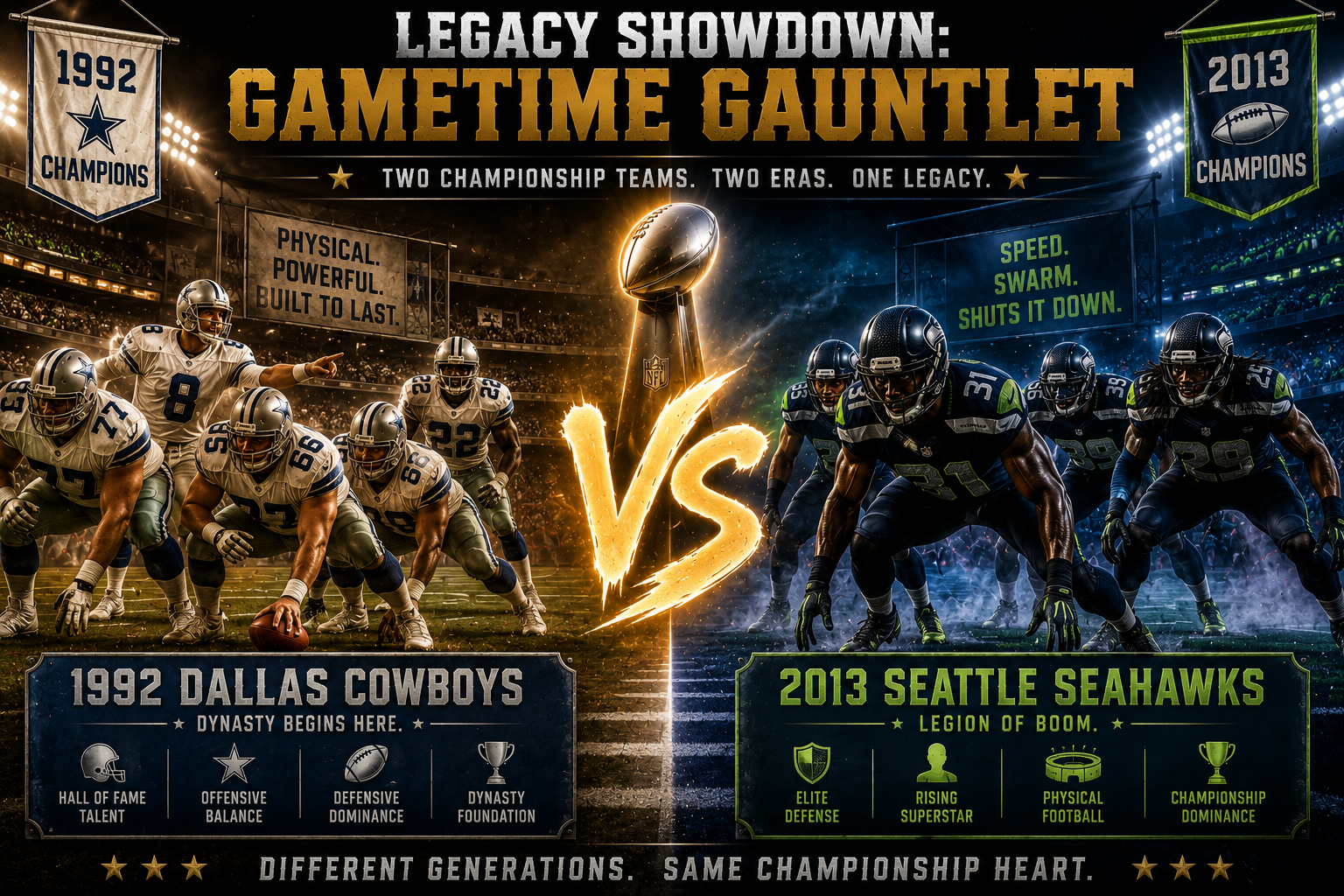


The birth of a 1990s dynasty collides with the Legion of Boom at its championship peak.
Affiliate Disclaimer
This blog may contain affiliate links or banner advertisements. If you click on one of these links or advertisements and make a purchase, The Shopping Plaza may earn a small commission at no additional cost to you. These commissions help support our work and allow us to continue creating free sports content, rankings, tournament features, and Legacy Showdown matchups like Gametime Gauntlet. We only recommend products, services, or merchandise that we believe may be of interest to our readers. Thank you for supporting The Shopping Plaza and Gametime Gauntlet.
The Matchup
The next first-round matchup in the NFL Region brings together two champions built around physical football, elite defense, and rosters that seemed ready to control an era. The #5 seed 1992 Dallas Cowboys announced the arrival of one of the NFL’s defining 1990s powers. Troy Aikman, Emmitt Smith, Michael Irvin, a dominant offensive line, and a fast, deep defense gave Dallas the balance to attack opponents from almost any direction.
The #12 seed 2013 Seattle Seahawks counter with one of the most intimidating defensive identities of the modern era. The Legion of Boom turned the secondary into the face of a championship team, while Russell Wilson, Marshawn Lynch, a deep pass rush, and an aggressive roster gave Seattle far more than a one-dimensional formula. Their season ended with a 43-8 Super Bowl victory over Denver, one of the most emphatic championship performances in league history.
Gametime Gauntlet does not ask which team would literally win under one era’s rules. Each champion is evaluated relative to its own time across ten consistent categories. Seattle brings a historically memorable defensive peak. Dallas brings exceptional balance and the foundation of a dynasty. The question is which complete legacy deserves the next-round spot.
1. Dominance Over Competition
Seattle’s 13-3 record and crushing Super Bowl victory make this an extremely competitive opening category. The Seahawks could suffocate opponents defensively and often forced games into the physical style they preferred. Dallas, however, built its championship through sustained control across the regular season and postseason rather than one defining finale. The Cowboys combined a powerful rushing attack, efficient quarterback play, a talented receiving corps, and a fast defense that rarely left opponents an obvious weakness to target. That balance allowed Dallas to win different types of games without abandoning its identity. Seattle’s peak dominance is undeniable, but the source matchup gives Dallas the edge for the breadth and consistency of its control. The 1992 Cowboys take Category 1.
Winner: 1992 Dallas Cowboys
2. Championship Achievement
Both teams completed convincing championship seasons, and Seattle’s Super Bowl performance remains one of the most memorable blowouts the event has produced. Dallas earns the category because the 1992 title became the launching point for something even larger. The Cowboys did not merely win one championship; this team established the core and confidence of a group that would capture three Super Bowls in four seasons. That context does not erase Seattle’s achievement, because every title must stand on its own. It does, however, show that Dallas’ championship formula proved repeatable almost immediately. The 1992 victory changed the trajectory of the franchise and announced a new NFL power. Championship Achievement goes to Dallas.
Winner: 1992 Dallas Cowboys
3. Strength of Competition
Seattle’s road to the championship unfolded in a modern NFL built around parity, free agency, salary-cap pressure, and sophisticated passing offenses. The Seahawks emerged from a highly competitive NFC and then faced a Denver team whose offense had produced a record-setting season. Rather than merely surviving that final challenge, Seattle overwhelmed it 43-8. That result gave the Seahawks a dramatic demonstration that their defensive formula could hold up against the most dangerous kind of opponent their era could produce. Dallas faced strong competition in 1992 and deserves full credit for its postseason success. But the source matchup gives Seattle the advantage for navigating the modern field and decisively defeating Denver’s historic offense. Strength of Competition belongs to the Seahawks.
Winner: 2013 Seattle Seahawks
4. Star Power
The 1992 Cowboys featured the core of an offense that would become one of the most recognizable collections of talent in NFL history. Troy Aikman supplied calm, accurate quarterback play; Emmitt Smith became the centerpiece of the rushing attack; and Michael Irvin gave Dallas a physical, high-level receiving threat. Charles Haley added championship pedigree and pass-rushing presence, while Darren Woodson became an important defensive figure and the offensive line developed its own reputation for dominance. Seattle had major stars as well, particularly throughout the Legion of Boom and with Russell Wilson and Marshawn Lynch on offense. Yet Dallas’ leading names became defining figures of an entire NFL decade and accumulated an extraordinary championship legacy together. The Cowboys take Star Power.
Winner: 1992 Dallas Cowboys
5. Depth and Supporting Cast
Seattle’s championship roster was remarkable because the talent extended well beyond its most famous defensive backs. The Seahawks could rotate pass rushers, play physical coverage, stop the run, and maintain aggression without asking one superstar to solve every problem. Offensively, Russell Wilson’s mobility and decision-making worked alongside Marshawn Lynch’s punishing running style, creating a complementary formula that protected the defense and controlled game flow. Dallas was exceptionally deep in its own right, particularly along the offensive line and across a young, fast defense. But the source matchup gives Seattle the edge because its defensive depth allowed the Seahawks to sustain an unusually demanding style against modern passing attacks. Their supporting cast turned the Legion of Boom from a nickname into a complete championship ecosystem. Seattle takes the category.
Winner: 2013 Seattle Seahawks
6. Historical Impact
The 1992 Cowboys helped change the direction of one of professional sports’ most famous franchises and quickly became central to the identity of the NFL in the 1990s. Dallas combined celebrity, championships, national attention, and on-field excellence in a way that made the team unavoidable even for fans outside its own market. The championship also announced the arrival of a dynasty built around Aikman, Smith, Irvin, and a deep roster assembled for sustained success. Seattle’s Legion of Boom had substantial influence on how modern defensive football was discussed, particularly the value of physical secondary play and roster depth. Still, Dallas’ broader cultural and league-wide footprint across the decade gives the Cowboys the stronger historical case. The 1992 team was not just a champion; it was the beginning of an era. Historical Impact goes to Dallas.
Winner: 1992 Dallas Cowboys
7. Statistical Excellence
Seattle’s defense makes this category far closer than the final tournament score suggests. The 2013 Seahawks produced elite defensive results and fielded a pass defense that belongs in conversations about the strongest of the modern era. Dallas wins under the source matchup because its excellence was spread more evenly across the entire team. The Cowboys could run efficiently, pass effectively, protect the quarterback, defend with speed, and control games without relying on one unit to compensate for a major weakness elsewhere. Statistical Excellence in Gametime Gauntlet rewards not only one historically dominant phase but also the total profile of a championship team. Seattle owns the more spectacular specialized case, while Dallas presents the broader all-around one. The Cowboys narrowly take the point.
Winner: 1992 Dallas Cowboys
8. Longevity of Greatness
This category strongly favors Dallas because the 1992 championship immediately became part of a sustained title run. The Cowboys won three Super Bowls in four seasons, proving that the core assembled for 1992 could survive changing opponents, growing expectations, and the pressure that follows a championship. Aikman, Smith, Irvin, and other central figures remained at the heart of that success. Seattle remained an elite contender after 2013 and returned to the Super Bowl the following season, so the Seahawks were far from a one-year wonder. But their championship core did not convert that window into the same collection of titles. Longevity of Greatness rewards repeated championship-level success, and Dallas owns the clearer advantage. The Cowboys take Category 8.
Winner: 1992 Dallas Cowboys
9. Clutch Performance
Seattle’s postseason ended with the kind of championship performance that leaves almost no room for second-guessing. Facing a Denver offense that entered the Super Bowl with enormous expectations, the Seahawks seized control immediately and never allowed the game to become the shootout many anticipated. Winning 43-8 on the sport’s biggest stage demonstrated preparation, confidence, and the ability to produce a team’s best football under maximum pressure. Dallas was also outstanding in high-stakes moments and completed its own championship run convincingly. But Clutch Performance can reward a team for delivering an extraordinary final statement when everything is on the line. Seattle’s Super Bowl demolition remains one of the clearest examples of that phenomenon. The Seahawks earn their third point.
Winner: 2013 Seattle Seahawks
10. Legacy Endurance
The 1992 Cowboys remain one of the defining teams of the modern NFL because their season is remembered as both a championship and the opening chapter of a dynasty. Their stars became permanent figures in league history, and the Cowboys’ three-title run remains central to any discussion of 1990s football. Seattle’s 2013 team also possesses exceptional staying power, particularly because the Legion of Boom and the 43-8 Super Bowl victory give the Seahawks a distinctive historical identity. Yet Dallas’ legacy reaches across multiple championships, iconic players, franchise mythology, and the larger cultural footprint of the Cowboys during the decade. The 1992 team continues to matter not only for what it won that season but for what it started. That broader endurance gives Dallas the final category.
Winner: 1992 Dallas Cowboys
Gametime Gauntlet Scorecard
- Dominance Over Competition: 1992 Dallas Cowboys
- Championship Achievement: 1992 Dallas Cowboys
- Strength of Competition: 2013 Seattle Seahawks
- Star Power: 1992 Dallas Cowboys
- Depth and Supporting Cast: 2013 Seattle Seahawks
- Historical Impact: 1992 Dallas Cowboys
- Statistical Excellence: 1992 Dallas Cowboys
- Longevity of Greatness: 1992 Dallas Cowboys
- Clutch Performance: 2013 Seattle Seahawks
- Legacy Endurance: 1992 Dallas Cowboys
FINAL SCORE: 1992 Dallas Cowboys 7 – 2013 Seattle Seahawks 3
Final Verdict
The 2013 Seahawks are much more formidable than a 7-3 final score might imply. Seattle wins Strength of Competition, Depth and Supporting Cast, and Clutch Performance. Those categories capture exactly why the Seahawks became such a memorable champion: they were deep enough to impose a demanding defensive style, strong enough to survive the modern NFL, and fearless enough to overwhelm a record-setting Denver offense on the biggest stage.
Dallas advances because the 1992 Cowboys present the more complete legacy across the tournament’s remaining categories. They win Dominance Over Competition, Championship Achievement, Star Power, Historical Impact, Statistical Excellence, Longevity of Greatness, and Legacy Endurance. The combination is difficult to overcome because Dallas was not merely talented in one phase. The Cowboys paired an elite offense with a strong defense, iconic stars with exceptional supporting talent, and one championship season with the beginning of a three-title run.
Seattle’s Legion of Boom may be the single most intimidating unit in the matchup, and its Super Bowl performance gives the Seahawks a championship moment that can stand beside almost any team in the bracket. But Gametime Gauntlet measures the entire legacy. Dallas’ balance, star power, dynasty foundation, and decade-defining impact create more paths to victory across the ten categories. The Legion of Boom lands several heavy shots, but the Cowboys’ complete roster survives and advances.
Final Result: 1992 Dallas Cowboys advance by a score of 7-3.
Audience Challenge
Would the Legion of Boom have contained Troy Aikman, Emmitt Smith, Michael Irvin, and Dallas’ powerful offensive line, or would the Cowboys’ balance eventually create too many problems? If you believe Seattle deserved another category, would you flip Statistical Excellence, Dominance Over Competition, or even Championship Achievement? Make your case for whether the 2013 Seahawks’ defensive peak or the 1992 Cowboys’ dynasty-building completeness deserves the next-round spot.