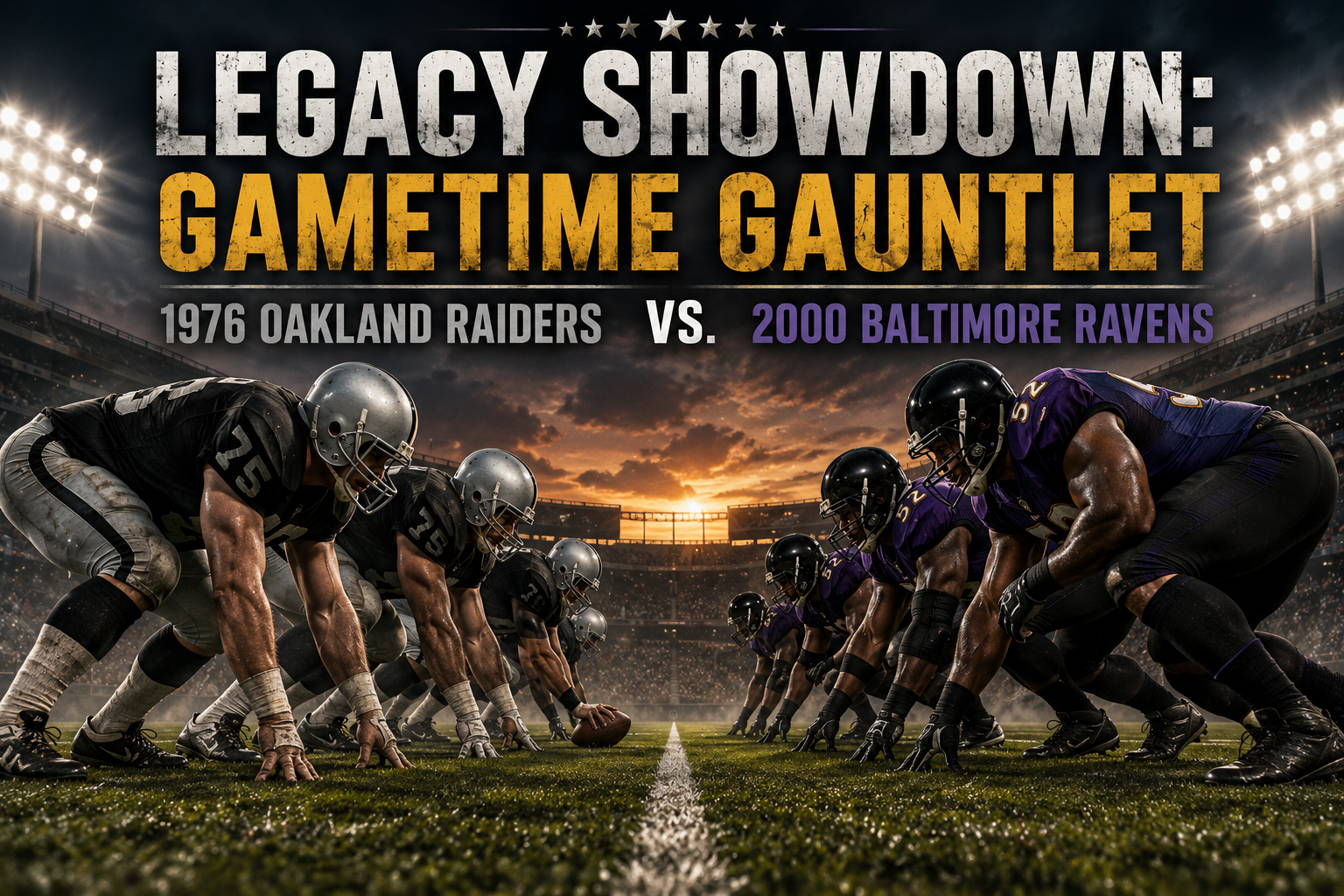

Silver-and-black balance meets one of the most feared defenses football has ever seen.
Affiliate Disclaimer
This blog may contain affiliate links or banner advertisements. If you click on one of these links or advertisements and make a purchase, The Shopping Plaza may earn a small commission at no additional cost to you. These commissions help support our work and allow us to continue creating free sports content, rankings, tournament features, and Legacy Showdown matchups like Gametime Gauntlet. We only recommend products, services, or merchandise that we believe may be of interest to our readers. Thank you for supporting The Shopping Plaza and Gametime Gauntlet.
The Matchup
The final first-round matchup in the NFL Region brings together two champions whose reputations were built on toughness, intimidation, and the ability to impose their preferred style on opponents. The #8 seed 1976 Oakland Raiders finally broke through after years of postseason frustration, finishing 13-1 before completing the season with the franchise’s first Super Bowl championship. Oakland combined offensive firepower, defensive toughness, personality, and balance into one of the most complete teams of the decade.
The #9 seed 2000 Baltimore Ravens arrive with a more specialized but historically overwhelming identity. Baltimore’s defense became the defining force of its championship season, turning field position, turnovers, physicality, and scoring prevention into a formula opponents struggled to solve. With Ray Lewis at the center of the unit and elite talent surrounding him, the Ravens created a defensive standard that is still invoked whenever a modern team begins dominating that side of the football.
This is not a hypothetical game played under one era’s rules. Gametime Gauntlet judges both champions relative to their own environments across ten categories of greatness. Oakland brings balance, tradition, and a 13-1 season. Baltimore brings a defense capable of taking over an entire championship run. Only one advances.
- Dominance Over Competition
The 1976 Raiders built their case with extraordinary consistency across the entire regular season. A 13-1 record meant Oakland spent almost every week demonstrating that opponents had very little room for error against them. The Raiders were not dependent on one narrow formula; they could win with offensive production, defensive toughness, physical football, and the confidence of a veteran contender that had endured previous postseason disappointment. That balance matters because dominance is stronger when it survives different styles of games. Baltimore’s defense was historically suffocating, and the Ravens became increasingly imposing as their championship run progressed. Yet Oakland’s near-perfect regular season gives the Raiders the cleaner full-season record of control. The #8 seed takes the opening category.
Winner: 1976 Oakland Raiders
- Championship Achievement
Both teams completed their seasons as Super Bowl champions, so this category requires more than simply counting trophies. Baltimore’s championship validated one of the greatest defensive seasons ever produced and gave a relatively young franchise an immediate place in NFL history. Oakland’s title carried a different kind of weight because it finally rewarded a team and organization that had spent years knocking on the championship door. The 1976 Raiders turned repeated contention into a breakthrough and established a championship identity that would become central to the franchise’s mythology. Their 13-1 regular season also meant the Super Bowl victory completed an already exceptional campaign rather than rescuing an uneven one. The source matchup treats that culmination of sustained contention as the deciding distinction. Championship Achievement goes narrowly to Oakland.
Winner: 1976 Oakland Raiders
- Strength of Competition
Baltimore’s postseason run gives the Ravens a powerful argument in this category. The 2000 team had to navigate a modern playoff structure in which every additional round created another opportunity for an opponent to expose its limitations. Instead, the Ravens’ defense became even more imposing when the stakes increased, allowing remarkably little scoring throughout the postseason. That performance showed the unit was not merely feasting on weak regular-season opponents; its identity held up against playoff-caliber competition. Oakland faced formidable teams in its own era and deserves full credit for reaching the top of a highly physical 1970s NFL. Still, the source matchup gives Baltimore the advantage for dominating a deep modern postseason field while repeatedly forcing good teams into uncomfortable, low-scoring games. The Ravens earn their first point.
Winner: 2000 Baltimore Ravens
- Star Power
The 2000 Ravens were far more than a collection of anonymous defenders operating inside a great scheme. Ray Lewis stood at the center of the defense and became the emotional and competitive face of the championship team. Rod Woodson brought elite experience and Hall of Fame stature to the secondary, while Jonathan Ogden gave Baltimore a cornerstone presence on the offensive line. Shannon Sharpe supplied championship experience and a dangerous receiving option at tight end, and Sam Adams contributed to the physical strength of the defensive front. Oakland possessed stars and iconic personalities of its own, making this category competitive. But the Ravens’ concentration of elite names across defense, offensive line, and skill positions gives Baltimore the edge in Star Power.
Winner: 2000 Baltimore Ravens
- Depth and Supporting Cast
Oakland’s greatest counterargument to Baltimore’s defense is that the 1976 Raiders were exceptionally balanced. They did not need one unit to carry the entire burden because the roster had championship quality on both offense and defense. Baltimore, however, wins this category because the depth surrounding its defensive stars made the unit historically difficult to attack. Opponents could not simply scheme away from Ray Lewis and expect the rest of the defense to become vulnerable. The Ravens had layers of physicality, coverage ability, tackling, and situational discipline that allowed the system to survive different offensive approaches. Their supporting cast also understood exactly what the championship formula required: protect field position, avoid giving opponents easy opportunities, and let the defense dictate the game. The historic depth of that unit gives Baltimore the point.
Winner: 2000 Baltimore Ravens
- Historical Impact
The 1976 Raiders represent more than one championship season; they embody an image of professional football that became inseparable from the franchise. Oakland’s rebellious, intimidating, silver-and-black identity helped make the Raiders one of the NFL’s most recognizable organizations. The breakthrough championship gave that attitude credibility at the highest level and transformed years of contention into a lasting winning tradition. Baltimore’s 2000 defense had enormous historical influence and remains one of the league’s great defensive benchmarks. Yet Oakland’s impact extends into franchise culture, league mythology, and the popular image of what a tough football team could look and feel like. The Raiders became a symbol as much as a champion. Historical Impact goes to Oakland.
Winner: 1976 Oakland Raiders
- Statistical Excellence
This category belongs to Baltimore because the Ravens’ defensive production was not merely impressive by reputation; it was historically extreme. The defense allowed only 165 points during the regular season, setting a 16-game NFL record at the time, and permitted just 970 rushing yards. Those numbers capture how difficult it was for opponents to sustain offense against Baltimore in virtually any form. The Ravens also carried that statistical excellence into the postseason, reinforcing that the regular-season performance was not a fluke created by schedule or circumstance. Oakland’s 13-1 record is itself a remarkable statistic and reflects a more balanced team profile. But when Statistical Excellence isolates extraordinary measurable performance, Baltimore’s defense provides one of the strongest cases in tournament history. The Ravens take the category.
Winner: 2000 Baltimore Ravens
- Longevity of Greatness
The 1976 championship was the payoff to a long period in which Oakland repeatedly established itself as one of professional football’s elite organizations. The Raiders had spent years contending, building a roster and culture capable of returning to important games even when earlier seasons ended in disappointment. That sustained relevance matters because Longevity of Greatness asks whether a champion belonged to a broader period of excellence rather than appearing suddenly for one magical season. Baltimore’s defensive identity would remain influential, and important pieces of the organization continued to matter beyond 2000. But the 1976 Raiders sit inside a more established multi-year championship tradition and a decade of repeated contention. Their title feels like the culmination of sustained greatness rather than an isolated spike. Oakland takes the category.
Winner: 1976 Oakland Raiders
- Clutch Performance
Baltimore’s postseason defense elevated an already historic season when the games mattered most. The Ravens repeatedly prevented opponents from turning playoff pressure into meaningful offensive production, allowing the team to play with confidence even when its own offense was not built to win shootouts. That is an important form of clutch performance: one unit knowing the championship burden rests heavily on it and continuing to deliver anyway. Baltimore’s Super Bowl performance provided the clearest final statement, as the Ravens controlled the game and completed their postseason run emphatically. Oakland was also excellent under pressure and finally overcame the playoff disappointments that had followed previous Raiders teams. Yet Baltimore’s postseason defensive authority was so complete that it became part of the team’s permanent identity. Clutch Performance goes to the Ravens.
Winner: 2000 Baltimore Ravens
- Legacy Endurance
The 2000 Ravens continue to appear whenever football fans debate the greatest defenses in NFL history. That is an unusually durable legacy because the team is not remembered merely as a champion; it is used as a measuring stick for an entire side of the sport. When a modern defense begins producing historically low scoring totals or carrying an offense through a season, comparisons with Baltimore quickly emerge. The 1976 Raiders remain an essential championship team in the history of one of the NFL’s iconic franchises, and their breakthrough title carries enormous significance. But the Ravens possess a more specific all-time benchmark that keeps the 2000 team active in league-wide debates across generations. Their defense gives the season an identity that requires almost no explanation. Baltimore earns the final category.
Winner: 2000 Baltimore Ravens
Gametime Gauntlet Scorecard
- Dominance Over Competition: 1976 Oakland Raiders
- Championship Achievement: 1976 Oakland Raiders
- Strength of Competition: 2000 Baltimore Ravens
- Star Power: 2000 Baltimore Ravens
- Depth and Supporting Cast: 2000 Baltimore Ravens
- Historical Impact: 1976 Oakland Raiders
- Statistical Excellence: 2000 Baltimore Ravens
- Longevity of Greatness: 1976 Oakland Raiders
- Clutch Performance: 2000 Baltimore Ravens
- Legacy Endurance: 2000 Baltimore Ravens
FINAL SCORE: 2000 Baltimore Ravens 6 – 1976 Oakland Raiders 4
Final Verdict
This matchup is much closer than the contrast between a balanced champion and a defense-first champion might initially suggest. Oakland wins Dominance Over Competition, Championship Achievement, Historical Impact, and Longevity of Greatness. Those four points capture why the 1976 Raiders were such an important team: they went 13-1, finally converted years of contention into a championship, strengthened one of football’s most recognizable identities, and represented a sustained era of organizational excellence.
Baltimore wins Strength of Competition, Star Power, Depth and Supporting Cast, Statistical Excellence, Clutch Performance, and Legacy Endurance. The common thread is the defense. It was deep enough to survive elite competition, talented enough to feature multiple major stars, statistically extreme enough to enter the record book, and dependable enough to become even more imposing in the postseason. More than two decades later, the 2000 Ravens remain one of the first teams mentioned whenever defensive greatness is discussed.
Oakland’s balance makes the Raiders a dangerous tournament opponent, and their championship legacy deserves far more respect than a simple 6-4 score can convey. But Baltimore’s defense creates too many category advantages to overcome. In a tournament designed to identify the greatest teams ever assembled, possessing a unit that can credibly claim to be among the greatest in league history becomes the deciding factor.
Final Result: 2000 Baltimore Ravens advance by a score of 6-4.
Audience Challenge
Would the balance, toughness, and offensive firepower of the 1976 Raiders have earned them another category, or is the 2000 Baltimore defense simply too historic to deny? If you could flip one result, would it be Championship Achievement, Depth and Supporting Cast, Clutch Performance, or Legacy Endurance? Make your case for whether Oakland’s complete championship team or Baltimore’s legendary defense deserves the next-round spot.