

Affiliate Disclaimer: This post may contain affiliate links. If you make a purchase through one of these links, The Shopping Plaza may earn a commission at no additional cost to you.
The Halloween Plot Twist Parents Know Too Well
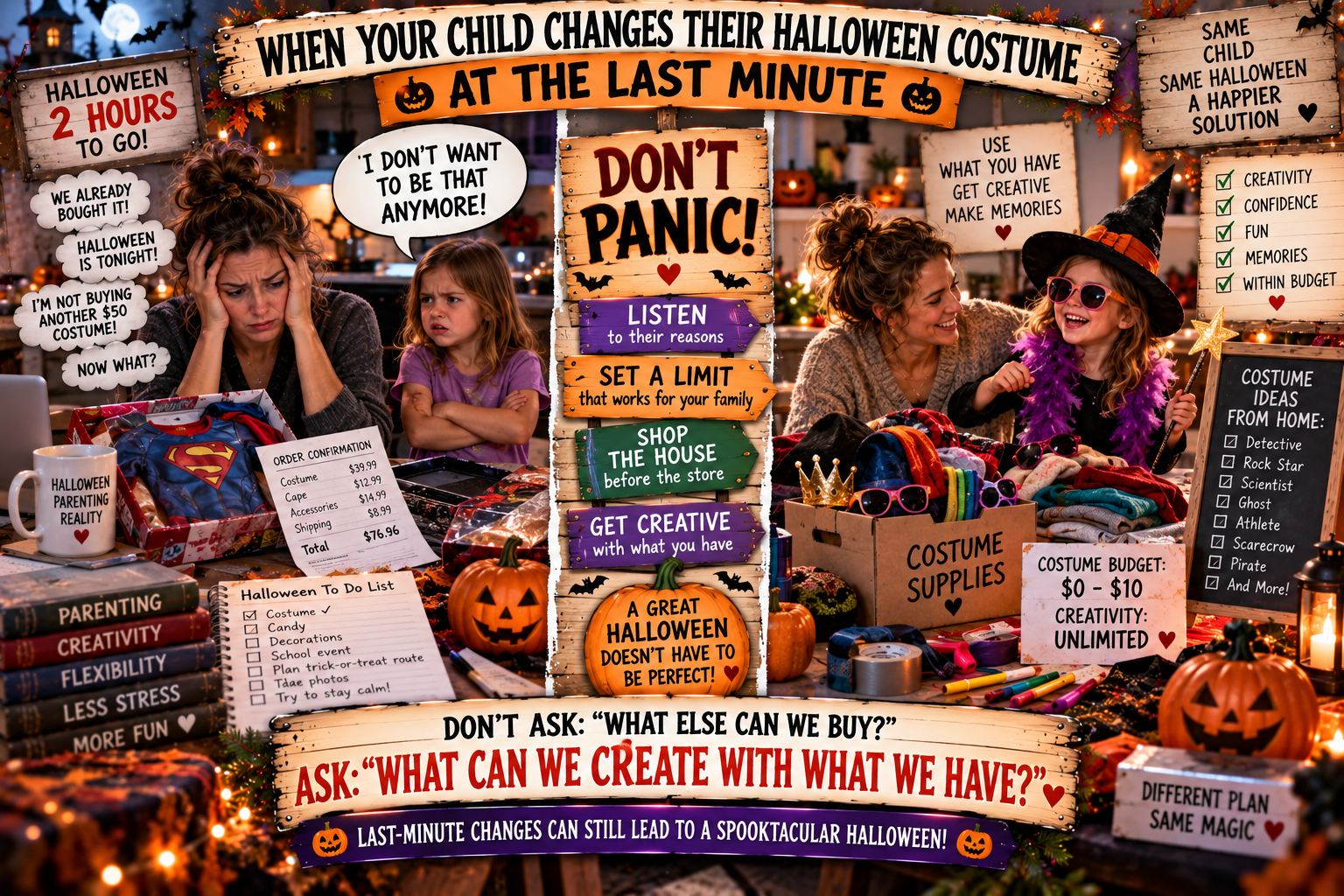
The costume was chosen weeks ago. Maybe you already bought it, ordered accessories, made part of it by hand, or spent several evenings helping your child put everything together. Then, just when you think Halloween is handled, your child announces the words no parent wants to hear: “I don’t want to be that anymore.”
Suddenly, the superhero wants to be a ghost. The princess wants to be an astronaut. The carefully planned family costume theme has lost one of its main characters. Halloween is days – or perhaps hours – away.
It is understandable to feel frustrated. Money, time, and effort may already be invested in the original costume. You may also be juggling school activities, work, candy, decorations, and everything else that comes with the season.
But a last-minute costume change does not have to become a Halloween crisis.
With calm boundaries, creativity, and realistic expectations, you can respond without spending a fortune or turning the evening into an argument. The goal is not to guarantee that your child gets every last-minute request. It is to protect both your family’s limits and the fun of the holiday.
Start by Finding Out Why They Changed Their Mind
Before immediately saying yes or no, ask what changed.
Children can reject costumes for many reasons. The costume may feel uncomfortable. A mask may be frightening or difficult to see through. They may have learned that several classmates are wearing the same thing. A friend may have criticized the idea. They may simply have discovered another character they now love more.
The reason matters.
If the problem is discomfort, you may be able to adjust the original costume. If the child is worried about being teased, the conversation may need reassurance rather than a shopping trip. If it is ordinary indecision, a reasonable boundary may be appropriate.
Listening first does not mean agreeing to every request. It means understanding the problem before choosing the response.
A calm question such as, “What made you decide you don’t want to wear it?” can prevent a quick disagreement from becoming much larger.
Acknowledge Their Feelings Without Promising a New Costume
Children often respond better when they feel heard.
You can say, “I understand that you really like this new idea,” without immediately agreeing to buy it. You can acknowledge disappointment while still maintaining a limit.
This is an important distinction.
Sometimes adults avoid validating a child’s feelings because they worry that doing so means surrendering the boundary. It does not.
You can understand why your child changed their mind and still explain that there is not enough time or money to start over completely.
Try separating the emotion from the solution: “It makes sense that you’re excited about being a vampire now. We already bought your other costume, so let’s see whether there is a way to use things we have at home.”
The child feels heard, and the family still has boundaries.
Decide What Your Nonnegotiable Limits Are
Before beginning a frantic search for a replacement, decide what you are actually willing to do.
Perhaps you are willing to spend another $10 but not $50. Maybe a new costume is fine if it can be assembled from items already at home. Perhaps you have time for one quick store trip but not an entire evening of searching.
Your limits should reflect your family’s real circumstances.
Once you know them, communicate them simply. Avoid turning the conversation into a long negotiation in which the boundary changes every five minutes.
For example: “We cannot buy another full costume, but we can make a different costume using what we already have.”
A clear limit reduces stress because it turns an unlimited problem into a smaller creative challenge.
Shop the House Before Shopping the Store
A last-minute costume request is the perfect time to become creative with what is already available.
Check closets, dress-up bins, old costumes, sports uniforms, hats, scarves, jackets, craft supplies, cardboard, makeup, costume jewelry, and reusable Halloween accessories.
Many recognizable costumes can be created around ordinary clothing. A detective, athlete, artist, tourist, scarecrow, rock star, scientist, pirate, witch, ghost, or other simple character may require only a few details.
Older costumes can also be mixed and matched. A cape from one year may work with a completely different idea. A hat, pair of glasses, or accessory can transform ordinary clothing.
This approach keeps costs under control and gives children a role in solving the problem.
Instead of asking, “What can we buy?” ask, “What can we create with what we have?”
Turn the Last-Minute Change Into a Creativity Challenge
Children may become more enthusiastic about a budget-friendly replacement when they are invited to help invent it.
Give them a few realistic options based on available materials and let them choose.
You might say, “We can make one of these three costumes tonight. Which one sounds most fun?”
Limits can actually make creativity easier because the child is no longer choosing from every costume imaginable.
Let them help assemble pieces, draw a sign, decorate a cardboard prop, choose makeup, or create a character name.
The process can become a Halloween memory of its own.
A costume that was improvised together at the last minute may ultimately be remembered more fondly than the expensive costume that arrived in a box.
Do Not Let Sunk Costs Control the Entire Decision
If you already spent money on the original costume, frustration is natural.
However, the money has already been spent whether your child wears the costume happily, wears it miserably, or chooses something else.
That does not mean you should automatically allow a replacement. Financial limits still matter. But forcing a child to wear something solely because it was expensive may not always produce the experience you hoped the purchase would create.
Consider whether the original costume can be returned, saved for another child, donated, resold, reused for dress-up, or incorporated into a future event.
Sometimes the most practical decision is to accept that the original plan did not work and avoid spending additional money trying to rescue it.
The lesson is not that choices have no consequences. It is that a disappointing purchase does not have to create a disappointing Halloween too.
Know When the Original Costume Can Be Saved
A costume change may actually be a request for a costume adjustment.
Ask what part your child dislikes.
Maybe the mask can be removed. Perhaps the uncomfortable shoes can be replaced with sneakers. A bulky accessory may be optional. Makeup can substitute for a face covering. A warm layer can make a cold costume comfortable.
Sometimes changing one element makes the original idea exciting again.
This is especially helpful when the main costume still fits and the concern is practical rather than emotional.
Before abandoning the entire plan, see whether the problem can be solved with one small change.
You may discover that you do not need a new costume at all.
Avoid Turning the Situation Into a Battle of Wills
It is easy for a costume disagreement to become about authority rather than Halloween.
The parent thinks, “I already told you no.” The child thinks, “You never listen to me.” Soon both sides are arguing about much more than clothing.
Keep returning to the actual problem.
You can be firm without becoming hostile: “I understand that you changed your mind. We are not buying another full costume. We can adjust this one or create something from home.”
Repeating a calm boundary is often more effective than adding new arguments.
The objective is not to defeat your child in a debate. It is to guide them through disappointment, choices, and limits while keeping the relationship intact.
Those lessons will matter much longer than the costume.
Watch for Peer Pressure Behind the Change
Sometimes a sudden costume rejection begins at school or among friends.
A child may hear that their costume is “babyish,” unpopular, strange, or not cool enough. They may discover that a friend group has decided to coordinate costumes without them.
If peer pressure is involved, the conversation deserves extra attention.
Ask what happened and listen without immediately dismissing the concern. Social embarrassment can feel enormous to a child even when it seems minor to an adult.
Help them decide whether they genuinely want a different costume or are abandoning something they liked because of someone else’s opinion.
Halloween can become an opportunity to talk about confidence, individuality, and the difference between considering feedback and letting other people make every choice for you.
Create a Last-Minute Costume Rule for Future Halloweens
Once you survive this year’s costume switch, use the experience to make next year easier.
Create a family rule about costume changes.
Perhaps children can change their minds freely until a certain date. After the costume is purchased, changes must use items already at home. Or each child receives a costume budget and understands that changing ideas does not increase the amount available.
The exact rule matters less than having expectations before emotions are high.
A predictable policy removes some of the personal conflict. Instead of inventing a consequence in the moment, you can refer to the rule everyone already understands.
Halloween becomes easier when boundaries are part of the plan rather than an emergency response.
Keep a Simple Backup Costume Available
A backup option can save the evening when a costume completely falls apart.
This does not require purchasing an extra costume every year.
Keep a few versatile items in a dress-up or Halloween box: a cape, hat, simple mask, old costume pieces, face paint, sports jersey, or other accessories that can create a quick alternative.
Even ordinary clothing can become a backup with imagination.
The purpose is not to encourage constant changes. It is to prevent one costume problem from making everyone feel trapped.
Knowing there is a simple Plan B can help parents remain calmer because the situation no longer feels like an emergency.
Remember That Disappointment Is Not an Emergency
Your child may be unhappy with the available choices. That can be difficult, especially when you want Halloween to feel magical.
But disappointment is a normal emotion, not something parents must eliminate at any cost.
If the desired replacement is unavailable, too expensive, or impossible to create in time, your child may need to choose among imperfect options.
You can be empathetic without fixing everything.
“I know that is disappointing. I wish we had more time too. These are the choices we have now.”
Learning to cope with a limit is valuable.
Sometimes protecting your patience means accepting that your child may be temporarily unhappy with your answer.
Protect the Mood of Halloween Night
Once Halloween arrives, try to stop revisiting the conflict.
If your child selected the backup costume, let them enjoy it. Avoid comments such as, “See, I told you the first costume was better,” or repeatedly reminding them how much the unused costume cost.
The decision has been made.
Take pictures. Compliment their creativity. Go trick-or-treating. Attend the party. Hand out candy. Enjoy the evening.
A costume problem does not deserve to become the theme of the entire holiday.
Children are often capable of moving on quickly when adults allow the moment to move on too.
The Costume Will Be Forgotten Before the Lesson
Halloween costumes are temporary. Children outgrow them, interests change, photographs get stored away, and next October brings another decision.
The way families handle frustration can leave a longer impression.
A last-minute costume change offers an opportunity to model flexibility without abandoning boundaries. You can show that disappointment can be handled, problems can be solved creatively, money has limits, and changing plans does not require panic.
You may still feel annoyed. That is normal. Patience does not mean pretending the situation is convenient.
It means choosing a response that serves the bigger goal.
Maybe your child wears the original costume with one adjustment. Maybe you create something ridiculous from a cardboard box and an old hat. Maybe the replacement is simpler than either of you imagined.
Years later, the unexpected costume may become the story everyone laughs about.
So when your child announces the last-minute change, remember: you do not need to recreate Halloween from scratch.
Listen. Set the boundary. Look around the house. Get creative. Make the best choice available.
Then let the costume be what it was always supposed to be – one small, playful part of a much bigger memory.