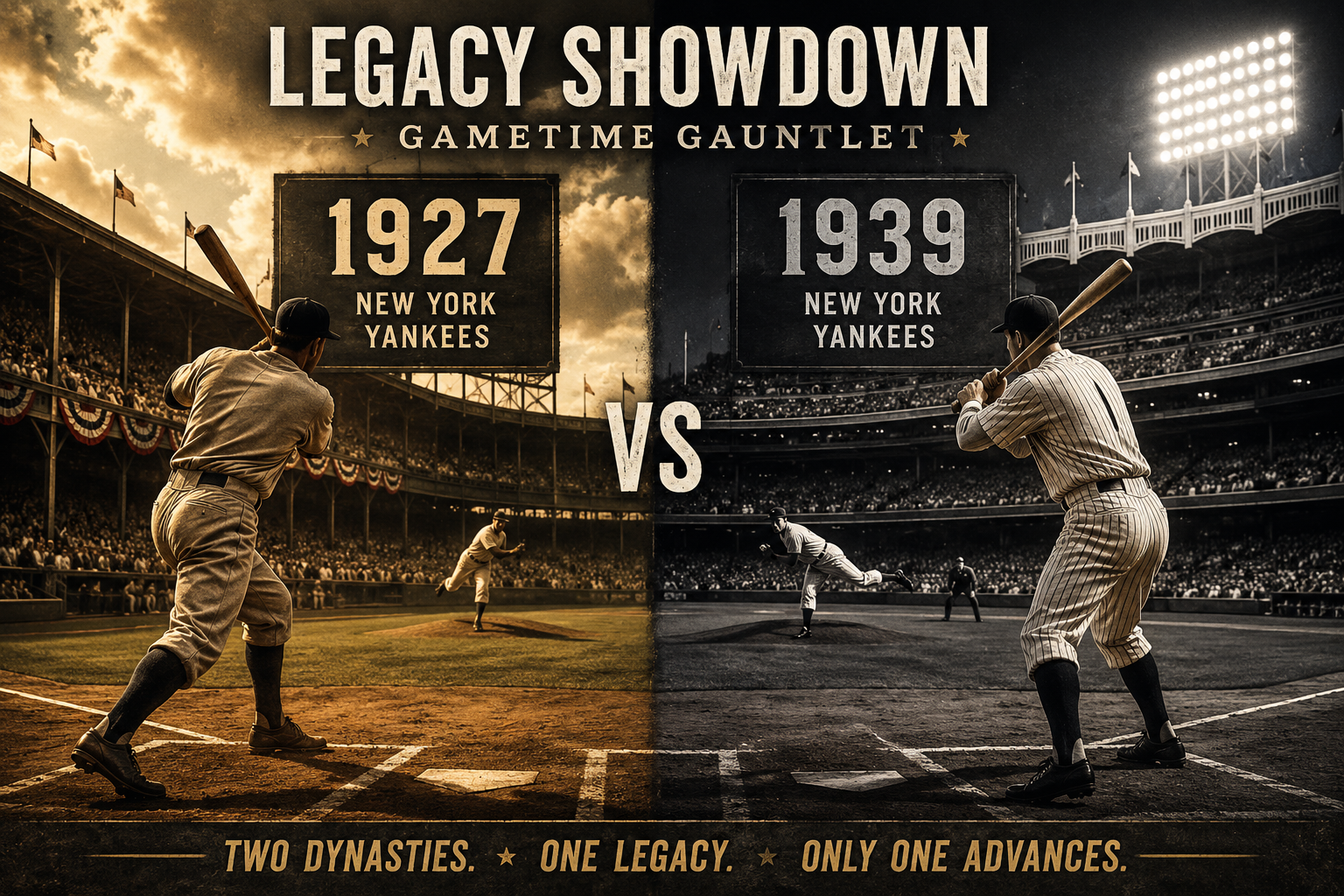

Murderers’ Row meets DiMaggio’s powerhouse champions in a battle between two of baseball’s greatest dynasties.
The MLB Region Second Round begins with perhaps the ultimate franchise showdown. The #1 seed 1927 New York Yankees, remembered forever as Murderers’ Row, combined Babe Ruth’s historic power with Lou Gehrig’s emerging greatness and overwhelmed the American League. Standing opposite them are the #8 seed 1939 New York Yankees, a club built around Joe DiMaggio and supported by one of the deepest, most balanced rosters of its era.
This matchup is not about imagining Ruth trying to hit Red Ruffing or DiMaggio facing Waite Hoyt. Gametime Gauntlet judges teams relative to their own eras and asks which team assembled the stronger overall case for greatness. The same ten tournament criteria apply: dominance, championship achievement, strength of competition, star power, depth, historical impact, statistical excellence, longevity, clutch performance, and legacy endurance.
Both teams finished their seasons as World Series champions. Both belonged to larger Yankee dynasties. Both still appear in conversations about the greatest baseball teams ever assembled. But only one can advance deeper into the MLB Region of Legacy Showdown.
Affiliate Disclaimer
This blog may contain affiliate links or banner advertisements. If you click on one of these links or advertisements and make a purchase, The Shopping Plaza may earn a small commission at no additional cost to you. These commissions help support our work and allow us to continue creating free sports content, tournaments, rankings, and entertainment features like Gametime Gauntlet and the larger Legacy Showdown series. We only recommend products, services, or merchandise that we believe may be of interest to our readers. Thank you for supporting The Shopping Plaza.
Gametime Gauntlet Rules
Each team receives one point for winning a judging category. Teams are evaluated relative to their own eras, modern training and technology advantages are ignored, and the focus is historical greatness rather than a hypothetical head-to-head game. Championship results matter, but they do not automatically decide every category. If the overall score is tied, the tournament uses Championship Achievement, Dominance Over Competition, and Historical Impact as tiebreakers, in that order.
1. Dominance Over Competition
The 1927 Yankees won 110 games, finished 19 games ahead of the Philadelphia Athletics, and made the American League race feel almost predetermined. Their lineup scored 975 runs, while Ruth’s 60 home runs and Gehrig’s 175 RBIs gave the offense historic star power at the center of its dominance. The club then swept the Pittsburgh Pirates in the World Series, completing a season in which opponents rarely found a meaningful opening. The 1939 Yankees were hardly ordinary by comparison: they won 106 games and also ran away with the American League pennant. Their run differential was extraordinary, reflecting a club that dominated through both scoring and run prevention. Yet the 1927 team’s 110 victories, enormous pennant margin, and perfect World Series finish create the stronger overall picture of control from April through October.
Winner: 1927 New York Yankees.
2. Championship Achievement
Both teams completed the only requirement that ultimately matters most in a championship season: they won the World Series. The 1927 Yankees swept Pittsburgh in four games, turning a historically dominant regular season into an undisputed championship. The 1939 Yankees were equally ruthless in October, sweeping the Cincinnati Reds and allowing no possibility of a prolonged series. That makes this category much closer than the original short comparison suggests because neither champion stumbled at the final hurdle. The distinction comes from the total arc of the season and the way the 1927 title became inseparable from the mythology of Murderers’ Row. Their championship did more than validate a great team; it became the defining finish to one of baseball’s most celebrated seasons.
Winner: 1927 New York Yankees.
3. Strength of Competition
The 1927 Yankees competed in an eight-team American League and dominated a baseball world that was already rich with legendary talent. Their closest league rival was a strong Philadelphia Athletics club, and their World Series opponent, Pittsburgh, had won the National League pennant with a talented roster. Still, the 1939 Yankees played in a somewhat more developed version of the major leagues, with another decade of tactical evolution, roster construction, and increasingly established professional systems. They also navigated a league containing notable stars and then faced the National League champion Cincinnati Reds. Neither team should be penalized for the structure of its own era, but the tournament rules allow the difficulty and depth of the competitive environment to matter. On that basis, the later Yankees receive a narrow advantage.
Winner: 1939 New York Yankees.
4. Star Power
The 1939 Yankees had extraordinary names, beginning with Joe DiMaggio and extending through Bill Dickey, Joe Gordon, Red Ruffing, and other major contributors. DiMaggio was already one of baseball’s brightest stars, and the roster contained the kind of elite talent expected from a dynasty. But the 1927 Yankees possessed Babe Ruth and Lou Gehrig together at overwhelming levels of production. Ruth’s 60-home-run season became one of the most famous individual achievements in sports history, while Gehrig drove in 175 runs and won the American League MVP award. Their partnership gave Murderers’ Row two transcendent figures whose names still sit near the center of baseball history. When a category specifically asks about the concentration and magnitude of superstar talent, Ruth and Gehrig are nearly impossible to overcome.
Winner: 1927 New York Yankees.
5. Depth and Supporting Cast
The 1927 lineup was much more than Ruth and Gehrig, with players such as Tony Lazzeri, Earle Combs, Bob Meusel, and a strong pitching staff helping create a complete champion. That supporting cast is sometimes overshadowed because the two central stars became so enormous historically. The 1939 Yankees, however, make depth one of their strongest arguments in the entire matchup. Joe DiMaggio was surrounded by Bill Dickey, Joe Gordon, Charlie Keller, Red Rolfe, George Selkirk, and a pitching staff led by Red Ruffing, Lefty Gomez, and others. Their greatness was distributed across the lineup, defense, and pitching staff rather than resting primarily on one legendary offensive duo. That balance made the 1939 club capable of overwhelming opponents in multiple ways and gives it the edge in overall roster depth.
Winner: 1939 New York Yankees.
6. Historical Impact
The 1939 Yankees belong to one of the greatest dynastic stretches in professional sports and helped reinforce New York’s reputation as baseball’s dominant organization. Their success strengthened the image of the Yankees as a machine capable of replacing stars, sustaining excellence, and repeatedly winning championships. Yet the 1927 Yankees occupy a different level of historical symbolism. Murderers’ Row became a phrase that survived far beyond the season itself, while Ruth’s home-run record and the Ruth-Gehrig pairing helped define the power-centered imagination of American baseball. The team became an enduring reference point whenever later clubs were described as historically dominant. Few single-season teams in any sport have shaped the mythology of greatness as strongly as the 1927 Yankees.
Winner: 1927 New York Yankees.
7. Statistical Excellence
The 1927 Yankees produced statistics that still look astonishing when placed in the context of their era. They won 110 games, scored 975 runs, and featured Ruth’s 60 home runs alongside Gehrig’s massive run production. The lineup’s collective offensive strength made Murderers’ Row more than a nickname; it described a team that placed constant pressure on opposing pitchers. The 1939 Yankees present an exceptional statistical case of their own, winning 106 games while combining elite offense with outstanding run prevention. In some measures of overall team efficiency and run differential, the 1939 club can make a serious argument for being the more balanced statistical machine. But because Gametime Gauntlet evaluates accomplishments relative to era as well as their enduring historical significance, the unprecedented offensive landmarks of 1927 narrowly carry the category.
Winner: 1927 New York Yankees.
8. Longevity of Greatness
The 1927 Yankees were not an isolated one-season miracle. They were part of a powerful era that also produced pennants and championships around Ruth, Gehrig, and the larger Yankees organization. Even so, the 1939 club sits inside an especially remarkable stretch of sustained supremacy. New York won four consecutive World Series championships from 1936 through 1939, making the 1939 team the closing champion of a dynasty that repeatedly proved itself against the best teams in baseball. That sustained run demonstrates organizational strength, roster continuity, and the ability to remain on top despite the pressure that follows repeated success. Because this category rewards greatness that extends beyond one celebrated season, the late-1930s Yankees own the clearer advantage.
Winner: 1939 New York Yankees.
9. Clutch Performance
The 1927 Yankees left little doubt in the World Series, sweeping the Pirates and finishing their historic season without allowing October to become a weakness. Their championship performance confirmed that regular-season dominance could survive the pressure of the sport’s biggest stage. The 1939 Yankees matched that standard by sweeping Cincinnati in four games, giving them an equally clean championship result. Their victory also completed a fourth consecutive World Series championship, meaning many core players were repeatedly succeeding under postseason pressure rather than experiencing October dominance only once. That history of championship repetition strengthens the 1939 team’s clutch argument. With both clubs perfect in their respective World Series, the larger postseason context gives the 1939 Yankees the narrow edge.
Winner: 1939 New York Yankees.
10. Legacy Endurance
The 1939 Yankees remain respected as one of the most complete teams in franchise history, particularly among baseball historians who value balance, run differential, depth, and the dynasty surrounding the club. Their case has actually grown stronger as statistical analysis has given fans more ways to appreciate just how thoroughly they controlled their season. But the 1927 Yankees occupy a rarer place in sports memory. Nearly a century later, Murderers’ Row remains a universally recognized nickname, Ruth’s 60 home runs remain part of baseball folklore, and the team is still routinely invoked as a benchmark for all-time greatness. Even people who cannot name every player on the roster often understand what the 1927 Yankees represent. Legacy Endurance asks which team has remained most firmly planted in the historical imagination, and that answer is still 1927.
Winner: 1927 New York Yankees.
Final Verdict
This is baseball royalty against baseball royalty, and the final 6-4 score reflects how little separates the two clubs. The 1939 Yankees win Strength of Competition, Depth and Supporting Cast, Longevity of Greatness, and Clutch Performance. Those victories tell a coherent story: DiMaggio’s club was extraordinarily balanced, belonged to a sustained championship machine, and completed another dominant October.
The 1927 Yankees win Dominance Over Competition, Championship Achievement, Star Power, Historical Impact, Statistical Excellence, and Legacy Endurance. Their path to victory is built around the extraordinary combination of results and mythology. They did not merely win 110 games and sweep the World Series; they created a lasting image of baseball dominance centered on Ruth, Gehrig, and Murderers’ Row.
The 1939 team may have been the more complete roster from top to bottom, and a reasonable historian can absolutely prefer its balance. Gametime Gauntlet, however, asks for overall greatness across all ten criteria rather than the answer to one statistical question. The 1927 Yankees combine championship success, overwhelming regular-season control, transcendent star power, and a legacy that still defines what an all-time team is supposed to look like.
Final Result: 1927 New York Yankees advance by a score of 6-4.
Gametime Gauntlet Scorecard
Dominance Over Competition: 1927 Yankees
Championship Achievement: 1927 Yankees
Strength of Competition: 1939 Yankees
Star Power: 1927 Yankees
Depth and Supporting Cast: 1939 Yankees
Historical Impact: 1927 Yankees
Statistical Excellence: 1927 Yankees
Longevity of Greatness: 1939 Yankees
Clutch Performance: 1939 Yankees
Legacy Endurance: 1927 Yankees
FINAL SCORE: 1927 NEW YORK YANKEES 6 – 1939 NEW YORK YANKEES 4
Audience Challenge
Which Yankees team deserves the title of greatest in franchise history: Ruth and Gehrig’s Murderers’ Row or DiMaggio’s powerhouse champions of 1939? Does the 1927 team’s unmatched mythology and star power outweigh the 1939 club’s depth, balance, and place within a four-year championship dynasty? Pick the category you would change, defend your choice, and tell us which Yankees team should advance in Gametime Gauntlet.