
Affiliate Disclosure
Some of the links on this page may be affiliate links. This means that if you click through and make a purchase, The Shopping Plaza may earn a small commission at no additional cost to you.
These commissions help support the operation of this website and allow us to continue creating free content, contests, rankings, and entertainment features like Sitcom Showdown.
We only recommend products, services, and merchandise that we believe may be of interest to our readers. Your support through these affiliate links is greatly appreciated and helps keep The Shopping Plaza growing.
Thank you for supporting The Shopping Plaza!
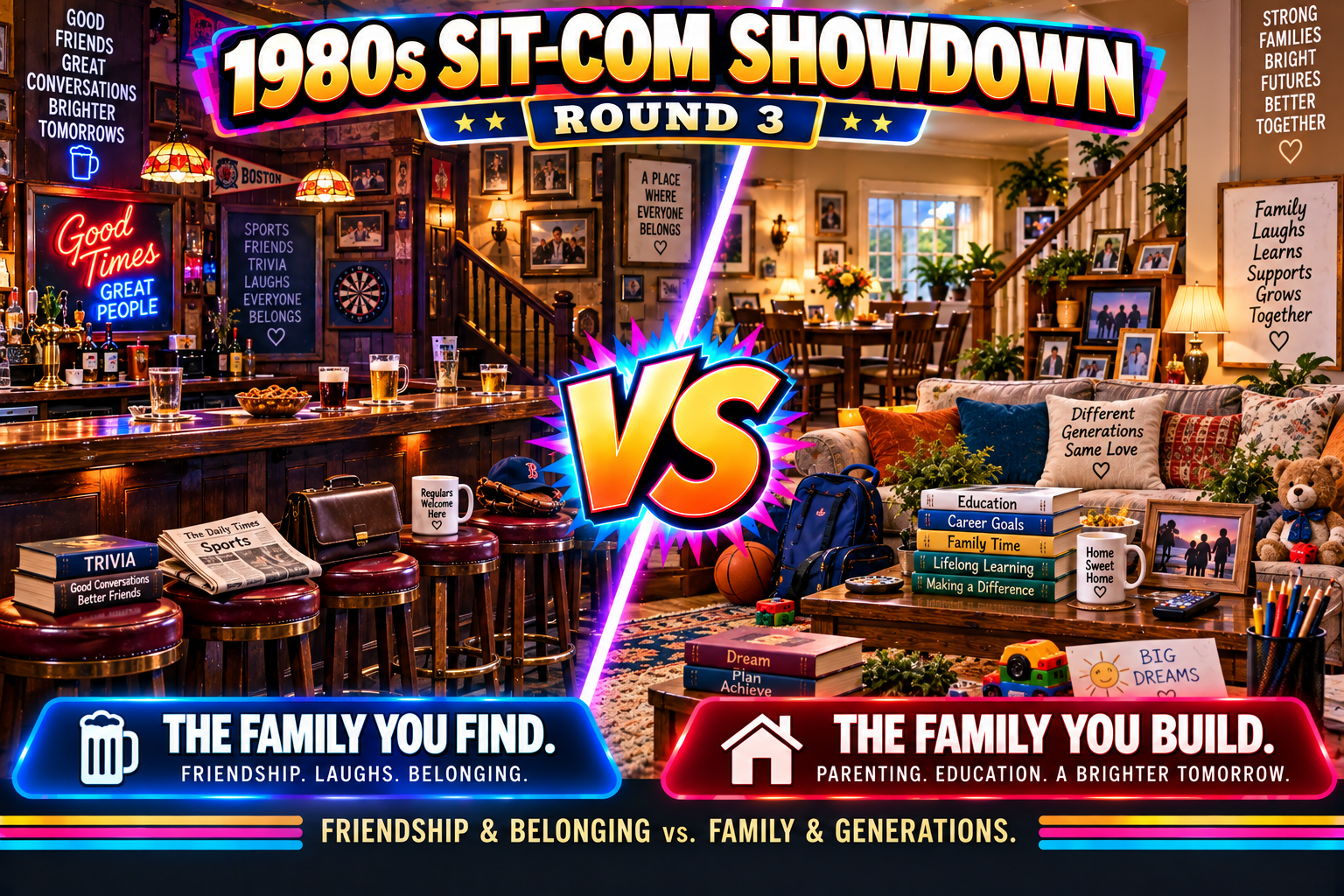
Round 3 now enters the 1980s bracket, and the opening matchup brings together two sitcoms that helped define the decade: Cheers and The Cosby Show. Cheers turned a neighborhood Boston bar into one of television’s richest ensemble worlds, where romance, friendship, rivalry, loneliness, and everyday conversation could generate comedy for eleven seasons. The Cosby Show centered the Huxtable family and became one of the defining family sitcoms of its era, combining parenting, marriage, education, generational relationships, and upper-middle-class family life.
Cheers arrives after dominating Diff’rent Strokes in the previous round. The Cosby Show advanced after defeating Growing Pains. Both were major 1980s successes, but they reached that success through different strengths: Cheers through character-driven workplace storytelling and an evolving ensemble, The Cosby Show through family chemistry, broad accessibility, and enormous cultural visibility.
Round 3 uses our expanded ten-category format, including Writing & Storytelling and Character Development. Those additional criteria matter here because the deeper we move into Sit-Com Showdown, the less a show can rely on popularity alone. We are now judging how completely each series mastered the sitcom form.
The Expanded Round 3 Legacy Showdown Rules
- Comedy Quality
- Character Chemistry
- Cultural Impact
- Longevity & Replay Value
- Iconic Moments
- Supporting Cast
- Era Difficulty
- Legacy Endurance
- Writing & Storytelling – How effectively the series constructs episodes, long-term arcs, themes, callbacks, and comic or emotional payoffs.
- Character Development – How convincingly major characters grow, change, deepen, or reveal new dimensions across the series.
Round 1: Comedy Quality
The Cosby Show built much of its humor from recognizable family situations: children testing boundaries, parents responding to questionable decisions, sibling competition, school problems, dating, and the everyday negotiations of a busy household. Its comedy was accessible enough for families to watch together while still giving adults plenty to recognize in Cliff and Clair’s parenting.
Cheers had a broader and sharper comic engine. Sam’s ego, Diane’s intellectual intensity, Carla’s insults, Coach’s innocence, Norm’s deadpan entrances, Cliff’s endless trivia, Frasier’s neuroses, Rebecca’s ambitions, and Woody’s good-natured simplicity gave the writers an extraordinary range of comic voices. A conversation at the bar could become a battle of class, romance, intelligence, insecurity, or pride. Cheers takes the opening round.
Winner: Cheers.
Round 2: Character Chemistry
The Cosby Show’s greatest strength was the sense of a functioning family. Cliff and Clair were affectionate partners as well as parents, and the five Huxtable children gave the household different ages, personalities, and problems. Grandparents, spouses, friends, and extended family helped make the home feel multigenerational rather than isolated.
Cheers built chemistry across an even larger number of combinations. Sam and Diane created one of television’s defining will-they-or-won’t-they relationships, but the series did not depend on them alone. Sam and Carla, Norm and Cliff, Frasier and Lilith, Woody and the regulars, Rebecca and Sam, and countless smaller pairings all worked. The bar itself functioned as a chosen family whose members could insult each other mercilessly and still belong together.
Winner: Cheers.
Round 3: Cultural Impact
Cheers became one of the defining workplace comedies in television history. Its theme song, the idea of a place ‘where everybody knows your name,’ Sam and Diane’s romance, Norm’s entrance, and the ensemble-bar format became deeply embedded in popular culture. Its influence can be traced through later hangout and workplace sitcoms.
The Cosby Show had a different level of immediate cultural reach. At its peak, the Huxtables were central figures in American television, and the show’s portrayal of an affluent Black professional family challenged narrow television stereotypes that had often limited Black family representation. It also became associated with the broader resurgence of the network family sitcom in the 1980s. Whatever later controversies surrounding its star have done to the show’s public legacy, its historical impact during its original era was enormous.
Winner: The Cosby Show.
Round 4: Longevity & Replay Value
The Cosby Show ran eight seasons and created a substantial catalog of family stories that followed the Huxtable children through different stages of growing up. Many episodes remain recognizable as family situations independent of the decade in which they were produced.
Cheers ran eleven seasons and successfully reinvented major pieces of itself along the way. Coach was replaced by Woody after Nicholas Colasanto’s death, Diane eventually departed, Rebecca entered, and Frasier grew from recurring romantic complication into a core member of the ensemble. Despite those changes, the bar remained familiar. That combination of length, adaptability, and character-based replay value gives Cheers the category.
Winner: Cheers.
Round 5: Iconic Moments
The Cosby Show created many memorable family-comedy moments, from Cliff’s elaborate parenting lessons to musical and anniversary sequences involving the Huxtable family. Cliff’s sweaters, the brownstone, and the show’s opening credits across different seasons became immediately recognizable parts of its identity.
Cheers has an unusually concentrated collection of sitcom signatures. Norm walking into the bar and being greeted by name, Sam behind the counter, Diane and Sam sparring, Cliff delivering questionable facts, Carla firing insults, and the bar’s staircase and entrance are inseparable from the series. Even the theme song functions almost like a statement of purpose for the entire show. Cheers wins on the strength of iconography that remains instantly associated with classic television.
Winner: Cheers.
Round 6: Supporting Cast
The Cosby Show’s family structure gave it a naturally deep supporting world. Sondra, Denise, Theo, Vanessa, and Rudy each developed their own relationships and stories, while Elvin, Martin, Olivia, grandparents, friends, and school figures expanded the Huxtables’ circle. Because children aged and their lives changed, new supporting relationships could enter organically.
Cheers may have the stronger supporting ensemble of the entire 1980s bracket. Carla, Norm, Cliff, Coach, Woody, Frasier, Lilith, Rebecca, and others are not background decoration; many became essential pieces of the show’s identity. Frasier Crane became so durable that he eventually anchored his own long-running series. Cheers wins because nearly every stool at the bar seems capable of producing a story.
Winner: Cheers.
Round 7: Era Difficulty
Cheers faced a famously difficult beginning. Its early ratings were weak, and a lesser series might not have survived long enough to become a classic. It also endured major cast changes, including the death of Nicholas Colasanto and the eventual departure of Shelley Long, without losing its identity. Surviving those disruptions required exceptional creative adaptability.
The Cosby Show carried a different burden. It had to prove that a family sitcom centered on an affluent Black family could become broad mainstream television rather than being treated as programming for a limited audience. Its success was massive and helped reshape network assumptions about both family comedy and Black representation. Because that success challenged industry expectations while reaching an enormous audience, The Cosby Show earns a narrow edge.
Winner: The Cosby Show.
Round 8: Legacy Endurance
The Cosby Show’s historical legacy is complicated. Its importance to 1980s television and Black family representation remains part of television history, but the criminal convictions and public disgrace of Bill Cosby profoundly changed the way many viewers and institutions engage with the series. The work’s historical impact and the later reputation of its central star cannot be treated as the same question, yet the controversy undeniably affects the show’s cultural afterlife.
Cheers has endured with far less disruption to its reputation. Its characters, theme song, bar setting, writing, and ensemble remain central to classic-sitcom discussions. More importantly, its universe continued through Frasier, extending the creative lineage of Cheers across decades. When judging legacy endurance specifically—not peak cultural impact—Cheers has the clearer advantage.
Winner: Cheers.
Round 9: Writing & Storytelling
The Cosby Show was highly effective at constructing family stories around lessons without always making them feel like lectures. Cliff and Clair could use humor, role-playing, consequences, or conversation to help their children understand responsibility. The episodic format allowed viewers to enter almost anywhere while still watching the family change over time.
Cheers excelled at layered character writing. Sam and Diane’s attraction could be romantic, competitive, intellectual, and self-destructive within the same storyline. The writers later reconfigured the series around Rebecca without simply recreating Diane. Secondary characters developed recurring emotional lives, and the bar allowed multiple stories to intersect naturally. The show’s ability to survive major structural changes while preserving its voice demonstrates exceptional storytelling craft.
Winner: Cheers.
Round 10: Character Development
The Cosby Show naturally developed its younger characters as they grew older. Theo matures from a struggling teenager into a more responsible young adult, Denise searches for direction, and the other Huxtable children move through changing educational, romantic, and family experiences. Cliff and Clair also adjust as parenting older children becomes different from parenting young ones.
Cheers provides even more extensive adult character evolution. Sam’s identity as a former athlete and compulsive womanizer is repeatedly challenged by age, sobriety, love, and responsibility. Frasier changes dramatically from his introduction, Woody grows into adulthood, Rebecca’s ambitions repeatedly collide with insecurity, and even supporting characters reveal unexpected vulnerability. The characters rarely become completely different people, but years at Cheers expose layers beneath their comic types.
Winner: Cheers.
Final Verdict
The Cosby Show wins Cultural Impact and Era Difficulty. Those are significant victories. Its portrayal of the Huxtables was a major part of 1980s television culture, and its mainstream success challenged restrictive assumptions about what a Black family sitcom could look like and how large an audience it could reach.
Cheers wins Comedy Quality, Character Chemistry, Longevity & Replay Value, Iconic Moments, Supporting Cast, Legacy Endurance, Writing & Storytelling, and Character Development. The final score is 8-2. As with several of our deeper-round matchups, that score does not mean every category was easy; Era Difficulty, chemistry, longevity, and character work all required close consideration.
Ultimately, Cheers proves to be the more complete tournament contender. It survived weak early ratings, major cast transitions, and eleven seasons while continuing to deepen its ensemble and produce memorable comedy. Its creative lineage also continued through Frasier, strengthening an already remarkable legacy. The Cosby Show exits with an important place in television history, but Cheers advances deeper into the 1980s Sit-Com Showdown.
Audience Challenge
Do you agree with the 8-2 decision? Should The Cosby Show’s enormous 1980s cultural impact, family chemistry, and historical importance have earned it more categories, or do Cheers’ ensemble depth, writing, longevity, character development, and enduring creative legacy justify the result? Cast your vote, defend your favorite, and keep following Legacy Showdown as Round 3 of the 1980s bracket continues.