

Affiliate Disclosure
Some of the links on this page may be affiliate links. This means that if you click through and make a purchase, The Shopping Plaza may earn a small commission at no additional cost to you.
These commissions help support the operation of this website and allow us to continue creating free content, contests, rankings, and entertainment features like Sitcom Showdown.
We only recommend products, services, and merchandise that we believe may be of interest to our readers. Your support through these affiliate links is greatly appreciated and helps keep The Shopping Plaza growing.
Thank you for supporting The Shopping Plaza!
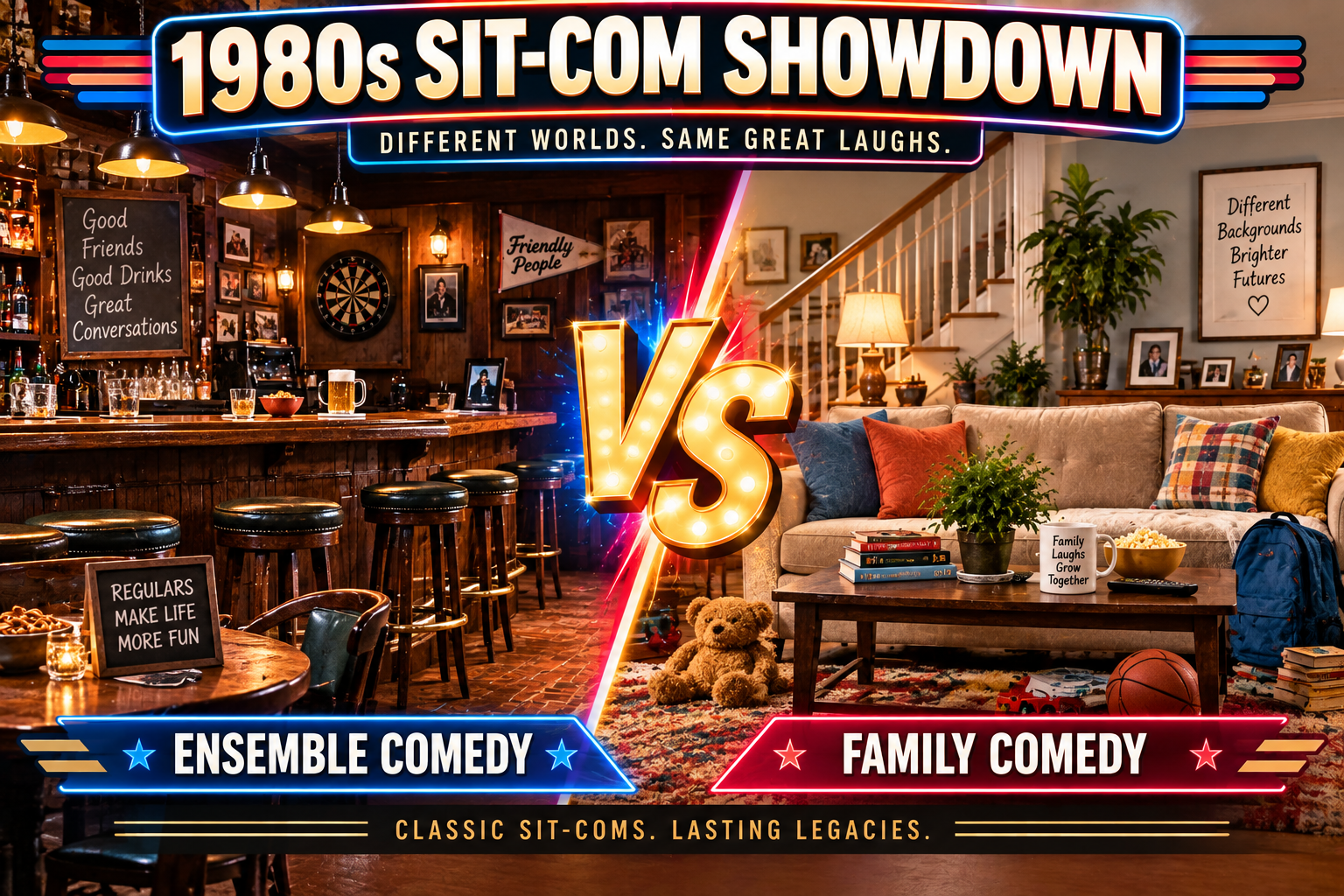
The second round now moves into the 1980s bracket, where the competition immediately delivers a clash between two of the decade’s most recognizable sitcoms: Cheers and Diff’rent Strokes. One turned a neighborhood Boston bar into one of television’s greatest ensemble settings, while the other built a family comedy around two brothers whose lives changed when they moved from Harlem into the Manhattan home of wealthy businessman Philip Drummond.
Cheers became famous for sophisticated writing, complicated relationships, and a collection of characters who could make sitting around a bar feel endlessly entertaining. Diff’rent Strokes offered a broader family-comedy style, led by Gary Coleman’s unforgettable performance as Arnold Jackson and supported by stories that frequently moved between lighthearted humor and serious social issues.
This matchup presents a real contrast in sitcom legacy. Can the enormous popularity, memorable catchphrases, and family-centered appeal of Diff’rent Strokes overcome the writing, ensemble chemistry, and long-term critical reputation of Cheers? The 1980s bracket is officially underway, and only one of these television favorites can advance.
The Legacy Showdown Rules
- Comedy Quality
- Character Chemistry
- Cultural Impact
- Longevity & Replay Value
- Iconic Moments
- Supporting Cast
- Era Difficulty
- Legacy Endurance
Round 1: Comedy Quality
Cheers operated at an unusually high level when it came to comedic writing. The humor could come from Sam Malone’s confidence, Diane Chambers’s intellectual intensity, Carla Tortelli’s sarcasm, Norm Peterson’s deadpan observations, Cliff Clavin’s endless trivia, or the simple rhythm of the entire bar reacting to one another. Rather than relying on one dominant comic formula, the series could shift between verbal wit, romantic tension, character flaws, running jokes, and ensemble banter. The result was comedy that rewarded viewers for knowing the personalities as much as the punch lines.
Diff’rent Strokes had a very different strength. Gary Coleman possessed remarkable comic timing, and Arnold’s reactions could turn an ordinary family scene into the funniest moment of an episode. His exchanges with Willis, Mr. Drummond, Kimberly, and later household characters gave the show a warm and accessible style. The famous ‘Whatchu talkin’ ’bout, Willis?’ line became larger than the series itself. But while Diff’rent Strokes could be very funny, Cheers delivered more consistent and sophisticated comedy across its ensemble.
Winner: Cheers.
Round 2: Character Chemistry
Diff’rent Strokes depended on viewers believing that the Drummond household could become a genuine family despite enormous differences in background and experience. Arnold and Willis shared convincing brotherly chemistry, while Philip Drummond’s relationship with the boys gave the series much of its heart. The show worked best when the comedy came from family personalities rather than from the social issue of the week. Gary Coleman and Todd Bridges created a central relationship audiences could immediately understand and care about.
Cheers, however, built one of the deepest chemistry networks in sitcom history. Sam and Diane created romantic tension that could drive entire seasons, but the series was never dependent on that relationship alone. Norm and Cliff felt like people who genuinely belonged at the bar, Carla could insult almost anyone without disrupting the ensemble, and Coach brought warmth to the early seasons. Later additions such as Woody, Frasier, and Rebecca changed the chemistry without destroying it. Few sitcoms have ever made such a large group of characters feel so naturally connected.
Winner: Cheers.
Round 3: Cultural Impact
Diff’rent Strokes became one of the defining family sitcoms of its era. Gary Coleman was a major television star, Arnold Jackson became an instantly recognizable character, and ‘Whatchu talkin’ ’bout, Willis?’ became one of television’s most famous catchphrases. The series also became known for tackling difficult subjects through its special-message episodes, addressing issues that many family sitcoms might otherwise have avoided. Its popularity helped make the Drummond apartment and the Jackson brothers familiar to millions of viewers.
Cheers reached an even broader level of television influence. The idea of a place ‘where everybody knows your name’ became a cultural shorthand for belonging and community, while the bar itself became one of television’s most recognizable settings. The series influenced later workplace and ensemble comedies by demonstrating how much storytelling could emerge from a fixed location and a carefully developed group of personalities. It also helped launch Frasier Crane into a successful spinoff that extended the Cheers universe for years. Diff’rent Strokes left a major pop-culture footprint, but Cheers had the larger impact on television comedy itself.
Winner: Cheers.
Round 4: Longevity & Replay Value
Diff’rent Strokes retains strong nostalgic appeal, especially for viewers who grew up with Arnold and Willis. Its family structure makes many episodes easy to revisit, and Gary Coleman’s performance remains entertaining decades later. The show also offers a fascinating snapshot of the era, particularly in the way network sitcoms combined broad comedy with episodes designed to teach serious lessons. At the same time, some of those storytelling choices can feel closely tied to the television conventions of the late 1970s and 1980s.
Cheers has aged exceptionally well because its greatest strengths are character, dialogue, and relationships. A bar conversation involving Norm, Cliff, Carla, Sam, and the rest of the group can still work without requiring viewers to understand the politics or trends of the decade. The show also evolved successfully over a long run, surviving major cast changes while maintaining its identity. Viewers can revisit individual episodes for the jokes or watch long stretches to follow relationships and character development. That combination gives Cheers extraordinary replay value.
Winner: Cheers.
Round 5: Iconic Moments
Diff’rent Strokes has one advantage that cannot be ignored: Arnold Jackson produced one of the most recognizable catchphrases in sitcom history. Gary Coleman’s delivery of ‘Whatchu talkin’ ’bout, Willis?’ became an enduring piece of popular culture, repeated and parodied long after the original series ended. The show also created memorable emotional episodes by confronting serious subjects, sometimes shifting dramatically away from its usual family-comedy tone. For viewers of the era, Arnold’s expressions and reactions remain inseparable from the show’s identity.
Cheers counters with a much larger collection of memorable television moments built over its long run. Sam and Diane’s romantic battles became one of the defining will-they-or-won’t-they relationships in sitcom history. Norm’s entrances regularly triggered one of television’s most beloved recurring greetings, while the bar’s familiar conversations made even small moments feel iconic to longtime viewers. The arrival and development of Frasier, the transition from Coach to Woody, and later changes in Sam’s relationships gave the series numerous landmark moments. Diff’rent Strokes may own the more famous single catchphrase, but Cheers has the deeper catalog.
Winner: Cheers.
Round 6: Supporting Cast
Diff’rent Strokes had a recognizable supporting group around Arnold and Willis. Philip Drummond provided stability, Kimberly gave the household another sibling perspective, and Mrs. Garrett became so popular that the character eventually moved into The Facts of Life. Later household characters helped the series adapt as the cast and stories changed. The show’s supporting cast was important because Arnold’s comedy worked best when he had strong personalities around him to react to.
Supporting cast depth is one of the categories where Cheers becomes extremely difficult to beat. Norm, Cliff, Carla, Coach, Woody, Frasier, Lilith, Rebecca, and others were not merely background characters; several could dominate an episode or carry major storylines. The show repeatedly introduced or elevated characters without making the bar feel overcrowded. Frasier became important enough to lead one of television’s most successful spinoffs, while Norm and Cliff became permanent symbols of the neighborhood-bar atmosphere. Cheers wins this category decisively because its supporting ensemble is central to its legendary reputation.
Winner: Cheers.
Round 7: Era Difficulty
Diff’rent Strokes became a major success during an era filled with memorable family comedies and television stars. It had to balance broad humor with changing audience expectations and increasingly serious storylines, all while keeping Arnold at the center as its young cast grew older. Maintaining that formula was not easy, especially because child-centered sitcoms often struggle when their young stars mature. The series nevertheless remained a recognizable part of the television landscape for years.
Cheers faced its own difficult path and famously did not begin as an immediate ratings powerhouse. It had to survive long enough for audiences to discover its characters and for the ensemble to develop into one of television’s strongest. The 1980s were packed with major sitcom competition, yet Cheers eventually became one of the decade’s defining comedies while continuing into the early 1990s. It also survived the departure of a central character and successfully reconfigured its romantic and ensemble dynamics. That combination of competition, early adversity, and reinvention gives Cheers the edge.
Winner: Cheers.
Round 8: Legacy Endurance
Diff’rent Strokes remains an important and fondly remembered part of 1980s television history. Arnold Jackson and Gary Coleman’s performance still generate immediate recognition, and the show’s catchphrase has survived far beyond its original broadcast era. Its connection to The Facts of Life also gives it an additional place within the larger history of television spinoffs. For audiences who grew up with the show, its mix of family warmth, comedy, and serious-message episodes carries powerful nostalgia.
Cheers has endured at an elite level. It continues to be discussed as one of the greatest American sitcoms, and its influence can be seen in later ensemble and workplace comedies built around groups of flawed but lovable characters. The theme song, the bar, Sam Malone, Norm Peterson, Diane Chambers, Carla Tortelli, Frasier Crane, and the phrase ‘where everybody knows your name’ remain deeply embedded in television culture. Its legacy was also extended by Frasier, proving that the world created by Cheers could survive even after the original bar closed its doors. Diff’rent Strokes remains beloved, but Cheers has achieved a broader and more durable television legacy.
Winner: Cheers.
Final Verdict
Diff’rent Strokes enters this matchup with more firepower than an 8-0 score might suggest. Gary Coleman was one of the defining television personalities of his era, Arnold Jackson produced a catchphrase that became part of pop culture, and the series combined family comedy with a willingness to confront serious subjects. It absolutely earned its place in the second round of the 1980s bracket.
But this matchup runs directly into one of the tournament’s heaviest contenders. Cheers takes all eight categories because its strengths extend across virtually every part of the Legacy Showdown formula: elite comedy writing, extraordinary ensemble chemistry, cultural influence, replay value, iconic moments, supporting-cast depth, resilience, and long-term endurance.
With an 8-0 victory, Cheers advances deeper into the 1980s Sit-Com Showdown bracket. The score looks dominant, but it reflects the exceptional completeness of Cheers more than a lack of legacy for Diff’rent Strokes. As the bracket gets tougher, the Boston bar has made an emphatic statement that everybody may know its name for a reason.
Audience Challenge
Do you agree with the decision? Is Cheers simply too complete for Diff’rent Strokes in this matchup, or should Arnold Jackson and the Drummond family have taken one or more of these rounds? Cast your vote, defend your favorite, and keep following Legacy Showdown as the 1980s Sit-Com Showdown bracket continues.