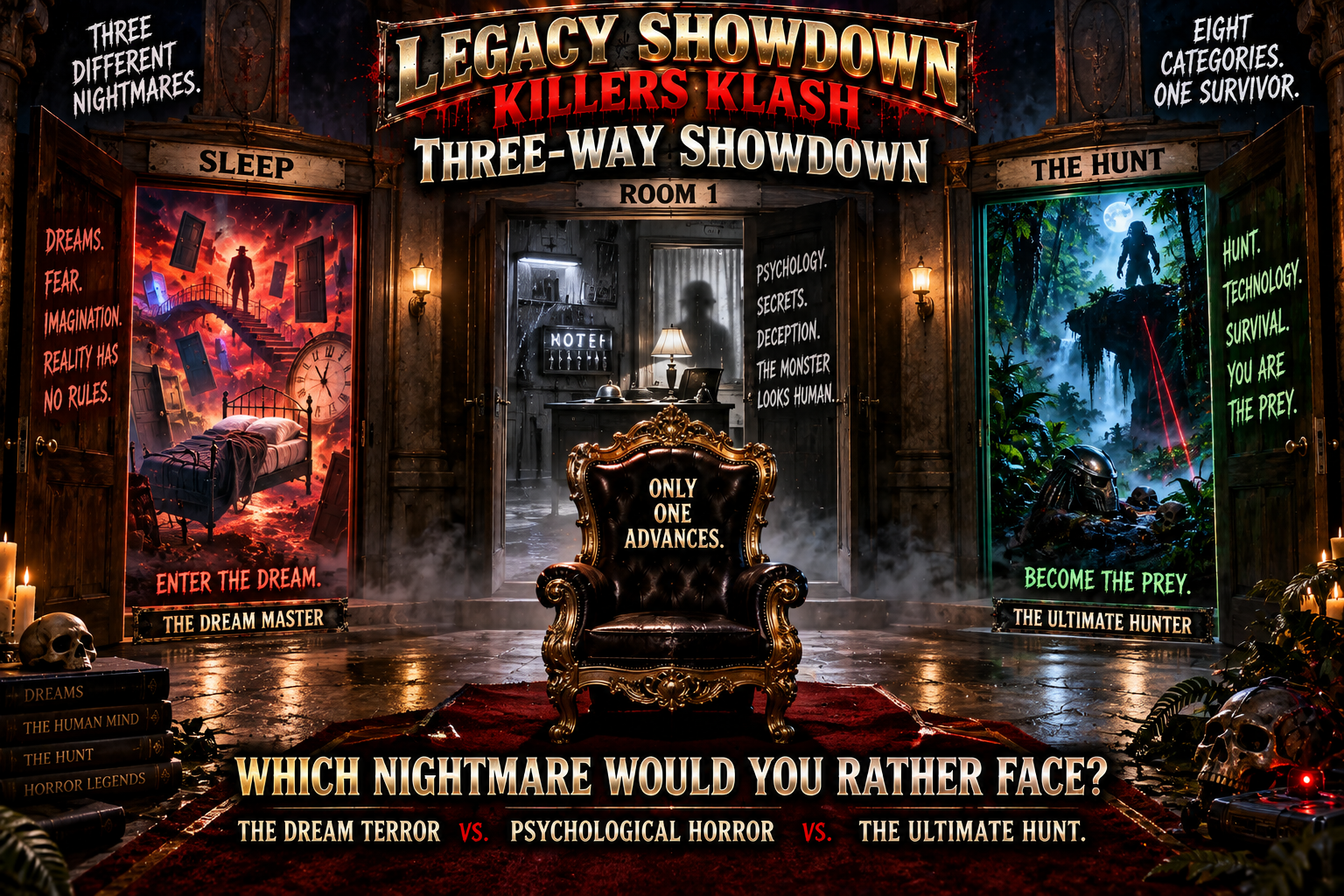

The Dream Master. The Bates Motel Killer. The Ultimate Hunter. Three radically different forms of horror enter one expanded showdown.
Welcome back to Killers Klash, where horror’s most terrifying, unforgettable, and iconic characters collide to determine who possesses the stronger legacy killer instinct. As part of the larger Legacy Showdown series, the tournament has moved beyond simple one-on-one battles. This stage is testing whether surviving legends can withstand surprise challengers from entirely different corners of horror.
Freddy Krueger and Norman Bates earned their places here through very different paths. Freddy dominated his opening matchup against the Creeper and then defeated Chucky 4-2 in Round 2, proving that his dream mythology, cultural reach, unforgettable moments, and long-term endurance remain extraordinarily difficult to overcome. Norman survived Ghostface and then stunned Jason Voorhees in a 3-3 deadlock, advancing through the overall legacy tiebreaker because Psycho’s foundational impact on modern horror gave him the final advantage.
They were prepared to face each other. Then Killers Klash changed the matchup.
Entering as the surprise third participant is the Predator, the extraterrestrial hunter introduced in 1987. The Predator brings something neither Freddy nor Norman can duplicate: science-fiction horror built around ritualized hunting, advanced technology, camouflage, physical superiority, trophy-taking, and an alien code that makes the creature more than a mindless monster.
This creates one of the strangest stylistic collisions in the tournament. Freddy attacks through dreams and transforms fear into supernatural spectacle. Norman hides horror behind an ordinary human face and psychological instability. The Predator turns the victim into prey, studying, stalking, and testing targets before moving in for the kill.
The expanded eight-category format introduced in the previous three-way dance remains in effect. Along with Peak Impact, Longevity, Cultural Impact, Big Moments, Identity & Style, and Legacy Endurance, the competitors will also be judged on Fear Factor & Threat Versatility and Franchise & Genre Influence.
Eight categories. Three completely different nightmares. One character advances. Let the Klash begin.
Affiliate Disclaimer
Affiliate Disclaimer: This blog may contain affiliate links or banner advertisements. If you click on one of these links or advertisements and make a purchase, we may earn a small commission at no additional cost to you. These commissions help support our work and allow us to continue creating entertaining content like Killers Klash and the Legacy Showdown series.
The Expanded Three-Way Showdown Rules
Each competitor is evaluated across eight categories:
- Peak Impact
- Longevity
- Cultural Impact
- Big Moments
- Identity & Style
- Legacy Endurance
- Fear Factor & Threat Versatility – How many different forms of terror the character can convincingly create, and how adaptable that threat remains across victims, environments, and stories.
- Franchise & Genre Influence – How strongly the character shaped later horror storytelling, filmmaking, villain design, genre conventions, or franchise development.
1. Peak Impact
Freddy Krueger:
Freddy’s 1980s peak transformed him from a frightening dream killer into one of horror’s biggest personalities. A Nightmare on Elm Street gave him a concept with almost unlimited creative possibilities: victims could not escape danger simply by locking a door because eventually they had to sleep.
As the franchise grew, Freddy became increasingly recognizable through the glove, sweater, fedora, burned face, voice, and dark humor. His peak expanded beyond horror audiences into mainstream popular culture, making him one of the defining genre icons of his generation.
Norman Bates:
Norman Bates’ peak is inseparable from Psycho, a film that altered audience expectations about horror, suspense, protagonists, violence, and psychological disturbance. Norman’s polite nervousness made the eventual revelation more unsettling because the monster initially looked painfully human.
The shower sequence, Bates Motel, Mother mythology, and final psychological revelation became permanent pieces of cinema history. Norman’s peak did not merely create a successful franchise villain. It helped move screen horror toward a more modern understanding of danger.
The Predator:
The Predator arrived in a film that successfully fused action, science fiction, survival, and horror. The original Predator gradually strips away the confidence of an elite military team until its heavily armed characters realize they are being hunted by something technologically and physically superior.
The creature reveal, thermal vision, cloaking technology, trophy-taking, and final duel with Dutch established an immediately distinctive antagonist. The peak was enormous, but its historical effect on horror itself is less foundational than Psycho.
Edge: Norman Bates
Freddy had the broadest celebrity peak and Predator delivered one of cinema’s great genre hybrids, but Norman Bates takes the first category. Psycho’s original impact changed the language of screen horror and helped establish psychological human monstrosity as a central modern threat.
The other two became icons inside a horror landscape Norman helped transform. Norman Bates takes Round 1.
2. Longevity
Freddy Krueger:
Freddy has survived sequels, changing tones, television exposure, a crossover, remake attempts, merchandise, games, comics, and decades of horror fandom. Even during long periods without a new Elm Street film, the character remains instantly recognizable.
His greatest longevity advantage is that Robert Englund’s defining portrayal created an unusually strong personality-based icon. Freddy can disappear from theaters for years without disappearing from horror culture.
Norman Bates:
Norman’s longevity is more substantial than the original Psycho alone suggests. Anthony Perkins returned for sequels, and later reinterpretations demonstrated that the Bates mythology could support new actors and extended storytelling.
Bates Motel was particularly important because it reintroduced Norman and Norma’s relationship through long-form television. Yet Norman’s cultural presence remains heavily concentrated around the original film’s historic power.
The Predator:
The Predator has endured through sequels, crossovers, comics, novels, games, collectibles, and major reinventions of the hunting mythology. Different individual Predators can appear in different eras and environments while the species’ code, technology, and visual identity maintain continuity.
That flexibility gives the franchise an enormous lifespan because no single human protagonist or one specific Predator must remain at the center.
Edge: Freddy Krueger
Predator’s species-based flexibility makes this very close, but Freddy narrowly takes Longevity because the same individual villain has remained the recognizable personality at the heart of his franchise for decades.
Freddy’s face, voice, humor, glove, and mythology survived changing horror eras without needing to transfer the identity to another member of a species. Freddy Krueger takes Round 2.
3. Cultural Impact
Freddy Krueger:
Freddy is one of horror’s rare villains who became a genuine mainstream celebrity. The striped sweater, fedora, bladed glove, burned face, and wisecracking personality became recognizable well beyond viewers of the films.
His concept also changed the relationship between killer and victim. Freddy could invade dreams, manipulate reality, and turn private fears into public spectacle. The character became a symbol not simply of slashers but of horror’s ability to become imaginative, surreal, and personality-driven.
Norman Bates:
Norman Bates has immense cultural importance. Bates Motel, Mother, the shower sequence, and Norman’s seemingly harmless demeanor have been referenced and parodied for generations. The character also influenced countless fictional killers whose ordinary appearance conceals disturbing psychology.
His influence often operates through cinema history and storytelling conventions rather than through the kind of merchandising and costume visibility associated with later horror icons.
The Predator:
The Predator’s mask, dreadlock-like tendrils, shoulder cannon, wrist blades, cloaking effect, thermal vision, and distinctive vocal clicking created one of science-fiction cinema’s most recognizable hunters.
The character has become a major presence in games, toys, comics, crossovers, fan culture, and discussions of cinematic extraterrestrials. Still, the Predator often shares cultural identity with the larger franchise and species rather than one individual villain.
Edge: Freddy Krueger
Norman is foundational and Predator is visually enormous, but Freddy wins Cultural Impact because he became both a horror symbol and a recognizable entertainment personality. Few villains crossed from terrifying audiences into mainstream celebrity without losing their core horror identity.
Freddy Krueger takes Round 3.
4. Big Moments
Freddy Krueger:
Freddy’s franchise is built for unforgettable set pieces. Tina’s death established that ordinary physical space could become meaningless inside a nightmare. Later films expanded the possibilities with surreal transformations, dream environments, elaborate kills, and Freddy’s battles with Nancy and other survivors.
His confrontation with Jason also gave him one of horror’s most anticipated crossover events. Freddy’s biggest moments are imaginative because dream logic removes ordinary limits.
Norman Bates:
Norman possesses fewer films and fewer kills, but his defining moments carry extraordinary historical weight. The shower sequence remains one of cinema’s most famous acts of screen violence. Norman’s cleanup afterward forces the audience into uncomfortable proximity with him, while the discovery of Mother and the final psychological revelation completely reshape the story.
The closing image of Norman, accompanied by the sense that Mother has consumed his identity, remains chilling precisely because the film no longer needs physical action.
The Predator:
Predator’s original film supplies a remarkable collection of moments: the discovery of skinned bodies, attacks seen through thermal vision, the realization that the team is being hunted, the creature’s partial and full reveals, Dutch covering himself in mud, the trap-filled final hunt, and the Predator’s self-destruct sequence.
Later entries add different hunts, weapons, environments, and encounters, while crossovers broaden the mythology.
Edge: Norman Bates
Freddy owns greater imaginative variety and Predator has an exceptional collection of action-horror sequences. Norman wins because several of Psycho’s signature moments became permanent landmarks in the history of filmmaking itself.
The shower, Mother reveal, and final image have endured for generations beyond the immediate experience of watching a horror franchise. Norman Bates takes Round 4.
5. Identity & Style
Freddy Krueger:
Freddy’s identity is one of horror’s most complete personality packages. The glove, sweater, hat, burned skin, voice, humor, and dream powers all reinforce a villain who wants victims to know exactly who is tormenting them.
Unlike silent slashers, Freddy’s speech is part of his weaponry. His personality became increasingly theatrical, allowing the franchise to create a killer who could be frightening, grotesque, funny, and visually inventive.
Norman Bates:
Norman’s identity depends on understatement. He looks ordinary, speaks softly, appears socially uncomfortable, and initially seems more vulnerable than dangerous. His relationship with Mother and the Bates Motel gradually reveal the horror hidden beneath that presentation.
That subtlety gives Norman psychological richness, but his visual design is intentionally less spectacular than either competitor.
The Predator:
The Predator’s identity combines creature design, technology, behavior, and mythology with extraordinary efficiency. The mask, armor, camouflage, thermal vision, shoulder cannon, wrist blades, trophy collection, mandibles, and code of the hunt all tell the audience what kind of creature it is.
Even the Predator’s behavior contributes to the style. It observes before attacking, chooses targets according to its own rules, collects trophies, and treats combat as ritual rather than random slaughter.
Edge: The Predator
Freddy is almost impossible to beat in this category, but the Predator wins by the smallest margin because virtually every visual and behavioral component reinforces the same concept: an extraterrestrial hunter whose entire culture appears organized around the pursuit of worthy prey.
Its weapons are not accessories; they are extensions of identity. Its technology, anatomy, hunting code, and silhouette create one of genre cinema’s most unified villain designs. The Predator takes Round 5.
6. Legacy Endurance
Freddy Krueger:
Freddy’s legacy is secure even through long gaps in active filmmaking. The concept remains too distinctive to disappear: sleep is unavoidable, dreams have unlimited visual potential, and Freddy himself possesses one of horror’s most recognizable personalities.
Future reinterpretations face the challenge of following Robert Englund’s defining performance, but the underlying mythology remains powerful enough for continued revival.
Norman Bates:
Norman has already endured since 1960, giving him the longest historical test of the three. Psycho remains essential viewing in horror and film history, while the Bates mythology has proven adaptable through sequels, remakes, television, scholarship, retrospectives, and continual cultural reference.
Most importantly, Norman’s core terror does not depend on special effects or a specific horror trend. The idea that an apparently ordinary person can conceal profound psychological darkness remains permanently relevant.
The Predator:
The Predator is exceptionally durable because the species can be placed into almost any period or environment. New hunters, new prey, and new settings can expand the mythology without erasing what audiences recognize.
That adaptability gives Predator one of the strongest franchise futures in the matchup. The creature can survive even when individual installments vary dramatically in tone.
Edge: Norman Bates
Predator may possess the easiest mechanism for future expansion, while Freddy remains one of horror’s permanent faces. Norman wins Legacy Endurance because his importance has already survived more than six decades and remains embedded in both horror history and broader cinema history.
Psycho continues to matter even without constant franchise output. Norman Bates takes Round 6.
7. Fear Factor & Threat Versatility
Freddy Krueger:
Freddy can attack when victims are at their most vulnerable: asleep. He can alter environments, impersonate people, transform bodies, exploit memories, create false awakenings, manipulate personal fears, and make the rules of reality unreliable.
The victim eventually has to sleep, which gives Freddy a built-in advantage that physical avoidance cannot permanently solve. His threat can be psychological, supernatural, physical, surreal, or deeply personal.
Norman Bates:
Norman’s fear factor comes from plausibility and intimacy. He does not arrive as an obvious monster. The danger is that someone apparently awkward, polite, and ordinary may conceal violent impulses and a fractured internal world.
That is psychologically disturbing, but Norman’s threat versatility is limited compared with supernatural dream manipulation or extraterrestrial hunting technology.
The Predator:
The Predator is dangerous in almost any physical environment. Camouflage allows observation without detection, thermal vision changes the rules of hiding, advanced weapons permit attacks from range, and enormous strength makes close combat equally dangerous.
The hunting code also creates uncertainty. Understanding that the Predator follows rules may help a victim, but those rules belong to an alien culture and do not make the hunt safe.
Edge: Freddy Krueger
Predator is the stronger physical and technological hunter, but Freddy owns the widest range of possible attacks. He can transform the battlefield itself because the battlefield is the victim’s dream.
There is no single environment, weapon, hiding place, or physical defense that reliably neutralizes that versatility. Freddy Krueger takes Round 7.
8. Franchise & Genre Influence
Freddy Krueger:
Freddy expanded what the slasher could become. A Nightmare on Elm Street moved beyond purely physical stalking and opened the genre to surreal effects, fantasy logic, elaborate set pieces, and a killer with an enormous personality.
The franchise demonstrated that a slasher villain could become the primary attraction without remaining silent or mysterious.
Norman Bates:
Norman’s influence reaches back before the slasher boom. Psycho disrupted conventional expectations about protagonists and narrative structure while bringing psychological human violence into mainstream cinematic horror with extraordinary force.
Its influence can be traced through slashers, serial-killer thrillers, psychological horror, motel horror, voyeuristic suspense, and stories in which normality hides monstrosity. Norman is part of the foundation upon which later human horror villains were built.
The Predator:
Predator helped establish a durable form of action-horror built around humans becoming prey to a technologically superior creature. Its design and equipment influenced later extraterrestrial hunters, video games, creature films, comics, and action science fiction.
The franchise also demonstrated the crossover potential of iconic monsters, particularly through its long association with Alien.
Edge: Norman Bates
Freddy transformed the possibilities of the supernatural slasher and Predator left a major imprint on action-horror and creature design. Norman wins because Psycho’s influence reaches further backward into the development of modern horror itself and then forward through multiple genres.
Norman Bates takes Round 8.
Final Verdict: Norman Bates Advances
Eight categories produce a remarkably competitive three-way result. Norman Bates wins Peak Impact, Big Moments, Legacy Endurance, and Franchise & Genre Influence. Freddy Krueger wins Longevity, Cultural Impact, and Fear Factor & Threat Versatility. The Predator wins Identity & Style.
That gives Norman Bates a 4-3-1 victory and sends him forward without requiring a tiebreaker.
The Predator’s one category victory should not be mistaken for a weak performance. Identity & Style may be the most competitive category in the entire matchup, and the Ultimate Hunter pushes Freddy extremely hard in Longevity, Fear Factor & Threat Versatility, and Franchise & Genre Influence. The Predator enters Killers Klash and immediately proves that science-fiction horror belongs in the same legacy conversation as the tournament’s established slashers and psychological monsters.
Freddy comes even closer. He remains the matchup’s most culturally flamboyant villain and the most versatile threat. His ability to invade dreams gives him possibilities Norman cannot approach, while his personality and iconography have kept him visible for decades. In a tournament focused more heavily on immediate fear or supernatural power, Freddy could easily win.
But this is Legacy Showdown. Norman’s case is built on the extraordinary historical weight of Psycho. His greatest film helped transform modern horror before Freddy or the Predator existed, his defining scenes remain landmarks of cinema, and his influence continues through psychological horror, serial-killer storytelling, slasher conventions, and the idea that the most frightening monster may look completely human.
Norman Bates defeats Freddy Krueger and the Predator 4-3-1 and advances deeper into Killers Klash. Freddy exits after one of the strongest performances of the round, and the Predator leaves an immediate mark as a surprise entrant, but the quiet man behind the desk at the Bates Motel survives another seemingly impossible matchup.
Three-Way Showdown Scorecard
Peak Impact: Norman Bates
Longevity: Freddy Krueger
Cultural Impact: Freddy Krueger
Big Moments: Norman Bates
Identity & Style: The Predator
Legacy Endurance: Norman Bates
Fear Factor & Threat Versatility: Freddy Krueger
Franchise & Genre Influence: Norman Bates
FINAL SCORE – Norman Bates 4, Freddy Krueger 3, The Predator 1
Audience Challenge
Did Norman Bates deserve to survive this three-way dance? Should Freddy’s dream powers and cultural reach have earned him one more category? Did the Predator deserve additional credit for longevity, threat versatility, or genre influence? Which single category would you flip, and would changing it alter the winner? Cast your vote, defend your villain, and tell us whether the Bates Motel’s most infamous resident truly deserves to advance.