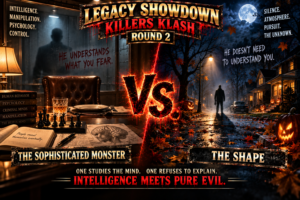
One studies the mind before he strikes. The other hides behind a blank mask and refuses to explain anything. Intelligence meets pure evil.
Welcome back to Killers Klash, where horror’s most terrifying, unforgettable, and iconic characters go head-to-head to determine who possesses the stronger legacy killer instinct. As part of the larger Legacy Showdown series, Killers Klash measures more than who would win a physical confrontation. Each matchup examines the impact, longevity, cultural presence, defining moments, identity, and lasting endurance that transformed these characters into horror legends.
The final matchup of Round 2 brings together two characters who could hardly approach horror more differently. Hannibal Lecter is cultured, articulate, psychologically brilliant, manipulative, and frightening precisely because he understands people so well. Michael Myers is nearly the opposite: silent, unreadable, emotionally inaccessible, and terrifying because the audience is given so little to understand.
Hannibal reached Round 2 after defeating Art the Clown, using his enormous Peak Impact, Longevity, Cultural Impact, and Legacy Endurance to overcome one of modern horror’s fastest-rising figures. Michael advanced after defeating Dexter Morgan, dominating the matchup through Peak Impact, Longevity, Cultural Impact, and Legacy Endurance while reinforcing his place among the foundational slasher icons.
Now the tournament asks a much harder question. Is the stronger legacy built through intelligence, performance, dialogue, psychological manipulation, and prestige—or through simplicity, atmosphere, visual iconography, relentless pursuit, and the frightening mystery of the Shape?
Round 2 keeps the six official Killers Klash categories: Peak Impact, Longevity, Cultural Impact, Big Moments, Identity & Style, and Legacy Endurance. Hannibal Lecter vs. Michael Myers. The sophisticated monster against the Shape. Let the Klash begin.
Affiliate Disclaimer
Affiliate Disclaimer: This blog may contain affiliate links or banner advertisements. If you click on one of these links or advertisements and make a purchase, we may earn a small commission at no additional cost to you. These commissions help support our work and allow us to continue creating entertaining content like Killers Klash and the Legacy Showdown series.
Rules of the Showdown
We evaluate each competitor based on six categories:
- Peak Impact
- Longevity
- Cultural Impact
- Big Moments
- Identity & Style
- Legacy Endurance
1. Peak Impact
Hannibal Lecter:
Hannibal Lecter’s greatest screen impact came through The Silence of the Lambs, where Anthony Hopkins transformed a character with limited screen time into the gravitational center of the film. Lecter’s calm voice, unnerving eye contact, extraordinary intelligence, and ability to psychologically dissect the people around him made conversation itself feel dangerous.
His exchanges with Clarice Starling became the heart of the film. Hannibal did not need to chase her through dark hallways to control a scene. A glass barrier, a few carefully chosen questions, and his ability to identify emotional vulnerabilities were enough to create tension. That restraint made the moments when his violence surfaced even more disturbing.
The performance crossed beyond horror into mainstream cinematic prestige. Hannibal became one of the rare horror-associated villains whose peak was embraced simultaneously by genre audiences, critics, awards culture, and the broader public. His name became shorthand for sophisticated, intelligent monstrosity.
Michael Myers:
Michael Myers’ peak begins with John Carpenter’s Halloween, a film whose influence on the slasher genre is enormous. Michael’s blank mask, slow pursuit, unexplained violence, and repeated appearances at the edges of the frame turned simplicity into terror. The character did not need elaborate mythology. He was frightening because he watched, waited, followed, and kept coming.
The original film’s restraint became part of Michael’s power. The Shape could appear behind a hedge, outside a school, across a street, or in the darkness of a house, and the audience learned to search the frame for him. Carpenter’s score and the Halloween-night setting made Michael’s presence inseparable from the atmosphere.
Halloween helped establish a blueprint that countless slashers would imitate. Michael’s peak is therefore foundational, not merely successful. Yet Hannibal’s highest point combined genre importance with an extraordinary level of mainstream critical recognition.
Edge: Hannibal Lecter
Michael Myers helped define the modern slasher, and the original Halloween is one of horror’s essential films. Hannibal Lecter nevertheless takes this category because his peak achieved something exceptionally rare for a horror villain: overwhelming genre recognition, mainstream cultural dominance, and elite critical prestige at the same time.
The Silence of the Lambs turned Hannibal into one of cinema’s most celebrated villains, with Anthony Hopkins’ performance becoming a defining piece of screen acting. Michael’s peak helped reshape horror. Hannibal’s peak conquered horror and the broader film world simultaneously. Hannibal Lecter takes Round 1.
2. Longevity
Hannibal Lecter:
Hannibal Lecter’s longevity extends across novels, films, television, multiple performers, prequels, sequels, and reinterpretations. Anthony Hopkins remains the defining screen Lecter for many viewers, but the character has also demonstrated that his central qualities can survive a different performance style and format.
The television series Hannibal was especially important to that endurance. Mads Mikkelsen offered a more extended, elegant, and psychologically intimate interpretation, allowing audiences to spend years exploring Hannibal’s relationships, manipulation, appetites, aesthetics, and worldview. The character proved capable of sustaining long-form storytelling rather than relying on one iconic movie.
Lecter’s longevity is therefore unusually sophisticated. He can function in crime thriller, psychological horror, prestige drama, procedural storytelling, and literary adaptation without losing his core identity.
Michael Myers:
Michael Myers has survived numerous timelines, sequels, reboots, retcons, reinterpretations, and returns since 1978. The Halloween franchise has repeatedly attempted to explain him, ignore earlier explanations, restart continuity, revisit Laurie Strode, and redefine what the Shape means for a new generation.
Through all of those changes, the central image has survived. Put Michael in the mask, return him to stalking behavior, and audiences immediately understand the character. His durability is especially impressive because the franchise has endured major creative fluctuations and long gaps without permanently losing its place in horror culture.
Michael has also remained tied to the Halloween season itself, giving him a recurring cultural advantage every October. New films may rise or fall in reputation, but the Shape keeps returning.
Edge: Michael Myers
Hannibal has demonstrated excellent longevity across literature, cinema, and television, but Michael Myers has made repeated resurrection part of his franchise identity. He has survived contradictory continuities, changing filmmaking eras, shifting slasher trends, and multiple attempts to conclude his story.
That persistence matters. Michael’s core concept is simple enough to be rebuilt repeatedly without losing recognition. For nearly five decades of franchise returns and his permanent connection to the Halloween season, Michael Myers takes Round 2.
3. Cultural Impact
Hannibal Lecter:
Hannibal Lecter became one of cinema’s defining images of intelligent evil. The restrained posture, measured voice, penetrating stare, and famous imagery associated with his confinement became instantly recognizable. His influence can be felt in countless fictional serial killers who combine refinement, intelligence, psychological insight, and brutality.
The character also changed expectations about what a horror villain could sound like. Hannibal’s most dangerous weapon is often conversation. His ability to make another person feel exposed helped popularize a kind of villain who dominates through intellect before physical violence ever occurs.
Hannibal’s cultural footprint reaches well beyond horror fandom. His name is regularly invoked as shorthand for a cultured but terrifying predator, and different adaptations have kept that archetype alive for several generations.
Michael Myers:
Michael Myers is one of the primary visual symbols of slasher horror. The pale mask, dark coveralls, kitchen knife, slow walk, and association with Halloween night can communicate the entire character without dialogue. Even people unfamiliar with the details of the franchise often recognize the image.
His influence on later slashers is enormous. The silent, masked, seemingly unstoppable killer became one of the genre’s defining templates, and Halloween’s success helped create the environment in which the slasher boom flourished. Michael’s visual language has been referenced, parodied, imitated, merchandised, and celebrated for decades.
His connection to the holiday gives him another layer of cultural permanence. Every October, Michael Myers naturally reenters costumes, decorations, marathons, merchandise, and horror conversations.
Edge: Michael Myers
Hannibal Lecter is one of cinema’s most famous villains, but Michael Myers possesses a broader visual relationship with horror culture itself. His mask functions almost like a universal slasher emblem, and his influence reaches through generations of masked killers who followed.
Hannibal changed the image of the sophisticated serial killer. Michael helped define the visual vocabulary of an entire horror subgenre. Combined with his annual association with Halloween, that gives the Shape the edge. Michael Myers takes Round 3.
4. Big Moments
Hannibal Lecter:
Hannibal Lecter’s greatest moments often begin with dialogue. His first meeting with Clarice Starling establishes almost everything audiences need to know: he observes details immediately, understands how to destabilize people, and treats psychological intrusion as a form of entertainment.
The quid-pro-quo conversations deepen that relationship, turning information exchange into a battle of control. Hannibal’s escape from custody provides the brutal counterpoint to his refined demeanor, demonstrating that the civilized presentation never makes him less dangerous. The contrast between intellect and violence makes the sequence especially memorable.
Across later stories and adaptations, Hannibal accumulates additional confrontations, manipulations, meals, escapes, and psychologically charged relationships. His best moments are not interchangeable kills; they reveal character while advancing the story.
Michael Myers:
Michael Myers owns some of slasher cinema’s most recognizable images. His appearances behind Laurie Strode, the hedge encounter, the stalking around Haddonfield, the closet confrontation, and the final disappearance after Dr. Loomis shoots him helped establish the visual grammar of the Shape.
Later films added decades of confrontations, resurrections, brutal kills, family revelations, and renewed battles with Laurie. The 2018 continuation gave Michael another major cultural moment by returning him to a stripped-down version of his mythology and placing the original survivor back against him.
Michael’s big moments are often built around suspense rather than dialogue: the audience sees him before the victim does, waits for movement in the background, or realizes that an apparently defeated body is no longer where it should be.
Edge: Hannibal Lecter
Michael has an extraordinary collection of stalking images and slasher set pieces, but Hannibal’s defining moments carry an unusual combination of psychological intensity, narrative importance, performance, and shocking violence.
The first Clarice meeting, the quid-pro-quo exchanges, and Hannibal’s escape are not merely famous horror scenes—they are among the defining sequences of modern thriller cinema. Michael’s images established slasher language; Hannibal’s biggest scenes repeatedly demonstrate multiple dimensions of the character at once. Hannibal Lecter takes Round 4.
5. Identity & Style
Hannibal Lecter:
Hannibal Lecter’s identity is built on contradiction. He is refined yet monstrous, polite yet invasive, aesthetically sophisticated yet capable of horrific violence. His intelligence and manners make him frightening because they eliminate the comforting assumption that brutality must look uncivilized.
Different performers have emphasized different aspects of the character, but certain traits remain constant: composure, psychological perception, manipulation, cultivated taste, and the sense that Hannibal is evaluating everyone around him. His style is verbal, intellectual, and behavioral rather than dependent on one costume.
That flexibility gives Hannibal enormous depth, though it also means his appearance can change significantly between adaptations while the character remains recognizable.
Michael Myers:
Michael Myers is almost pure visual identity. The blank white mask removes readable emotion. The dark coveralls create a simple silhouette. The kitchen knife is ordinary enough to feel plausible. His slow movement suggests that he does not need to hurry because escape is temporary.
Silence is equally important. Michael does not explain himself, negotiate, joke, or reveal what he is thinking. That absence became the character’s style. Dr. Loomis’ description of him as evil helps frame Michael not simply as a man with motives but as the Shape—something human-looking that resists normal interpretation.
The design is so efficient that even small alterations to the mask can become major topics among fans. Few horror characters demonstrate more clearly how silhouette, movement, sound, and absence of speech can create identity.
Edge: Michael Myers
Hannibal may be the more psychologically complex character, but Identity & Style belongs to Michael Myers. The Shape is one of horror’s purest examples of minimalist character design becoming iconic.
Mask, coveralls, knife, silence, measured movement, breathing, and the Halloween-night atmosphere combine into a style that can be recognized almost instantly. Hannibal’s identity depends heavily on performance and dialogue. Michael can stand motionless at the far end of a hallway and still be unmistakable. Michael Myers takes Round 5.
6. Legacy Endurance
Hannibal Lecter:
Hannibal Lecter’s legacy appears secure because the character has already survived major changes in medium, performer, tone, and audience. Thomas Harris’ novels provide a literary foundation, Anthony Hopkins created an immortal film interpretation, and Mads Mikkelsen demonstrated that a radically different screen version could earn passionate acclaim.
The character also occupies multiple genres simultaneously. Hannibal belongs to horror, crime fiction, psychological thriller, serial-killer drama, and prestige television. That versatility makes future reinterpretations plausible because creators do not need to reproduce one exact formula.
His enduring fascination comes from the same central question: why is someone so intelligent, controlled, and perceptive also capable of such monstrosity? That contradiction will remain compelling.
Michael Myers:
Michael Myers has already endured from 1978 into multiple generations of horror fandom. His franchise has experienced acclaim, decline, reinvention, continuity resets, remakes, legacy sequels, and repeated endings, yet Michael’s basic place in the genre remains untouched.
The character benefits from a visual identity that does not require a specific actor’s face or voice. Different performers can inhabit the Shape while the mask and movement preserve continuity. That makes Michael unusually resistant to the passage of time.
He is also permanently attached to one of the world’s most recognizable seasonal horror traditions. As long as Halloween remains a cultural event and slasher history continues to be revisited, Michael Myers has a natural route back into public consciousness.
Edge: Michael Myers
Hannibal’s literary and prestige-screen legacy makes him one of the most durable villains in fiction. Michael Myers nevertheless takes the final category because his endurance is woven directly into horror culture, seasonal tradition, and the visual history of the slasher.
The Shape does not require one definitive performer, one continuity, or even a complicated mythology. The mask can return, the music can begin, and audiences immediately know what kind of fear has entered the story. Nearly five decades after Halloween, Michael remains one of horror’s essential faces. Michael Myers takes Round 6.
Final Verdict: Michael Myers Advances
After six rounds, Hannibal Lecter and Michael Myers finish tied 3-3. Hannibal wins Peak Impact and Big Moments, while Michael takes Longevity, Cultural Impact, Identity & Style, and Legacy Endurance. That actually gives Michael a 4-2 category victory—not a tiebreaker—and sends the Shape forward.
Hannibal’s victories demonstrate why he is one of the greatest villains ever placed on screen. His peak reached a level of critical prestige almost unheard of for a horror-associated antagonist, and his defining scenes with Clarice Starling combine dialogue, performance, psychology, suspense, and violence with extraordinary precision.
Michael wins the broader legacy battle because so many of the tournament’s categories reward the qualities that made the Shape permanent. He has survived more franchise reinventions, owns one of horror’s most universally recognized visual identities, helped define the modern slasher, and remains culturally renewed every Halloween season.
The contrast makes this matchup especially revealing. Hannibal is the richer conversational and psychological character. Michael is the purer horror symbol. Hannibal invites audiences to study the monster. Michael frightens audiences partly because there may be nothing understandable behind the mask to study.
Michael Myers wins 4-2 and advances to the next round of Killers Klash. Hannibal Lecter exits as one of the tournament’s most sophisticated and prestigious competitors, but the Shape’s combination of longevity, iconography, cultural influence, and enduring slasher identity proves too powerful in Round 2.
Round 2 Scorecard
Peak Impact: Hannibal Lecter
Longevity: Michael Myers
Cultural Impact: Michael Myers
Big Moments: Hannibal Lecter
Identity & Style: Michael Myers
Legacy Endurance: Michael Myers
Audience Challenge
Do you agree with the result? Should Michael Myers advance because his mask, slasher influence, longevity, and Halloween-season permanence make him the stronger overall horror legacy? Or should Hannibal Lecter’s psychological complexity, elite performances, unforgettable dialogue, and extraordinary cinematic prestige carry him into the next round? Which category would you change? Cast your vote, defend your killer, and tell us who truly possesses the stronger legacy killer instinct.