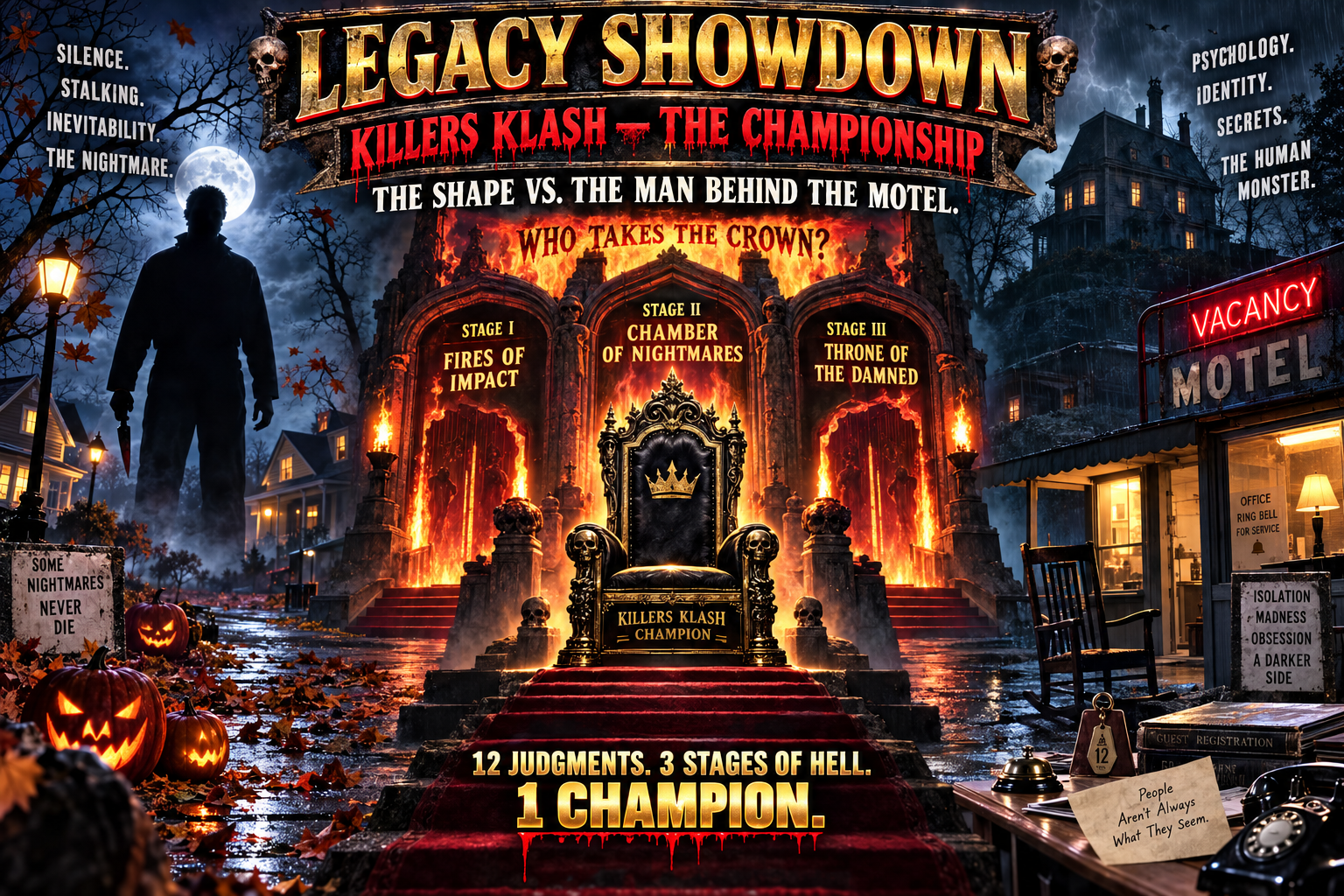


THE THREE STAGES OF HELL
The Shape vs. the man behind the Bates Motel. Twelve final judgments. Three stages. One first-ever Killers Klash Champion.
Welcome to the Killers Klash Championship.
What began as a field of horror’s most unforgettable killers has been reduced to two survivors who represent opposite ends of the genre. Michael Myers is the Shape: silent, masked, relentless, visually elemental, and almost impossible to separate from the modern slasher. Norman Bates is the apparently ordinary man behind the Bates Motel: nervous, psychologically fractured, deeply human, and forever connected to a film that helped transform horror before the slasher boom had even begun.
Their paths to the championship have been brutal. Michael survived Dexter Morgan and Hannibal Lecter before entering the tournament’s first three-way dance against Pennywise and the Xenomorph. He emerged from that expanded showdown after a 3-3-2 category result forced an overall legacy tiebreaker with the Xenomorph, and Michael’s endurance as one continuing individual horror icon carried him into the final.
Norman’s path may be even more improbable. He defeated Ghostface, survived a 3-3 deadlock with Jason Voorhees through an overall legacy tiebreaker, and then entered a three-way battle with Freddy Krueger and the Predator. Norman won that showdown outright, 4-3-1, because his Peak Impact, Big Moments, Legacy Endurance, and Franchise & Genre Influence kept returning the tournament to the enormous historical shadow of Psycho.
Now there are no surprise entrants. No wild cards. No third competitor. No next round.
Only Michael Myers and Norman Bates remain.
For the championship, the eight judging criteria used in the previous stage are not enough. Four final categories have been added: Psychological Depth & Thematic Power, Reinvention & Adaptability, Audience Fear Across Generations, and Ultimate Horror Legacy. The twelve categories are divided into three groups of four. We call them the Three Stages of Hell.
Stage One measures the impact that built the legend. Stage Two measures the terror and identity that sustained it. Stage Three measures what remains when history itself becomes the opponent.
Twelve judgments. Three Stages of Hell. One crown. Let the final Klash begin.
Affiliate Disclaimer
Affiliate Disclaimer: This blog may contain affiliate links or banner advertisements. If you click on one of these links or advertisements and make a purchase, we may earn a small commission at no additional cost to you. These commissions help support our work and allow us to continue creating entertaining content like Killers Klash and the Legacy Showdown series.
The Championship Rules: The Three Stages of Hell
The championship is decided across twelve categories divided into three stages of four:
- STAGE ONE — THE FIRES OF IMPACT: Peak Impact; Longevity; Cultural Impact; Big Moments.
- STAGE TWO — THE CHAMBER OF NIGHTMARES: Identity & Style; Fear Factor & Threat Versatility; Psychological Depth & Thematic Power; Audience Fear Across Generations.
- STAGE THREE — THE THRONE OF THE DAMNED: Legacy Endurance; Franchise & Genre Influence; Reinvention & Adaptability; Ultimate Horror Legacy.
STAGE ONE OF HELL — THE FIRES OF IMPACT
Before a killer can become immortal, the legend must first be forged. Stage One judges the impact, staying power, cultural reach, and defining moments that built these two reputations.
1. Peak Impact
Michael Myers:
Michael Myers’ peak begins with John Carpenter’s Halloween, where a low-budget production transformed a blank mask, suburban streets, patient stalking, and minimalist music into a new grammar of suspense. Michael’s appearances at the edge of the frame made the audience search for danger even when nothing seemed to be happening.
Halloween became one of the essential foundations of the slasher boom. Michael’s peak therefore cannot be reduced to popularity; the Shape helped establish a model that later franchises would repeatedly adapt.
Norman Bates:
Norman Bates arrived nearly two decades earlier in Psycho, and his peak altered the boundaries of mainstream screen horror. Norman’s nervous politeness and apparent vulnerability made the truth behind the Bates Motel more disturbing because the film placed horror inside a person who initially seemed ordinary.
The shower sequence, the sudden narrative disruption, the Mother revelation, and Norman’s final psychological collapse became landmarks of cinema. Psycho helped redirect horror toward psychological disturbance, human violence, voyeurism, and danger hidden inside everyday spaces.
Edge: Norman Bates
Michael’s original peak helped define the slasher. Norman’s helped create the conditions from which much of modern human-centered horror eventually grew.
Because the championship asks which peak changed the landscape most profoundly, Norman Bates takes the first judgment.
2. Longevity
Michael Myers:
Michael has endured since 1978 through sequels, remakes, continuity resets, alternate timelines, legacy sequels, shifting creative teams, and multiple attempts to conclude his story. The franchise has repeatedly changed its explanation of Michael without changing the essential image audiences recognize.
His connection to Halloween night gives him another advantage. Every October naturally renews the Shape through marathons, costumes, merchandise, decorations, and horror culture.
Norman Bates:
Norman has remarkable longevity of his own. Anthony Perkins returned in sequels decades after Psycho, and Bates Motel later demonstrated that Norman’s relationship with his mother and his psychological descent could support a long-form modern reinterpretation.
Yet Norman’s visibility remains more concentrated around Psycho’s historic importance. Michael has spent more of his existence as the active engine of a continuing horror franchise.
Edge: Michael Myers
Norman has survived longer historically, but Michael has sustained a more continuous identity as a recurring horror-franchise centerpiece. He has survived almost every kind of sequel-era turbulence imaginable.
Michael Myers takes Judgment 2.
3. Cultural Impact
Michael Myers:
Michael’s white mask, dark coveralls, knife, slow walk, breathing, and association with Halloween have become universal horror imagery. He can be recognized in silhouette and frequently functions as visual shorthand for the slasher genre itself.
The Shape’s influence extends through later masked killers, Halloween costumes, parodies, merchandise, haunted attractions, and decades of seasonal horror culture.
Norman Bates:
Norman’s cultural influence is enormous but often operates through ideas and scenes. Bates Motel, Mother, the shower, and the seemingly harmless killer have been referenced and parodied for generations. His influence can be felt throughout serial-killer thrillers and psychological horror.
Norman is one of cinema’s most important villains, but he does not possess Michael’s immediate costume-level recognition among the broad public.
Edge: Michael Myers
Norman helped change what audiences feared. Michael became one of the images audiences use to represent horror.
For sheer visual penetration into popular culture, Michael Myers takes Judgment 3.
4. Big Moments
Michael Myers:
Michael owns some of slasher cinema’s defining images: watching Laurie from a distance, appearing behind the hedge, emerging from darkness, the closet confrontation, rising after apparent defeat, and disappearing after Loomis shoots him.
Later films added brutal returns and renewed confrontations with Laurie, creating a decades-long collection of franchise moments.
Norman Bates:
Norman’s list is shorter but almost impossibly heavy. The shower sequence is one of the most famous scenes in film history. Norman’s cleanup forces the audience into uncomfortable proximity with him. The discovery of Mother changes the meaning of everything that came before it.
Then comes the final image: Norman sitting quietly while the Mother’s voice dominates his mind, ending not with spectacle but psychological imprisonment.
Edge: Norman Bates
Michael has more franchise highlights. Norman has moments that escaped the boundaries of horror and entered the permanent language of cinema.
Norman Bates takes Judgment 4 and closes Stage One.
STAGE ONE SCORE: Norman Bates 2 — Michael Myers 2
STAGE TWO OF HELL — THE CHAMBER OF NIGHTMARES
The second gate strips away history and asks why the nightmare itself works. Identity, fear, psychology, and the ability to terrify different generations decide who survives the Chamber of Nightmares.
5. Identity & Style
Michael Myers:
Michael is minimalist villain design perfected. The mask removes expression. The coveralls remove individuality. The knife is ordinary. The silence prevents explanation. The slow movement creates the sense that urgency belongs to the victim, not the killer.
Carpenter’s music, Michael’s breathing, and the visual language of Haddonfield complete an identity that requires almost no exposition.
Norman Bates:
Norman’s style is intentionally human. His awkward smile, soft speech, nervous mannerisms, motel office, taxidermy, and relationship with Mother create an identity built from discomfort rather than spectacle.
That subtlety is one of his greatest strengths, but his visual iconography is less instantly portable than Michael’s.
Edge: Michael Myers
Norman is psychologically distinctive. Michael is visually elemental.
Mask, movement, silence, music, and silhouette combine into one of horror’s most complete identities. Michael Myers takes Judgment 5.
6. Fear Factor & Threat Versatility
Michael Myers:
Michael’s threat is brutally simple but surprisingly adaptable. He can stalk unnoticed, attack suddenly, overpower victims physically, use darkness and familiar spaces against them, and survive injuries that repeatedly blur the line between human killer and supernatural force.
His greatest fear weapon is inevitability. Running may create distance, but Michael’s mythology teaches audiences that distance rarely becomes safety.
Norman Bates:
Norman’s fear comes from intimacy and plausibility. He can appear harmless, gain trust, conceal violence, and exist in the kind of roadside location where vulnerability already feels believable. His danger does not announce itself with a mask.
Yet Norman’s threat remains human-scale. He is frightening precisely because he could exist, but he cannot match Michael’s combination of stalking, physical domination, endurance, and near-supernatural persistence.
Edge: Michael Myers
Norman wins plausibility. Michael wins the broader nightmare.
The Shape can generate suspense, pursuit, physical terror, home-invasion fear, survival horror, and the uncanny fear of something human-shaped that refuses to stay down. Michael Myers takes Judgment 6.
7. Psychological Depth & Thematic Power
Michael Myers:
Michael’s thematic power comes largely from what is absent. He is frequently described as evil without ordinary explanation, and the blankness allows audiences to project meaning onto him. The strongest Halloween stories use that mystery to explore fear, trauma, survival, obsession, and the possibility that evil cannot always be rationalized.
That simplicity is powerful, but attempts to over-explain Michael have often demonstrated how dependent the character is on mystery.
Norman Bates:
Norman is constructed almost entirely through psychology and theme. His relationship with Mother, isolation, repression, identity, guilt, loneliness, voyeurism, and fractured selfhood make him one of horror’s richest subjects for interpretation.
Psycho also asks audiences uncomfortable questions about sympathy. Norman can seem vulnerable and even likable before the full horror becomes clear, forcing viewers to reconsider how they have emotionally responded to him.
Edge: Norman Bates
Michael’s mystery is philosophically potent, but Norman offers greater psychological complexity and thematic density.
The championship’s first new category belongs decisively to Norman Bates.
8. Audience Fear Across Generations
Michael Myers:
Michael has frightened audiences through multiple generations because the core mechanism of the character barely ages. Being watched, followed, trapped, and pursued by someone who will not explain himself remains immediate.
The original Halloween can still create tension through framing and patience, while later films translate Michael into more graphic forms of modern horror. Different generations can meet different versions and still recognize the Shape.
Norman Bates:
Norman continues to unsettle viewers, particularly when Psycho is encountered without every twist already known. Even when the surprises are culturally familiar, Anthony Perkins’ performance and the film’s psychological atmosphere remain effective.
But widespread knowledge of Psycho’s revelations inevitably changes how later audiences experience the original mystery. Norman often enters the room already famous.
Edge: Michael Myers
Norman remains disturbing. Michael remains frightening in a more immediate, repeatable way.
The mask, stalking, silence, and pursuit require little historical context, allowing the Shape to cross generations with minimal adjustment. Michael Myers takes Judgment 8 and wins Stage Two.
STAGE TWO SCORE: Michael Myers 3 — Norman Bates 1
STAGE THREE OF HELL — THE THRONE OF THE DAMNED
The final stage is where icons become immortal—or fall short of the throne. Endurance, influence, reinvention, and the ultimate weight of horror legacy determine the first Killers Klash Champion.
9. Legacy Endurance
Michael Myers:
Michael’s legacy is extraordinarily secure. Nearly five decades of franchise turbulence have failed to remove him from horror’s top tier. The mask remains recognizable, and future filmmakers can restart the timeline again without needing to rebuild the basic concept.
Michael is likely to remain one of the permanent faces of slasher history.
Norman Bates:
Norman has already endured since 1960, and Psycho remains essential not because the franchise continually produces sequels but because the original work retains extraordinary importance. Film students, horror audiences, critics, historians, and new viewers continue returning to Norman.
Bates Motel also proved that the character could be dramatically reimagined while preserving the central relationship and psychological tragedy.
Edge: Norman Bates
Michael has stronger franchise endurance. Norman has deeper historical endurance.
More than six decades after Psycho, Norman’s importance remains embedded in the story of cinema itself. Norman Bates takes Judgment 9.
10. Franchise & Genre Influence
Michael Myers:
Halloween’s influence on the slasher is undeniable. Michael helped popularize the silent masked killer, stalking perspective, suburban vulnerability, final-survivor structure, and franchise-ready villain whose return becomes the central attraction.
Without Halloween, the commercial and stylistic trajectory of the slasher boom looks very different.
Norman Bates:
Psycho’s influence begins earlier and spreads wider. Norman’s story helped normalize psychological human horror, destabilized narrative expectations, transformed ordinary locations into sites of terror, and influenced slashers, serial-killer films, thrillers, voyeuristic suspense, and stories built around hidden identity.
Michael’s own genre lineage exists partly downstream from the cinematic revolution Psycho helped accelerate.
Edge: Norman Bates
Michael helped define a subgenre. Norman helped reshape the larger ecosystem from which that subgenre emerged.
By the narrowest margin, Norman Bates takes Judgment 10.
11. Reinvention & Adaptability
Michael Myers:
Michael has been reinterpreted as mysterious stalker, family-linked killer, supernatural evil, remake-era brute force, and legacy-sequel embodiment of trauma. Some versions work better than others, but the essential character survives radical continuity changes.
That adaptability comes from the simplicity of the Shape. Filmmakers can discard mythology and return to mask, silence, stalking, and Haddonfield.
Norman Bates:
Norman has also proven highly adaptable. Anthony Perkins expanded the original character through sequels, while Bates Motel rebuilt Norman as a younger protagonist whose relationship with Norma unfolds gradually over years.
The difficulty is that Norman’s identity is more dependent on characterization and psychology. Reinvention requires greater narrative precision because changing too much can turn him into a different kind of killer.
Edge: Michael Myers
Norman may support deeper reinterpretation, but Michael is easier to transplant across filmmaking eras while retaining instant recognition.
The Shape can be stripped back to fundamentals and rebuilt again. Michael Myers takes Judgment 11.
12. Ultimate Horror Legacy
Michael Myers:
Michael’s case for the crown is formidable. He is one of the definitive slashers, one of Halloween culture’s most recognizable figures, and one of the purest examples of horror iconography ever created. His legacy is immediate: audiences see the mask and understand the threat.
He has also survived long enough to influence several generations of filmmakers and fans. If Killers Klash were deciding the greatest slasher legacy alone, Michael would have an extraordinary claim to the throne.
Norman Bates:
Norman’s final argument reaches beyond franchise identity. Psycho arrived before the modern slasher and helped change what mainstream audiences understood horror could be. Norman brought terror into the ordinary human face, while the film around him challenged expectations about protagonists, violence, psychology, sexuality, voyeurism, and narrative safety.
His influence does not require Norman to keep returning every few years. It exists in the DNA of modern horror. The Bates Motel remains open in cultural memory because filmmakers have never stopped exploring the doors Psycho helped unlock.
Edge: Norman Bates
The championship comes down to the hardest distinction in Killers Klash: the greater horror icon versus the deeper foundational legacy.
Michael Myers may be the stronger visual mascot of horror. Norman Bates has the stronger claim to having changed the direction of horror history itself.
For that reason, the final judgment—and the Killers Klash crown—belongs to Norman Bates.
STAGE THREE SCORE: Norman Bates 3 — Michael Myers 1
THE FINAL VERDICT: Norman Bates Is the First Killers Klash Champion
The Three Stages of Hell have spoken.
After twelve championship judgments, Norman Bates defeats Michael Myers 6-6 on the raw category score—an exact deadlock worthy of the final. Norman wins Peak Impact, Big Moments, Psychological Depth & Thematic Power, Legacy Endurance, Franchise & Genre Influence, and Ultimate Horror Legacy. Michael wins Longevity, Cultural Impact, Identity & Style, Fear Factor & Threat Versatility, Audience Fear Across Generations, and Reinvention & Adaptability.
Six to six.
There could be no more appropriate ending for two characters who represent completely different definitions of horror greatness. Michael Myers is the stronger recurring nightmare. He owns the more instantly recognizable visual identity, the more active franchise longevity, the broader immediate fear mechanism, and an extraordinary ability to be reinvented without losing the Shape.
Norman Bates is the stronger historical force. His victories repeatedly return to the same fact: Psycho did not merely succeed inside an existing horror formula. It helped transform the formula. Norman’s greatest moments became cinematic landmarks, his psychology gave horror a new kind of human monster, and his influence extends through genres and characters that appeared long after he first welcomed Marion Crane to the Bates Motel.
A 6-6 championship requires one final tiebreaker, but this tiebreaker cannot simply repeat one of the twelve categories. It asks the question the entire tournament was built to answer:
If every sequel, reboot, costume, catchphrase, kill, performance, and franchise entry is placed on the table, which killer possesses the stronger overall legacy instinct—the legacy that most fundamentally changed horror and still matters when the history of the genre is told?
Michael Myers has an almost unbeatable claim as a horror icon. But Norman Bates has the stronger claim as a horror turning point.
That distinction decides the championship.
Norman Bates wins the Ultimate Championship Tiebreaker and becomes the first Killers Klash Champion of Legacy Showdown.
Michael Myers leaves the tournament as the Shape who survived decades, conquered slashers, and came within one final judgment of the crown. Norman leaves as the quiet motel proprietor who somehow survived Ghostface, Jason Voorhees, Freddy Krueger, the Predator, and finally Michael Myers—not through supernatural strength or invulnerability, but because the shadow cast by Psycho remains one of the longest in horror history.
The motel sign is still glowing.
Mother is still waiting.
And the first Killers Klash crown belongs to Norman Bates.
The Championship Scorecard
STAGE ONE — THE FIRES OF IMPACT
- Peak Impact: Norman Bates
- Longevity: Michael Myers
- Cultural Impact: Michael Myers
- Big Moments: Norman Bates
STAGE TWO — THE CHAMBER OF NIGHTMARES
- Identity & Style: Michael Myers
- Fear Factor & Threat Versatility: Michael Myers
- Psychological Depth & Thematic Power: Norman Bates
- Audience Fear Across Generations: Michael Myers
STAGE THREE — THE THRONE OF THE DAMNED
- Legacy Endurance: Norman Bates
- Franchise & Genre Influence: Norman Bates
- Reinvention & Adaptability: Michael Myers
- Ultimate Horror Legacy: Norman Bates
FINAL CATEGORY SCORE — Norman Bates 6, Michael Myers 6
ULTIMATE CHAMPIONSHIP TIEBREAKER — NORMAN BATES
Audience Challenge: Would You Crown the Same Killer?
The championship ended exactly 6-6 before the ultimate tiebreaker. Would you give Norman Bates the crown because Psycho’s foundational influence reaches deeper into horror history, or would you crown Michael Myers because the Shape became the more enduring visual embodiment of horror itself? Which one of the twelve judgments would you flip? Would Michael take Peak Impact or Ultimate Horror Legacy? Should Norman take Cultural Impact or Reinvention & Adaptability? Choose the category that decides your championship, defend your killer, and tell us who deserves to sit on the throne of Killers Klash.
A Final Salute to the Killers Klash Tournament
From slashers and serial killers to supernatural legends, psychological monsters, and surprise science-fiction challengers, Killers Klash was built around one question: what makes a horror villain last?
The tournament proved there is no single answer. Some characters endure because of a mask. Some because of a voice. Some because of mythology, performance, design, fear, brutality, personality, tragedy, or the unforgettable films built around them.
Michael Myers reached the championship because simplicity became immortality. Norman Bates won it because psychological horror became history.
The first tournament is over. The arguments will continue.
That is exactly what Legacy Showdown was made for.