
Affiliate Disclaimer: This post may contain affiliate links. If you make a purchase through one of these links, The Shopping Plaza may earn a commission at no additional cost to you.
The Unknown Is Where Fear and Possibility Meet
Halloween has always understood the power of the unknown. A dark hallway is unsettling because we cannot see what waits at the other end. A closed door becomes more frightening when we do not know what is behind it. A strange sound in the darkness makes our imagination race because uncertainty gives our minds room to create possibilities.
Life works much the same way. Starting a new job, moving somewhere unfamiliar, pursuing a dream, beginning a relationship, launching a project, learning a new skill, or making a difficult decision can all feel like walking into a dark room. We want to know what will happen before we move, but life rarely gives us that guarantee.
The unknown can contain disappointment, mistakes, and challenges. It can also contain opportunities, friendships, discoveries, accomplishments, and versions of ourselves we have not met yet.
Courage is not having a map that reveals every turn. Courage is being willing to take the next responsible step when the entire road cannot be seen. The darkness ahead does not automatically mean danger. Sometimes it simply means the future has not been illuminated yet.
Why Uncertainty Feels So Uncomfortable
Human beings naturally look for patterns, predictability, and control. Knowing what comes next helps us prepare. Uncertainty removes that comfort. When information is missing, our minds often attempt to fill the gap, and fear can quickly supply the darkest possibilities.
What if I fail? What if I regret this? What if people judge me? What if I make the wrong decision? What if the opportunity does not work out?
These questions feel productive because they sound like preparation, but repeated endlessly they can become a form of paralysis. We begin believing that we must answer every possible “what if” before acting.
The truth is that some answers can only be discovered through experience. You cannot know exactly how a new career will feel until you begin working in it. You cannot know the final outcome of a creative project before you create it. You cannot guarantee that every decision will work perfectly.
The goal is not to eliminate uncertainty. It is to become better at functioning within it. When we accept that not knowing is part of moving forward, uncertainty becomes less like a locked door and more like an unopened one.
You Do Not Need to See the Entire Path
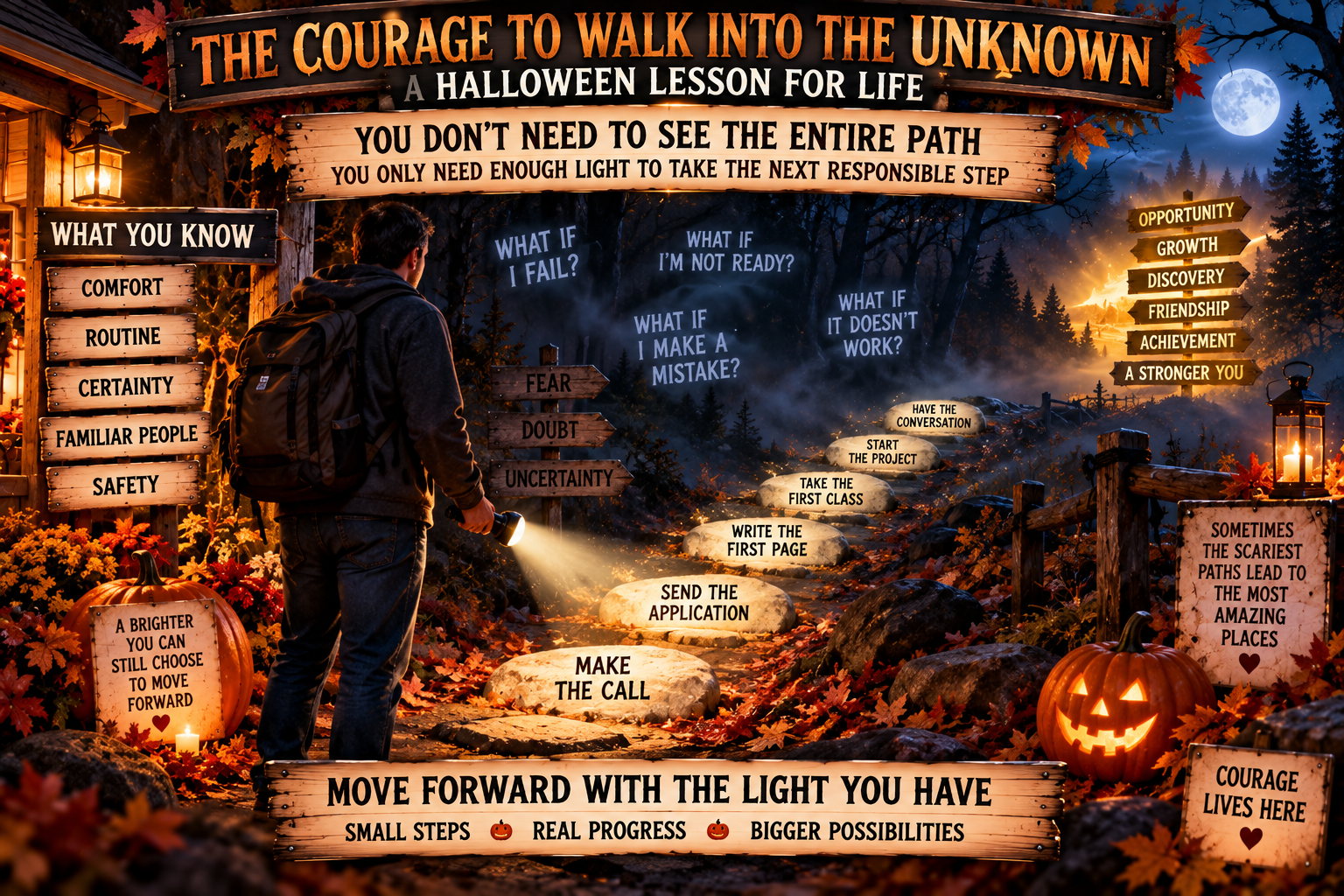
Imagine walking through a dark Halloween attraction with a flashlight that illuminates only several feet ahead. You cannot see the exit from the entrance, but you can see enough to take the next few steps.
Many life goals work exactly this way.
People often delay action because they believe they need a complete plan. They want to know how the business will grow, where the career will lead, how long the project will take, whether the relationship will succeed, or whether the dream will ultimately be worth the effort.
Planning is valuable, but complete visibility is impossible.
Instead of demanding a map for the next five years, identify what you need to do next. Make the call. Complete the application. Research the first requirement. Write the first page. Take the first class. Save the first amount of money. Have the first conversation.
The next step does not need to reveal the entire journey. It only needs to move you forward responsibly. As you advance, new information appears, just as more of the path becomes visible when you move the flashlight ahead.
Fear Often Creates Stories Before Reality Does
Halloween thrives on imagination. A shadow becomes a monster because our minds create a story before we have enough information. The unknown in everyday life can trigger the same response.
We may imagine that an interviewer will reject us, an audience will laugh at us, a project will fail, or a change will ruin everything. None of those outcomes has happened, but emotionally we begin experiencing them as though they already have.
When this happens, separate possibility from probability and prediction from fact.
Ask yourself what you actually know. What evidence supports the frightening story? What evidence might point in another direction? If the feared outcome happened, what could you do in response?
This is not forced optimism. The future may contain difficulties. The point is to avoid giving one negative possibility the authority of certainty.
Your imagination can create monsters, but it can also imagine solutions. If your mind is capable of asking, “What if everything goes wrong?” it is also capable of asking, “What if I learn something valuable?” “What if I handle this better than expected?” and “What if this opens a door I cannot see yet?”
Courage Is Moving Without a Guarantee
We sometimes define courage as confidence, but the two are not the same. Confidence says, “I believe I can do this.” Courage may say, “I do not know whether I can do this yet, but I am willing to try.”
That difference is powerful.
If courage required certainty, many meaningful actions would never happen. People would not change careers, start businesses, create art, return to school, move to new places, form new relationships, or pursue ambitious goals. Every one of those decisions contains uncertainty.
Courage does not guarantee a positive result. It guarantees only that fear will not make the decision automatically.
You can acknowledge risk and still move forward. You can feel nervous and still prepare. You can question yourself and still take action. You can admit that the outcome matters and that failure would hurt without surrendering before the attempt begins.
Sometimes the bravest sentence is not “I know this will work.” It is “I do not know exactly what will happen, but I have enough reason to take the next step.”
Use Preparation as Your Flashlight
Walking into the unknown does not mean walking blindly. Courage and preparation work best together.
Before entering an unfamiliar situation, gather the information you reasonably can. If you are changing careers, research the field and identify transferable skills. If you are starting a business, learn about costs, customers, and basic requirements. If you are giving a presentation, practice your material. If you are making a major purchase, understand your budget and options.
Preparation illuminates part of the path.
The danger comes when preparation becomes an excuse to remain at the entrance forever. There will always be another article, another opinion, another possible scenario, or another detail you could investigate.
At some point you must decide whether you know enough to move responsibly.
A flashlight does not illuminate an entire forest. It helps you see the ground immediately ahead. Good preparation works the same way. It reduces unnecessary risk while accepting that some uncertainty will remain.
Let Curiosity Walk Beside Fear
Fear asks, “What could go wrong?” Curiosity asks, “What might I discover?”
Both questions can exist at the same time.
Curiosity is useful because it changes our relationship with uncertainty. Instead of viewing every unfamiliar situation as a threat, we begin treating some of them as experiments. What will I learn if I try this? Who might I meet? Which skills could I develop? What will I understand afterward that I cannot understand from where I am standing now?
This mindset does not require pretending that every experience will be wonderful. Experiments sometimes fail. New opportunities sometimes disappoint us. But even an imperfect experience can produce information.
Curiosity gives us a reason to move toward the unknown instead of only away from it.
The next time fear tells you, “You have never done this before,” try answering, “That is exactly why there may be something here for me to learn.”
Small Steps Make the Unknown Familiar
The unfamiliar becomes less intimidating through contact. A new workplace eventually develops routines. A difficult skill becomes more natural through repetition. A strange neighborhood becomes recognizable after you travel through it enough times.
This is why small steps are so effective.
You do not have to confront the largest version of a fear immediately. If you want to speak publicly, begin with a small group. If you want to publish your work, start with one piece. If you are considering a major transition, explore it through research, conversations, or a limited commitment before making the largest decision.
Each step converts part of the unknown into the known.
Yesterday you did not know whether you could complete the first task. Today you know because you completed it. Tomorrow you can use that knowledge when approaching the next task.
Progress does not eliminate all uncertainty. It shrinks the territory controlled by it. What once looked like one enormous dark space gradually becomes a series of places you have already learned how to navigate.
Mistakes Are Part of Exploring New Territory
Walking into unfamiliar territory means you will occasionally take a wrong turn. That does not automatically mean you should never have started the journey.
When we try something new, mistakes are often the cost of gaining experience. The first attempt may be inefficient. The first plan may need revision. We may misunderstand something, choose poorly, or discover that an idea works differently in practice than it did in our imagination.
The important question is what happens next.
A mistake can become evidence that you are incapable, or it can become information about how to improve. One interpretation produces shame and retreat. The other produces learning.
This does not mean ignoring consequences. Responsible people acknowledge mistakes, repair what they can, and change their approach. But they do not need to transform every imperfect decision into a permanent identity.
If you demand that you never make mistakes in unfamiliar territory, you are demanding experience before experience exists. Give yourself permission to learn while still holding yourself accountable for learning well.
The Unknown Can Reveal Strength You Did Not Know You Had
Familiar routines show us what we already know how to do. Unfamiliar challenges reveal abilities that may have remained hidden.
You may discover that you are more adaptable than you thought. You may learn that you can solve problems under pressure, communicate with new people, recover from disappointment, learn technology, manage responsibility, or continue working even when the original plan changes.
These strengths cannot always be proven in advance.
Sometimes we learn who we are only after circumstances require more from us.
Think about difficult periods you have already survived. There were probably moments when you did not know exactly how everything would work out. Yet you made decisions, adjusted, asked for help, learned, endured, or found another path.
Past uncertainty can become evidence for future courage. You may not know exactly what waits ahead, but you know more about your ability to respond than you once did.
Not Every Unknown Door Needs to Be Opened
A lesson about courage should never become an argument for recklessness. Halloween stories often teach another useful rule: sometimes the suspicious door really should stay closed.
Not every risk deserves to be taken.
If an opportunity threatens your safety, violates your values, creates unreasonable financial danger, or contains serious warning signs, courage may mean walking away. If you lack essential information, the next brave step may be to slow down and investigate rather than rush forward.
The goal is not to prove that you are unafraid. The goal is to make thoughtful decisions without allowing ordinary discomfort to control you.
Ask whether the risk is necessary, whether it can be reduced, whether the potential benefit matters, and whether you have reasonable safeguards.
There is a difference between an unknown future and an obviously dangerous one. Wisdom helps us recognize it.
You Can Change Direction Without Calling It Failure
One reason the unknown scares us is the belief that every decision must be permanent. If we choose a path and later change direction, we may worry that we wasted time or failed.
Life is rarely that simple.
Sometimes exploring an opportunity teaches us that it is not the right fit. A job can reveal what we want from the next one. A project can teach skills that become valuable elsewhere. A failed idea can expose a better idea. A goal can evolve as we learn more about ourselves.
Changing direction is not always quitting. Sometimes it is responding intelligently to new information.
When you enter unfamiliar territory, give yourself permission to evaluate what you find. Courage is not stubbornly continuing down every road. It is being willing to begin without demanding certainty and being willing to adjust when reality teaches you something new.
Growth Lives Beyond What Is Familiar
Comfort has value. We need places, people, and routines that make life feel stable. But if we refuse to leave what is familiar, our world can gradually become smaller.
Growth usually requires some contact with uncertainty.
Learning means admitting there is something we do not know. Leadership means accepting responsibility for outcomes we cannot completely control. Creativity means producing something whose reception cannot be guaranteed. Relationships require vulnerability. Ambitious goals require effort before results are visible.
The unknown is therefore not only where fear lives. It is also where possibility lives.
The future you want may contain experiences you cannot fully picture from your current position. Becoming stronger may require skills you have not developed yet. Opportunities may arrive in forms you did not expect.
You do not need to abandon stability. You need enough courage to occasionally move beyond it.
Walk Forward With the Light You Have
Halloween gives darkness a playful form, but its deeper lesson can follow us long after the decorations disappear. What we cannot see often frightens us more than what we can. Yet every meaningful future begins as something unknown.
You will not receive guarantees for every important decision. You will not always know whether the opportunity will succeed, whether the plan will unfold exactly as expected, or whether you will feel completely ready.
What you can do is prepare responsibly. You can identify real risks. You can ask for help. You can take small steps. You can learn from mistakes. You can remain curious. You can adjust when new information appears.
Most importantly, you can stop requiring the entire road to be visible before you begin walking.
Maybe courage is not carrying a light bright enough to reveal everything. Maybe it is trusting yourself to move forward with the light you have.
The unknown will always contain reasons to be afraid. It will also contain possibilities that cannot reach you if you never leave the doorway.
Take the next responsible step. Let the path reveal itself as you go. Your future does not need to be completely visible for it to be worth exploring.