

Affiliate Disclaimer: This post may contain affiliate links. If you make a purchase through one of these links, The Shopping Plaza may earn a commission at no additional cost to you.
When Halloween Excitement Turns Into Overload
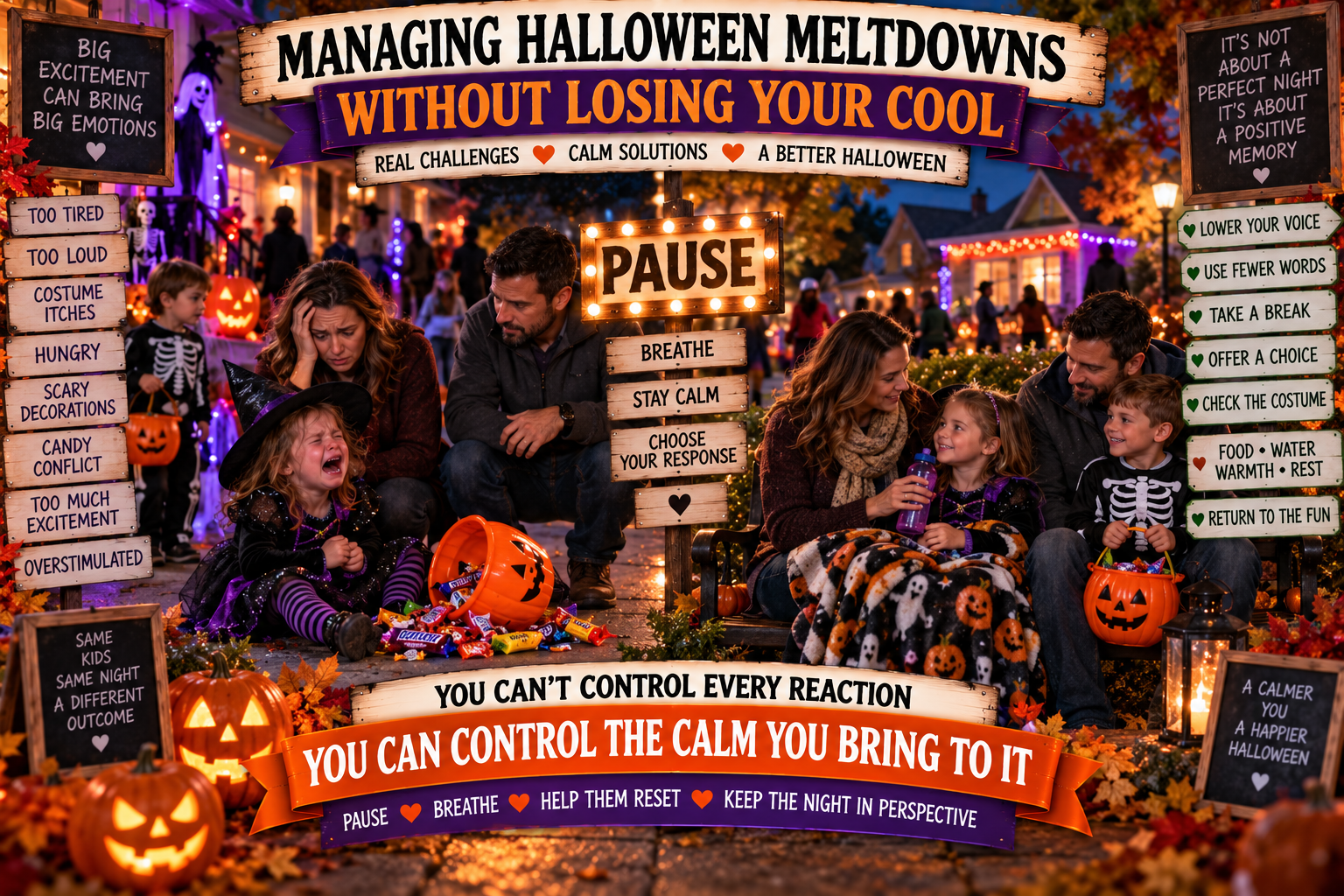
Halloween can be one of the most exciting nights of childhood. Costumes, candy, decorations, parties, school activities, trick-or-treating, and staying up later than usual can make the entire day feel special.
Those same ingredients can also create the perfect conditions for a meltdown.
A child may be tired before trick-or-treating even begins. The costume may suddenly feel uncomfortable. A sibling gets a piece of candy they wanted. A scary decoration catches them by surprise. Plans change. The weather is unpleasant. The candy bag becomes too heavy. Someone says it is time to go home.
Then the excitement collapses into tears, yelling, refusal, or frustration.
Parents can feel overwhelmed too. After spending time and money trying to create a memorable Halloween, watching the evening unravel can be deeply frustrating.
The important thing to remember is that a meltdown does not automatically mean Halloween has been ruined. Often it means a child’s ability to handle stimulation, disappointment, hunger, or exhaustion has reached its limit.
Your calm response can become the bridge that helps everyone get through the difficult moment and return to what actually matters.
Understand What May Be Hiding Behind the Behavior
A meltdown is usually easier to manage when you stop asking, “Why are they acting like this?” and start asking, “What might be making this harder right now?”
Halloween disrupts normal routines. Children may eat differently, sleep differently, spend more time in crowds, encounter loud noises, wear unusual clothing, and process a huge amount of excitement.
A child who appears angry may actually be exhausted. A child refusing to walk may have uncomfortable shoes. A child crying about one piece of candy may be reacting to an entire evening of overstimulation.
Look beneath the immediate complaint.
This does not mean every behavior becomes acceptable. Boundaries still matter. But understanding the likely cause helps you choose a response that solves the problem instead of escalating it.
Sometimes the child needs correction. Sometimes they need food, water, warmth, quiet, reassurance, or sleep.
Lower Your Voice Instead of Raising the Stakes
When children become louder, adults often become louder too.
Unfortunately, matching their intensity usually increases the emotional temperature.
Try doing the opposite.
Lower your voice. Use fewer words. Slow down.
A calm statement such as, “I know you’re upset. We’re going to step over here for a minute,” is often more useful than delivering a long lecture in the middle of a crowded sidewalk.
Children who are emotionally overwhelmed may not be able to process complicated explanations.
Your calm tone communicates that the situation is manageable.
You do not have to feel perfectly calm inside. Parenting composure is often about choosing a steady response even while you are frustrated.
Do Not Try to Solve Everything in Front of an Audience
Public meltdowns can feel especially stressful because parents become aware of other people watching.
That can create pressure to stop the behavior immediately.
If possible, move away from the crowd. Step to a quieter part of the sidewalk, return to the car, sit on a bench, or go inside for a few minutes.
Privacy reduces stimulation for the child and social pressure for the parent.
Most strangers are paying far less attention than it feels like they are.
Your job is not to demonstrate perfect parenting to everyone in the neighborhood. Your job is to help your child regulate and make the next reasonable decision.
Prepare for the Predictable Problems
Many Halloween meltdowns are surprisingly predictable.
Children get hungry. Costumes become itchy. Shoes hurt. Temperatures drop. Candy creates disagreements. Younger children become tired.
Prepare for these possibilities.
Feed children a real meal before trick-or-treating. Bring water. Consider comfortable shoes even if they are not perfectly matched to the costume. Carry an extra layer when the weather may turn cold.
If your child is young, decide beforehand how long you expect to stay out.
Preparation cannot prevent every emotional moment, but it reduces the number of avoidable problems competing for everyone’s patience.
Set Expectations Before the Candy Arrives
Candy can create instant conflict if the rules are invented after the bag is full.
Before trick-or-treating, explain what will happen afterward.
Can children eat a certain number of pieces that night? Will the rest be saved? Are there candies that need to be checked or avoided? Can siblings trade?
Keep the rules simple and appropriate for your family.
Clear expectations do not guarantee that children will happily accept every limit, but they reduce surprise.
A child may still be disappointed when you say, “That is enough candy for tonight,” but at least the boundary was not invented in the middle of the disagreement.
Give Choices Where Choices Are Possible
Children often become more cooperative when they have some control.
Offer two acceptable options.
“Do you want to visit three more houses or five?” “Would you like to carry your costume mask or put it in the bag?” “Do you want to take a break here or walk back to the car?”
Both options should be choices you can genuinely accept.
Choices are especially helpful on Halloween because children spend much of the evening following adult schedules and navigating unpredictable environments.
A little control can reduce frustration without giving up necessary boundaries.
Know When the Costume Is the Problem
A costume that looked wonderful at home may become miserable after an hour.
Masks get hot. Makeup feels irritating. Capes drag. Shoes rub. Accessories become heavy. Layers that were comfortable indoors become too warm outside.
If your child’s behavior changes suddenly, check the costume.
Sometimes removing one accessory can rescue the evening.
Do not let the need to preserve a perfect costume photograph become more important than the child wearing it.
The costume exists to support the fun. The child does not exist to support the costume.
Create a Calm-Down Plan Before Halloween
Do not wait for a meltdown to decide how your family will handle one.
Talk about breaks before the evening begins.
Explain that anyone can ask for a quiet minute if things become overwhelming. Choose a phrase your child can use, or simply tell them they can say, “I need a break.”
You can also identify likely quiet places: the car, home, a less crowded street, or a nearby bench.
A plan gives both parent and child something familiar to follow when emotions are high.
The goal is not to guarantee perfect behavior. It is to make recovery easier.
Avoid Threats You Do Not Intend to Keep
Frustrated parents sometimes make enormous threats in the moment: “We’re throwing away all the candy,” “You’re never trick-or-treating again,” or “Halloween is over forever.”
These statements may briefly express anger, but they rarely help.
If a consequence is needed, choose one that is realistic, related to the behavior, and something you are prepared to follow through on.
For example, if a child repeatedly runs away from the group after being warned, they may need to walk beside an adult or end trick-or-treating early for safety.
Calm, believable boundaries are more effective than dramatic threats made under pressure.
Do Not Let One Difficult Moment Define the Whole Night
A meltdown can make parents think, “All that work, and Halloween is ruined.”
That interpretation adds disappointment to an already difficult moment.
Instead, treat the meltdown as one part of the evening.
Maybe the first hour was wonderful. Perhaps the child recovers after ten minutes and continues. Maybe the family goes home early and finishes the night with a movie.
A difficult fifteen minutes does not erase everything else.
Children also learn something valuable when they experience a hard moment, recover, and continue.
The ability to reset is more useful than the expectation that nothing will ever go wrong.
Watch Your Own Halloween Expectations
Parents can unintentionally create pressure because they have a picture of how Halloween is supposed to unfold.
Everyone will love the costumes. The children will cooperate for photographs. Trick-or-treating will last exactly as planned. Everyone will be grateful and cheerful.
Real children rarely follow a perfect holiday script.
If your expectations are too rigid, every deviation feels like failure.
Choose a few priorities instead. Maybe your goal is simply to enjoy some trick-or-treating, take a couple of pictures, and spend time together.
Flexible expectations leave more room for real life.
Recognize When You Need Your Own Pause
Parents have limits too.
If you feel yourself approaching the point where you may yell or say something you will regret, create a pause when it is safe.
Ask another trusted adult to take over briefly if one is available. Take several slow breaths. Get a drink of water. Remind yourself that the current problem is temporary.
You are not required to be emotionally unaffected by difficult behavior.
You are responsible for how you respond to it.
Sometimes thirty seconds of intentional silence protects the next thirty minutes.
Reconnect After the Meltdown
Once everyone is calm, reconnect before turning the moment into a lesson.
A hug, kind word, or simple reassurance can help signal that the conflict has ended.
Later, when the child can listen, briefly discuss what happened.
You might say, “You were really tired and angry when it was time to leave. Next time, you can tell me you need a break instead of yelling.”
Keep the conversation focused on learning rather than shame.
Children need to know that making a poor choice during a difficult moment does not make them a bad child.
The goal is helping them build better tools for the next difficult moment.
Know When It Is Time to Go Home
Sometimes the best strategy is ending the evening.
If a child is exhausted, repeatedly overwhelmed, unable to recover, or no longer enjoying the activity, another twenty houses may not improve anything.
Going home early is not admitting defeat.
Halloween is not a competition to collect the maximum amount of candy or stay outside the longest.
You can return home, change into comfortable clothes, sort candy, watch a movie, or simply go to bed.
Knowing when enough is enough protects the positive parts of the evening.
Use the Experience to Prepare for Next Year
After Halloween, think about what worked and what did not.
Was trick-or-treating too late? Did the costume create problems? Was the group too large? Did your child need more food beforehand? Was the route too long?
Write down the lessons while they are fresh.
Next year’s Halloween can be easier because this year’s difficult moments gave you useful information.
Parenting often works this way. We rarely get every situation right the first time. We observe, adjust, and try again.
A meltdown can become information rather than simply a bad memory.
Your Calm Matters More Than a Perfect Halloween
Halloween is exciting precisely because it is different from an ordinary day. But different also means less predictable.
There may be tears. Someone may refuse the costume. Candy may spill. A scary decoration may cause panic. A sibling argument may erupt on the sidewalk. Your carefully planned schedule may collapse before the evening is halfway finished.
You cannot control every reaction.
You can control the tone you bring to the response.
Prepare where you can. Feed children before the excitement begins. Set clear expectations. Offer reasonable choices. Watch for exhaustion and overstimulation. Take breaks. Keep consequences realistic. And when your own frustration rises, remember that you are allowed to pause too.
Managing a meltdown does not mean making the emotion disappear instantly. Sometimes success means staying steady while the emotion passes.
Years from now, your family is unlikely to remember exactly how many houses you visited or whether everyone smiled in every photograph. They may remember the traditions, costumes, laughter, candy, and feeling of being together.
One difficult moment does not have to steal that memory.
Halloween does not need a perfect child or a perfectly calm parent. It needs enough patience to get through the messy moments and enough perspective to recognize that the fun is still there when the storm passes.