
Affiliate Disclaimer: This post may contain affiliate links. If you make a purchase through one of these links, The Shopping Plaza may earn a commission at no additional cost to you.
Holiday Loneliness Can Feel Heavier Than Ordinary Loneliness
The holiday season is filled with messages about togetherness. Commercials show crowded tables. Social media fills with family photographs. Movies end with people reunited around glowing trees and holiday meals. Everywhere you look, the season seems to suggest that everyone belongs somewhere.
When you feel lonely, those images can make the loneliness feel even sharper.
Maybe you live far from family. Perhaps a relationship ended, someone you love died, friendships changed, or circumstances left you spending more time alone than you expected. You may even be surrounded by people and still feel emotionally disconnected.
Loneliness is not always about an empty room. Sometimes it is the feeling that nobody truly sees what you are carrying.
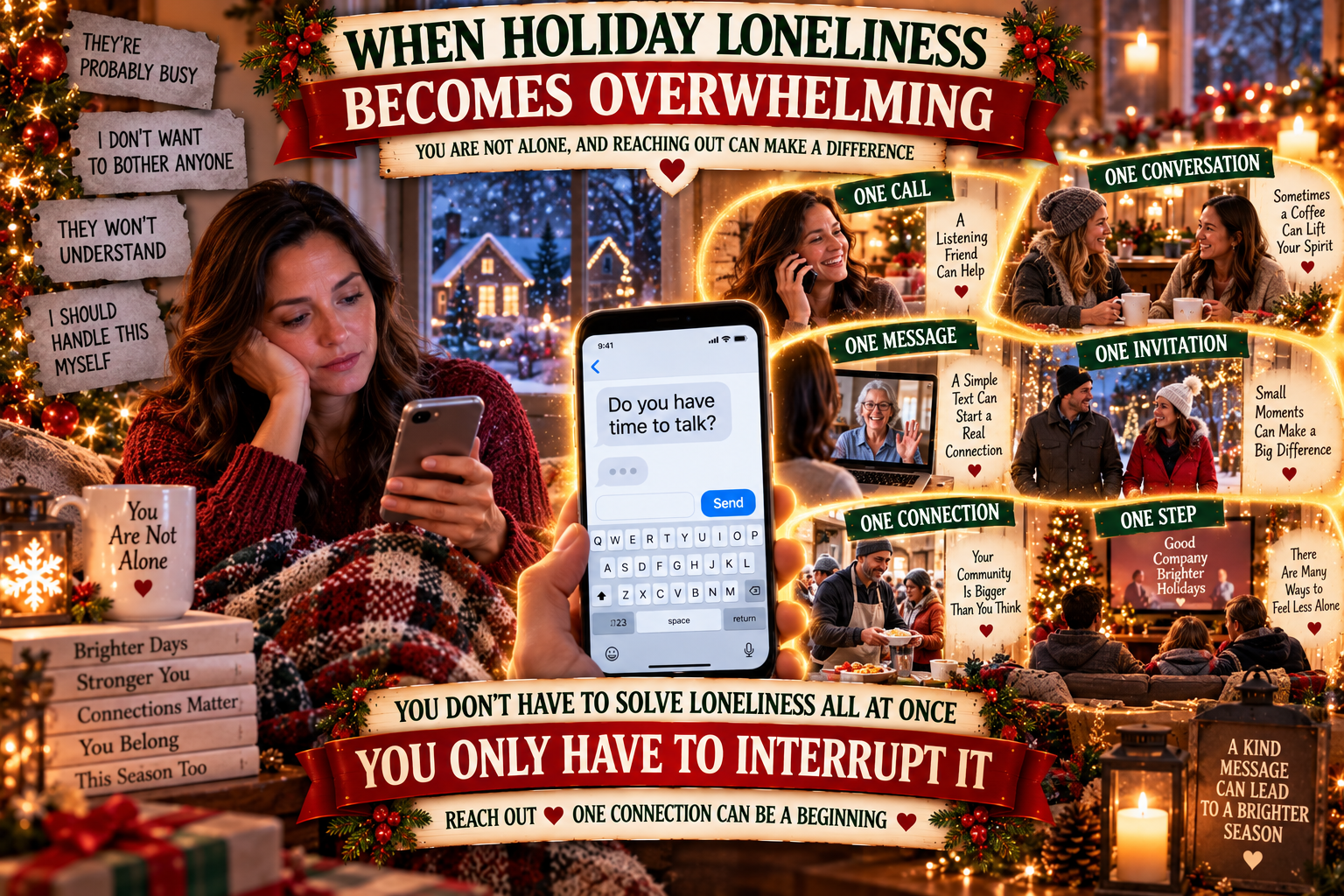
When that feeling becomes overwhelming, the instinct may be to withdraw even further. You may tell yourself that other people are busy, that you do not want to bother anyone, or that reaching out will make you look needy.
But isolation often becomes heavier when it is carried silently.
Reaching out does not require a dramatic announcement. It can begin with one message, one phone call, one honest sentence, or one small step toward another person.
You do not have to solve loneliness all at once. You only have to interrupt it.
Recognize When You Are Beginning to Withdraw
Loneliness can create a cycle.
You feel disconnected, so you stop reaching out. The lack of contact then makes you feel even more disconnected.
Notice when you begin ignoring messages, avoiding invitations, or convincing yourself that nobody wants to hear from you.
You do not need to force yourself into constant social activity.
Simply recognize when solitude has stopped feeling restorative and started feeling painful.
Do Not Wait Until You Know Exactly What to Say
People sometimes delay reaching out because they cannot find the perfect words.
You do not need them.
Try something simple.
“I’ve been having a difficult holiday week and could use some company.”
“Do you have a few minutes to talk?”
“I’ve been feeling lonely lately.”
Honesty does not need to be eloquent to create connection.
Choose One Safe Person
When loneliness feels overwhelming, contacting many people can feel impossible.
Start with one.
Think about someone who is generally kind, reliable, and willing to listen.
It could be a friend, relative, neighbor, coworker, mentor, or another trusted person.
You are not trying to rebuild your entire social world in one afternoon.
You are opening one door.
Be Specific About What Would Help
People often want to help but do not know what you need.
Instead of saying only, “I’m having a hard time,” consider adding a specific request.
“Could we talk for fifteen minutes?”
“Would you like to get coffee this week?”
“Could I come by for a little while?”
Specific requests make it easier for another person to respond.
Send the Message Before You Talk Yourself Out of It
Loneliness can produce convincing arguments against reaching out.
“They’re probably busy.”
“They won’t understand.”
“I should be able to handle this myself.”
If you have identified someone safe, send the message before overthinking takes control.
You can survive a delayed response.
What matters is refusing to let fear make every decision for you.
Remember That a Slow Reply Is Not Automatic Rejection
The holidays can be busy.
People travel, cook, shop, work, care for children, and attend gatherings.
If someone does not respond immediately, avoid turning the delay into a conclusion about your worth.
Give them time.
If necessary, reach out to someone else.
One unanswered message does not mean nobody cares.
Accept Invitations That Feel Manageable
When you are lonely, an invitation can sometimes feel intimidating.
You may worry about being awkward, staying too long, or not knowing anyone.
You do not have to commit to an entire day.
Attend for an hour.
Meet for coffee.
Join a small activity.
Give yourself permission to leave when your energy is gone.
A manageable amount of connection is still connection.
Create Connection Instead of Waiting for It
You do not always have to wait for someone else to make the first move.
Invite a friend to watch a movie.
Ask a neighbor to take a walk.
Suggest lunch.
Start a group chat.
Sometimes other people are lonely too and are equally unsure about reaching out.
Your invitation may help more than one person.
Use Technology as a Bridge, Not a Substitute for Every Connection
A video call, text conversation, online community, or voice chat can reduce distance when in-person connection is unavailable.
Use those tools intentionally.
A meaningful conversation is different from endlessly scrolling through other people’s holiday photographs.
Choose technology that helps you interact rather than technology that only reminds you what you think you are missing.
Step Away From Social Media Comparison
Holiday social media can distort reality.
You may see hundreds of smiling photographs and conclude that everyone else has a perfect family, active social life, and joyful holiday.
You are seeing selected moments.
If scrolling increases loneliness, close the app.
Protecting your emotional state is more useful than gathering more evidence for an unfair comparison.
Look for Community Beyond Your Usual Circle
Connection does not have to come only from relatives or longtime friends.
Community organizations, volunteer opportunities, faith communities, hobby groups, classes, neighborhood activities, and local events can create new points of contact.
You do not need to find your new best friend immediately.
Repeated small interactions can gradually create belonging.
Volunteer if Giving Helps You Feel Connected
Helping another person can interrupt the feeling that you are separate from everyone around you.
If an appropriate opportunity is available, consider volunteering, helping a neighbor, donating time, or supporting a community effort.
Do it because the activity feels meaningful, not because you need to earn the right to feel better.
Connection often grows when people work toward something together.
Tell Someone When You Need More Than Casual Conversation
Sometimes a quick holiday greeting is not enough.
If you are struggling deeply, tell a trusted person that you need a real conversation.
You might say, “I appreciate the check-in, but I’m actually having a harder time than I’ve been saying.”
That sentence gives the other person a chance to understand the seriousness of what you are feeling.
Do Not Minimize Your Loneliness Because Someone Else Has Bigger Problems
Pain is not a competition.
You may know people dealing with grief, illness, financial problems, or other serious challenges.
Their difficulties do not make your loneliness imaginary.
You can care about other people’s struggles while acknowledging your own.
You do not need to prove that your pain is the worst before asking for support.
Create Structure for the Loneliest Parts of the Day
Loneliness may become stronger at predictable times.
Evenings.
Weekend mornings.
Holiday meals.
Plan something for those hours.
Schedule a phone call.
Watch a favorite movie.
Take a walk.
Cook something.
Listen to an audiobook.
Join an activity.
Structure cannot replace human connection, but it can prevent an empty stretch of time from becoming emotionally overwhelming.
Use Small Interactions to Reconnect With the World
Not every connection needs to become a deep conversation.
Say hello to a neighbor.
Talk briefly with a coworker.
Thank someone helping you in a store.
Send a message to an old friend.
Small social interactions remind the mind that you are still part of a larger human world.
Reach Back Toward Relationships That Have Simply Become Quiet
Some relationships disappear because of conflict.
Others simply become quiet because life gets busy.
Think about someone you once enjoyed talking with.
A simple “I was thinking about you and wanted to say hello” can reopen a connection.
You do not need a complicated explanation for the time that passed.
Do Not Force Yourself Into Harmful Relationships Just to Avoid Being Alone
Loneliness can make unhealthy relationships look more appealing.
Be careful.
Connection should not require accepting cruelty, manipulation, disrespect, or repeated emotional harm.
Being lonely does not mean every available relationship is good for you.
Reach toward safe connection, not simply any connection.
Make Your Home Feel Supportive
When you are spending time alone, your environment matters.
Create warmth where you can.
Play music.
Prepare food you enjoy.
Use comfortable lighting.
Watch something familiar.
Keep a simple routine.
A supportive environment cannot eliminate loneliness, but it can make the hours feel less harsh while you work on rebuilding connection.
Consider Professional Support When Loneliness Is Persistent
Sometimes loneliness becomes more than a difficult holiday feeling.
It may last for weeks or months and begin affecting sleep, motivation, appetite, work, or your ability to function.
A counselor, therapist, support group, or other qualified professional can provide a place to talk honestly and develop strategies for rebuilding connection.
Seeking professional support is another form of reaching out.
You do not have to wait until everything feels unbearable before asking for help.
Take Urgent Emotional Distress Seriously
If loneliness becomes so intense that you feel unsafe, believe you may harm yourself, or feel unable to get through the immediate moment safely, treat that as urgent.
Contact emergency services or an appropriate crisis service in your location, or go to the nearest emergency department. If possible, tell a trusted person what is happening and stay connected with someone rather than remaining alone.
An emotional crisis deserves immediate support just as a physical emergency does.
You do not need to solve the rest of your life in that moment.
The immediate goal is safety and connection.
Build Connection Beyond the Holiday Season
Holiday loneliness can reveal a need that existed before Thanksgiving or December.
When the season ends, continue building.
Schedule regular calls.
Join an ongoing activity.
Reconnect with people.
Invite someone for coffee.
Volunteer consistently.
Friendships and community usually develop through repeated contact rather than one dramatic moment.
Give relationships time to grow.
Remember That Reaching Out Is an Act of Courage
It can feel vulnerable to tell someone that you are lonely.
You may fear rejection.
You may worry that you will sound weak.
But reaching out is not surrender.
It is action.
It is deciding that isolation does not get to make every choice for you.
Courage sometimes looks like a five-word text message: “Do you have time to talk?”
You Do Not Have to Carry Holiday Loneliness in Silence
Holiday loneliness can make the world feel as though everyone else has somewhere to belong.
That feeling can be powerful.
It is not always accurate.
Many people experience loneliness during the holidays, including people sitting in crowded rooms.
Connection is not measured only by how many invitations you receive or how many people appear in a photograph.
Real connection begins when people allow themselves to be known.
That may begin with you.
One message.
One call.
One invitation.
One honest answer when someone asks how you are doing.
You do not need to tell everyone.
Choose one safe person.
You do not need to explain everything.
Say enough to open the conversation.
You do not need to solve loneliness tonight.
Create one point of contact.
And if the first person is unavailable, try another.
The goal is not to prove that nobody will ever disappoint you.
The goal is to stop allowing loneliness to convince you that reaching out is pointless.
There are people who may care more than you realize.
There are relationships that can be strengthened.
There are communities you have not joined yet.
There are future friendships you have not formed.
There are conversations you have not had.
Your current loneliness does not predict your permanent future.
This holiday season may be difficult.
Acknowledge that.
Care for yourself through it.
Reduce the comparisons.
Accept manageable invitations.
Create opportunities for connection.
Ask clearly for what you need.
Seek professional support when the loneliness becomes persistent or difficult to manage.
And take immediate action if emotional distress ever becomes a safety concern.
Most importantly, remember that needing people is not a personal failure.
Human beings are built for connection.
Reaching out is not an admission that you are incapable of standing on your own.
Sometimes it is the strongest way of refusing to stand alone when you no longer need to.
Send the message.
Make the call.
Open the door.
One connection may not fix everything.
But it can be the beginning of something that loneliness does not want you to believe is possible:
feeling connected again.