

Affiliate Disclaimer: This post may contain affiliate links. If you make a purchase through one of these links, The Shopping Plaza may earn a commission at no additional cost to you.
Thanksgiving Can Bring Gratitude and Emotional Stress at the Same Time
Thanksgiving is often described as a day of warmth, gratitude, family, and togetherness. But not every gathering feels peaceful.
For some people, Thanksgiving means entering a room filled with complicated relationships, old disagreements, uncomfortable questions, unresolved tension, grief, financial stress, or expectations that feel impossible to meet. You may care about the people around the table and still find the gathering emotionally exhausting.
Protecting your mental wellness does not mean demanding that everyone behave exactly the way you want. It means recognizing what you can control and making choices that protect your ability to move through the day with stability, dignity, and perspective.
You do not have to absorb every mood in the room.
You do not have to answer every question.
You do not have to solve every disagreement.
And you do not have to sacrifice your entire emotional well-being simply because the calendar says everyone is supposed to be together.
A difficult Thanksgiving can still contain meaningful moments. The goal is to give yourself enough emotional space to notice them.
Prepare Emotionally Before You Arrive
If you already know a gathering may be difficult, preparation can help.
Think about the situations that usually create stress.
Is there a relative who asks intrusive questions? A topic that reliably causes arguments? A family dynamic that makes you feel responsible for keeping everyone happy?
Identifying likely pressure points allows you to decide how you want to respond before emotions are high.
Preparation cannot control other people.
It can make your own choices more intentional.
Set Realistic Expectations for the Gathering
Sometimes emotional stress begins with hoping that this Thanksgiving will suddenly fix long-standing family problems.
People may still be themselves.
The relative who talks too much may talk too much. The person who complains may complain. Old tensions may not disappear because there is turkey on the table.
Realistic expectations are not pessimism.
They prevent you from spending the day shocked by behavior you already knew was possible.
You can hope for a good gathering without requiring everyone to become a different person.
Decide Your Boundaries Ahead of Time
Boundaries are easier to maintain when you know what they are.
Decide which topics you will discuss, what behavior you will step away from, and how long you are comfortable staying.
A boundary might sound like, “I am not discussing my finances today,” or, “If the conversation becomes insulting, I am going to step away.”
You do not need to announce every boundary when you enter the room.
You simply need to know what you will do when the situation arises.
Remember That You Are Allowed to Decline Personal Questions
Holiday gatherings can sometimes feel like informal interviews.
Questions may come about relationships, children, work, money, weight, future plans, or other personal matters.
You are not required to answer simply because someone asked.
Try a calm response such as, “I’d rather not get into that today,” or, “Everything is fine, but let’s talk about something else.”
You can be polite without surrendering your privacy.
Do Not Make Yourself Responsible for Everyone’s Emotions
Some people enter family gatherings believing it is their job to keep everyone happy.
They monitor conversations, smooth over disagreements, entertain guests, and worry whenever someone seems upset.
That responsibility is too large.
You can be considerate.
You can help create a welcoming atmosphere.
But adults are ultimately responsible for managing their own feelings and behavior.
You are allowed to enjoy Thanksgiving without constantly checking whether everyone else is enjoying it correctly.
Choose Which Conversations Deserve Your Energy
Not every disagreement needs your participation.
Someone may bring up a controversial topic or make a statement you strongly disagree with.
Ask yourself what is likely to happen if you engage.
Will the conversation be respectful and productive?
Or will everyone repeat the same arguments they have had before?
Your energy is limited.
Use it on conversations that have a reasonable chance of producing understanding rather than simply increasing tension.
Have a Few Exit Phrases Ready
When you are uncomfortable, it can be difficult to think of the right words.
Prepare a few simple phrases.
“I’d rather not discuss that today.”
“Let’s change the subject.”
“I need to check on something.”
“I’m going to step away for a few minutes.”
You do not need a dramatic explanation.
A short sentence can create the space you need.
Find One Safe Person at the Gathering
If possible, identify someone who helps you feel grounded.
It may be your spouse, sibling, friend, cousin, or another trusted person.
You do not need them to rescue you from every uncomfortable moment.
Sometimes simply knowing that one person understands the situation can make the gathering feel less isolating.
A familiar conversation or quick check-in can help you reset when the room becomes emotionally heavy.
Take Breaks Before You Feel Overwhelmed
Do not wait until your patience is completely gone.
Step away early.
Go to another room. Take a short walk. Help with a quiet task. Sit somewhere less crowded.
A five-minute break can lower the emotional intensity of the day.
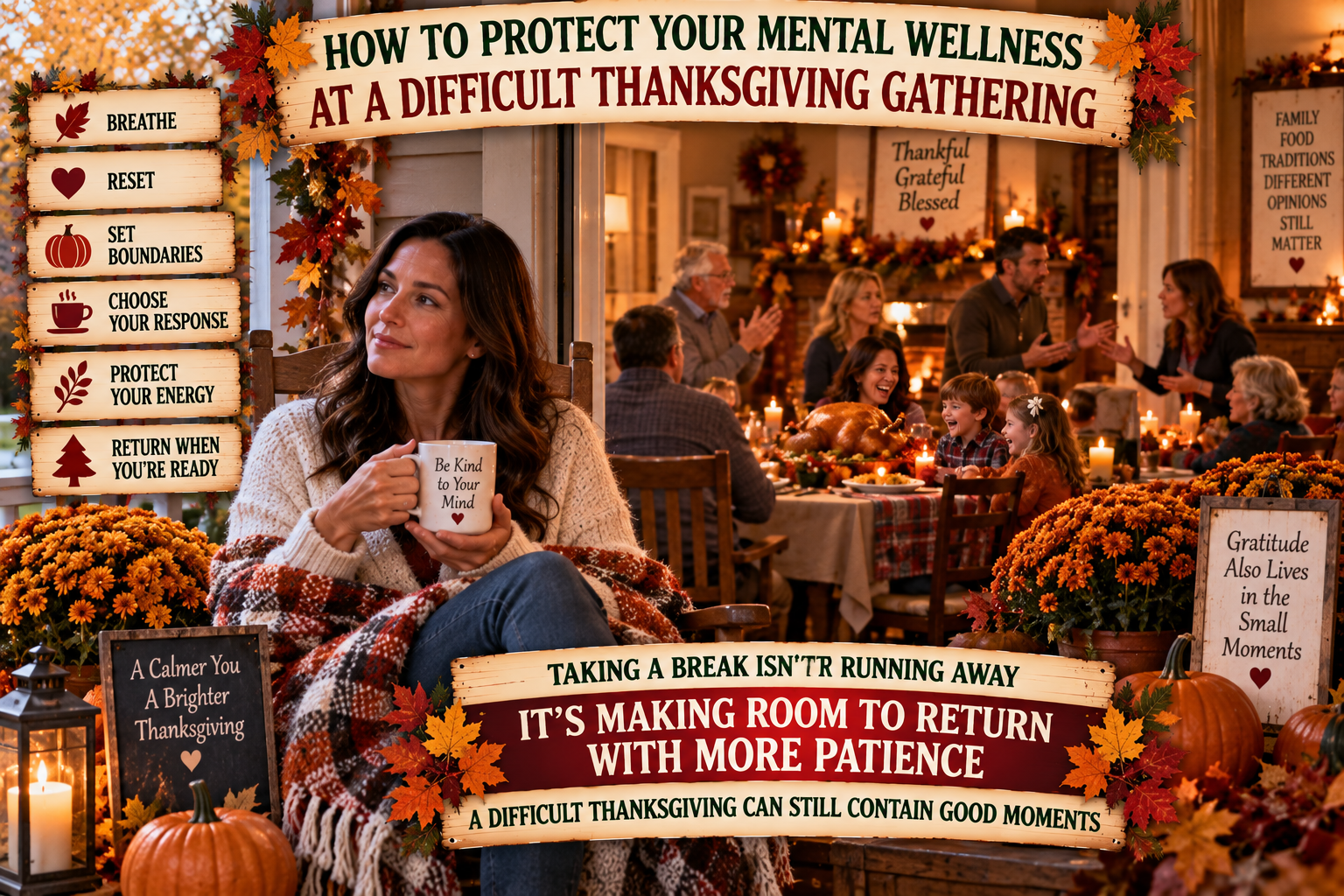
Think of breaks as maintenance rather than escape.
You are giving yourself enough space to return with more patience and clarity.
Pay Attention to Your Physical Needs
Mental wellness and physical well-being are connected.
Hunger, exhaustion, dehydration, and overstimulation can make difficult interactions feel even harder.
Eat something. Drink water. Rest when you can. Take medication as normally directed. Give yourself a quieter environment if the room becomes too intense.
Basic self-care will not solve a difficult family dynamic.
It can keep physical depletion from making that dynamic harder to manage.
Do Not Use Alcohol as Your Only Coping Strategy
Some people rely on alcohol to make uncomfortable gatherings feel easier.
If alcohol is part of your celebration, be mindful of whether you are using it to avoid emotions or tolerate situations that feel difficult.
Alcohol can lower inhibitions and sometimes make tense conversations more likely.
Have other coping strategies available: breaks, supportive people, clear boundaries, food, water, a planned departure time, and calming activities.
Your ability to make thoughtful decisions is one of your strongest tools during a challenging gathering.
Protect Yourself From Comparison
Thanksgiving can create comparison in subtle ways.
Someone may talk about a promotion, new home, relationship, vacation, children’s accomplishments, or financial success.
Their good news does not reduce the value of your own life.
You do not have to turn another person’s update into a measurement of where you believe you should be.
Celebrate what you genuinely can.
Then return your attention to your own path.
Do Not Let Old Family Roles Define Who You Are Today
Families sometimes continue treating people according to roles formed years ago.
The irresponsible one. The quiet one. The difficult one. The successful one. The sensitive one.
You may have changed significantly while the family’s picture of you stayed frozen.
You do not need to perform an outdated role.
Respond as the person you are now.
Growth sometimes means refusing to keep playing a character that no longer fits.
Give Yourself Permission Not to Explain Every Life Choice
You may have made decisions that relatives do not understand.
Career choices. Parenting choices. Financial decisions. Relationships. Where you live. How you spend your time.
You can listen to sincere concern without turning Thanksgiving into a defense of your entire life.
Not everyone needs to understand every decision in order for that decision to be valid.
Sometimes protecting your wellness means allowing another person to remain unconvinced.
Stay Out of the Middle When Conflict Is Not Yours
Family disagreements can recruit bystanders.
One person complains about another and suddenly expects you to take a side.
Be careful about becoming the messenger, referee, or judge.
You can say, “I think that’s something you should discuss directly with them.”
Protecting your mental wellness includes refusing responsibilities that belong to other people’s relationships.
Create a Time Limit if Long Gatherings Drain You
You do not necessarily need to stay from the first arrival until the last person leaves.
If long gatherings are difficult, decide on a reasonable amount of time.
Arrive for the meal. Participate in the traditions that matter. Spend meaningful time with people.
Then leave before exhaustion turns into resentment.
Quality of presence can matter more than quantity of hours.
Keep Your Own Transportation or Exit Options in Mind
Feeling trapped can increase stress.
When practical, know how you will leave and approximately when.
If you are relying on someone else for transportation, discuss the plan beforehand.
If you are hosting, create a natural ending to the gathering.
Having an exit plan does not mean you expect disaster.
It simply reminds you that the situation has an endpoint.
Allow Yourself to Feel What You Feel
You may be sad, anxious, frustrated, lonely, or disappointed during part of Thanksgiving.
Those emotions do not mean you are doing gratitude incorrectly.
A holiday does not erase what is happening in your life.
You can appreciate a good meal and still miss someone.
You can love your family and still find the gathering difficult.
You can be thankful and emotionally tired at the same time.
Human emotions do not have to arrive one at a time.
Use a Simple Grounding Practice When Tension Rises
When you notice yourself becoming emotionally activated, bring your attention back to the immediate moment.
Slow your breathing.
Notice where your feet or body are supported.
Identify a few sounds around you.
Focus on the temperature of a drink or the texture of an object in your hand.
The purpose is not to pretend the stressful situation is gone.
It is to interrupt the mental spiral long enough to choose your next response.
Do Not Confuse Keeping the Peace With Abandoning Yourself
There is value in avoiding unnecessary conflict.
But keeping the peace does not require tolerating disrespect indefinitely.
You can remain calm and still be firm.
You can leave a conversation.
You can say that a comment was inappropriate.
You can decide that a particular interaction is over.
Peace that requires you to silently absorb everything is not much of a peace at all.
Healthy calm includes self-respect.
Create Something to Look Forward to After the Gathering
Give the day an emotional landing place.
Plan a quiet evening, favorite movie, comfortable meal, phone call with a friend, or relaxing activity for later.
Knowing that restorative time is coming can make a difficult gathering feel more manageable.
It also reminds you that Thanksgiving is one part of your day, not the entirety of your emotional world.
Reflect Without Replaying Everything
After a difficult gathering, it can be tempting to mentally review every awkward comment and frustrating interaction.
Reflection can be useful.
Rumination usually is not.
Ask a few constructive questions.
What went better than expected?
Which boundary helped?
What would you change next time?
Then allow the gathering to end.
You do not need to keep attending it in your mind for the next three days.
Notice the Moments That Were Still Good
A difficult Thanksgiving does not have to become an entirely bad Thanksgiving.
Maybe one conversation made you laugh.
Someone brought your favorite dessert.
A child said something funny.
You enjoyed a tradition.
A person you care about gave you a hug.
Notice those moments.
They do not erase what was difficult.
They simply keep difficulty from becoming the only story you tell yourself about the day.
Your Mental Wellness Matters During the Holidays Too
Thanksgiving can place enormous emphasis on togetherness.
Togetherness can be beautiful.
But togetherness is healthiest when it leaves room for boundaries, respect, rest, and emotional honesty.
You are allowed to protect your mental wellness during a difficult gathering.
That may mean preparing before you arrive.
It may mean declining a personal question.
It may mean stepping away from an argument, taking a quiet break, or leaving earlier than someone expected.
It may mean accepting that another person is disappointed with a boundary you needed.
None of those choices require you to become cold or disconnected.
You can be kind and still have limits.
You can love people without agreeing with them.
You can participate without surrendering every ounce of emotional energy.
And you can find gratitude without pretending that every relationship or circumstance is easy.
Thanksgiving is one day.
You do not need to resolve every family conflict before dessert.
You do not need to prove anything about your life.
You do not need to win every argument or satisfy every expectation.
Protect what deserves protecting.
Your patience.
Your perspective.
Your dignity.
Your ability to recognize the good moments that are actually happening.
When the gathering becomes difficult, return to what you can control: your words, your boundaries, your attention, your choices, and when necessary, your decision to step away.
Then let the rest belong to the people responsible for it.
A difficult Thanksgiving may never become effortless.
But with preparation, boundaries, perspective, and self-respect, it does not have to take everything out of you.
You can leave the table with more than relief that the day is over.
You can leave knowing that you protected your wellness while still making room for whatever gratitude, connection, and joy the day was able to offer.