
Affiliate Disclaimer: This post may contain affiliate links. If you make a purchase through one of these links, The Shopping Plaza may earn a commission at no additional cost to you.
Halloween Magic Can Feel Scary When You Are Small
Halloween is built around imagination. Friendly neighborhoods suddenly contain skeletons, witches, ghosts, giant spiders, monsters, glowing eyes, fog machines, moving decorations, and adults wearing costumes that make them difficult to recognize. For many children, this is exciting. For others, it can be overwhelming.
Young children are still learning how to separate pretend danger from real danger. A decoration that an adult immediately recognizes as plastic may look very convincing to a child. A motion-activated monster can be especially startling because it appears to come alive without warning.
Parents do not need to eliminate every frightening part of Halloween. Instead, they can prepare children for what they may encounter and give them tools for responding when something feels too scary.
The goal is not to force children to prove that they are brave. It is to help them understand what is happening, feel supported, and gradually discover that they can handle unfamiliar Halloween sights at their own pace.
Explain That Halloween Is a Season of Pretend
One of the most useful conversations begins with a simple idea: Halloween involves a lot of pretending.
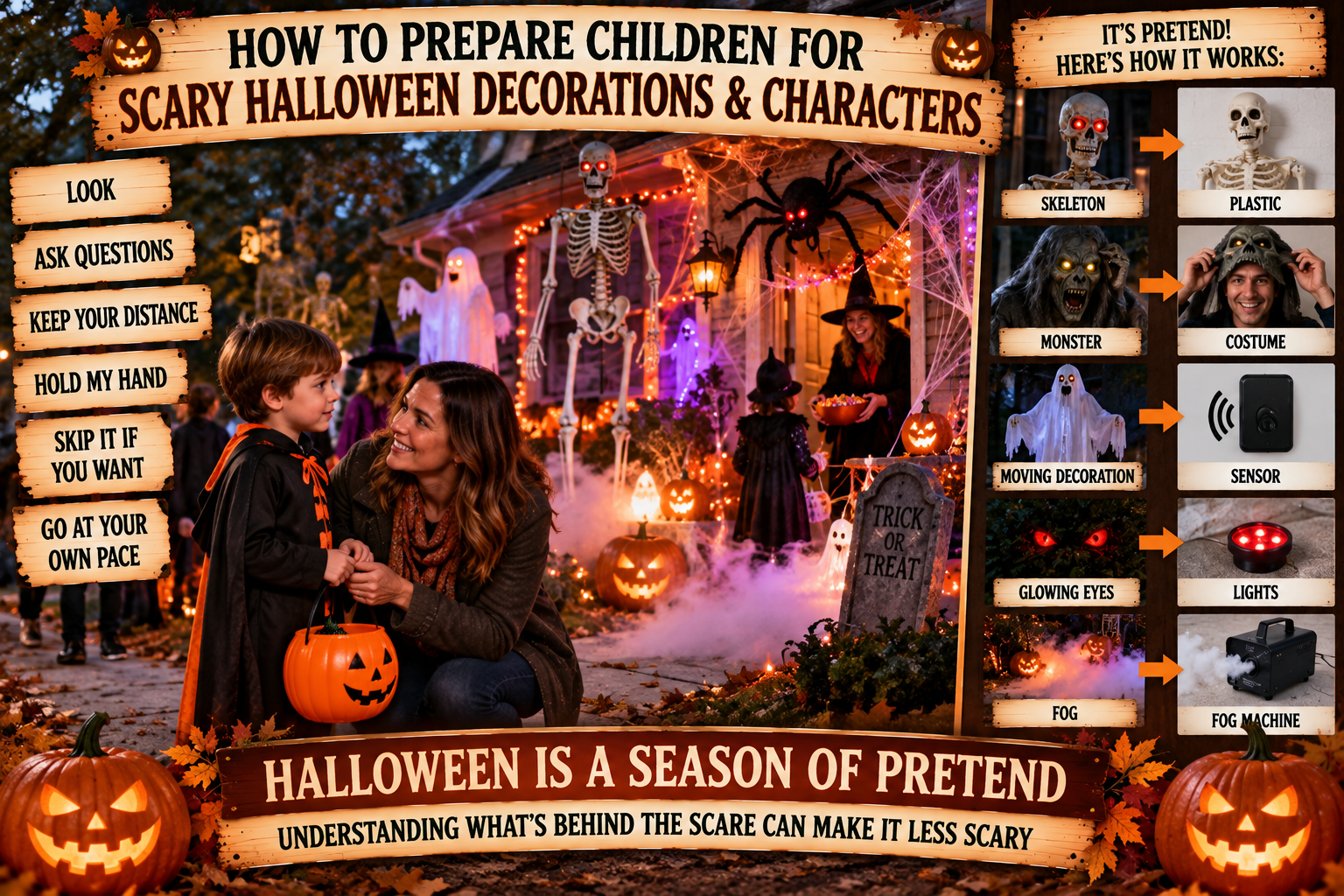
Explain that people may dress like monsters, ghosts, superheroes, animals, or characters, but underneath the costumes they are still ordinary people. Decorations may look frightening even though they are made from plastic, fabric, foam, lights, motors, and other materials.
Keep the explanation appropriate for your child’s age.
You might say, “Some houses like to pretend they are spooky for Halloween. The skeletons and monsters are decorations, just like birthday decorations are used for a birthday.”
This gives children a framework for interpreting what they see.
Instead of encountering a frightening object with no explanation, they can begin thinking, “This is part of the Halloween pretending.”
That understanding may not remove every fear, but it can reduce confusion.
Introduce Halloween Images Gradually
If your child is easily frightened, Halloween night should not be the first time they encounter intense decorations.
Begin with gentle seasonal images such as pumpkins, friendly ghosts, smiling witches, black cats, bats, or cartoon monsters. As the child becomes comfortable, you can introduce slightly spookier decorations while explaining what they are.
Gradual exposure allows the child’s understanding to grow alongside the imagery.
There is no need to deliberately show children the most frightening Halloween content you can find. The purpose is preparation, not desensitization.
Follow their reactions. If something is clearly too intense, move back toward gentler material.
Confidence grows best when children experience manageable challenges rather than being overwhelmed.
Show Them How Decorations Work
A frightening decoration often becomes less mysterious when a child understands the trick behind it.
If you own a motion-activated decoration, let the child see it while it is turned off. Show them the switch, batteries, speaker, or moving parts. Then activate it from a comfortable distance.
Explain that the decoration moves because a sensor detects someone nearby.
If appropriate, let the child activate it themselves.
The same idea works with masks. Let a trusted adult show the mask first, put it on slowly, and then remove it again so the child sees that the familiar person never disappeared.
Understanding the mechanics can transform something from “a monster that suddenly wakes up” into “a decoration that moves when someone walks past.”
Knowledge gives children a little more control over the experience.
Prepare Them for Costumed Adults
Children may understand costumes when other children wear them but react differently when an adult appears in a large mask, full-face makeup, or elaborate character suit.
Explain beforehand that adults may dress up too.
Remind children that costumes can change how someone’s face, voice, height, or body shape appears. A person may look like a monster while still being a regular person inside the costume.
If you have costume pieces at home, demonstrate. Put on a hat, cape, mask, or wig and speak to your child. Then remove it.
This creates a simple lesson: appearance can change while the person remains the same.
For younger children, seeing the transformation happen can be more reassuring than simply being told that costumes are pretend.
Teach Them That They Can Keep Their Distance
Children should know that they are not required to approach every decoration or character.
If a porch has an enormous moving monster and your child wants to skip the house, skipping is okay. If a costumed character at an event makes them uncomfortable, they do not have to hug, touch, or pose for a photograph.
Giving children permission to create distance can actually increase confidence.
When they know they are not trapped, they may become more willing to observe from a safe place.
You can say, “We can stand here and look. You do not have to go closer.”
That sentence puts some control back into the child’s hands.
Courage does not require ignoring personal boundaries.
Never Use Scary Characters as a Threat
Halloween characters should remain part of pretend play, not become tools for discipline.
Avoid statements such as, “That monster will get you if you don’t behave,” even as a joke.
Young children may take the statement much more seriously than an adult expects. It can turn a seasonal character into a genuine source of fear and make Halloween environments harder to navigate.
If your child is already uncertain about scary decorations, reassure them that the figures are not there to punish or chase them.
Keeping fantasy separate from discipline makes it easier for children to understand that Halloween scares are playful rather than personal.
Validate Fear Without Making It Bigger
When a child says something is scary, avoid laughing at them or immediately insisting that there is nothing to fear.
From the child’s perspective, the fear is real even when the danger is not.
Try saying, “That surprised you,” or “That decoration looks scary, doesn’t it? It is pretend, and we can stay back here.”
This validates the emotion while providing accurate information.
At the same time, avoid accidentally increasing the fear with an overly dramatic response. You do not need to treat every decoration as a major threat.
Calm reassurance communicates both messages: “I understand why you feel nervous, and I also know that you are safe.”
That balance helps children borrow confidence from the adults around them.
Give Children a Simple Plan for When They Feel Scared
Children often handle difficult moments better when they know what to do.
Create a simple plan before going out.
If something feels too scary, they can hold your hand, step farther away, close their eyes briefly, tell you they want to skip the house, or take a short break.
You might create a phrase such as, “Too spooky,” that tells you they need help without requiring a long explanation.
The plan gives children an alternative to panic.
It also reassures them that being scared does not mean the entire evening must end. They can respond to one uncomfortable moment and then decide what to do next.
Choose the Time and Environment Carefully
Halloween experiences can become more intense after dark.
If your child is nervous, consider beginning trick-or-treating earlier when there is still some daylight. Decorations may feel less frightening when they are easier to see clearly.
Likewise, choose events carefully. A family-friendly pumpkin festival is very different from a haunted attraction designed to frighten teenagers or adults.
Read descriptions and age recommendations when available. Ask other parents about an event if you are unsure.
A child does not need to attend the scariest Halloween experience available in order to enjoy the holiday.
Matching the environment to the child’s developmental level can prevent unnecessary distress.
Watch Out for Motion, Sound, and Surprise
Some Halloween decorations are frightening not because of how they look but because they move or make loud noises unexpectedly.
Motion-activated figures may scream, lunge, shake, or light up when someone approaches. Fog machines, sound effects, flashing lights, and crowded spaces can add intensity.
Warn your child when you notice something that may activate.
You can say, “I think that skeleton might move when we get closer.”
Knowing that a surprise is coming changes the experience.
If your child is especially sensitive to sudden sounds or movement, choose a different route or keep more distance from elaborate displays.
Preparation is not spoiling the Halloween effect. For a nervous child, preparation is what makes participation possible.
Let Them Watch Other Children First
Observation can be a powerful confidence-building tool.
If your child is unsure about approaching a decorated porch or costumed character, stand back and watch another family interact first.
Your child may see that the monster does not chase anyone, the decoration repeats the same movement, or the person in costume simply waves and hands out candy.
This gives them evidence.
After watching, ask, “Do you want to try it, or should we skip this one?”
Sometimes children become ready after seeing what happens. Sometimes they still prefer to move on.
Either response is okay.
Do Not Turn Bravery Into a Competition
Avoid comparing your child’s reaction with siblings, cousins, friends, or other trick-or-treaters.
One child may run toward a giant skeleton while another refuses to walk onto the porch.
Neither reaction determines who is stronger.
Children have different temperaments, experiences, and developmental stages. Fear also changes over time.
Instead of saying, “Your little brother isn’t scared,” focus on personal progress: “Last year you did not want to look at those decorations, and tonight you stood here and watched for a minute.”
Confidence grows when children notice their own progress rather than feeling ashamed for not matching someone else’s.
Know When to Leave
Sometimes preparation and reassurance are not enough.
A child may become increasingly distressed, exhausted, or overwhelmed. If that happens, leaving the environment may be the best choice.
Going home early is not failure.
A positive thirty-minute Halloween experience can be better than a two-hour experience that ends in tears and panic.
You can always continue the celebration at home with candy, a favorite movie, pumpkin decorating, music, or another comfortable activity.
Protecting the child’s sense of safety today may make them more willing to try again next year.
Celebrate the Small Acts of Courage
Courage can look very small from the outside.
A child may stand near a decoration they previously avoided. They may walk past a costumed character while holding your hand. They may approach one decorated house and decide to skip the next.
Notice those moments.
Say, “You looked nervous, but you stayed with me and walked past it.”
This teaches children that bravery does not mean never feeling afraid.
It means discovering that fear can be present without controlling every choice.
That lesson extends far beyond Halloween.
Help Them Build a Healthier Relationship With Fear
Halloween can become a surprisingly useful opportunity to teach children about fear.
They can learn that something can look frightening without being dangerous. They can learn to ask questions, gather information, create distance, seek support, and decide whether they are ready to approach.
Those are valuable skills.
As adults, we face our own versions of intimidating masks and unexpected noises: new situations, difficult conversations, unfamiliar responsibilities, and uncertain outcomes.
Children begin learning how to handle those feelings in small everyday experiences.
When parents respond with patience rather than ridicule, children learn that fear is something they can talk about and manage.
Let Halloween Stay Magical
Scary decorations and costumed characters are part of what makes Halloween unusual and memorable, but children do not need to experience the holiday at an adult level of intensity.
Prepare them before the night begins. Explain the difference between costumes and reality. Show them how decorations work. Give them permission to keep their distance. Create a plan for moments when something feels too scary.
Then follow their pace.
Maybe this is the year your child watches the giant skeleton from across the street. Next year they may walk past it. A year later they may laugh at the same decoration that once frightened them.
Growth does not need to happen all at once.
Your calm presence teaches something important: the world can contain surprising and intimidating things, and your child can learn how to respond without being ashamed of feeling afraid.
That may be one of Halloween’s best lessons.
Behind the masks, moving monsters, glowing eyes, and spooky sounds is a holiday built on imagination. With preparation, patience, and a little reassurance, children can learn to enjoy that imagination without feeling like they have to conquer every fear before they are allowed to have fun.