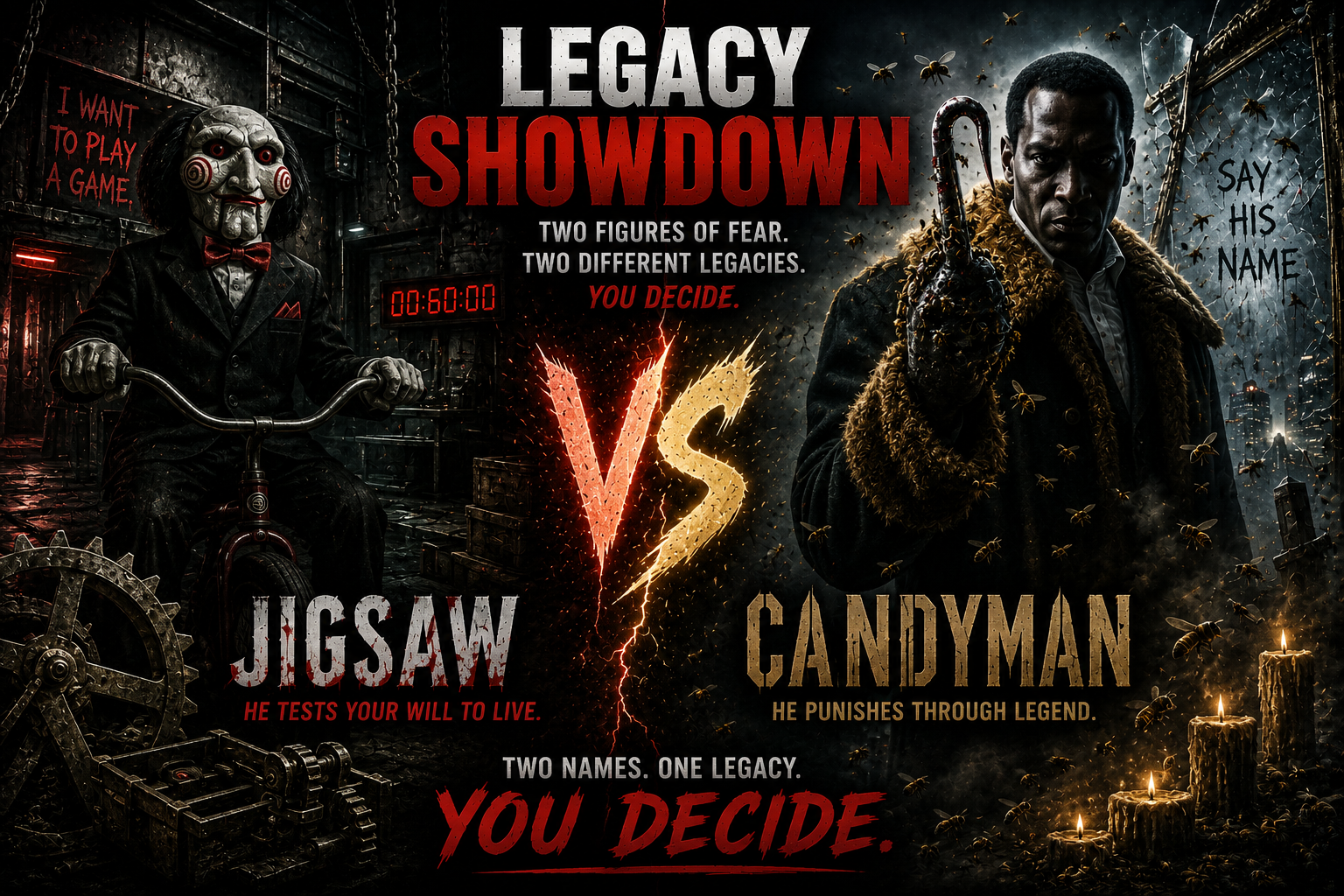


Two figures of fear rooted in morality and myth. One tests your will to live. The other punishes through legend. One question remains: whose legacy stands the test of time?
Welcome back to Killers Klash, where horror’s most terrifying, unforgettable, and iconic characters go head-to-head to determine who possesses the stronger legacy killer instinct. As part of our larger Legacy Showdown series, Killers Klash takes legendary killers, monsters, and supernatural threats from across horror history and puts their reputations to the test. Each matchup looks beyond who is simply more terrifying or dangerous to determine who has left the greater lasting impact on horror, popular culture, and the memories of generations of fans.
This matchup brings together two characters who transformed horror through very different approaches: Jigsaw vs. Candyman.
Representing the Saw franchise is Jigsaw, the calculating mastermind behind some of modern horror’s most elaborate and terrifying games. John Kramer doesn’t operate like the traditional masked slasher who simply stalks and kills his victims. Instead, he places people inside carefully designed tests where survival often requires confronting their choices, making horrifying sacrifices, or proving how desperately they want to live. His calm philosophy, elaborate traps, Billy the Puppet, recorded instructions, and chilling invitation to “play a game” helped make Jigsaw one of the defining horror villains of the 2000s.
Standing across from him is Candyman, the haunting supernatural legend whose power comes from fear, memory, storytelling, and belief. With his unmistakable voice, hook, connection to bees, and legendary mirror ritual, Candyman became one of horror’s most distinctive supernatural figures. Yet his legacy reaches deeper than his frightening appearance. His mythology explores tragedy, historical violence, race, community trauma, urban legends, and the frightening possibility that stories can become more powerful every time someone repeats them.
That creates a fascinating Killers Klash battle between the mastermind and the myth.
Jigsaw creates terror through control. His victims enter games where almost every decision has consequences, and escaping often requires tremendous physical and psychological sacrifice. Candyman creates terror through legend. Simply speaking his name can invite the horror into your world, making fear and belief essential parts of his power.
One built a sprawling franchise around traps, moral dilemmas, shocking twists, and the question of how much someone is willing to sacrifice to survive. The other became an enduring urban legend whose mythology can be retold, reinterpreted, and passed from one generation to another.
But which one possesses the stronger overall legacy?
We’ll put Jigsaw and Candyman through the six Killers Klash categories: Peak Impact, Longevity, Cultural Impact, Big Moments, Identity & Style, and Legacy Endurance. An edge will be awarded in each round before we determine which competitor ultimately possesses the stronger legacy killer instinct.
It’s time for Jigsaw vs. Candyman.
Let’s break it down.
Affiliate Disclaimer: This blog may contain affiliate links or banner advertisements. If you click on one of these links or advertisements and make a purchase, we may earn a small commission at no additional cost to you. These commissions help support our work and allow us to continue creating entertaining content like Killers Klash and the Legacy Showdown series.
RULES OF THE SHOWDOWN
We evaluate each competitor based on six categories:
1. Peak Impact
2. Longevity
3. Cultural Impact
4. Big Moments
5. Identity & Style
6. Legacy Endurance
1. PEAK IMPACT
Jigsaw:
Jigsaw redefined mainstream horror in the 2000s through the Saw franchise, introducing audiences to a distinctive combination of psychological manipulation, elaborate traps, mystery, and extreme physical danger. John Kramer stood apart from many traditional horror villains because he did not view himself as a conventional murderer, instead claiming that his games were designed to force people to appreciate their lives. That twisted philosophy gave the character an additional psychological dimension, as victims were frequently confronted with painful choices involving survival, sacrifice, guilt, or personal responsibility. The original Saw delivered one of the franchise’s defining moments with its final revelation, immediately establishing that audiences could expect major twists alongside the gruesome traps. As the series expanded, Jigsaw’s recorded messages, Billy the Puppet, the phrase “I want to play a game,” and increasingly elaborate tests became instantly associated with the franchise. His influence helped fuel a major wave of graphic, trap-driven horror during the 2000s while giving the genre one of its most recognizable new villains. At his peak, Jigsaw wasn’t simply the antagonist of a successful horror movie—he became the centerpiece of one of the era’s defining horror franchises.
Candyman:
Candyman delivered a powerful blend of supernatural horror, tragedy, urban legend, and social commentary that distinguished him from many conventional horror villains. The original Candyman built much of its terror around the idea that stories can become powerful enough to shape how communities understand fear, history, and trauma. Tony Todd’s commanding performance gave Candyman an unusual combination of menace, intelligence, sadness, and almost hypnotic charisma. Rather than functioning simply as a monster who appears to kill victims, Candyman is inseparable from the legend surrounding him, making belief and storytelling essential parts of his identity. The mirror ritual—saying his name five times—gave the character an immediately memorable supernatural mythology that audiences could repeat outside the movie itself. His story also allowed the film to explore race, violence, inequality, community memory, and the ways traumatic histories can continue affecting later generations. Candyman’s peak may not have produced the same enormous franchise machine as Saw, but it gave horror a villain with thematic depth and an atmosphere unlike almost anything else in the genre.
Edge: Jigsaw
Candyman’s peak deserves enormous respect because the character combines horror mythology with deeper themes involving history, race, trauma, belief, and the power of storytelling. However, Jigsaw’s arrival created a larger immediate shift within mainstream horror and helped define what audiences associated with a significant portion of the genre during the 2000s. Saw quickly developed from an inventive low-budget horror film into a major franchise, with Jigsaw’s games, traps, philosophy, voice recordings, and imagery becoming recognizable trademarks. While Candyman demonstrated how intellectually and socially layered a horror villain could be, Jigsaw helped create an entire style of horror spectacle that filmmakers and audiences would associate with his era. His influence was reinforced by repeated sequels that kept expanding his mythology and introducing increasingly complicated games. Candyman arguably offers the richer individual mythology, but Peak Impact is about how forcefully a character struck horror at the height of their popularity. For helping reshape 2000s horror and becoming the centerpiece of one of the era’s defining franchises, Jigsaw takes Round 1.
2. LONGEVITY
Jigsaw:
Jigsaw has remained a major horror presence through multiple Saw films and interconnected storylines spanning more than two decades. Even after John Kramer’s death became part of the franchise’s story, the series repeatedly found ways to maintain his importance through flashbacks, previously unseen games, apprentices, recordings, and revelations about events that occurred behind the scenes. That storytelling structure allowed Tobin Bell’s Jigsaw to remain the spiritual center of Saw even when other characters physically carried out the games. His philosophy also gave the franchise something that could survive beyond one character, as different apprentices interpreted, continued, or corrupted Kramer’s belief that his tests could force people to appreciate their lives. The franchise has repeatedly disappeared and returned, yet audiences continue associating Saw primarily with Jigsaw, Billy the Puppet, elaborate traps, and the invitation to “play a game.” Later installments demonstrated that filmmakers could revisit different points in the mythology rather than simply moving the timeline forward, giving the character additional opportunities to remain involved. Few horror villains introduced in the 2000s have maintained this level of franchise visibility, making Jigsaw one of the most enduring horror creations of his generation.
Candyman:
Candyman has appeared in considerably fewer films, but the character has maintained a consistent cultural presence since the original Candyman arrived in 1992. Tony Todd’s performance created such a distinctive villain that Candyman remained recognizable even during long periods when the franchise was not producing major new installments. The character’s mythology contributes significantly to that endurance because the simple ritual of repeating Candyman’s name five times in front of a mirror can be passed from one generation of horror fans to another almost like a genuine urban legend. That concept gives Candyman an unusual advantage: his legend can survive independently of frequent sequels because storytelling and belief are already central to the character himself. The franchise’s 2021 return also demonstrated that Candyman’s themes could be revisited for a newer generation while expanding conversations surrounding race, violence, community trauma, memory, and the stories societies inherit from the past. Tony Todd’s unmistakable voice and commanding presence have also remained deeply connected to the character’s identity throughout his history. Candyman may have fewer chapters in his cinematic story, but his ability to remain relevant across decades demonstrates that longevity does not always require constant franchise output.
Edge: Jigsaw
Candyman’s endurance is impressive precisely because the character has remained recognizable despite having far fewer movies and lengthy gaps between major appearances. However, Jigsaw has maintained a much more continuous presence within mainstream horror since the arrival of Saw. The franchise repeatedly expanded John Kramer’s mythology, introduced new connections to his previous games, and found creative ways to keep him central even when the timeline made his continued involvement increasingly complicated. Candyman’s longevity relies heavily on the strength of his mythology and the lasting power of Tony Todd’s portrayal, while Jigsaw combines a recognizable character with an enormous interconnected franchise. More than two decades after his introduction, the phrase “I want to play a game,” Billy the Puppet, and the concept of elaborate moral tests remain immediately associated with Jigsaw. Both characters have successfully crossed generations, but Jigsaw has done so with considerably more sustained cinematic exposure. For maintaining a central role across an extensive franchise and remaining one of modern horror’s most recognizable figures for more than two decades, Jigsaw takes Round 2.
3. CULTURAL IMPACT
Jigsaw:
Jigsaw has become one of the most recognizable horror figures introduced in the 21st century, with the Saw franchise creating an entire collection of imagery, phrases, and concepts that audiences immediately associate with him. The chilling invitation to “play a game” became a defining part of his identity, signaling that another victim was about to face an elaborate test involving survival and sacrifice. Billy the Puppet became another instantly recognizable symbol of the franchise, appearing alongside Jigsaw’s recorded instructions and helping establish a visual identity that extends well beyond the individual films. The elaborate traps themselves became such an important part of popular culture that audiences regularly debate and rank the most memorable tests throughout the series. Jigsaw has also been referenced and parodied across television, comedy, Halloween culture, internet memes, merchandise, and other forms of entertainment. More importantly, his philosophy gave audiences something deeper to discuss, particularly his insistence that he is testing people rather than simply murdering them. Jigsaw’s cultural footprint is enormous, and he helped make Saw one of the defining horror properties of the 2000s and beyond.
Candyman:
Candyman’s cultural impact reaches beyond his status as a supernatural horror villain because the character is deeply connected to the tradition of urban legends, collective memory, historical trauma, and the power of storytelling. The simple challenge of standing in front of a mirror and repeating his name five times gave Candyman a ritual that could exist outside the movie itself, resembling the kinds of frightening legends children and teenagers have shared for generations. That makes Candyman unusual among horror icons because audiences don’t simply watch his mythology—they can participate in it. Tony Todd’s commanding performance added tremendous power to that legend, giving Candyman a deep voice, striking appearance, and tragic presence that separated him from more straightforward movie monsters. The character also became significant for the way his mythology engages with race, violence, inequality, community trauma, and the consequences of history being remembered or forgotten. Later interpretations of Candyman demonstrated how those themes could be revisited and expanded for another generation rather than simply repeating the original story. As a result, Candyman occupies a distinctive place where supernatural horror, folklore, cultural history, and social commentary intersect, giving his influence a depth that extends beyond scares and franchise recognition.
Edge: Candyman
Jigsaw unquestionably has the larger footprint in terms of franchise visibility, recognizable imagery, memorable quotes, and influence on 2000s horror. However, Cultural Impact is not simply about determining which character has appeared on more merchandise or produced more sequels. Candyman’s mythology reaches into broader conversations about folklore, race, historical trauma, community memory, urban legends, and the way stories can preserve the fears and experiences of previous generations. The mirror ritual is especially powerful because it allows the legend to function almost independently of the movies, becoming something horror fans can repeat and pass along just as people have done with traditional urban legends. Jigsaw changed the direction of modern horror, but Candyman demonstrates how horror can reflect deeper cultural anxieties while still creating an unforgettable supernatural icon. His continued relevance also shows that the themes surrounding the character can evolve as society changes, giving new generations different reasons to examine the story. For creating an enduring horror legend whose significance reaches beyond the genre into folklore, history, race, trauma, and social commentary, Candyman takes Round 3.
4. BIG MOMENTS
Jigsaw:
Jigsaw is responsible for some of the most shocking twists, intense trap sequences, and unforgettable reveals in modern horror. The original Saw established this immediately by placing two men inside a filthy bathroom with seemingly no escape, forcing audiences to spend the movie trying to understand who had placed them there and why. Its climactic revelation involving the supposedly dead body lying in the room became one of the franchise’s defining surprises and established the twist-ending formula that future installments would repeatedly embrace. Beyond the twists, Jigsaw’s elaborate games created countless memorable situations in which victims were forced to make horrifying choices under extreme time pressure. Traps such as the Reverse Bear Trap became recognizable pieces of horror imagery in their own right, demonstrating how closely Jigsaw’s identity became connected to his methods. His recorded instructions and calm explanations made these sequences even more unsettling because John Kramer often presented horrific situations as though he were conducting carefully designed moral experiments. Across the franchise, the combination of traps, revelations, interconnected storylines, and last-minute twists gave Jigsaw an enormous collection of moments that kept audiences wondering what horrifying surprise might come next.
Candyman:
Candyman’s greatest moments operate very differently, relying on chilling presence, supernatural mythology, psychological unease, and haunting atmosphere rather than elaborate physical traps. The simple act of standing before a mirror and saying “Candyman” five times became one of horror’s most memorable summoning rituals, creating tension before the character even appears. That concept works because audiences understand that every repetition of the name brings the person performing the ritual closer to something they may immediately regret. Tony Todd’s commanding voice and controlled performance also allow Candyman to dominate scenes without requiring frantic action or excessive movement. His encounters with Helen Lyle in the original Candyman are particularly effective because they blur the boundaries between supernatural terror, obsession, legend, and psychological uncertainty. The hook, bees, mirror imagery, and haunting environments surrounding his mythology give his appearances a distinctive visual and atmospheric identity. Candyman’s biggest moments aren’t necessarily remembered because they are the most physically outrageous scenes in horror; they are remembered because they create the disturbing sensation that an urban legend has suddenly become real.
Edge: Tie
Jigsaw and Candyman create memorable moments through such fundamentally different methods that neither clearly overwhelms the other in this category. Jigsaw specializes in spectacle and surprise, using elaborate traps, impossible choices, interconnected mysteries, and shocking final revelations to create scenes audiences immediately want to discuss after the movie ends. Candyman specializes in atmosphere and mythology, making mirrors, whispered names, bees, hooks, and the anticipation of his appearance frightening without requiring the complicated machinery associated with Saw. Jigsaw’s franchise gives him the advantage in the sheer quantity of major twists and elaborate set pieces, while Candyman’s strongest scenes possess an almost timeless urban-legend quality. One makes audiences wonder how anyone could possibly escape the next game; the other makes them question whether they would have the courage to say his name five times while staring into a mirror. Both approaches produced signature moments that perfectly represent the characters and the different kinds of horror they bring to the screen. For Jigsaw’s unforgettable traps and twists against Candyman’s haunting supernatural imagery and legendary mirror ritual, Round 4 ends in a tie.
5. IDENTITY & STYLE
Jigsaw:
Jigsaw possesses one of modern horror’s most distinctive identities because he operates through intelligence, philosophy, preparation, and psychological manipulation rather than simply hunting victims himself. John Kramer is usually calm and calculated, presenting his horrifying games as carefully designed lessons intended to make participants recognize the value of their lives. That philosophy separates him from killers motivated primarily by revenge, bloodlust, or supernatural evil, especially because Kramer refuses to view himself as a murderer. His style is also built around indirect action, with recorded messages, surveillance, elaborate traps, and carefully constructed scenarios allowing him to control events without always being physically present. Billy the Puppet, the distorted recordings, countdown timers, and the familiar invitation to “play a game” became extensions of Jigsaw’s identity and gave the Saw franchise an unmistakable atmosphere. Even his victims are frequently selected according to a specific rationale, reinforcing his belief that each test serves some larger purpose rather than existing solely to inflict suffering. Jigsaw’s combination of engineering, manipulation, moral judgment, and controlled delivery created a villain whose greatest weapon is often his ability to make other people confront impossible choices.
Candyman:
Candyman possesses a poetic, eerie, and almost mythological identity that combines supernatural horror with tragedy, romance, history, and the power of storytelling. Tony Todd’s deep, commanding voice gives the character a hypnotic quality that makes even his quietest appearances feel threatening. Unlike villains who immediately attack their victims, Candyman often speaks with an unsettling elegance, creating the impression that audiences are encountering a legend rather than simply another supernatural killer. His hook, long coat, connection to bees, and mirror-summoning ritual create a visual and supernatural identity that is immediately distinctive. Yet the tragedy surrounding his mythology gives him emotional dimensions that many horror villains never receive, connecting his violence to suffering, memory, injustice, and the preservation of his legend. Candyman also depends upon people continuing to believe in and repeat his story, meaning that his identity is literally strengthened through fear, storytelling, and cultural memory. This combination of monster, tragic figure, urban legend, and supernatural symbol gives Candyman a style that feels uniquely his own.
Edge: Candyman
Jigsaw has an exceptionally strong identity, particularly because his philosophy and elaborate games distinguish him from almost every traditional slasher villain. However, Candyman brings together more elements into a single character identity: visual horror, supernatural mythology, tragedy, history, poetic dialogue, atmosphere, and urban legend. Jigsaw’s style is heavily expressed through the games and traps he constructs, while Candyman can dominate a scene simply through his voice, presence, and the mythology surrounding his name. The mirror ritual adds another dimension because audiences themselves can participate in the legend, making Candyman feel like something that exists beyond the boundaries of the movies. His tragic origins also complicate the audience’s relationship with him, allowing the character to be frightening while still carrying a sense of sorrow and historical weight. Tony Todd’s performance ties all of those qualities together with a presence that is elegant, threatening, and haunting at the same time. For combining supernatural terror, tragic storytelling, unforgettable imagery, and an almost poetic presence into one uniquely recognizable horror identity, Candyman takes Round 5.
- LEGACY ENDURANCE
Jigsaw:
Jigsaw continues to remain relevant through the lasting popularity of the Saw franchise, ongoing audience engagement, and the ability of his mythology to support new stories long after his original introduction. John Kramer became so essential to the identity of Saw that even his death within the storyline could not truly remove him from the franchise. Flashbacks, previously unseen games, apprentices, recordings, and connections to earlier events have repeatedly allowed filmmakers to expand his influence while keeping Tobin Bell’s presence important to the larger mythology. The basic concept behind Jigsaw is also remarkably durable because new characters can always be placed inside different games built around difficult choices, personal failures, and the question of how badly someone wants to survive. Billy the Puppet, elaborate traps, recorded instructions, and the invitation to “play a game” continue to make the franchise immediately recognizable to horror audiences. Jigsaw has therefore become one of the relatively rare horror villains introduced after the classic slasher era who successfully developed into a multigenerational franchise icon. As long as audiences remain fascinated by the games and the philosophy behind them, Jigsaw has a foundation capable of keeping his legacy alive.
Candyman:
Candyman maintains a lasting legacy through cultural discussion, symbolism, reinterpretation, and the timeless quality of the urban legend at the center of his story. Unlike characters whose relevance depends heavily upon regularly producing sequels, Candyman can disappear from movie screens for years and still remain recognizable because his mythology is designed to survive through storytelling itself. The mirror ritual is particularly important to that endurance, providing each new generation with a simple and frightening way to encounter the legend: stand before a mirror, repeat his name five times, and discover whether you are brave enough to face what follows. Beyond the supernatural mythology, Candyman’s connections to race, historical violence, inequality, community trauma, memory, and forgotten suffering give the character themes that can be reconsidered as cultural conversations evolve. The franchise’s later reinterpretation demonstrated how the mythology could be expanded rather than merely recreated, allowing Candyman to represent something larger than a single supernatural killer. Tony Todd’s unforgettable portrayal remains central to the character’s enduring identity, particularly his voice, presence, and combination of menace and tragedy. Candyman survives because the fundamental idea behind him is timeless: legends remain powerful as long as people continue telling their stories.
Edge: Candyman
Jigsaw has an excellent argument for this category because Saw has demonstrated an extraordinary ability to continue expanding its mythology and attracting audiences more than two decades after the original film. However, Candyman possesses a different kind of endurance that may ultimately be even more powerful. Jigsaw’s continuing visibility is closely connected to the Saw franchise remaining active, while Candyman’s mythology is specifically built around the idea that a legend survives through memory, repetition, fear, and belief. His deeper themes also allow filmmakers and audiences to reinterpret the character as cultural conversations surrounding race, violence, trauma, inequality, and historical memory continue evolving. That gives Candyman the ability to mean something slightly different to each generation without abandoning the fundamental mythology that made him frightening in the first place. Jigsaw’s games can continue indefinitely, but Candyman’s entire existence represents the endurance of stories and the consequences of refusing to confront the history behind them. For a legacy capable of surviving through folklore, symbolism, cultural reinterpretation, and the continuing power of the legend itself, Candyman takes Round 6.
FINAL VERDICT
Candyman wins this Legacy Showdown due to his deeper cultural impact, thematic significance, and lasting symbolic presence.
Jigsaw remains a defining figure of modern horror, but Candyman’s legacy reaches beyond the genre itself.
—
YOU DECIDE
Who has the greater legacy?
The mastermind behind the games… or the legend that lives through fear itself?
Two names. One legacy. You decide.