
Two nightmares that haunt in very different ways. One attacks in your dreams. The other hunts in the real world. One question remains: whose legacy stands the test of time?
Welcome to Killers Klash, where horror’s most terrifying, unforgettable, and iconic characters go head-to-head to determine who possesses the stronger legacy killer instinct. As part of our larger Legacy Showdown series, Killers Klash takes legendary horror characters from different franchises and puts their reputations to the test. Each matchup examines the qualities that transformed these killers, monsters, and supernatural threats into enduring horror icons.
We will compare the competitors across six categories: Peak Impact, Longevity, Cultural Impact, Big Moments, Identity & Style, and Legacy Endurance. An edge will be awarded in each round before we determine which character ultimately walks away with the stronger overall legacy. Some competitors dominated entire eras of horror, some terrified generations of moviegoers, and others introduced unforgettable new monsters and concepts to the genre. But when their legacies collide, only one question matters: Who has the stronger legacy killer instinct?
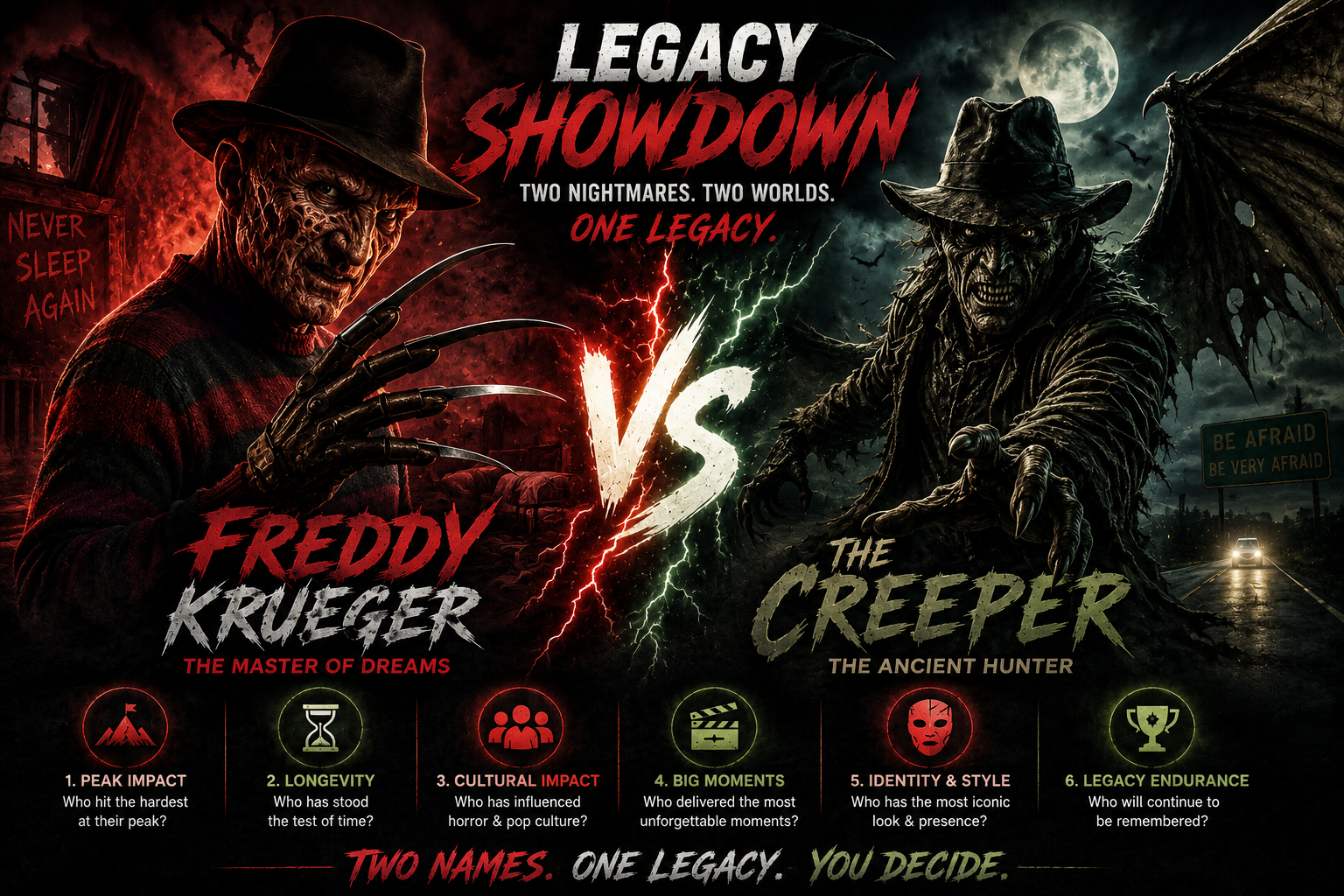
In this edition of Killers Klash, two supernatural predators from very different generations of horror collide: Freddy Krueger vs. The Creeper. Freddy transformed dreams into deadly playgrounds, terrorizing victims with his razor glove, twisted imagination, and unmistakable dark humor. The Creeper brought audiences a mysterious ancient predator that awakens to hunt, feed, and disappear until its terrifying cycle begins again. One attacks when you fall asleep, while the other relentlessly hunts its chosen prey in the waking world. Both have left their marks on horror—but only one can emerge from this Legacy Showdown with the victory.
Affiliate Disclosure
This article may contain affiliate links. If you purchase a product or service through one of these links, we may earn a small commission at no additional cost to you. These commissions help support our website and allow us to continue creating entertaining content, including future editions of Killers Klash and the Legacy Showdown series.
Let’s break it down.
RULES OF THE SHOWDOWN
We evaluate each competitor based on six categories:
1. Peak Impact
2. Longevity
3. Cultural Impact
4. Big Moments
5. Identity & Style
6. Legacy Endurance
1. PEAK IMPACT
Freddy Krueger
Freddy Krueger exploded onto the horror scene in A Nightmare on Elm Street in 1984 and immediately challenged the traditional rules of the slasher genre. Instead of stalking victims through camps, neighborhoods, or dark buildings, Freddy attacked teenagers inside their dreams, turning sleep—something every person eventually needs—into a source of terror. His ability to control the dream world gave filmmakers nearly unlimited creative possibilities, because Freddy could manipulate environments, transform his body, and exploit each victim’s deepest fears. At his peak during the 1980s, Freddy became more than another successful horror villain; he became one of the defining faces of the genre. A powerful example comes in the original film when Nancy realizes that simply staying awake cannot protect her forever, creating the terrifying idea that Freddy’s victims eventually have to enter the world where he holds the advantage. Later films expanded the surreal possibilities of his powers, making his attacks increasingly elaborate and imaginative. Freddy’s peak impact was enormous because he didn’t merely introduce another killer—he introduced an entirely new battlefield for horror.
The Creeper
The Creeper made an immediate impression when Jeepers Creepers arrived in 2001, offering audiences a mysterious monster at a time when supernatural creatures were competing with slashers and more self-aware forms of horror. What initially makes the Creeper effective is that audiences do not fully understand what they are watching. The first film gradually reveals that this apparently human predator is actually an ancient creature that awakens every 23rd spring for 23 days to feed. That mythology gives the Creeper a distinctive identity while its ability to regenerate itself by consuming body parts from victims adds an especially disturbing element to the character. One of the strongest examples of the Creeper’s impact comes from the first film’s early highway sequence, where Darry and Trish encounter the mysterious figure near an abandoned church and witness what appears to be a body being dumped into a pipe. At that point, viewers know very little about the creature, allowing suspense and uncertainty to make the eventual revelations even more frightening. The Creeper became a memorable modern horror monster, particularly because the original movie understood how effectively mystery could build fear.
Edge: Freddy Krueger
The Creeper deserves considerable credit for introducing an original monster with memorable mythology, abilities, and visual characteristics, but Freddy Krueger wins Peak Impact by a substantial margin. The Creeper made an impressive entrance with Jeepers Creepers, while Freddy’s arrival fundamentally expanded what audiences could expect from a horror villain. By making dreams his hunting ground, Freddy eliminated one of the most basic forms of escape available to a horror victim: simply getting away from the killer. His dream powers also opened the door to surreal imagery and increasingly imaginative confrontations that conventional slashers could not easily reproduce. Most importantly, Freddy’s peak extended beyond one successful film and helped turn A Nightmare on Elm Street into one of the defining horror franchises of the 1980s. Freddy Krueger wins Round 1: Peak Impact.
2. LONGEVITY
Freddy Krueger
Freddy Krueger has demonstrated extraordinary longevity since first haunting audiences in A Nightmare on Elm Street in 1984. The character became the centerpiece of a long-running film franchise and remained prominent through sequels, television, merchandise, video games, and countless appearances throughout horror culture. Unlike villains whose popularity depended heavily on one or two successful movies, Freddy remained a major horror attraction across multiple decades. His longevity was demonstrated especially well by 2003’s Freddy vs. Jason, which brought him together with another legendary horror villain and turned their rivalry into a major crossover event. Freddy’s distinctive striped sweater, fedora, burned face, bladed glove, and sarcastic personality have also allowed him to remain instantly recognizable even during periods when new Nightmare on Elm Street movies were not being released. Generations of horror fans continue discovering the original films, keeping Freddy’s reputation alive long after his peak during the 1980s. Few horror villains have maintained that level of recognition for more than four decades.
The Creeper
The Creeper has also maintained a recognizable place in horror since Jeepers Creepers debuted in 2001, but the character’s longevity has been considerably less consistent. The original film introduced a compelling monster and mythology, while Jeepers Creepers 2 expanded the creature’s story and demonstrated how dangerous it could become when confronting a larger group of potential victims. The Creeper’s unusual feeding cycle—awakening every 23rd spring for 23 days—gave the franchise a built-in mythology that could theoretically support stories across many different time periods. However, the series has produced far fewer installments than A Nightmare on Elm Street, and later entries have not generated the same mainstream impact as the earlier films. The Creeper nevertheless remains recognizable because of its distinctive appearance, wings, weapons, vehicle, and unusual method of selecting victims based on what it senses that it needs from them. There is still considerable potential within the character’s mythology, but potential is different from demonstrated longevity. Compared with Freddy, the Creeper has simply had fewer opportunities to remain consistently visible to multiple generations of moviegoers.
Edge: Freddy Krueger
Freddy Krueger wins Longevity because his legacy has survived multiple generations, changing periods of horror, numerous sequels, and long stretches without a major new film. The Creeper has been around for more than two decades and established a memorable horror identity, but the franchise has experienced a much more limited and inconsistent run. Freddy, meanwhile, became so deeply embedded within horror culture that his popularity no longer depends upon having a new movie constantly in theaters. Freddy vs. Jason also demonstrated the strength of that legacy by positioning Freddy as one-half of a blockbuster confrontation between established horror icons. Even decades after his debut, the glove, sweater, hat, burned face, and idea of a killer invading your dreams remain immediately associated with Freddy Krueger. Freddy Krueger wins Round 2: Longevity.
3. CULTURAL IMPACT
Freddy Krueger
Freddy Krueger has transcended A Nightmare on Elm Street to become one of the most recognizable horror characters in popular culture. His burned face, brown fedora, red-and-green striped sweater, and bladed glove create a look that can be identified almost instantly, even by people who have never watched the movies. Unlike many horror villains who remain largely confined to their franchises, Freddy’s sarcastic personality and one-liners made him unusually adaptable to television appearances, parodies, merchandise, Halloween costumes, and other forms of popular entertainment. During the height of his popularity, Freddy became almost a celebrity villain, with audiences sometimes attending the movies as much to see what Freddy would say and do as to root for his victims. A strong example of his crossover appeal was the television series Freddy’s Nightmares, which demonstrated that his popularity was strong enough to extend beyond theatrical films. His signature glove has also become one of horror’s most recognizable props, comparable to Jason Voorhees’ hockey mask or Michael Myers’ white mask. Freddy’s ability to remain frightening while simultaneously developing an enormous personality helped establish him as a permanent fixture of horror and Halloween culture.
The Creeper
The Creeper has developed a recognizable identity of its own, particularly among fans of early-2000s monster horror. Its trench coat, hat, wings, unusual weapons, and monstrous appearance give the character a distinctive visual style that separates it from traditional masked slashers. The mythology surrounding the creature also contributed significantly to its appeal, especially the concept that it awakens every 23rd spring for 23 days to hunt and feed. Jeepers Creepers further strengthened the character’s identity by connecting the classic song “Jeepers Creepers” with the approaching danger, giving the franchise an eerie musical association that fans immediately recognize. The Creeper has consequently earned a dedicated following and remains a memorable monster from its era. However, the character has never achieved the enormous crossover visibility that transformed Freddy into a household name. Outside dedicated horror audiences, recognition of the Creeper is considerably less universal.
Edge: Freddy Krueger
Freddy Krueger takes Cultural Impact decisively because his influence extends far beyond the boundaries of his original franchise. The Creeper created a memorable mythology and became a recognizable modern horror monster, but Freddy reached a completely different level of cultural visibility. His appearance, voice, glove, personality, and dream-based powers have become shorthand for A Nightmare on Elm Street and, more broadly, 1980s horror itself. Freddy also accomplished something relatively rare for a horror villain: audiences became fascinated by his personality rather than simply fearing his appearance or abilities. Decades later, Halloween costumes, collectibles, references, parodies, and horror celebrations continue keeping Freddy visible to generations who did not experience his original theatrical run. The Creeper has a loyal place within horror culture, but Freddy Krueger occupies a much larger place within popular culture. Freddy Krueger wins Round 3: Cultural Impact.
4. BIG MOMENTS
Freddy Krueger
Freddy Krueger’s ability to control dreams has produced some of the most creative and surreal sequences in horror history. Because the normal rules of reality disappear once his victims fall asleep, Freddy can transform locations, objects, and even his own body into whatever nightmare best serves his purpose. This freedom allowed the Nightmare on Elm Street films to create kills that were not simply violent, but visually imaginative and psychologically disturbing. One of the greatest examples occurs in the original A Nightmare on Elm Street when Tina is attacked by Freddy and dragged across the walls and ceiling while Rod watches helplessly, unable to see what is attacking her. The sequence immediately demonstrates that Freddy operates according to completely different rules from an ordinary physical killer. Later installments pushed the concept even further, creating increasingly elaborate dream sequences based around the personalities and fears of individual victims. Freddy’s biggest moments therefore became memorable not only because of who he killed, but because audiences never knew what bizarre nightmare he would create next.
The Creeper
The Creeper’s biggest moments rely less on surrealism and more on stalking, suspense, sudden violence, and the frightening realization that its victims are being hunted by something they do not understand. The original Jeepers Creepers is particularly effective because it gradually reveals the creature rather than immediately explaining exactly what it is or what it can do. One memorable example comes when Darry and Trish see the mysterious figure dumping what appears to be a body into a pipe near an abandoned church, creating immediate questions about who—or what—they have encountered. The Creeper’s pursuit of their vehicle afterward transforms that mystery into direct danger and establishes the creature as a relentless predator. Later revelations involving its wings, regeneration abilities, and collection of victims make the monster increasingly disturbing as the story progresses. Jeepers Creepers 2 also creates memorable tension by trapping a group of potential victims inside a stranded school bus while the Creeper circles and selects its targets. These moments are effective because the Creeper often allows suspense to build before suddenly unleashing its speed and brutality.
Edge: Freddy Krueger
The Creeper has delivered some excellent stalking sequences and frightening reveals, but Freddy Krueger takes Big Moments because the dream world gives him possibilities that few horror villains can match. The Creeper’s strongest scenes often depend upon suspense, isolation, and sudden attack, while Freddy can completely reshape reality around his victims. That creative freedom has produced sequences that are frightening, bizarre, darkly humorous, and visually unforgettable all at once. Freddy’s greatest moments also tend to reveal something about the victim’s fears, turning the environment itself into part of the attack rather than simply providing a location for it. The original ceiling attack alone demonstrated how dramatically A Nightmare on Elm Street could break the established rules of the slasher film. When it comes to delivering unforgettable horror spectacle, Freddy’s imagination becomes his greatest weapon. Freddy Krueger wins Round 4: Big Moments.
5. IDENTITY & STYLE
Freddy Krueger
Freddy Krueger possesses one of the most complete and instantly recognizable identities in horror history. His burned face, battered fedora, red-and-green striped sweater, and razor-bladed glove create a visual combination that audiences can identify almost immediately. However, Freddy’s style extends far beyond his appearance because his personality is equally important to what makes him distinctive. Unlike silent killers such as Michael Myers, Freddy talks constantly, taunting his victims with cruel jokes and sarcastic remarks while manipulating their dreams. His ability to control the dream world also means his surroundings become part of his identity, allowing ordinary locations to suddenly transform into bizarre and terrifying nightmares. The original A Nightmare on Elm Street establishes this brilliantly through Freddy’s boiler-room sequences, where the industrial setting, shadows, sounds, and Freddy’s distinctive silhouette combine to create an atmosphere completely associated with him. Add Robert Englund’s distinctive performance and Freddy becomes a villain whose appearance, voice, personality, weapon, and supernatural abilities all work together to form one unforgettable horror identity.
The Creeper
The Creeper takes almost the opposite approach, building its identity around mystery, silence, predatory behavior, and the frightening impression that audiences are witnessing something ancient. Its long coat and wide-brimmed hat initially give the creature a strangely human silhouette, but the gradual revelation of its monstrous face, enormous wings, and supernatural abilities completely changes how audiences perceive it. The Creeper does not need sarcastic dialogue because its movements, expressions, and relentless stalking communicate its intentions. Its ancient feeding cycle—awakening every 23rd spring for 23 days—also creates a mythology that makes the creature feel as though it has been hunting human beings for generations. One of the most distinctive elements of its style is the way it selects victims by sensing fear and determining which body parts it needs, giving its attacks a disturbing purpose beyond simple killing. The Creeper’s customized weapons, imposing truck, wings, and eerie association with the song “Jeepers Creepers” further strengthen its individual identity. Taken together, these characteristics make the Creeper much more than a generic movie monster and give the franchise a recognizable style of its own.
Edge: Freddy Krueger
The Creeper deserves considerable credit for developing an original visual design and mythology, but Freddy Krueger wins Identity & Style because virtually every element surrounding him has become iconic. Freddy has the face, sweater, hat, glove, voice, personality, dream powers, dark humor, and even recognizable environments associated with his character. You can remove almost any single element and still have several others capable of immediately identifying him. The Creeper’s silent, ancient-predator approach is extremely effective, but Freddy possesses an additional advantage because his personality is just as memorable as his physical appearance. His style helped prove that a horror villain could become terrifying through visual design while simultaneously becoming charismatic enough that audiences actually anticipated seeing him. Few horror characters have ever developed an identity as complete or culturally recognizable. Freddy Krueger wins Round 5: Identity & Style.
6. LEGACY ENDURANCE
Freddy Krueger
Freddy Krueger’s legacy has endured for more than four decades because he became much larger than the A Nightmare on Elm Street franchise itself. New generations continue to recognize his burned face, striped sweater, fedora, and bladed glove even if they were born long after Freddy’s original 1984 debut. His central concept has also aged remarkably well: sleep is unavoidable, meaning the idea of a supernatural killer who can attack people inside their dreams remains frightening regardless of the decade. Freddy’s influence can still be found in horror merchandise, Halloween costumes, video games, collectibles, conventions, parodies, and discussions ranking the greatest horror villains ever created. Freddy vs. Jason further demonstrated his legacy by placing him alongside another established horror legend and treating their confrontation as a major genre event. Robert Englund’s performance also became so closely associated with the character that Freddy’s voice, mannerisms, humor, and physical appearance are all parts of the legacy fans remember. Even during long periods without a new Nightmare on Elm Street movie, Freddy remains firmly planted in horror culture, demonstrating that his reputation no longer depends on constant new releases.
The Creeper
The Creeper has established a lasting legacy of its own, particularly among horror fans who discovered the character through the original Jeepers Creepers films. Its unusual mythology, distinctive appearance, enormous wings, customized weapons, and 23-year feeding cycle helped create a monster that was immediately different from traditional slashers. The first Jeepers Creepers remains especially important to the character’s endurance because its gradual revelation of the Creeper allowed mystery to become one of the monster’s defining qualities. The Creeper has also remained recognizable enough to inspire merchandise, costumes, collectibles, fan discussions, and continued interest in the mythology surrounding the creature. However, later franchise installments have not maintained the same level of mainstream visibility or cultural momentum associated with Freddy’s strongest decades. The character therefore occupies an established position within modern horror without becoming quite as universal a symbol of the genre. The Creeper’s legacy is significant, but it remains more closely tied to the Jeepers Creepers fanbase and the reputation of its earlier films.
Edge: Freddy Krueger
Freddy Krueger wins Legacy Endurance because his reputation has successfully survived changing generations, horror trends, and long gaps between major screen appearances. The Creeper remains a memorable monster with a dedicated following, but Freddy has reached the point where his character functions almost as part of horror’s permanent vocabulary. Mention nightmares, a razor glove, or a burned killer in a striped sweater, and audiences immediately know who is being referenced. More importantly, Freddy continues attracting fans who were not alive during the original franchise’s 1980s peak, which is one of the strongest measurements of genuine legacy endurance. The Creeper has maintained its place within horror, but Freddy has become part of the genre’s history alongside its most enduring icons. After more than forty years of haunting dreams, Freddy Krueger still refuses to disappear. Freddy Krueger wins Round 6: Legacy Endurance.
FINAL VERDICT
Freddy Krueger wins this Legacy Showdown with a clean sweep due to his massive cultural impact, longevity, and innovation in horror storytelling.
The Creeper remains a unique and terrifying figure, but Freddy’s legacy stands on another level.
YOU DECIDE
Who has the greater legacy?
The master of dreams… or the ancient hunter that never truly disappears?
Two names. One legacy. You decide.