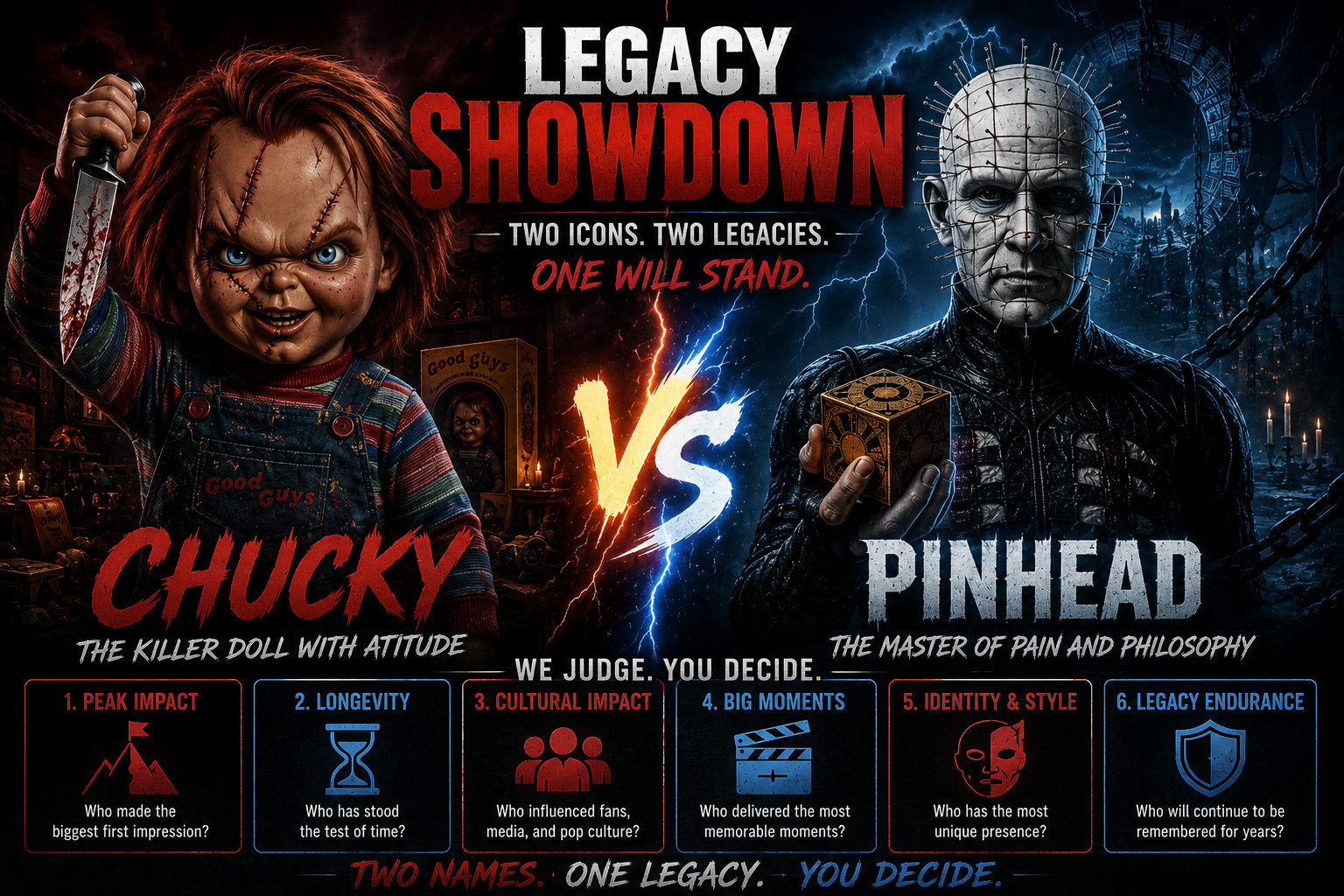

Welcome to Killers Klash, where horror’s most terrifying, unforgettable, and iconic characters go head-to-head to determine who possesses the stronger legacy killer instinct. As part of our larger Legacy Showdown series, Killers Klash takes legendary horror characters from different franchises and puts their reputations to the test. Each matchup examines the qualities that helped transform these killers, monsters, and supernatural threats into enduring horror icons. We will compare them across categories including Peak Impact, Longevity, Cultural Impact, Big Moments, Identity & Style, and Legacy Endurance, awarding an edge in each round before determining who ultimately walks away with the stronger legacy. Some competitors dominated the box office, some terrified generations of moviegoers, and others permanently changed what audiences expect from a horror villain. But when their legacies collide, only one question matters: Who has the stronger legacy killer instinct?
In this edition of Killers Klash, two unmistakable horror icons collide: Chucky vs. Pinhead. One is a foul-mouthed killer trapped inside a seemingly innocent children’s doll; the other is a chilling supernatural figure whose very presence represents pain, pleasure, and horrors beyond the ordinary world. They became icons through dramatically different styles—but only one can emerge from this Legacy Showdown with the victory.
Affiliate Disclosure
This article may contain affiliate links. If you purchase a product or service through one of these links, we may earn a small commission at no additional cost to you. These commissions help support our website and allow us to continue creating entertaining content, including future editions of Killers Klash and the Legacy Showdown series.
Let’s break it down.
RULES OF THE SHOWDOWN
We evaluate each competitor based on six categories:
1. Peak Impact
2. Longevity
3. Cultural Impact
4. Big Moments
5. Identity & Style
6. Legacy Endurance
- PEAK IMPACT
Chucky
Chucky made his unforgettable debut in Child’s Play in 1988 and immediately gave horror audiences something dramatically different from the traditional masked slasher. Instead of relying on physical size or silent intimidation, Chucky combined the innocent appearance of a children’s doll with the personality of a vicious, foul-mouthed killer. His small stature actually became one of his greatest advantages because victims initially underestimated what they were facing. Chucky also brought dark humor into his attacks, allowing the franchise to balance genuine horror with an increasingly twisted sense of comedy. His personality helped distinguish him from largely silent killers such as Michael Myers and Jason Voorhees, making the character himself just as important as the murders. A perfect example is the original Child’s Play, where the revelation that the seemingly harmless Good Guy doll is actually alive transforms an ordinary childhood toy into something terrifying. Chucky’s peak impact came from proving that a horror icon did not need to be physically imposing to become frightening, recognizable, and culturally enduring.
Pinhead
Pinhead arrived one year earlier in Hellraiser in 1987 and represented an entirely different evolution of the horror villain. Rather than behaving like a conventional slasher who simply stalked and murdered victims, Pinhead and the Cenobites introduced audiences to a disturbing mythology built around the boundaries between pain, pleasure, desire, punishment, and human curiosity. His calm voice, controlled demeanor, elaborate appearance, and philosophical dialogue made him feel less like an ordinary killer and more like a supernatural authority from another dimension. That distinction gave Pinhead an intellectual and psychological quality that separated him from many of the horror villains dominating the 1980s. The original Hellraiser provides the strongest example, as the mysterious puzzle box opens the doorway to the Cenobites and reveals that their concept of experience exists far beyond ordinary human understandings of pleasure and suffering. Pinhead’s presence therefore expanded what a horror antagonist could represent, creating fear not merely through violence but through unsettling ideas about desire and the consequences of pursuing forbidden experiences. His peak influence helped establish Hellraiser as a distinctive form of supernatural and philosophical horror that stood apart from the conventional slasher formula.
Edge: Pinhead
Chucky deserves tremendous credit for transforming an ordinary children’s toy into one of horror’s most recognizable killers, and his combination of comedy, personality, and brutality created an enduring franchise. However, Pinhead receives the edge in Peak Impact because his arrival represented something more conceptually ambitious for the horror genre. Hellraiser introduced audiences to an entire mythology surrounding the Cenobites while exploring disturbing ideas about desire, suffering, and the dangerous consequences of seeking experiences beyond ordinary human limits. Pinhead wasn’t simply another memorable murderer—he represented an entirely different kind of horror villain. For that reason, Pinhead wins Round 1: Peak Impact.
2. LONGEVITY
Chucky
Chucky has demonstrated remarkable staying power since making his debut in Child’s Play in 1988. While many horror villains eventually became trapped by the formulas that made them successful, Chucky has repeatedly adapted his personality and surroundings to match changing audiences. The franchise has moved through straightforward horror, dark comedy, self-aware satire, and television while keeping the murderous Good Guy doll at the center of the story. One of the strongest examples of Chucky’s longevity was his successful transition from movies to the Chucky television series, which introduced new characters and younger audiences while continuing storylines and relationships established throughout the films. His distinctive personality also gives writers considerable flexibility because Chucky can be frightening, funny, outrageous, or surprisingly calculating without becoming unrecognizable. More than three decades after his introduction, the character remains instantly identifiable even to people who have never watched every installment. That ability to evolve without abandoning the qualities that made him famous gives Chucky an enormous advantage in longevity.
Pinhead
Pinhead has also survived for decades as one of horror’s most visually distinctive supernatural figures, beginning with Hellraiser in 1987. His appearance, voice, mythology, and association with the Cenobites established an image powerful enough to remain recognizable long after the original film. However, the Hellraiser franchise has experienced a much more uneven journey, with numerous sequels failing to achieve the cultural impact or mainstream attention of its strongest installments. Pinhead remained the franchise’s recognizable centerpiece, particularly through Doug Bradley’s long association with the character, but later productions often struggled to recreate the disturbing originality of the early films. The 2022 Hellraiser reboot demonstrated that the underlying mythology could still be reinterpreted for modern audiences, with Jamie Clayton presenting a new version of the character. That revival reinforced Pinhead’s lasting importance, but it has not produced the same continuous mainstream presence that Chucky has maintained across movies and television. Pinhead’s longevity as a horror icon is undeniable, but the franchise surrounding the character has been considerably less consistent.
Edge: Chucky
This category goes to Chucky because longevity is about more than simply remaining recognizable—it is also about continuing to find meaningful ways to reach audiences. Pinhead’s image and mythology have survived for nearly four decades, but the quality and visibility of the Hellraiser franchise have fluctuated considerably. Chucky, meanwhile, has repeatedly reinvented his franchise while maintaining the personality and continuity that longtime fans recognize. His successful movement from theatrical movies to increasingly comedic sequels and eventually serialized television demonstrates an unusual ability to adapt to different eras of horror entertainment. Few horror villains introduced during the 1980s have remained as active, recognizable, and adaptable across multiple generations. Chucky wins Round 2: Longevity.
3. CULTURAL IMPACT
Chucky
Chucky has grown far beyond the Child’s Play movies to become one of the most recognizable characters in horror and popular culture. His combination of bright red hair, overalls, striped shirt, and deceptively innocent doll-like appearance makes him instantly identifiable, even among people who have never watched a Child’s Play film. Chucky has been referenced, imitated, and parodied across television, comedy, music, merchandise, and other forms of entertainment. He has also become a major presence during Halloween, with Chucky costumes, decorations, collectibles, and haunted-attraction appearances helping introduce the character to new generations. Part of his cultural strength comes from the simplicity of the concept: the idea of a child’s beloved toy suddenly becoming a murderous threat is immediately understandable and taps into a basic childhood fear. Chucky’s distinctive voice and sarcastic personality have also produced memorable lines and moments that fans can easily imitate and reference. Few horror characters have managed to combine genuine horror with enough personality and humor to become such a broadly recognized pop-culture figure.
Pinhead
Pinhead has achieved significant cultural influence of his own, particularly among dedicated horror fans. His pale face, black leather clothing, symmetrical grid of pins, and calm but threatening demeanor created one of the most visually unforgettable villain designs of the 1980s. Within horror culture, Pinhead represents something much deeper than a conventional slasher, becoming closely associated with the disturbing themes of pain, pleasure, temptation, and forbidden experience that define Hellraiser. His appearance has inspired countless pieces of horror artwork, costumes, collectibles, and references, while the Cenobites themselves have become an important part of supernatural horror mythology. For example, even someone unfamiliar with the complete Hellraiser storyline may recognize Pinhead immediately from his extraordinary character design. However, his darker mythology and adult subject matter have generally prevented him from achieving the same broad mainstream accessibility as Chucky. Pinhead remains enormously respected within the horror community, but his cultural influence is more concentrated among genre enthusiasts.
Edge: Chucky
Pinhead may actually possess the more unusual and artistically distinctive mythology, but Chucky takes the edge in Cultural Impact because his influence reaches much further beyond dedicated horror audiences. Chucky can exist simultaneously as a terrifying movie villain, Halloween costume, collectible figure, comedic reference, television character, and instantly recognizable pop-culture image. Pinhead has achieved iconic status within horror, but Chucky has crossed more successfully into mainstream entertainment and Halloween culture. The fact that audiences who have never watched Child’s Play can still immediately understand who Chucky is demonstrates how deeply the character has entered popular culture. His personality has also allowed him to remain culturally relevant instead of existing primarily as an image from a classic horror franchise. Chucky wins Round 3: Cultural Impact.
4. BIG MOMENTS
Chucky
Chucky has built his reputation around outrageous kills, memorable confrontations, and dialogue that gives his violent scenes a personality unlike most horror villains. Because Chucky constantly talks to his victims, his biggest moments often combine suspense with insults, jokes, and dark comedy immediately before or after something horrifying happens. This allows the Child’s Play franchise to create memorable sequences that audiences can enjoy for both their creativity and their entertainment value. One great example comes in the original Child’s Play, when Chucky finally reveals himself to Andy’s mother, Karen, after she threatens to throw him into the fireplace. The sudden transformation from an apparently lifeless Good Guy doll into a screaming, attacking killer is one of the franchise’s defining moments because it finally confirms what the audience has been waiting to see. Later installments became increasingly inventive and comedic with Chucky’s attacks, turning his personality into an essential part of the spectacle. Chucky has plenty of unforgettable scenes, but his biggest moments generally succeed because they combine violence, humor, and his larger-than-life personality.
Pinhead
Pinhead’s greatest moments operate very differently because they depend more heavily on atmosphere, imagery, dialogue, and a sense of supernatural dread. He rarely needs to become frantic or wildly aggressive because his calmness actually makes his appearances more disturbing. When Pinhead enters a scene, audiences often feel as though something far more powerful and terrifying than an ordinary murderer has arrived. The original Hellraiser demonstrates this brilliantly when Kirsty encounters the Cenobites after solving the puzzle box, introducing audiences to their horrifying appearance and completely unfamiliar understanding of pain and pleasure. Pinhead’s controlled delivery during these encounters makes his words feel almost ceremonial, strengthening the impression that the Cenobites operate according to rules and beliefs beyond normal human morality. The chains, hooks, puzzle box, elaborate Cenobite designs, and nightmarish environments also give his biggest sequences an extraordinary visual identity. Rather than simply delivering memorable kills, Pinhead creates moments that can feel like glimpses into an entirely different and terrifying reality.
Edge: Pinhead
Chucky certainly has the advantage when it comes to entertaining kills and memorable one-liners, but Pinhead takes Big Moments because his strongest scenes carry an extraordinary combination of imagery, atmosphere, dialogue, and supernatural terror. Chucky’s best sequences frequently make audiences laugh and recoil at the same time, while Pinhead’s best appearances can completely change the mood of a film simply by having him enter the scene. His introduction alongside the Cenobites in the original Hellraiser remains a particularly powerful example of a horror villain establishing his identity through presence rather than relentless action. The visual design alone makes many of these scenes difficult to forget, while the philosophical nature of Pinhead’s dialogue adds another layer of uneasiness. Chucky may produce the more entertaining moments, but Pinhead’s greatest moments are often more haunting. Pinhead wins Round 4: Big Moments.
5. IDENTITY & STYLE
Chucky
Chucky possesses one of the most unusual and immediately recognizable identities in horror history. On the surface, he looks like an innocent children’s toy, complete with bright red hair, colorful clothing, freckles, and the friendly appearance of a Good Guy doll. That childish exterior creates an effective contrast with his murderous personality, profanity, sarcasm, and violent behavior. Unlike silent killers who rely primarily on physical presence, Chucky’s voice and personality are essential parts of his identity, making his dialogue almost as recognizable as his appearance. His small size also creates a distinctive fighting style, forcing him to rely on surprise, deception, improvised weapons, and attacks from places where victims do not expect him. For example, the original Child’s Play initially uses Chucky’s harmless appearance to conceal the truth from the adults around Andy, making his eventual transformation into an openly murderous doll even more effective. Remove the red hair, overalls, sinister expressions, and wisecracking personality, and Chucky simply would not be Chucky.
Pinhead
Pinhead counters with perhaps one of the most visually distinctive character designs ever created for a horror villain. His pale, scarred head divided into a precise grid with pins extending from each intersection immediately communicates that audiences are encountering something completely outside ordinary humanity. Combined with his black leather clothing and the grotesque appearance of the other Cenobites, Pinhead looks less like a traditional movie killer and more like a supernatural figure emerging from a nightmarish world. His style becomes even more effective because of the contrast between his disturbing appearance and remarkably calm behavior. Rather than screaming, chasing victims wildly, or displaying uncontrolled rage, Pinhead often speaks slowly and deliberately, giving him an eerie sense of authority. The original Hellraiser demonstrates this perfectly when the Cenobites appear after Kirsty solves the puzzle box—their elaborate designs, controlled movements, and unsettling dialogue immediately establish that they follow their own terrifying rules. Pinhead’s combination of visual horror, intelligence, composure, and supernatural mythology creates an identity that is virtually impossible to confuse with another horror villain.
Edge: Tie
This is one category where separating the two becomes extremely difficult because Chucky and Pinhead achieve iconic identities through completely different methods. Chucky wins through contradiction: an innocent-looking children’s doll transformed into a foul-mouthed, sarcastic, murderous personality. Pinhead wins through disturbing sophistication: a terrifying supernatural design paired with calm speech and an almost philosophical presence. You could identify either character from a silhouette, costume, voice, or a few defining visual details, which demonstrates how successfully both franchises established their identities. More importantly, neither character feels like a variation of another famous horror villain—they occupy their own unmistakable territory. Chucky may have the bigger personality, while Pinhead arguably has the more haunting visual design, but neither clearly overwhelms the other when the entire package is considered. Round 5: Identity & Style ends in a tie.
6. LEGACY ENDURANCE
Chucky
Chucky’s legacy has endured because the character has never been allowed to exist solely as a piece of 1980s horror nostalgia. Since his 1988 debut, the franchise has continually found new ways to reinvent him while preserving the sarcastic personality, murderous tendencies, and instantly recognizable appearance that made him famous. Different installments have experimented with straightforward horror, dark comedy, family relationships, self-aware humor, and increasingly elaborate mythology, allowing Chucky to change with his audience. One of the strongest examples was the transition to the Chucky television series, which continued the established movie continuity while introducing younger characters and storylines capable of attracting a new generation of viewers. The character has also remained prominent through Halloween costumes, collectibles, merchandise, horror conventions, and other pieces of popular culture. Importantly, longtime fans can still recognize the Chucky they grew up with while newer audiences have multiple entry points into the franchise. That combination of nostalgia and continued reinvention has transformed Chucky from a successful horror villain into a multigenerational horror icon.
Pinhead
Pinhead’s legacy remains extremely strong despite the character having a less consistent modern presence. The original Hellraiser established Pinhead and the Cenobites as some of horror’s most distinctive creations, ensuring that their imagery would continue influencing the genre decades later. Pinhead’s importance is especially apparent in the way the character remains instantly associated with supernatural horror built around forbidden desire, suffering, and the terrifying consequences of curiosity. His visual design alone has achieved lasting recognition, while the mythology surrounding the puzzle box and Cenobites continues to distinguish Hellraiser from conventional slasher franchises. The 2022 reimagining of Hellraiser, featuring Jamie Clayton as the lead Cenobite, demonstrated that filmmakers can reinterpret the concept for a new generation without simply duplicating the original portrayal. However, Pinhead has not enjoyed the same continuous stream of highly visible mainstream projects that has helped Chucky remain constantly in front of audiences. His legacy therefore remains powerful and historically important, but it is sustained more heavily by the enduring reputation of Hellraiser and its mythology than by continuous modern exposure.
Edge: Chucky
Chucky earns the edge in Legacy Endurance because he has successfully turned historical importance into continuing relevance. Pinhead unquestionably belongs among horror’s most memorable supernatural figures, and the imagery and ideas introduced by Hellraiser have secured his place in genre history. Chucky, however, has done something particularly difficult: he has remained active across generations without losing the fundamental identity that originally made him popular. Movies, television, merchandise, Halloween culture, and an extremely recognizable personality have repeatedly introduced him to audiences who were not even born when Child’s Play premiered. Pinhead’s legacy remains formidable, but Chucky’s legacy feels more continuously alive within contemporary popular culture. Chucky wins Round 6: Legacy Endurance.
FINAL VERDICT
Chucky wins this Legacy Showdown due to his longevity, cultural impact, and continued relevance.
However, Pinhead’s depth and uniqueness make him one of the most respected figures in horror.
YOU DECIDE
Who has the greater legacy?
The killer doll with attitude… or the master of pain and philosophy?
Two names. One legacy. You decide.