
Affiliate Disclaimer: This article may contain affiliate links. If you make a purchase through one of these links, The Shopping Plaza may earn a commission at no additional cost to you.
Fear Is Not Always the Enemy
Fear is one of the body’s most important survival systems. It helps people notice danger, react quickly, and avoid situations that could cause harm. That makes it seem strange that millions of people willingly watch horror movies, enter haunted houses, ride towering roller coasters, tell ghost stories, or play frightening video games. The key difference is context. When people believe they are genuinely threatened, fear is unpleasant and protective. When they know they are physically safe, however, the same sensations can become exciting, playful, and even rewarding. Psychologists often describe this mixture of fear and enjoyment as recreational fear.
The Body’s Built-In Alarm System
A convincing scare activates the body’s alarm response. The brain rapidly evaluates a sudden noise, shadow, threatening face, or unexpected movement and prepares the body to respond. Heart rate may increase, breathing can become faster, muscles tense, attention narrows, and the senses become more alert. These changes are useful during a real emergency because they prepare a person to fight, escape, or freeze.
Inside a haunted attraction or movie theater, the body may briefly respond as though the threat is real even while the thinking part of the mind understands that it is staged. That split creates the thrill: the person receives the intensity of an emergency without having to endure the actual danger. Once the scare passes, relief can feel powerful. The contrast between tension and release is part of what makes a well-designed scare satisfying.
Safe Fear Gives Us a Sense of Control
Enjoyable fear depends heavily on perceived safety and control. A viewer can pause a movie, cover their eyes, leave the room, or remind themselves that the monster is fictional. A haunted-house visitor knows that actors are following rules and that an exit exists. Even on a roller coaster, the rider understands that restraints and safety systems are in place.
This control changes the emotional meaning of fear. Instead of being trapped in an uncontrollable threat, the person chooses when to approach it and how much to tolerate. The experience becomes a challenge rather than a crisis. For some people, finishing a frightening movie or walking through a haunted attraction produces a genuine sense of accomplishment: they faced something intense, managed their reactions, and reached the other side.
The ‘Just Right’ Level of Fear
More fear does not automatically create more enjoyment. Research conducted in a haunted attraction found that enjoyment followed an inverted-U pattern: participants tended to have the most fun at a moderate level of fear. Too little fear felt boring, while too much became overwhelming. The sweet spot sat somewhere between those extremes.
That explains why people have very different tastes in scary entertainment. One person may enjoy a playful ghost story but dislike graphic horror. Another may find ordinary thrillers too mild and seek intense haunted attractions. Good recreational fear allows the audience to remain emotionally engaged without losing the feeling that the situation is manageable.
Curiosity Pulls Us Toward the Unknown
Humans are naturally curious about threats, death, monsters, disasters, and other unsettling subjects. This does not necessarily mean that people want terrible events to happen. Instead, scary stories offer a safe way to examine dangerous possibilities. Viewers can ask what they would do, whom they would trust, how they might escape, or whether they would recognize warning signs.
Horror also turns uncertainty into a puzzle. The audience searches dark corners, studies suspicious characters, predicts what will happen next, and tries to understand the rules of the threat. That mental participation can be as enjoyable as the scare itself. Suspense keeps attention focused because the mind wants an answer to one urgent question: what is about to happen?
Scary Stories Can Feel Like Emotional Practice
Fictional fear may function as a form of emotional rehearsal. A horror story creates a simulated crisis in which people can observe panic, courage, cooperation, betrayal, and survival without being personally endangered. The audience experiences strong emotion while still having room to think about it.
Some researchers have suggested that horror fans and people with strong morbid curiosity may use frightening fiction to explore uncertainty and rehearse responses to threatening situations. This does not mean horror automatically makes someone resilient, nor should it be treated as a substitute for mental-health care. It does suggest that scary entertainment can provide a structured environment for encountering uncertainty, testing emotional limits, and discovering which coping strategies help.
Fear Is More Fun When It Is Shared
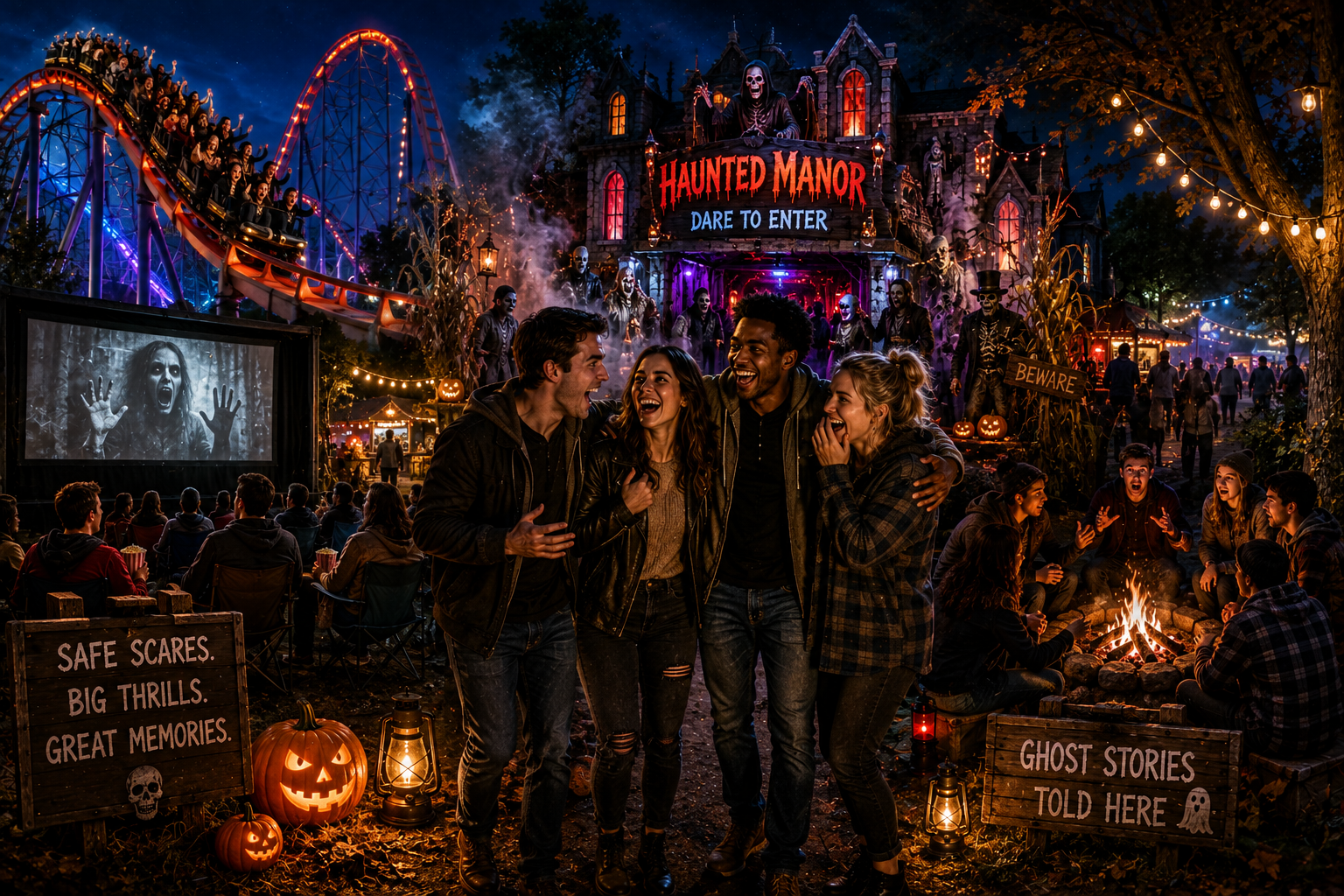
Scary experiences are often social experiences. People watch horror movies with friends, hold onto a partner inside a haunted house, laugh after a jump scare, and retell the experience afterward. Shared fear can make people feel connected because everyone is reacting to the same intense event.
The group also provides reassurance. Seeing friends laugh signals that the situation remains safe. Joking can reduce tension and help people regain emotional control. At the same time, screams, nervous laughter, and startled reactions can spread through the group, making the attraction feel more immersive. Fear becomes both an individual feeling and a collective performance.
Personality Shapes the Experience
Not everyone enjoys being scared, and there is nothing unusual about avoiding horror. Individual preferences are influenced by temperament, past experiences, sensitivity to disgust, anxiety, empathy, age, and sensation seeking. Some people enjoy intense stimulation and novelty, while others become uncomfortable when suspense lasts too long or imagery feels too realistic.
The type of fear matters as well. A person who dislikes gore may still love supernatural mysteries. Someone who avoids haunted houses may enjoy suspense novels because reading provides more control over pacing. Personal boundaries can also change over time, which is why the same movie may feel thrilling at one age and unpleasant at another.
The Relief Afterward Is Part of the Reward
A scare has a beginning, peak, and ending. When the threat disappears and safety is confirmed, the body begins to settle. That return to calm can feel pleasant because it follows a period of intense attention and tension. People may laugh, talk more energetically, or feel proud that they endured the experience.
This emotional reset helps explain why audiences often leave haunted attractions smiling even though they screamed inside. The enjoyable memory is not only the frightening moment; it is also the relief, laughter, social bonding, and accomplishment that follow it.
When Fear Stops Being Fun
Recreational fear works only when the participant feels safe enough and remains willing to continue. A scare can become harmful or deeply unpleasant when it is forced, humiliating, excessively graphic, connected to personal trauma, or difficult to escape. Children may also struggle to separate fictional danger from reality, especially when an image is too intense for their developmental level.
The healthiest approach is to respect individual limits. People should be free to skip an attraction, stop a movie, choose a milder story, or leave without being mocked. Fear is entertaining because it is voluntary. Once meaningful choice disappears, the experience is no longer the same kind of play.
The Real Appeal of a Good Scare
People do not simply love fear itself. They love what safe fear can provide: heightened attention, curiosity, suspense, relief, social connection, a test of courage, and the satisfaction of regaining control. Horror movies, ghost stories, haunted houses, and thrill rides package a powerful survival emotion inside a controlled experience.
That is the psychology behind the scream followed by laughter. The body briefly prepares for danger, the mind recognizes the protective frame, and the person enjoys exploring the edge between safety and uncertainty. A successful scare lets us visit danger without living in it—and return to ordinary life feeling relieved, energized, and eager to tell someone what happened.
Sources and Further Reading
- Andersen, M. M., et al. “Playing With Fear: A Field Study in Recreational Horror.” Psychological Science, 2020.
- Martin, G. N. “(Why) Do You Like Scary Movies? A Review of the Empirical Research on Psychological Responses to Horror Films.” Frontiers in Psychology, 2019.
- Clasen, M., et al. “A Quantitative Study of Fear Management in Haunted House Visitors.” Poetics, 2019.
- Scrivner, C., et al. “Pandemic Practice: Horror Fans and Morbidly Curious Individuals Are More Psychologically Resilient During the COVID-19 Pandemic.” Personality and Individual Differences, 2021.