
Affiliate Disclaimer: This post may contain affiliate links. If you make a purchase through one of these links, The Shopping Plaza may earn a commission at no additional cost to you.
Fear Does Not Have to Be Your Enemy
Fear is usually described as something we need to defeat. We are told to conquer it, eliminate it, push it away, or pretend it is not there. But fear is not always an enemy standing between us and success. Sometimes it is information. Sometimes it is energy. Sometimes it points directly toward the places where growth is waiting for us.
Think about the moments that make your stomach tighten: applying for an opportunity you really want, starting a business, speaking in front of others, sharing creative work, making a major life change, learning an unfamiliar skill, or admitting that you want something bigger for yourself. Fear often appears precisely because the outcome matters.
The goal is not to romanticize fear or ignore legitimate danger. Some fears protect us and deserve careful attention. But many of the fears that hold us back are connected to uncertainty, rejection, embarrassment, failure, or the possibility that we may discover our current limits.
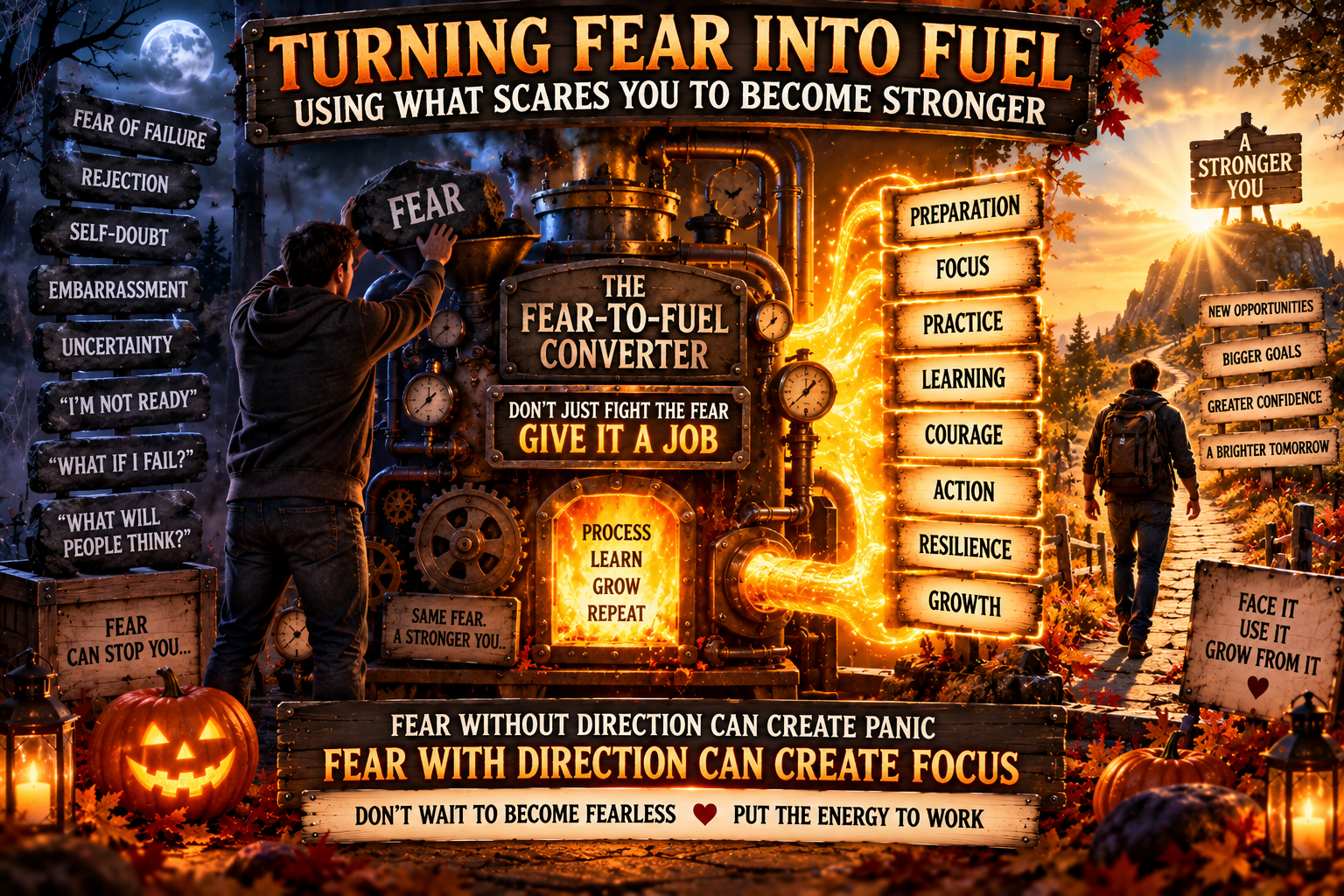
Instead of asking only, “How do I stop being afraid?” try asking, “How can I use this fear?” When fear becomes a signal to prepare, focus, learn, and move forward, it stops being only an obstacle. It becomes fuel.
Understand What Your Fear Is Trying to Tell You
Fear becomes harder to manage when it remains vague. “I’m scared” can describe dozens of different concerns, and each one may require a different response. The first step toward using fear productively is identifying exactly what it is saying.
Are you afraid you will fail? Are you afraid other people will judge you? Are you worried you are not prepared? Do you fear losing money, wasting time, disappointing someone, or discovering that you are not as capable as you hoped? Perhaps you are not afraid of failure at all—you may be afraid of success because success could bring new expectations and responsibilities.
Write the fear down in one clear sentence. Then ask whether it represents a real danger, a reasonable concern, or a prediction your mind is treating like a fact.
This distinction matters. A legitimate safety risk may require caution, expert advice, or a different plan. Fear of embarrassment may require practice and exposure. Fear caused by lack of knowledge may require research. Fear of failure may require accepting that no meaningful goal comes with a guarantee.
When you identify the real fear, you can stop fighting a shadow and start solving the actual problem.
Fear Reveals What Matters to You
One of fear’s most useful qualities is that it can reveal your priorities. We rarely experience intense fear about things that mean absolutely nothing to us.
If you are nervous before an interview, the opportunity probably matters. If publishing your work scares you, your work probably carries personal meaning. If you fear disappointing your family, those relationships matter to you. If the thought of abandoning a dream bothers you, that dream may represent an important part of the future you want to build.
This does not mean every fear should be followed. It means fear can help you identify where emotional stakes exist.
Ask yourself, “What am I protecting?” Maybe you are protecting your reputation, your financial stability, your sense of competence, or your hope for a better future. Once you understand what matters, you can make more deliberate choices.
Fear then becomes more than an uncomfortable emotion. It becomes a compass pointing toward values, ambitions, and responsibilities. You may still decide that a particular risk is not worth taking, but you will make that decision with greater clarity rather than simply retreating because the feeling was uncomfortable.
Turn Nervous Energy Into Preparation
Fear creates energy. Your thoughts speed up. Your attention sharpens. You begin imagining possibilities. Left unmanaged, that energy can become rumination and anxiety. Directed intentionally, it can become preparation.
If you are afraid of an upcoming presentation, use the nervous energy to practice. If you are worried about an interview, research the organization and prepare examples of your experience. If starting a project scares you, build a realistic plan. If you fear making a mistake, identify the most likely mistakes and create safeguards.
Preparation does not guarantee success, but it gives fear a job.
Instead of allowing your mind to repeat, “Something might go wrong,” turn that thought into a question: “What can I do now that would make me better prepared if it does?”
There is an important limit. Preparation can become another hiding place. You can research forever, revise forever, and wait forever for the moment when you feel completely ready. That moment may never come.
Use fear to prepare, but set a point when preparation must become action. The purpose of sharpening the tool is eventually to use it.
Let Fear Improve Your Focus
When something matters, fear can strip away distractions. A deadline, important decision, difficult challenge, or meaningful opportunity often forces us to identify what truly deserves our attention.
You can use that effect intentionally.
Suppose you are afraid that a major goal will remain unfinished. Instead of letting the fear produce guilt, ask what actions would actually move the goal forward. Which tasks matter most? Which activities only make you feel busy? What could you reduce, postpone, automate, delegate, or stop doing?
Fear of losing an opportunity can remind you to act while the opportunity exists. Fear of remaining stuck can motivate you to learn. Fear of wasting time can encourage you to protect your schedule. Fear of repeating a mistake can make you more attentive to the choices that produced it.
The key is to convert emotional urgency into specific priorities. Fear without direction creates panic. Fear with direction can create focus.
You do not need to do everything. You need to identify what matters now and give it your best attention.
Use Small Acts of Courage to Build Evidence
One of the biggest mistakes we make is believing that courage must begin with a huge action. We imagine that strong people suddenly take enormous risks without hesitation. In reality, courage can be trained through smaller decisions.
If networking frightens you, introduce yourself to one person. If public speaking scares you, practice a short presentation for a small audience. If you are afraid to share your writing, show one piece to someone you trust. If starting a business feels overwhelming, research one requirement or create one product.
Each small act produces evidence.
Before taking action, your mind may say, “I cannot handle this.” Afterward, even if the experience was uncomfortable, you can answer, “I handled that step.”
Repeat this process and your personal history begins to change. You are no longer relying only on motivational phrases. You have memories of yourself doing difficult things.
Confidence grows more reliably from evidence than from wishful thinking. Small acts of courage give you that evidence, one experience at a time.
Failure Can Become Training Instead of a Verdict
Fear of failure has enormous power because we often treat failure as a statement about our identity. A failed attempt becomes “I am a failure.” A rejection becomes “I am not good enough.” A mistake becomes “I should never have tried.”
That interpretation makes action terrifying.
A stronger approach is to treat failure as training data. What happened? What worked? What did not? What was within your control? What needs to change before the next attempt?
This does not mean failure never hurts. Losing an opportunity, investing time in something that does not work, or hearing “no” can be deeply disappointing. You do not have to pretend otherwise.
But disappointment and defeat are not the same thing.
When you analyze a setback rather than allowing it to define you, fear begins producing resilience. You learn that an unsuccessful result can be survived. You discover that you can adjust. You become less dependent on every attempt going perfectly.
Eventually, the question changes from “What if I fail?” to “If this attempt fails, what will I learn and what will I do next?” That is a much stronger position from which to act.
Stop Waiting for Fear to Disappear
Many people unknowingly make a bargain with themselves: “I will begin when I feel confident.”
The problem is that confidence often arrives after beginning.
You may never feel completely comfortable before the first difficult conversation, first application, first video, first business launch, first class, first speech, or first attempt at something unfamiliar. Waiting for fear to vanish can therefore become a permanent postponement strategy.
Action teaches lessons that thinking cannot.
Once you take the first step, you gain real information. You learn what the task actually feels like. You discover which parts are difficult and which parts were exaggerated in your imagination. You identify skills you need to improve. You also discover strengths you could not prove while standing on the sidelines.
Fear may come with you. Let it.
You do not need fear’s permission to act. You need a responsible plan, a meaningful reason, and enough courage for the next step.
Turn Comparison Into Motivation, Not Intimidation
Fear often grows when we compare our beginning to someone else’s middle. We see a successful entrepreneur, confident speaker, talented creator, accomplished professional, or disciplined athlete and assume they possess something we do not.
What we usually cannot see is the history behind the performance.
We do not see the awkward first attempts, rejected ideas, mistakes, private doubts, years of practice, or moments when that person considered quitting. Comparing your unfinished development to someone’s polished result can make growth seem impossible.
Instead, use successful people as evidence that improvement is possible. Study their habits, decisions, strategies, and persistence. Ask what can be learned rather than what should be envied.
Someone else’s strength does not prove your weakness.
If another person’s success scares you because it exposes the distance between where you are and where you want to be, convert that discomfort into direction. What skill would close part of the gap? What habit could you begin? What action can you repeat consistently?
Comparison becomes useful when it creates a map instead of a judgment.
Build Strength by Doing Hard Things on Purpose
Strength is developed through resistance. Physical muscles become stronger when they are challenged appropriately, and emotional resilience often develops in a similar way.
This does not mean seeking unnecessary suffering. It means occasionally choosing worthwhile discomfort instead of automatically choosing the easiest path.
Have the conversation you have been postponing. Ask the question you are embarrassed to ask. Learn the technology you keep avoiding. Apply for the opportunity even though you might hear no. Practice the skill that exposes your weaknesses. Finish the project that forces you to confront perfectionism.
Each intentional challenge expands your understanding of what you can tolerate.
Over time, difficult experiences stop feeling like proof that something is wrong. They become part of the process of becoming capable.
The goal is not to make life permanently uncomfortable. It is to stop allowing comfort to become a cage. Growth often requires temporary discomfort in exchange for greater freedom later.
Know When Fear Is Warning You to Slow Down
Turning fear into fuel does not mean ignoring every warning signal. Some fears are connected to genuine risk, and strength includes knowing when to slow down.
If a situation threatens your physical safety, financial security, health, legal standing, or basic well-being, enthusiasm should not replace judgment. Gather information. Seek qualified help when appropriate. Create safeguards. Change the plan if necessary.
There is a major difference between courageous discomfort and reckless exposure.
A useful question is, “Am I afraid because this is dangerous, or because this is difficult?”
Sometimes the answer will be both. In that case, reduce the avoidable risk before moving forward. You may need more training, more savings, better equipment, professional guidance, or a smaller first step.
Real courage is not proving that you can ignore fear. It is learning how to interpret fear accurately. When fear signals danger, respect it. When fear mainly signals uncertainty, vulnerability, or growth, decide whether it is time to move through it.
Create a Personal Fear-to-Fuel Plan
The next time fear begins holding you back, give yourself a simple process.
First, name the fear precisely. Avoid vague statements. Write down what you believe could happen.
Second, identify what the fear is protecting or revealing. What matters to you in this situation?
Third, separate real risks from imagined outcomes. Decide which concerns require preparation and which require courage.
Fourth, choose one action that is small enough to complete but meaningful enough to create progress.
Fifth, prepare for that action. Gather the information, practice, or support you reasonably need.
Sixth, act before preparation turns into avoidance.
Finally, review what happened. Do not judge the experience only by whether you achieved the perfect result. Ask what you learned, what became easier, what remains difficult, and what the next step should be.
This process transforms fear from an emotional wall into a practical sequence. You may still feel nervous, but you will know what to do with the feeling.
The Stronger Version of You Is Built Through Action
Strength is rarely created in moments when everything feels easy. It is built when we face uncertainty and discover that we can continue. It grows when we hear no and try again, when we make a mistake and learn from it, when we enter unfamiliar territory and gradually make it familiar.
Fear can become part of that training.
The things that scare you may reveal where you need preparation, where you need support, where you need better boundaries, and where you need greater courage. They may expose weaknesses, but weaknesses are not permanent verdicts. They are places where development can begin.
You do not have to become fearless to become stronger.
You can feel nervous and prepare. You can doubt yourself and still practice. You can be disappointed and recover. You can be uncertain and take a responsible step. You can hear fear telling you to stay where you are and still decide that your future deserves movement.
The next time something meaningful scares you, do not immediately run from the feeling. Examine it. Learn from it. Decide what it is asking of you. Then, if the path is responsible and worthwhile, put that energy to work.
Fear can stop you—or it can sharpen you, teach you, focus you, and push you toward growth.
The difference is not whether fear appears. The difference is what you choose to do when it does.