
Powerhouse Champions vs. the Miracle Mets
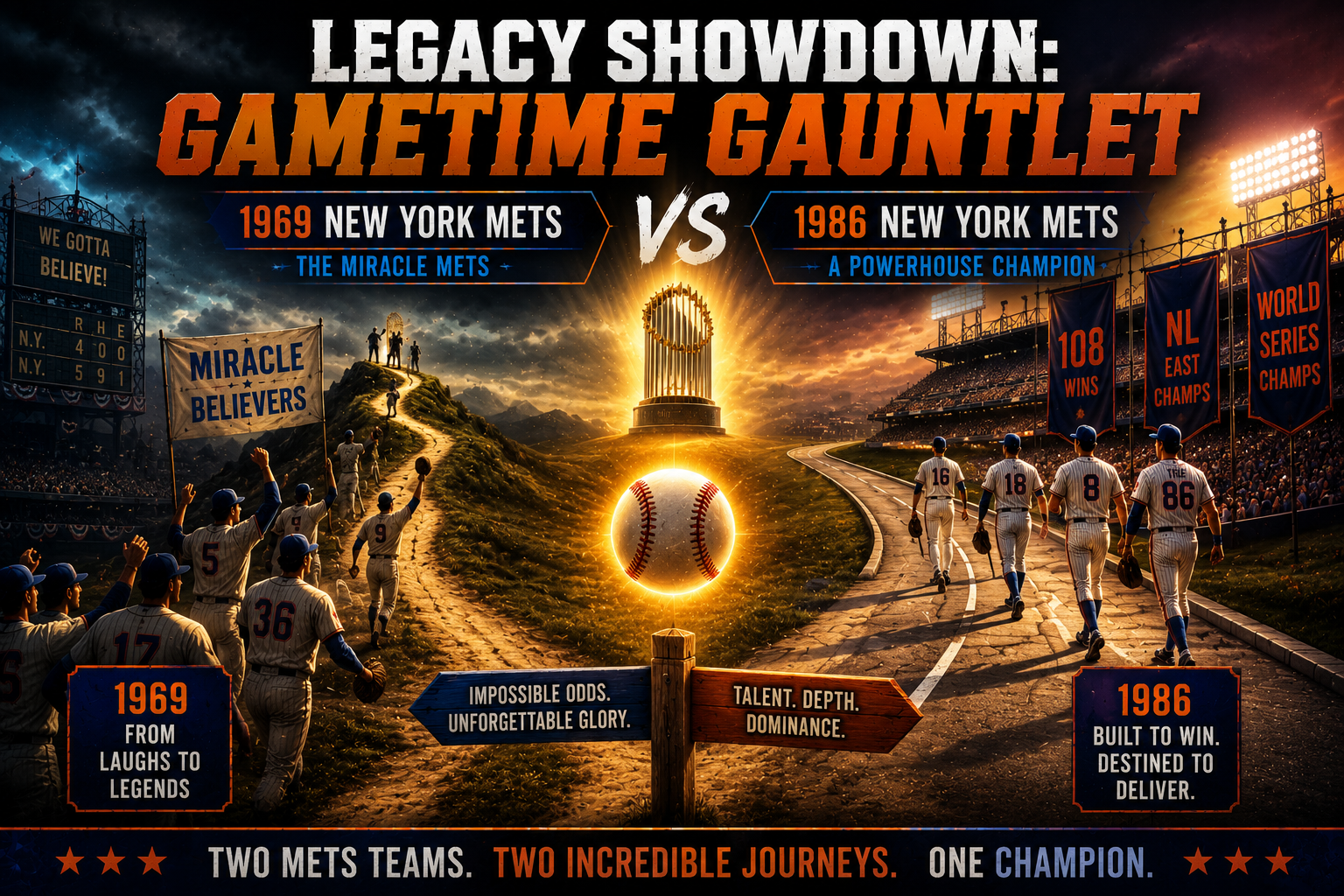
The fifth first-round matchup in the MLB Region is a fascinating battle between two championship teams from the same franchise. The #5 seed 1986 New York Mets are remembered as one of the most talented, confident, and colorful teams in baseball history, powered by Dwight Gooden, Darryl Strawberry, Keith Hernandez, Gary Carter, and a roster that expected to win every night. Standing across from them are the #12 seed 1969 New York Mets, forever known as the Miracle Mets, who completed one of the most astonishing turnarounds in American sports. After years of losing, the 1969 club captured New York’s imagination and then shocked a heavily favored Baltimore Orioles team in the World Series. This is not simply a comparison of two Mets champions; it is a debate between overwhelming baseball excellence and one of the greatest underdog stories the sport has ever produced. Under Gametime Gauntlet rules, the teams are judged relative to their own eras rather than through a hypothetical head-to-head game. Ten categories will determine which version of the Mets earns the right to advance.
Affiliate Disclaimer
This blog may contain affiliate links or banner advertisements. If you click on one of these links or advertisements and make a purchase, The Shopping Plaza may earn a small commission at no additional cost to you. These commissions help support our work and allow us to continue creating free sports content, tournament features, rankings, and Legacy Showdown matchups such as Gametime Gauntlet. We only recommend products, services, or merchandise that we believe may be of interest to our readers. Thank you for supporting The Shopping Plaza and Gametime Gauntlet.
- Dominance Over Competition
The 1986 Mets did not merely win the National League East; they overwhelmed it. Their 108 regular-season victories were the most in Major League Baseball that year, and they finished 21.5 games ahead of the second-place Philadelphia Phillies. New York combined a powerful offense with an elite pitching staff, producing the kind of balance that made prolonged losing stretches extremely rare. The Mets then survived a difficult National League Championship Series against Houston before winning the World Series, proving that their regular-season dominance could withstand postseason pressure. The 1969 Mets were excellent at 100-62 and closed the season with a remarkable surge, but their story was built more around an extraordinary transformation than wire-to-wire superiority. When the category focuses on how thoroughly a team controlled its competition across the full season, the 1986 club owns the stronger case.
Winner: 1986 New York Mets
- Championship Achievement
Both Mets teams finished the job and therefore begin this category with the most important credential: a World Series championship. The 1969 Mets defeated Atlanta in the inaugural National League Championship Series and then stunned the heavily favored Baltimore Orioles four games to one, completing a championship run that seemed almost unimaginable when the franchise was born only seven years earlier. The 1986 Mets faced a tougher road than their regular-season record might suggest, surviving a dramatic six-game NLCS against Houston and then an unforgettable seven-game World Series against Boston. Their title came after a 108-win season in which they had already established themselves as baseball’s most imposing regular-season club. The Miracle Mets deserve enormous credit for the magnitude of their upset, but Championship Achievement also rewards the complete body of championship work. The combination of 108 wins, postseason survival, and a World Series title gives 1986 the narrow edge.
Winner: 1986 New York Mets
- Strength of Competition
The 1969 Mets faced an imposing final obstacle in the Baltimore Orioles, a 109-win powerhouse loaded with elite talent and widely expected to control the World Series. Instead, New York’s pitching and defense turned the matchup on its head, holding Baltimore down after losing Game 1 and winning four straight to claim the championship. Defeating a club of that caliber gave the Miracle Mets’ title immediate credibility beyond the emotional power of their underdog story. The 1986 Mets also faced serious postseason competition, particularly a Houston club led by dominant pitching and a Boston team that pushed the World Series to seven games. Their path required resilience and multiple high-pressure victories. Still, the 1969 club’s decisive defeat of a 109-win Orioles champion represents the strongest single competitive mountain in this matchup. That achievement gives the Miracle Mets the advantage here.
Winner: 1969 New York Mets
- Star Power
The 1986 Mets were overflowing with recognizable talent. Dwight Gooden was already one of baseball’s most electric pitchers, Darryl Strawberry supplied superstar power, Keith Hernandez combined leadership with elite first-base defense, and Gary Carter brought Hall of Fame credentials behind the plate. The roster also included important personalities and performers such as Mookie Wilson, Lenny Dykstra, Ray Knight, Jesse Orosco, and others who became permanently associated with the championship season. The 1969 Mets had outstanding players of their own, led by Tom Seaver, Jerry Koosman, Cleon Jones, and a young Nolan Ryan, but their championship identity was more collective than star-driven. Seaver is arguably the greatest individual player represented by either team, yet the 1986 roster carried more established star power across multiple positions. From the rotation to the heart of the lineup, the later Mets were simply more loaded with headline talent.
Winner: 1986 New York Mets
- Depth and Supporting Cast
The 1986 Mets could attack opponents in multiple ways because the roster extended far beyond its biggest names. Players such as Mookie Wilson, Lenny Dykstra, Wally Backman, Ray Knight, Kevin Mitchell, and Howard Johnson gave manager Davey Johnson numerous offensive combinations and matchup options. The pitching staff was similarly deep, with Gooden, Ron Darling, Sid Fernandez, Bob Ojeda, and a bullpen capable of handling high-leverage innings. That depth became especially important during a postseason in which the Mets repeatedly had to find different heroes. The 1969 team was also beautifully constructed, receiving contributions from players such as Tommie Agee, Cleon Jones, Donn Clendenon, Ed Kranepool, and a deep pitching staff behind Seaver and Koosman. But the 1986 roster offered greater lineup flexibility, more offensive firepower, and exceptional pitching depth at the same time. This category rewards the team that could absorb more variables without losing its identity, and that is the 1986 Mets.
Winner: 1986 New York Mets
- Historical Impact
Few championship teams in any sport have altered the emotional identity of a franchise as dramatically as the 1969 Mets. The organization had begun as a lovable symbol of expansion-era futility, losing 120 games in its inaugural 1962 season and spending years near the bottom of the standings. Seven years later, the Mets were World Series champions, giving New York one of sports’ defining worst-to-first stories. The phrase ‘Miracle Mets’ became larger than a nickname; it became shorthand for the possibility that a seemingly hopeless team could suddenly become a champion. The 1986 club created its own enormous cultural footprint and remains one of the most famous teams of the decade, but it entered the season with championship expectations rather than disbelief surrounding its very ability to contend. The 1969 team changed what the Mets franchise meant to its fans and created a story that still resonates whenever an underdog makes an improbable run. Historical Impact belongs clearly to the Miracle Mets.
Winner: 1969 New York Mets
- Statistical Excellence
The statistical profile of the 1986 Mets supports the eye test: this was an elite team with very few obvious weaknesses. They won 108 games, led the National League in runs scored, and combined that offense with one of the league’s strongest pitching staffs. Their run differential reflected sustained control rather than a season built primarily on narrow victories or isolated hot streaks. The 1969 Mets were exceptional on the mound and allowed the fewest runs in the National League, with Seaver and Koosman anchoring a staff perfectly suited to a low-scoring era. Their offense, however, was much less imposing than the 1986 lineup. Because Gametime Gauntlet evaluates statistics relative to each team’s era, both deserve significant credit for what they did best. Still, the 1986 Mets’ ability to rank among the league’s best on both sides of the ball gives them the more complete statistical résumé.
Winner: 1986 New York Mets
- Longevity of Greatness
The 1986 championship represented the peak of a Mets core that remained highly competitive for several seasons. New York won 98 games in 1985, exploded to 108 in 1986, won 92 in 1987, and captured another division title with 100 victories in 1988. That sustained run demonstrates that the championship roster was not simply a one-season collection that caught fire at the perfect moment. The 1969 Mets also remained relevant after their miracle season, and several key players continued contributing to strong clubs, including the 1973 team that returned to the World Series. Even so, the 1969 championship itself stands somewhat apart as a sudden breakthrough that exceeded what came immediately before it. The 1986 team sits more naturally inside a multi-year window of high-level contention and extraordinary roster talent. For sustained excellence surrounding the championship season, 1986 earns the point.
Winner: 1986 New York Mets
- Clutch Performance
The 1969 Mets built their legend by delivering when the stakes became highest. After surging past the Chicago Cubs in the pennant race, they swept Atlanta in the NLCS and then responded to a Game 1 World Series loss by winning four consecutive games against Baltimore. Their pitching repeatedly neutralized an Orioles lineup that had powered a 109-win season, and Donn Clendenon’s timely hitting helped turn the World Series into an upset for the ages. The 1986 Mets were extraordinarily clutch as well, particularly during the marathon NLCS clincher in Houston and the famous Game 6 comeback against Boston in the World Series. Few teams have ever produced a more memorable escape from elimination than the 1986 club. But the 1969 Mets’ entire postseason identity was built around repeatedly outperforming expectations against opponents believed to be stronger. In a category devoted specifically to delivering in defining moments, the Miracle Mets take the edge by the narrowest margin.
Winner: 1969 New York Mets
- Legacy Endurance
The 1986 Mets remain one of the most discussed teams in franchise history. Their personalities, 108 victories, postseason drama, and Game 6 comeback have kept the season alive in documentaries, anniversary celebrations, books, broadcasts, and debates about teams that should have become dynasties. Yet the 1969 Mets occupy a different kind of historical space. More than half a century later, ‘Miracle Mets’ remains one of baseball’s most instantly understood championship labels, and the story continues to symbolize the sport’s capacity for sudden transformation. The team’s legacy is not dependent on one famous play or one superstar; it rests on the complete improbability of a franchise going from historic ineptitude to a championship in such a short period. The 1986 club may have been better on the field, but the 1969 team became folklore. When the question is which legacy has endured most powerfully across generations, the Miracle Mets win the final category.
Winner: 1969 New York Mets
Final Verdict
This matchup captures why Gametime Gauntlet judges greatness through multiple lenses. The 1969 Miracle Mets win Strength of Competition, Historical Impact, Clutch Performance, and Legacy Endurance because their championship remains one of baseball’s most improbable and emotionally powerful stories. They did more than win a title; they transformed the identity of a young franchise and defeated a 109-win Baltimore powerhouse while doing it. But the 1986 Mets win Dominance Over Competition, Championship Achievement, Star Power, Depth and Supporting Cast, Statistical Excellence, and Longevity of Greatness. Their 108-win season was backed by a deep lineup, elite pitching, exceptional star talent, and a multi-year period of contention that confirms the roster’s quality was no accident. The Miracle Mets own the more inspirational story, but the 1986 Mets present the stronger overall case for baseball excellence across the ten official judging criteria. In a matchup this close, the difference is the number of ways the 1986 team could dominate a game and the sustained evidence that its championship-level talent was real. The powerhouse survives the miracle and advances.
Final Result: 1986 New York Mets advance by a score of 6-4.
Gametime Gauntlet Scorecard
Dominance Over Competition: 1986 Mets
Championship Achievement: 1986 Mets
Strength of Competition: 1969 Mets
Star Power: 1986 Mets
Depth and Supporting Cast: 1986 Mets
Historical Impact: 1969 Mets
Statistical Excellence: 1986 Mets
Longevity of Greatness: 1986 Mets
Clutch Performance: 1969 Mets
Legacy Endurance: 1969 Mets
Audience Challenge
Which Mets champion deserves the greater place in baseball history? Do you choose the 1986 powerhouse that won 108 games and combined stars, depth, pitching, offense, and postseason drama, or the 1969 Miracle Mets whose championship transformed a struggling expansion franchise into one of sports’ greatest underdog legends? Which of the ten categories would you change, and would flipping that category alter the final result? Make your case for the Mets team you believe should advance in Gametime Gauntlet.