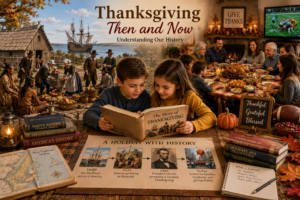
Teaching Kids the History of Thanksgiving
Affiliate Disclosure: This article may contain affiliate links. If you purchase products through these links, The Shopping Plaza may earn a small commission at no additional cost to you. These commissions help support The Shopping Plaza and allow us to continue creating helpful educational resources, holiday guides, family activities, and seasonal inspiration. Thank you for your support!
Thanksgiving is one of America’s most familiar holidays. Children often grow up associating it with turkey, pumpkin pie, parades, football, family gatherings, and school crafts. But behind those traditions is a much larger and more complicated history that provides families with an opportunity to teach children about gratitude, cooperation, Native American history, colonization, and how holidays change over time.
For generations, the Thanksgiving story was frequently reduced to a simple tale about Pilgrims and Native Americans sharing a friendly feast. While a harvest gathering did take place at Plymouth in 1621, the complete history is far more complex. Teaching children about Thanksgiving doesn’t mean taking away the joy of the holiday. Instead, it means giving them an age-appropriate understanding of the people and events connected to it.
By combining history with stories, activities, family discussions, and gratitude traditions, parents and educators can help children understand both the history and the meaning Thanksgiving holds today.
Start with What Children Already Know
Before beginning a history lesson, ask children what they already know about Thanksgiving.
Questions might include:
- Why do we celebrate Thanksgiving?
- Who were the Pilgrims?
- Who lived in America before Europeans arrived?
- What foods do you think people ate in 1621?
- How is Thanksgiving different today?
Their answers will help you identify what they understand and what misconceptions may need clarification.
Explain That Native Peoples Were Already Here
One of the most important lessons children should learn is that North America was not an empty wilderness waiting for European settlers.
Indigenous peoples had lived throughout the Americas for thousands of years before the arrival of the Pilgrims.
The Native people most closely connected to the Plymouth story were the Wampanoag, whose communities had existed in the region for generations.
Depending on a child’s age, discuss how Native nations had their own:
- Governments
- Languages
- Traditions
- Spiritual practices
- Agricultural knowledge
- Trade relationships
- Family structures
This provides important context for understanding what happened when Europeans established colonies.
Introduce the Pilgrims
The group commonly called the Pilgrims were English Separatists and others who traveled across the Atlantic aboard the Mayflower in 1620.
After a difficult journey, they established Plymouth Colony in what is now Massachusetts.
Their first winter was devastating. Disease, hunger, and harsh conditions caused many colonists to die.
Explaining these hardships helps children understand why survival and the harvest became so important to the settlers.
Talk About the Wampanoag
The Wampanoag played a central role in the early history of Plymouth Colony.
Their relationship with the English settlers involved diplomacy, trade, cooperation, tension, and eventually conflict.
Children should understand that the Wampanoag were not simply supporting characters in someone else’s story. They were a people with their own communities, leaders, goals, traditions, and history.
Teaching Thanksgiving from multiple perspectives gives children a fuller understanding of the past.
Explain the 1621 Harvest Gathering
The event often described as the “First Thanksgiving” occurred in the autumn of 1621.
After a successful harvest, Plymouth colonists held a multi-day gathering. Members of the Wampanoag community, including their leader Ousamequin—often called Massasoit in historical accounts—were also present.
The gathering lasted approximately three days.
Rather than presenting it as the beginning of the modern Thanksgiving holiday, explain that it was a harvest celebration that later generations connected to Thanksgiving traditions.
What Was Actually on the Menu?
Children often enjoy learning how different the 1621 meal was from today’s Thanksgiving dinner.
The menu likely included foods such as:
- Venison
- Wild fowl
- Corn
- Local seafood
- Seasonal vegetables
Many foods associated with modern Thanksgiving would have looked very different—or wouldn’t have appeared at all.
Pumpkin pie, for example, wasn’t served in the form we recognize today.
Comparing historical and modern menus can become a fun family learning activity.
Explain That Thanksgiving Developed Over Time
Modern Thanksgiving didn’t simply begin in 1621 and continue unchanged.
Various communities observed days of thanksgiving at different times for religious, agricultural, military, and civic reasons.
Over generations, these observances gradually contributed to the development of the national holiday Americans recognize today.
Helping children understand this evolution prevents the misconception that today’s Thanksgiving celebration began exactly as we practice it now.
Discuss Abraham Lincoln’s Role
An important chapter in Thanksgiving history occurred during the Civil War.
In 1863, President Abraham Lincoln issued a proclamation encouraging Americans to observe a national day of Thanksgiving in November.
The country was experiencing tremendous division and suffering, making the message of gratitude and national reflection especially meaningful.
Older children can explore how historical events influence national traditions.
Explain How the Date Became Established
Thanksgiving’s date also changed over time.
In the 20th century, President Franklin D. Roosevelt moved the observance earlier during the Great Depression in an effort to extend the holiday shopping season.
After controversy over the change, Congress eventually established Thanksgiving as the fourth Thursday of November.
This provides a great example of how traditions continue evolving long after they begin.
Include Native American Perspectives
As children grow older, Thanksgiving provides an opportunity to discuss the difficult history that followed European colonization.
Topics can include:
- Loss of Native lands
- Disease
- Broken agreements
- Cultural disruption
- Warfare
- Native resilience
These subjects should be approached in ways appropriate for the child’s age.
The goal isn’t to make children feel guilty about celebrating Thanksgiving. Instead, it’s to help them understand that history can contain cooperation and conflict, celebration and suffering, all at the same time.
Use Books to Bring History Alive
Age-appropriate books can make historical subjects easier for children to understand.
Look for books that:
- Include Native perspectives
- Explain historical events accurately
- Feature primary sources when appropriate
- Avoid stereotypes
- Present history in age-appropriate language
Reading several books from different perspectives can help children understand that historical events are often more complex than a single story.
Create a Thanksgiving Timeline
Visual learners may enjoy creating a timeline.
Include important events such as:
- 1620 – Mayflower arrives
- 1621 – Plymouth harvest gathering
- 1863 – Lincoln’s Thanksgiving proclamation
- 20th century – Thanksgiving date becomes standardized
Children can add illustrations, maps, and short descriptions.
Visit Museums and Historic Sites
If possible, explore Thanksgiving history through museums, cultural centers, and historic sites.
Virtual museum exhibits are another excellent option.
Encourage children to examine:
- Historical clothing
- Tools
- Homes
- Cooking methods
- Maps
- Artifacts
Seeing how people actually lived makes history feel much more real.
Compare Past and Present Thanksgiving Traditions
Ask children to compare Thanksgiving in different periods.
Today we might celebrate with:
- Football
- Parades
- Television
- Large family dinners
- Holiday shopping
People living centuries ago experienced the season very differently.
This comparison helps children understand how traditions evolve.
Connect History with Gratitude
After learning about the past, bring the conversation back to the meaning your family gives Thanksgiving today.
Ask children what they’re grateful for, such as:
- Family
- Friends
- Teachers
- Food
- Home
- Opportunities
- Kindness they’ve received
Understanding history and practicing gratitude don’t have to compete with one another.
Both can be meaningful parts of the holiday.
Encourage Children to Ask Questions
History becomes more interesting when children are encouraged to investigate rather than simply memorize facts.
If they ask a question you can’t answer, research it together.
Questions might include:
- What did Wampanoag children do every day?
- What games did children play?
- What languages were spoken?
- What happened to Plymouth Colony later?
- When did turkey become a Thanksgiving tradition?
Curiosity transforms history from a school subject into an exploration.
Create a Family Thanksgiving History Tradition
Consider making historical learning part of your annual Thanksgiving celebration.
Each year, choose one subject to explore together, such as Native American history, the Mayflower voyage, Thanksgiving during the Civil War, traditional foods, or the history of the Thanksgiving parade.
As children grow older, the discussions can become more detailed and sophisticated. What begins as a simple childhood activity can eventually become a family tradition that encourages lifelong curiosity about history.
Final Thoughts
Teaching kids the history of Thanksgiving offers families an opportunity to go beyond familiar holiday stories and explore the people, cultures, events, and traditions that shaped the celebration we know today.
Children can learn about the Wampanoag, the Plymouth colonists, the 1621 harvest gathering, the development of national Thanksgiving observances, and the complicated consequences of European colonization. Presenting these subjects accurately and in age-appropriate ways helps children develop a more thoughtful understanding of American history.
Thanksgiving can still be filled with turkey, football, crafts, parades, desserts, and family fun. Adding honest historical learning doesn’t diminish those traditions—it gives them greater context.
By combining curiosity about the past with gratitude in the present, families can create a Thanksgiving celebration that’s not only enjoyable but also educational, respectful, and meaningful.