

Affiliate Disclaimer: This blog may contain affiliate links or affiliate banner advertisements. If you click on these ads or make purchases through them, we may earn a small commission at no additional cost to you.
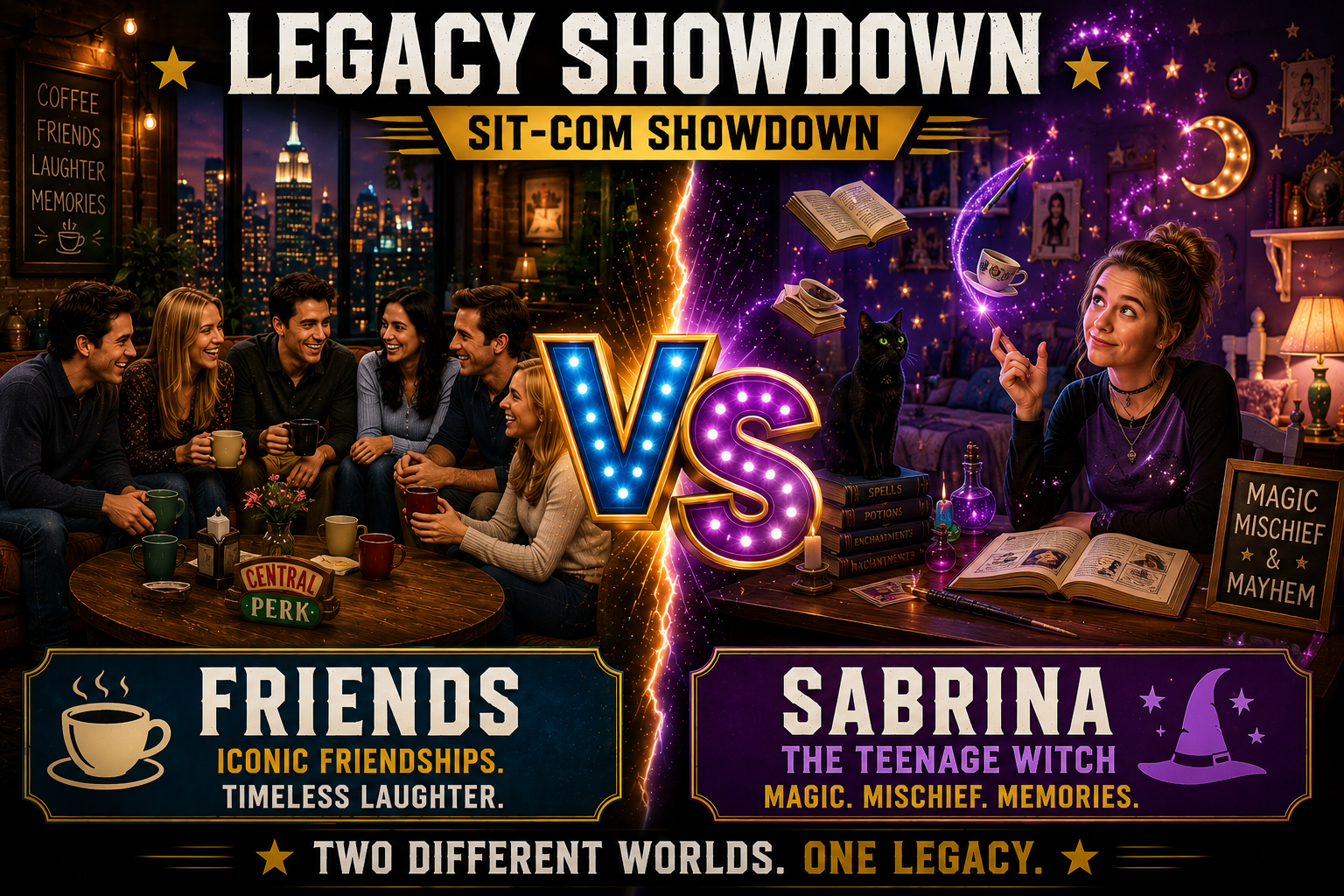
The Legacy Showdown tournament heads back to the 1990s for one of the most entertaining first-round matchups in the bracket. On one side stands Friends, the global sitcom phenomenon that helped define an entire generation of television comedy. On the other side is Sabrina the Teenage Witch, the magical family comedy that blended teen drama, fantasy, and humor into one of the decade’s most beloved cult favorites.
At first glance, this matchup may appear heavily one-sided. Friends became one of the biggest sitcoms in television history, while Sabrina the Teenage Witch developed a more niche audience built around young viewers and fantasy storytelling. Still, Sabrina carried enormous nostalgic power for audiences who grew up during the TGIF era and early WB television boom.
The Legacy Showdown Rules
- Comedy Quality
- Character Chemistry
- Cultural Impact
- Longevity & Replay Value
- Iconic Moments
- Supporting Cast
- Era Difficulty
- Legacy Endurance
Round 1: Comedy Quality
Both shows developed distinctive comedic identities, but Friends takes Round 1 because it could generate humor from six completely different personalities while combining dialogue, physical comedy, romantic awkwardness, misunderstandings, and character flaws with remarkable consistency. Ross, Rachel, Monica, Chandler, Joey, and Phoebe each offered a different comedic weapon—from Chandler’s sarcasm and Joey’s lovable cluelessness to Monica’s competitiveness, Ross’s escalating frustration, Phoebe’s eccentric worldview, and Rachel’s reactions to adulthood—which meant the series rarely depended on one character to produce the laughs. One of the strongest examples is “The One with the Embryos,” where a simple trivia contest between Monica and Rachel versus Chandler and Joey escalates until the women unbelievably wager their apartment, allowing the episode to generate comedy from how intimately these friends know—and occasionally fail to know—one another. Sabrina the Teenage Witch had a wonderfully creative comedic advantage of its own because Sabrina’s attempts to solve ordinary teenage problems with magic frequently created much larger disasters, while Salem’s sarcastic personality provided a steady stream of one-liners and reactions. A strong example comes from “Pancake Madness,” where Sabrina discovers that the Spellman family has a bizarre hereditary addiction to pancakes, turning something completely ordinary into the kind of absurd supernatural situation that gave the series its unique comedic personality. Friends, however, could produce equally memorable comedy without requiring an extraordinary premise, because something as simple as Thanksgiving dinner, a bad date, an embarrassing secret, an apartment argument, or Ross trying to move a couch could escalate into a classic sitcom situation purely through the personalities involved. For combining exceptional ensemble timing, layered character humor, sharp dialogue, physical comedy, and everyday situations that repeatedly became unforgettable comedic disasters, Friends convincingly takes Round 1.
Round 1 Winner: Friends
Round 2: Character Chemistry
This round also belongs to Friends, because while Sabrina the Teenage Witch developed a lovable family unit, few sitcoms have ever matched the natural chemistry among Rachel, Ross, Monica, Chandler, Joey, and Phoebe, supporting the original blog’s verdict. What made the ensemble exceptional was that the series could pair virtually any two characters and create a distinctive dynamic—Joey and Chandler’s brother-like friendship, Monica and Rachel’s longtime bond, Ross and Monica’s sibling rivalry, or Phoebe’s wonderfully unpredictable interactions with everyone around her. The friendship between Joey and Chandler provides perhaps the strongest example, as their years of living together produced everything from ridiculous arguments over possessions to the unforgettable experience of raising the chick and the duck, while underneath the comedy was genuine loyalty and affection. Sabrina possessed excellent chemistry of its own, particularly between Sabrina, Hilda, Zelda, and Salem, whose household gradually felt like a supernatural but recognizable family where magical disasters existed alongside ordinary arguments, advice, and growing-up problems. Salem was especially important because his sarcastic commentary and schemes allowed him to function as more than a magical talking cat—he became Sabrina’s mischievous friend and an essential comedic member of the Spellman household. Friends, however, took ensemble chemistry another step because the relationships continually evolved, with friendships becoming romances, roommates becoming spouses, siblings becoming closer, and the entire group gradually becoming a chosen family as they navigated adulthood together. For creating six characters whose individual relationships were strong enough to drive stories in almost any combination while making audiences genuinely believe these people loved spending their lives together, Friends takes Round 2.
Round 2 Winner: Friends
Round 3: Cultural Impact
This round provides one of the clearest advantages for Friends, because while Sabrina the Teenage Witch became an important part of 1990s youth and fantasy television, Friends grew into a global pop-culture phenomenon whose influence extended far beyond the sitcom genre, matching the original blog’s verdict. The series helped make Rachel, Ross, Monica, Chandler, Joey, and Phoebe internationally recognizable characters, while their apartments and regular gatherings at Central Perk helped popularize an image of young adulthood centered around a close-knit group of friends functioning almost like a second family. Perhaps the strongest example of the show’s cultural reach was “The Rachel” haircut, as Jennifer Aniston’s hairstyle became one of the most recognizable fashion trends associated with 1990s television and was widely copied by viewers. Sabrina the Teenage Witch created a meaningful legacy of its own by placing a teenage girl at the center of a fantasy sitcom where school, dating, friendships, and growing up collided with witches, spells, magical disasters, and a sarcastic talking cat, helping make supernatural storytelling accessible to a young mainstream audience. Melissa Joan Hart’s Sabrina and Salem the cat became particularly recognizable parts of late-1990s youth culture, and the show’s combination of fantasy and everyday teenage life helped give it a distinctive identity among family sitcoms of the period. Friends, however, influenced everything from hairstyles and catchphrases to relationship conversations and the cultural image of friends gathering in coffeehouses, while its enormous international popularity allowed those influences to spread well beyond American television audiences. For becoming a worldwide television phenomenon whose characters, relationships, fashion, locations, and comedic moments became recognizable pieces of popular culture, Friends decisively takes Round 3.
Round 3 Winner: Friends
Round 4: Longevity & Replay Value
This round also goes to Friends, because while Sabrina the Teenage Witch retains tremendous nostalgic appeal, Friends has demonstrated an extraordinary ability to remain relatable and entertaining for audiences well beyond its original 1990s and early-2000s run, matching the original blog’s verdict. Much of that durability comes from stories centered on friendship, dating, breakups, marriage, careers, roommates, financial struggles, and figuring out adulthood, experiences that continue to connect with viewers even as some of the show’s technology and cultural references become dated. A perfect example is “The One with Ross’s Sandwich,” where Ross completely loses control after discovering that someone at work ate the special Thanksgiving leftover sandwich Monica made for him, turning a ridiculously small workplace frustration into an unforgettable comedy about someone already overwhelmed by problems in his life. Sabrina also offers strong replay value, especially through Sabrina’s teenage experiences, Salem’s sarcastic humor, and Hilda and Zelda’s attempts to guide Sabrina through both adolescence and witchcraft, giving the series a comforting quality for viewers who grew up watching it. Its magical premise actually strengthens its nostalgic appeal because spells, the Other Realm, talking animals, and supernatural mishaps give Sabrina a distinctive personality that separates it from more conventional teen sitcoms of the period. Friends, however, has the broader advantage because viewers can discover different aspects of the characters as they age themselves—relating first to the group’s dating adventures and friendships and later to Monica and Chandler’s marriage, Rachel’s career development, Ross’s parenting, or the group’s gradual transition into more settled adult lives. For combining enormously rewatchable comedy with universal themes of friendship, relationships, careers, and adulthood that continue attracting audiences across generations, Friends comfortably takes Round 4.
Round 4 Winner: Friends
Round 5: Iconic Moments
This round becomes another major advantage for Friends, because while Sabrina the Teenage Witch created memorable magical adventures and characters, Friends produced an extraordinary number of scenes, quotes, and storylines that became recognizable far beyond the show’s regular audience, exactly as the original blog argues. One of the strongest examples is “The One with the Cop,” where Ross buys a new couch and attempts to maneuver it up a narrow staircase with Rachel and Chandler, repeatedly screaming “Pivot!” as the increasingly impossible situation collapses into one of the series’ most famous physical-comedy sequences. Sabrina certainly had iconic elements of its own, particularly Salem the talking cat, Sabrina’s magical transformations, the Spellman house, and the wonderfully bizarre Other Realm, all of which gave the show a visual and comedic identity unlike almost any other teen sitcom of its era. Salem became especially memorable because his sarcastic comments, ridiculous ambitions, and constant attempts to manipulate Sabrina and her aunts made him far more than a magical sidekick and arguably the show’s most recognizable character besides Sabrina herself. Friends, however, accumulated an almost unmatched collection of signature moments, including Ross and Rachel’s “We were on a break” argument, Monica dancing with a turkey on her head, Joey wearing all of Chandler’s clothes, the apartment trivia contest, and countless Thanksgiving disasters that fans continue to associate immediately with the series. Even relatively simple lines, character habits, and running jokes became part of the show’s identity because audiences were so familiar with the six friends and the relationships connecting them. For producing an enormous collection of scenes, quotes, running jokes, romantic milestones, and comedic disasters that remain instantly recognizable decades later, Friends decisively takes Round 5.
Round 5 Winner: Friends
Round 6: Supporting Cast
This round goes to Friends, because while Sabrina the Teenage Witch surrounded Sabrina with a colorful collection of characters, Friends developed a remarkably deep supporting roster that expanded the world beyond its famous central six, matching the original blog’s verdict. Janice is perhaps the strongest example, as her unmistakable voice, larger-than-life personality, and recurring relationship with Chandler allowed her unexpected appearances—and her famous “Oh. My. God.”—to become running jokes throughout the series. Sabrina had memorable supporting characters of its own, with Harvey Kinkle providing the heart of Sabrina’s teenage romantic life while characters such as Libby Chessler created school conflicts that allowed Sabrina’s ordinary teenage problems to collide with her extraordinary magical abilities. The series also benefited tremendously from Hilda and Zelda Spellman, whose contrasting personalities made them more than guardians, as Hilda’s impulsiveness and Zelda’s practical intelligence frequently created their own comedic stories while helping Sabrina navigate witchcraft. Friends, however, could reach beyond its core group to characters such as Gunther, Richard Burke, Jack and Judy Geller, Carol and Susan, and recurring romantic partners, many of whom developed recognizable personalities and relationships with the main cast rather than functioning simply as temporary plot devices. Gunther is a particularly good example because his largely unrequited obsession with Rachel transformed what could have been a background coffee-shop employee into one of the show’s longest-running recurring jokes. For creating a supporting ensemble filled with recurring personalities who strengthened the show’s relationships, expanded its comedic possibilities, and became memorable characters in their own right, Friends takes Round 6.
Round 6 Winner: Friends
Round 7: Era Difficulty
The 1990s were packed with major sitcom competition, but Friends takes Round 7 because it did not merely survive that crowded landscape—it became one of the defining television programs of the decade, matching the original blog’s verdict. Sabrina the Teenage Witch deserves considerable credit because it found a loyal audience within the competitive teen and family market by combining Sabrina’s high-school experiences with witchcraft, Salem’s sarcasm, and Hilda and Zelda’s supernatural family dynamic, giving it an identity that separated it from conventional youth sitcoms. Friends, however, had to compete for mainstream prime-time attention during an era that included powerhouse comedies such as Seinfeld, Frasier, Home Improvement, The Fresh Prince of Bel-Air, and later Everybody Loves Raymond, yet Ross, Rachel, Monica, Chandler, Joey, and Phoebe became television fixtures rather than being overshadowed by that competition. The show’s relatively simple premise actually makes that achievement more impressive because there was no fantasy element or unusual gimmick at its center—its success depended largely on writing, comedic timing, romantic storylines, and the chemistry of six friends navigating adulthood in New York City. Major developments such as Ross and Rachel’s relationship gave viewers continuing storylines to follow, while episodes involving Thanksgiving disasters, dating problems, weddings, roommate conflicts, and career changes kept the comedy accessible to an enormous audience. Sabrina successfully carved out an important place within its specific demographic, but Friends managed to dominate a much broader television landscape while competing directly against several shows now considered among the strongest sitcoms ever produced. For rising to the top during an extraordinarily competitive comedy era and becoming one of the programs that ultimately helped define that era, Friends convincingly takes Round 7.
Round 7 Winner: Friends
Round 8: Legacy Endurance
The final round goes decisively to Friends, because while Sabrina the Teenage Witch remains a beloved source of 1990s nostalgia, Friends has secured a much larger position in television history and continues to attract audiences across generations, matching the original blog’s verdict. Sabrina certainly possesses an enduring legacy through Melissa Joan Hart’s Sabrina Spellman, Salem the cat, Hilda and Zelda, Harvey, and its distinctive combination of teenage life and supernatural comedy, helping the series remain a favorite among viewers who grew up with fantasy-oriented family television. Its basic concept also proved remarkably durable, with Sabrina Spellman continuing as a recognizable character beyond this particular sitcom and demonstrating the lasting appeal of a teenage witch attempting to balance supernatural abilities with ordinary adolescence. Friends, however, achieved another level of endurance because Rachel, Ross, Monica, Chandler, Joey, and Phoebe remain instantly recognizable characters, while Central Perk, the apartments, Thanksgiving episodes, romances, and countless running jokes continue to define the show’s identity decades after its premiere. The enormous attention surrounding Friends: The Reunion in 2021 demonstrated how emotionally invested audiences remained in the cast and characters many years after the original finale, while the death of Matthew Perry in 2023 also produced a worldwide outpouring that reflected how deeply Chandler Bing and the series had connected with viewers. More importantly, the show’s fundamental idea of close friends becoming a chosen family while navigating careers, relationships, marriage, parenthood, heartbreak, and adulthood remains understandable to viewers who were not even born during the show’s original run. For maintaining extraordinary worldwide recognition, influencing later ensemble and relationship comedies, and continuing to introduce its six central characters to new generations of viewers, Friends takes Round 8 and advances deeper into the Sit-Com Showdown tournament.
Round 8 Winner: Friends
Final Verdict
Sabrina the Teenage Witch entered this matchup with nostalgia, creativity, and one of the most unique concepts in the 1990s sitcom landscape. But Friends proved far too powerful across nearly every Legacy Showdown category.
With global popularity, timeless replay value, and massive cultural influence, Friends advances deeper into the Sit-Com Showdown tournament as one of the strongest contenders in the entire bracket.
Audience Challenge
Do you agree with the result? Or does Sabrina the Teenage Witch deserve more credit for shaping fantasy television for young audiences? Join the debate and keep the Legacy Showdown tournament alive.