Affiliate Disclaimer: This article may contain affiliate links. If you purchase products or services through links mentioned in this article, we may earn a commission at no additional cost to you. Recommendations are provided for informational and educational purposes only.
Introduction: Why Names Tell Human Stories
Names are among the oldest and most personal parts of human identity. Before modern paperwork, government records, passports, school rosters, or social media profiles, people still needed ways to identify one another, remember family connections, describe personal traits, and pass stories from one generation to the next. A name could tell a community who someone was, where they came from, what work they did, whose child they were, or what qualities others associated with them.
Today, many people choose names because they sound beautiful, honor a loved one, reflect a cultural background, or feel unique. Yet even the most modern name is part of a much older human tradition. Names carry traces of language, religion, migration, class, occupation, geography, and family history. When we study names, we are really studying how people have understood identity across time.
The Earliest Names Were Practical and Descriptive
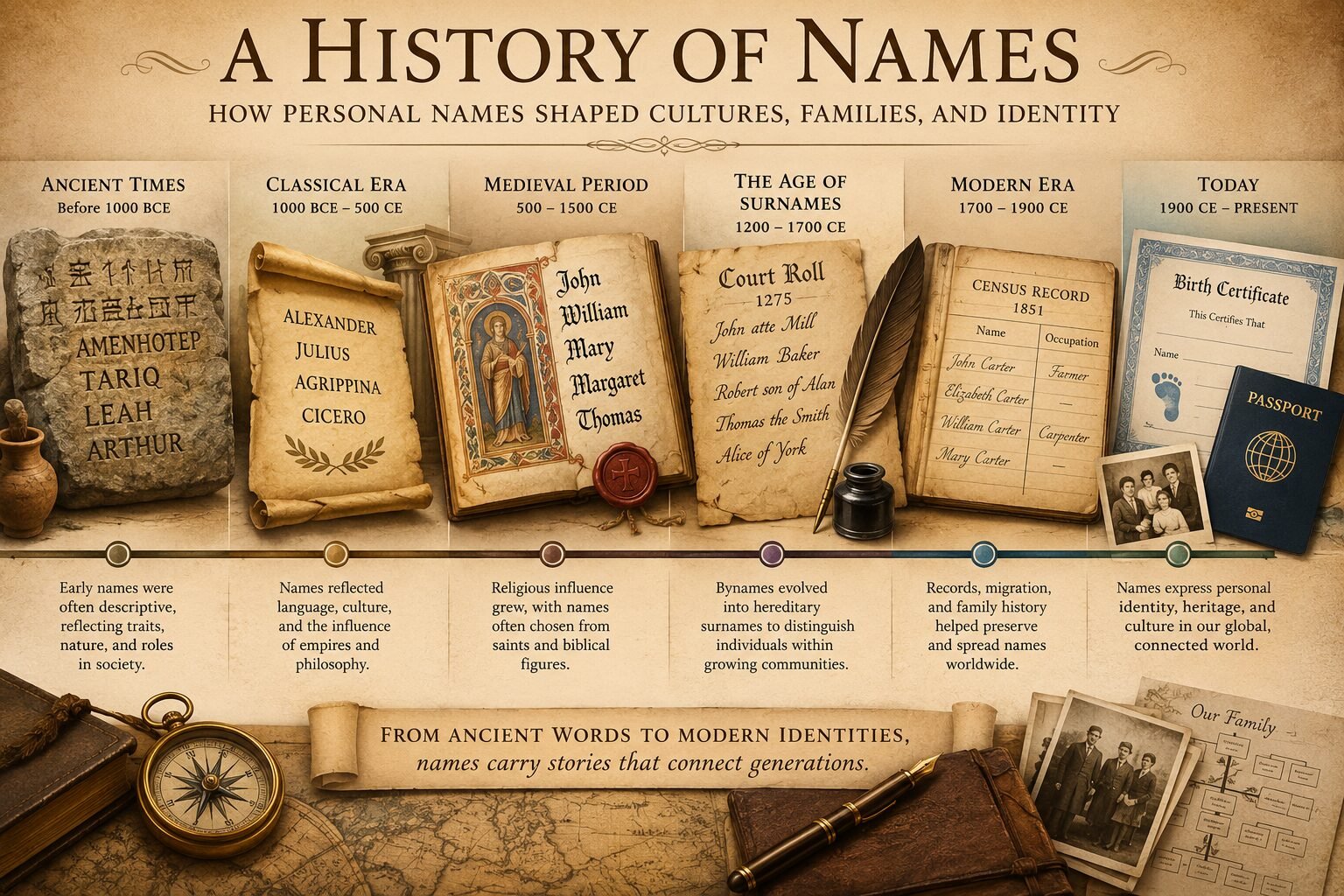
No one knows exactly when human beings first began using personal names, but the practice is ancient. In small early communities, names were likely practical and descriptive. A person might be identified by a physical trait, a skill, a personality quality, a place, or a memorable event. These names helped distinguish people in groups where formal records did not exist.
Descriptive names may have referred to strength, speed, courage, height, hair color, temperament, or connection to the natural world. A hunter known for speed, a storyteller known for wisdom, or a person who lived near a river might receive a name that reflected that identity. In this way, early names functioned almost like short biographies.
Language Change and the Mystery of Old Names
One reason name history is so fascinating is that language constantly changes. Words that once had obvious meanings can become mysterious after centuries of sound shifts, spelling changes, migration, and translation. A name that originally described a landscape, animal, profession, or virtue may no longer be recognizable to modern speakers.
This is why many common names feel familiar even when their meanings are not widely understood. Over time, a name may travel from one language into another, adapt to a new alphabet, change pronunciation, or develop several regional versions. The original meaning can become hidden, but the name continues to survive.
Religion and the Spread of Personal Names
Religion has shaped naming traditions across much of the world. In Christian cultures, names from the Bible and names of saints became especially influential. Names such as Mary, Joseph, John, James, Paul, Matthew, Mark, Martha, and Elizabeth spread widely because they connected children to religious stories, moral examples, and community faith.
Missionaries, churches, and religious calendars helped reinforce these patterns. In many communities, naming a child after a saint or biblical figure was not only a family choice but also a spiritual statement. Similar patterns can be found in other religious traditions, where names may honor prophets, virtues, deities, ancestors, or sacred ideas.
Medieval Europe and the Pool of Common Names
By the Middle Ages, many European communities had relatively small pools of given names. Religious influence, local language, and family tradition meant that many people in the same village might share the same first name. A town could easily contain several men named John, William, Thomas, or Robert, and several women named Mary, Anne, Margaret, or Elizabeth.
This created a practical problem. A single given name was no longer enough to identify someone clearly. Communities needed additional labels. Those labels eventually became bynames, and many bynames later became hereditary surnames.
The Rise of Surnames
Surnames developed because societies became larger, more mobile, and more administratively complex. Governments, churches, landowners, and communities needed reliable ways to distinguish people in tax records, property agreements, legal documents, and parish registers. A second name helped solve that problem.
At first, these extra names were often flexible. A person might be called John the Baker, William son of Robert, Alice from York, or Thomas Long. Over time, many of these identifiers became fixed family names passed from parents to children. This transition did not happen everywhere at the same time, but it permanently changed how people recorded identity.
Patronymic Names: Identifying a Person by Their Father
Patronymic surnames are among the most common types of family names. These names identify a person through a father or male ancestor. In English, names such as Johnson, Williamson, Richardson, and Davidson originally meant son of John, son of William, son of Richard, and son of David.
Other cultures developed similar systems. Gaelic names often use Mac or Mc, meaning son of, as in MacDonald or MacArthur. Irish names beginning with O often refer to descendant of. Scandinavian naming traditions produced surnames such as Anderson, Johansson, and Erikson. These names preserve family relationships long after the original father or ancestor has disappeared from memory.
Matronymic Names: Honoring the Mother Line
Matronymic names identify a person through the mother rather than the father. These names are less common than patronymic names in many societies, largely because historical legal and inheritance systems often emphasized male family lines. Still, matronymic names exist and provide important evidence of family structures, social circumstances, and naming flexibility.
A matronymic name might develop when the mother was especially well known, when the father’s identity was less central, or when a community recognized the mother’s family status. These names remind us that naming history is not only about rules; it is also about real human families and the ways communities described them.
Locative Names: Where a Family Came From
Locative surnames connect people to places. Names such as Hill, Wood, Brook, Rivers, Ford, Fields, and York often began as geographic identifiers. They may have described where someone lived, where they were born, or where they came from after moving to a new area.
In a time when many people lived their entire lives near one village, a place-based name could be extremely useful. If a person moved from one town to another, the new community might identify them by their place of origin. Over generations, that label could become a permanent family surname.
Occupational Names: Work Preserved in Family History
Occupational surnames are some of the easiest to recognize. Baker, Carpenter, Shepherd, Smith, Miller, Taylor, Weaver, Fisher, Cooper, and Wright all point to jobs that shaped everyday life. These names reveal how deeply work was connected to identity in earlier societies.
Many occupational surnames preserve trades that were essential to medieval and early modern communities. A smith worked with metal. A miller processed grain. A cooper made barrels. A wright built or crafted things. Even if descendants no longer practice those trades, the name keeps an echo of that ancestral work alive.
Descriptive Names: Appearance, Character, and Reputation
Some surnames began as descriptions of appearance or personality. Names such as Long, Short, Young, Strong, Wise, Brown, White, Black, Swift, and Good may have started as informal labels used by neighbors. They helped communities distinguish people with the same given name.
These descriptive names can be tricky because meanings may have shifted over time. A name might refer to hair color, clothing, complexion, age, strength, moral reputation, or even irony. Still, descriptive surnames show how communities turned everyday observations into lasting identifiers.
Roman Naming Systems and Complex Identity
The ancient Romans used multi-part naming systems that helped identify individuals within families, clans, and broader society. Roman citizens could have personal names, family names, and additional identifiers that reflected ancestry or personal distinction. This system demonstrated the usefulness of layered identity in a large and complex civilization.
Although modern Western naming systems did not simply copy Rome in a direct line, Roman practices show that sophisticated naming structures are ancient. Large societies often require more than one name to organize legal rights, family relationships, political status, and social identity.
Irish and Gaelic Surnames
Ireland played an important role in the development of hereditary surnames. Irish names such as O’Brien, O’Connor, MacCarthy, and MacDonnell preserve old family and clan relationships. Prefixes such as O and Mac tell stories about descent, ancestry, and kinship.
Gaelic surnames are especially valuable for family history because they often point toward older clan structures. Even when families migrated far from Ireland or Scotland, these names continued to carry cultural memory. For many descendants today, researching a Gaelic surname becomes a way to reconnect with ancestral identity.
Names, Migration, and Adaptation
Migration has always changed names. When families move across borders, their names may be translated, shortened, respelled, or altered to fit a new language. Sometimes changes happen gradually through pronunciation. Other times they occur quickly because officials, employers, teachers, or neighbors struggle to record unfamiliar names.
These changes can make genealogy challenging, but they also show how families adapted to new environments. A surname may have several spellings across documents, countries, or generations. Rather than seeing those differences as mistakes only, it is useful to recognize them as evidence of movement, survival, and cultural exchange.
First Names in the Modern World
Modern parents choose names for many reasons. Some honor relatives. Others reflect faith, cultural heritage, favorite writers, admired athletes, musicians, historical figures, or personal values. Some parents want timeless names, while others prefer names that feel fresh, rare, or creative.
Popular culture has a major influence. Movies, television, books, sports, and social media can cause certain names to rise quickly. A name associated with a beloved character or celebrity may suddenly become fashionable. At the same time, older names often return in cycles as families rediscover vintage choices.
Gender-Neutral Names and Changing Identity
One major modern trend is the growth of gender-neutral naming. Names such as Avery, Jordan, Riley, Taylor, Morgan, Quinn, and Rowan are used across gender lines in many communities. This reflects broader cultural conversations about identity, flexibility, and individuality.
Gender-neutral names are not entirely new, but they have become more visible in recent decades. Many parents like them because they feel modern, adaptable, and less tied to traditional expectations. This trend shows that naming practices continue to evolve with society.
Genealogy and the Search for Meaning
Interest in genealogy has grown as online records, DNA testing, and digital archives have made family research more accessible. Many people now investigate the origins of their surnames, trace family migrations, and study naming patterns across generations.
Names can provide clues, but they should be studied carefully. A surname may suggest a trade, place, or ancestor, but family history often includes migration, adoption, translation, remarriage, and spelling changes. The most accurate research combines name meanings with records, oral history, and historical context.
Why Names Still Matter Today
Names still carry emotional power. They can honor the past, express hope for the future, preserve cultural heritage, or mark belonging within a family. A name may connect a child to a grandparent, a religious tradition, a homeland, a language, or a story that matters deeply to the family.
At the same time, names shape how people are perceived. They appear on job applications, classroom lists, business cards, creative work, legal documents, and online profiles. Because names are so public and so personal, they remain one of the most important ways people present themselves to the world.
Final Thoughts
The history of names is the history of people. From descriptive labels in early communities to religious names, surnames, occupational identifiers, and modern creative choices, naming traditions reveal how human beings organize identity and memory.
Every name has a story, even when that story is partly hidden by time. Some names preserve ancient occupations. Others point to places, ancestors, faith traditions, or personal traits. Modern names may reflect pop culture, family love, individuality, or cultural pride. Together, they remind us that identity is never just personal; it is also historical, linguistic, and deeply connected to the communities that shape us.