
Some athletes break records.
Jackie Robinson broke barriers.
Before the bright lights and sold-out stadiums, before the Hall of Fame and the monuments, there was a man who stood alone on a field where few wanted him — and he didn’t just play.
He endured, he excelled, and he inspired a nation to look in the mirror.
Jackie Robinson wasn’t just the face of baseball.
He was the face of courage.
Affiliate Disclosure: This post may contain affiliate links. If you purchase through these links, I may earn a small commission at no additional cost to you.
Early Life: Strength Born from Struggle
Jack Roosevelt Robinson was born on January 31, 1919, in Cairo, Georgia, the youngest of five children to Mallie and Jerry Robinson, sharecroppers in the Deep South.
When Jackie was a baby, his father left the family. His mother, Mallie, moved the children west to Pasadena, California, seeking opportunity and freedom from the heavy hand of segregation.
They were the only Black family on their street.
Neighbors threw rocks at their house and shouted slurs.
But Mallie Robinson never wavered — and her strength became Jackie’s foundation.
“She taught me to never let anyone tell me I didn’t belong,” Jackie later said.
At John Muir High School, Jackie was a natural athlete — a four-sport star excelling in baseball, basketball, football, and track.
He carried that excellence to UCLA, where he became the first athlete in school history to earn varsity letters in four sports.
He was one of the most gifted competitors in the country — fast, fearless, and fiery.
But in 1941, he left college just shy of graduation to help support his family.
A Soldier and a Symbol
In 1942, Robinson was drafted into the U.S. Army during World War II.
Even in uniform, he confronted racism head-on.
While stationed in Texas, he refused to move to the back of a segregated military bus.
That act of defiance led to his court-martial — but he was eventually acquitted.
It was an early glimpse of his unshakable integrity.
“There was a system I didn’t believe in,” he said. “And I wasn’t going to live by it.”
He left the Army as a second lieutenant, but more importantly, as a man who understood that fighting injustice didn’t stop on the battlefield.
The Negro Leagues: A Proving Ground
After the war, Jackie Robinson joined the Kansas City Monarchs of the Negro American League in 1945.
He was brilliant on the field — hitting .387 and dazzling crowds with his speed and daring base running — but he was frustrated by the disorganization and lack of structure within the league.
Meanwhile, Branch Rickey, president and general manager of the Brooklyn Dodgers, was searching for the man who could break Major League Baseball’s color barrier.
He didn’t just want a great player — he needed someone with the emotional strength to withstand hatred, pressure, and isolation.
Rickey found his man in Jackie Robinson.
“I’m Looking for a Man with Guts Enough Not to Fight Back”
In August 1945, Robinson met with Branch Rickey for the most important interview in baseball history.
Rickey tested him, taunted him, and even shouted racial slurs — not out of cruelty, but to prepare him for what was to come.
When Robinson clenched his fists, Rickey leaned in and said:
“I’m looking for a man with guts enough not to fight back.”
Jackie paused.
Then he replied,
“Mr. Rickey, do you want a ballplayer who’s afraid to fight back?”
“I want a ballplayer,” Rickey said, “with guts enough not to.”
And that’s exactly who Jackie was.
Breaking the Barrier: April 15, 1947
On April 15, 1947, Jackie Robinson made his debut for the Brooklyn Dodgers at Ebbets Field, becoming the first African American to play Major League Baseball in the modern era.
The world changed that day.
The jeers were relentless. Opposing teams cursed him, fans hurled insults — and worse.
Some of his own teammates initially refused to play alongside him.
But Jackie stood tall.
He didn’t retaliate. He let his bat, his glove, and his sheer willpower do the talking.
That season, he hit .297, stole 29 bases, scored 125 runs, and led the Dodgers to the National League pennant.
He was named the Rookie of the Year, a new award created that very season.
He had done it — not just by playing, but by prevailing.
“Jackie Robinson made everyone around him better,” said teammate Pee Wee Reese. “And he made all of us braver.”
A Star Among Giants
Jackie Robinson didn’t just integrate baseball — he dominated it.
Over a 10-year career (1947–1956), he became one of the game’s premier players:
| Category | Career Total |
| Batting Average | .311 |
| Hits | 1,518 |
| Runs | 947 |
| Home Runs | 137 |
| RBIs | 734 |
| Stolen Bases | 197 |
| All-Star Selections | 6 |
| MVP | 1949 |
| World Series Champion | 1955 |
In 1949, he won the National League MVP Award after hitting .342 with 124 RBIs and 37 stolen bases.
He was fiery on the field — sliding hard, stealing home, and challenging pitchers with both skill and spirit.
But more than the numbers, it was the meaning of his presence that mattered most.
Every hit, every slide, every cheer chipped away at 60 years of segregation.
Courage Under Fire
Jackie Robinson’s greatest strength wasn’t athletic — it was moral.
He endured racial slurs, death threats, and violence with dignity.
When hotel owners refused him entry, he slept on buses.
When fans spat on him, he ignored them.
When pitchers threw at his head, he dusted himself off and stole the next base.
He faced hate with grace — not weakness.
“Jackie Robinson didn’t just open a door,” said Martin Luther King Jr. “He built a bridge for generations to cross.”
And cross they did.
Within a decade, nearly every MLB team had integrated.
Jackie had not only changed baseball — he’d helped change America.
The Power of Solidarity: Pee Wee Reese and Brotherhood
One of the most iconic moments in sports history came in 1947, when Dodgers shortstop Pee Wee Reese, a white Southerner, put his arm around Jackie during a game in Cincinnati.
The crowd was booing viciously, hurling slurs and insults.
Reese stepped toward Robinson, smiled, and wrapped his arm around him.
The stadium fell silent.
It was a simple gesture — but a revolutionary one.
“That arm around me,” Jackie said later, “meant the world.”
That moment symbolized unity, courage, and the beginning of change — on and off the diamond.
After Baseball: The Legacy of Leadership
Jackie Robinson retired in 1956, but he never stopped fighting for justice.
He became a civil rights advocate, joining forces with Martin Luther King Jr., and spoke out on issues of inequality, housing discrimination, and education.
He served on the NAACP Board of Directors, helped establish the Freedom National Bank of Harlem, and used his voice to demand progress in both sports and society.
He wrote newspaper columns, gave speeches, and challenged MLB to hire Black managers and executives — something that wouldn’t happen until decades later.
“I cannot stand and sing the anthem,” he once wrote, “I cannot salute the flag; I know that I am a Black man in a white world.”
He was unafraid to speak uncomfortable truths — because silence was never his style.
Family, Faith, and Enduring Love
Through it all, Jackie’s wife Rachel Robinson stood by his side — a pillar of strength and grace.
They married in 1946 and raised three children: Jackie Jr., Sharon, and David.
Rachel became not only a partner but a co-architect of his legacy.
After his passing in 1972, she founded the Jackie Robinson Foundation, which provides scholarships and mentorship for minority students across the U.S.
👉 Jackie Robinson Foundation
Through her work, his message continues to inspire young people to dream, fight, and achieve.
The Final Years and Immortality
Jackie Robinson passed away on October 24, 1972, at the age of 53, after battling diabetes and heart disease.
His death came just months after he threw out the first pitch at the 1972 World Series — his hair gray, his eyes still fierce, his message timeless.
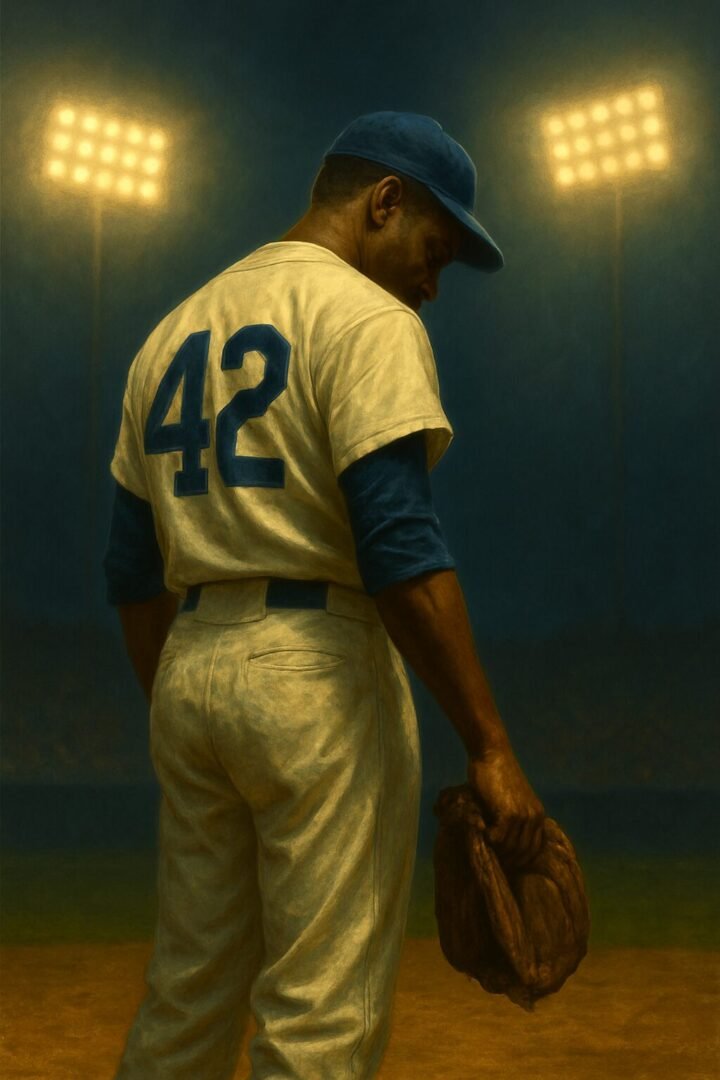
In 1997, fifty years after he broke the color barrier, Major League Baseball retired his number — 42 — across all teams.
It remains the only number retired league-wide in any major sport.
Each year on April 15, every MLB player wears No. 42 in his honor.
It’s not just a tradition.
It’s a reminder — that one man’s courage can rewrite history.
Legacy: The Man Who Carried a Nation’s Hope
Jackie Robinson wasn’t just the man who broke baseball’s color line.
He was the man who proved that dignity could defeat hate.
His courage opened doors for athletes like Hank Aaron, Willie Mays, and Ken Griffey Jr., and later inspired activists like Muhammad Ali and Colin Kaepernick.
He showed that greatness has no color — only character.
Today, every time a player slides into home, every time a fan rises for the national anthem, every time a barrier falls — Jackie Robinson’s spirit is there.
“Life is not a spectator sport,” he said. “If you’re going to spend your whole life in the grandstand, you’re wasting your life.”
Jackie never sat in the grandstand.
He stood tall.
And in doing so, he lifted all of us.
Happy Birthday, Jackie Robinson — The Hero Who Changed the Game and the World
From the cotton fields of Georgia to the green grass of Ebbets Field, Jackie Robinson’s journey is a story of faith, fire, and fearless conviction.
He didn’t ask for permission to be great — he simply was.
Happy Birthday, Jackie Robinson — the man who broke barriers, built bridges, and reminded America that courage is the most powerful swing of all.
Jackie Robinson Products:
Jackie Robinson Brooklyn Dodgers Nike Cooperstown Collection Jackie Robinson Day Jersey – White
Jackie Robinson Brooklyn Dodgers Mitchell & Ness Youth 1955 Authentic Jersey – Cream
Jackie Robinson Rookie 1947 Brooklyn Dodgers Team Signed Program PSA DNA COA
(Brooklyn Dodgers) — January 31 1919
Jackie Robinson Single Signed Baseball One Of The Finest In Existence PSA DNA
Jackie Robinson 1949 Bowman – T-Shirt
Jackie Robinson Blue Retro – T-Shirt