
Affiliate Disclaimer
This blog may contain affiliate links or banner advertisements. If you click on one of these links or advertisements and make a purchase, The Shopping Plaza may earn a small commission at no additional cost to you. These commissions help support our work and allow us to continue creating free sports content, rankings, tournament features, and Legacy Showdown matchups like Gametime Gauntlet. We only recommend products, services, or merchandise that we believe may be of interest to our readers. Thank you for supporting The Shopping Plaza and Gametime Gauntlet.
The Matchup
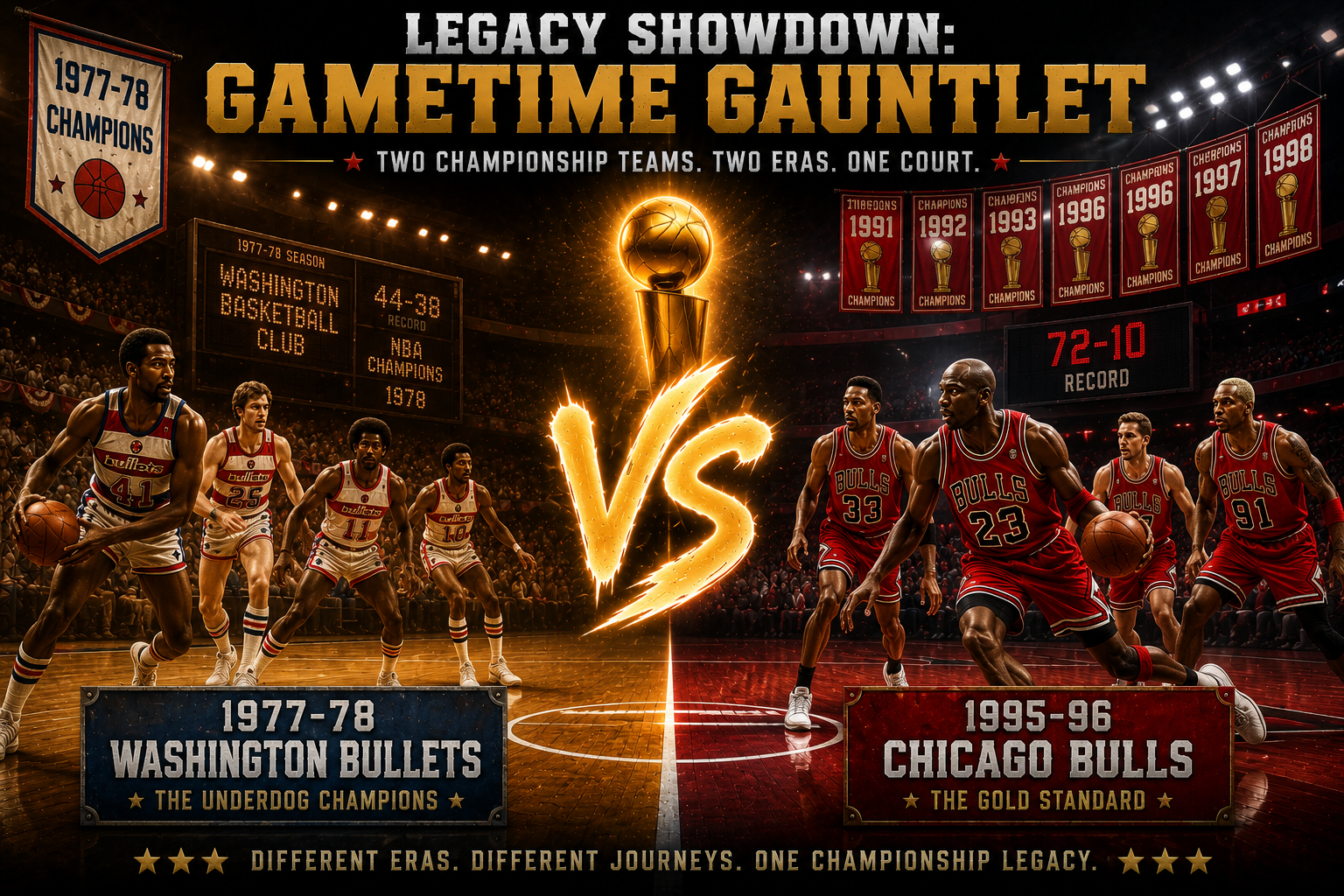
The next matchup of the Gametime Gauntlet NBA Region places the tournament’s top overall seed against a champion whose greatest strength was peaking when the stakes were highest. The 1995–96 Chicago Bulls entered the season with Michael Jordan back for a full campaign and produced a year that immediately became a benchmark for professional basketball greatness. Jordan, Scottie Pippen, Dennis Rodman, Toni Kukoc, Ron Harper, Luc Longley, Steve Kerr, and a disciplined supporting cast combined star power with role clarity, defense, rebounding, shooting, and championship experience.
The #16 seed 1977–78 Washington Bullets followed a very different path. Washington finished only 44–38, but Wes Unseld, Elvin Hayes, Bob Dandridge, Phil Chenier, Kevin Grevey, Mitch Kupchak, and their teammates became far more dangerous once the postseason began. The Bullets survived three playoff rounds and then defeated the Seattle SuperSonics in a seven-game NBA Finals to capture the franchise’s championship. Their run is an enduring reminder that regular-season seeding does not always predict postseason greatness.
The original matchup awards all ten categories to Chicago, producing the first 10–0 sweep in this section of the bracket. That score should not be interpreted as a dismissal of Washington’s championship. The Bullets deserve a serious case in several categories, particularly championship achievement, strength of competition, and clutch performance. But when each category is judged independently, the 1995–96 Bulls repeatedly possess an advantage strong enough to preserve the source result.
1. Dominance Over Competition
Washington’s championship run is impressive partly because it came after an ordinary 44–38 regular season. The Bullets finished well behind the league’s elite teams and had to find another level once the playoffs began. Chicago’s season was almost the exact opposite. The Bulls went 72–10, setting the NBA single-season wins record at the time, and lost consecutive games only once all year. Their dominance extended beyond the standings: Chicago imposed elite defense, relentless rebounding, transition pressure, and an offense centered on Michael Jordan while still receiving major contributions throughout the rotation. The Bulls then went 15–3 in the playoffs, never allowing a series to reach a seventh game. Washington’s postseason transformation deserves admiration, but Chicago controlled its competition from October through the championship. Dominance Over Competition belongs decisively to the Bulls.
Winner: 1995–96 Chicago Bulls
2. Championship Achievement
The Bullets earned their championship the difficult way. Washington defeated Atlanta, San Antonio, Philadelphia, and Seattle, ultimately surviving a seven-game NBA Finals in which neither side could create lasting separation. Wes Unseld’s leadership and rebounding earned Finals MVP honors, and the title remains the defining accomplishment in the franchise’s history. Chicago’s championship, however, completed one of the most extraordinary seasons the league had ever witnessed. The Bulls combined 72 regular-season victories with a 15–3 playoff record and defeated a 64-win Seattle SuperSonics team in the Finals. The title also launched Chicago’s second three-peat and demonstrated that Jordan’s return could restore the Bulls immediately to the top of the sport. Washington’s achievement was the more surprising championship; Chicago’s was the more complete championship season. The source therefore gives Championship Achievement to the Bulls.
Winner: 1995–96 Chicago Bulls
3. Strength of Competition
Washington’s playoff road was substantial. The Bullets eliminated a 52-win San Antonio team led by George Gervin, then defeated a 55-win Philadelphia team featuring Julius Erving before surviving Seattle in seven games. That path gives the underdog a legitimate argument in this category. Chicago nevertheless faced a strong collection of contenders while posting one of the greatest records in league history. In the playoffs the Bulls eliminated Miami, New York, and an Orlando team that had won 60 games and featured Shaquille O’Neal and Penny Hardaway. Chicago then faced a Seattle team that had gone 64–18 behind Gary Payton and Shawn Kemp. The Bulls did not simply avoid elite opposition on their way to 72 wins; they defeated multiple teams built to contend for championships. Washington’s path keeps this category competitive, but Chicago’s combination of Eastern Conference challenges and a 64-win Finals opponent earns the edge.
Winner: 1995–96 Chicago Bulls
4. Star Power
Washington possessed major talent of its own. Elvin Hayes was one of the era’s great scorers and rebounders, Wes Unseld was a former league MVP and the emotional foundation of the team, and Bob Dandridge supplied versatile scoring and championship experience. That trio gave the Bullets enough high-end ability to survive difficult playoff opponents. Chicago’s star power, however, is historically exceptional. Michael Jordan won the league MVP, Finals MVP, scoring title, and All-Star Game MVP during the season, reinforcing his status as the defining player of the era. Scottie Pippen was an elite two-way superstar capable of defending multiple positions while serving as Chicago’s secondary creator, and Dennis Rodman remained one of basketball’s premier rebounders and defenders. Toni Kukoc added another high-level offensive talent in a sixth-man role. Washington had championship stars, but Chicago had an all-time centerpiece surrounded by two other historically distinctive players. Star Power belongs to the Bulls.
Winner: 1995–96 Chicago Bulls
5. Depth and Supporting Cast
The Bullets were more than Hayes and Unseld. Bob Dandridge played a major scoring role, Kevin Grevey contributed from the perimeter, Mitch Kupchak supplied frontcourt depth, and the roster had enough balance to survive a long postseason. Washington’s championship required different contributors to answer different moments, which is the hallmark of a legitimate title team. Chicago’s supporting structure was deeper and more specialized. Ron Harper accepted a reduced scoring role and became an important defender, Luc Longley provided size and interior stability, Toni Kukoc won Sixth Man of the Year, and Steve Kerr supplied elite outside shooting. Bill Wennington, Jud Buechler, Randy Brown, and others gave Phil Jackson usable depth around the stars. More importantly, the role players fit seamlessly into the triangle offense and Chicago’s switching, pressure-oriented defense. The Bulls could withstand poor shooting nights from individual players because their roster supplied defense, rebounding, passing, and spacing from multiple positions. Depth and Supporting Cast goes to Chicago.
Winner: 1995–96 Chicago Bulls
6. Historical Impact
Washington’s 1978 championship remains historically meaningful because it represents the franchise’s only NBA title and one of the memorable underdog runs of the late 1970s. The Bullets demonstrated that a team did not need a dominant regular-season record to become a champion, and their seven-game victory over Seattle gave the franchise an enduring identity. The 1995–96 Bulls affected basketball on a much larger scale. Their 72 wins became the standard for single-season dominance for two decades, and the team’s success arrived during the NBA’s rapid global expansion. Jordan was already an international sports icon, and the Bulls’ championship return after his baseball hiatus intensified worldwide interest in the league. The season also began Chicago’s second three-peat and created the first chapter of another dynasty run. Jerseys, highlights, documentaries, debates, and retrospectives have kept the team culturally visible across generations. Historical Impact therefore goes overwhelmingly to Chicago.
Winner: 1995–96 Chicago Bulls
7. Statistical Excellence
Washington’s numbers reflect a team whose greatness was concentrated in the postseason rather than the regular season. A 44–38 record does not normally signal an all-time champion, although the Bullets’ playoff success proves why raw regular-season totals cannot tell the entire story. Chicago’s statistical résumé is one of the central reasons the 1996 team remains so highly regarded. The Bulls won 72 of 82 games, produced the league’s best record by a wide margin, and combined elite offense with elite defense. Jordan averaged more than 30 points per game and won the scoring title, while Rodman again led the league in rebounding. Chicago also generated one of the strongest point differentials of the era and maintained its excellence despite carrying enormous expectations throughout the season. The postseason record of 15–3 reinforced rather than contradicted the regular-season data. Washington’s playoff numbers improved when they mattered most, but Chicago’s statistical excellence covered virtually the entire campaign. The Bulls take the category.
Winner: 1995–96 Chicago Bulls
8. Longevity of Greatness
The 1978 Bullets were not a one-year curiosity. Washington had reached the NBA Finals in 1975 and returned to the Finals in 1979, meaning the championship occurred within a legitimate multi-season window of contention. Hayes, Unseld, and Dandridge formed a core capable of competing at the highest level beyond a single postseason. Chicago’s context is nevertheless much larger. The 1995–96 championship was the fourth title of the Jordan-Pippen era and the beginning of a second three-peat that would produce championships in 1996, 1997, and 1998. Taken together, the Bulls won six championships in eight seasons in which Jordan played a full postseason. The roster changed around the core, but Chicago repeatedly adapted while maintaining championship-level results. The 1996 team therefore sits at the center of one of the most famous dynastic runs in professional sports. Washington’s sustained relevance deserves recognition, but Longevity of Greatness goes to the Bulls.
Winner: 1995–96 Chicago Bulls
9. Clutch Performance
This may be Washington’s strongest challenge to Chicago in the entire matchup. The Bullets repeatedly survived elimination pressure during their 1978 championship run and ultimately won a Game 7 on the road in Seattle to secure the title. A 44-win team does not become champion without extraordinary resilience, and Washington proved capable of producing its best basketball when regular-season expectations no longer mattered. Chicago’s postseason was less dramatic because the Bulls so often created separation before a series reached that point. Yet the absence of repeated Game 7 escapes should not be mistaken for a lack of clutch performance. Jordan remained the league’s premier pressure scorer, Chicago closed difficult games with elite defense, and the Bulls answered Seattle’s two-game Finals response by winning Game 6 in Chicago. They also carried the burden of being overwhelming favorites every night without allowing that pressure to derail the season. Washington’s Game 7 championship makes this category far closer than the final sweep suggests, but the source awards the point to Chicago’s season-long ability to deliver under championship expectations.
Winner: 1995–96 Chicago Bulls
10. Legacy Endurance
The 1977–78 Bullets will always matter to Washington basketball history. Their championship is the franchise’s defining team accomplishment, and the story of a 44-win club fighting through the playoffs gives the season enduring underdog appeal. Yet the 1995–96 Bulls exist on a different level of historical visibility. Nearly every discussion of the greatest NBA teams eventually reaches Chicago’s 72–10 record, Jordan’s MVP season, the return to championship glory, and the beginning of the second three-peat. The team remained the league’s single-season wins benchmark until Golden State surpassed the record in 2015–16, and even that achievement renewed comparisons with Chicago rather than diminishing the Bulls’ reputation. The 1996 championship is also embedded within the larger cultural legacy of Jordan, Pippen, Rodman, Phil Jackson, and the Bulls dynasty. Decades later, the team is still used as a measuring stick for new champions and dominant regular-season teams. Washington’s legacy is meaningful; Chicago’s is foundational to modern NBA greatness debates. Legacy Endurance goes to the Bulls.
Winner: 1995–96 Chicago Bulls
Gametime Gauntlet Scorecard
Dominance Over Competition: 1995–96 Chicago Bulls
Championship Achievement: 1995–96 Chicago Bulls
Strength of Competition: 1995–96 Chicago Bulls
Star Power: 1995–96 Chicago Bulls
Depth and Supporting Cast: 1995–96 Chicago Bulls
Historical Impact: 1995–96 Chicago Bulls
Statistical Excellence: 1995–96 Chicago Bulls
Longevity of Greatness: 1995–96 Chicago Bulls
Clutch Performance: 1995–96 Chicago Bulls
Legacy Endurance: 1995–96 Chicago Bulls
FINAL SCORE: 1995–96 Chicago Bulls 10 — 1977–78 Washington Bullets 0
Final Verdict
A 10–0 result can make a tournament matchup appear dismissive, but Washington’s championship deserves much more respect than the scoreboard alone communicates. The Bullets were a 44-win team that became dramatically better when the postseason arrived, defeated strong opponents, and won a Game 7 on the road to capture the NBA championship. Their cases in Strength of Competition and especially Clutch Performance are substantial. This is not a sweep because Washington lacked championship credentials; it is a sweep because Chicago’s résumé happens to answer nearly every one of those credentials with an even stronger argument.
The 1995–96 Bulls combine qualities that are usually divided among different all-time teams. They have historic regular-season dominance, a 15–3 playoff run, an MVP and Finals MVP in Michael Jordan, an elite second superstar in Scottie Pippen, a historically unique rebounder and defender in Dennis Rodman, exceptional role definition, championship coaching, statistical superiority, and enormous cultural impact. They were simultaneously a great offensive team, a great defensive team, a veteran champion, and a roster hungry to reestablish itself after two seasons without a title.
Washington’s underdog championship story remains one of the strengths of the NBA bracket because it demonstrates that greatness can emerge in very different forms. But Gametime Gauntlet evaluates ten separate dimensions, and Chicago owns the stronger case in each one according to the original matchup. The top seed therefore survives its opening test in emphatic fashion and establishes an intimidating standard for every NBA champion waiting deeper in the tournament.
Final Result: 1995–96 Chicago Bulls advance with a 10–0 sweep.
Audience Challenge
Does a 10–0 score accurately reflect the distance between these teams, or should Washington’s 1978 postseason resilience have earned the Bullets a category such as Clutch Performance? More importantly, are the 1995–96 Bulls the greatest basketball team ever assembled, or is there another champion deeper in the Gametime Gauntlet bracket with the star power, depth, statistics, championship résumé, and historical legacy to finally expose a weakness?