

Affiliate Disclosure
Some of the links on this page may be affiliate links. This means that if you click through and make a purchase, The Shopping Plaza may earn a small commission at no additional cost to you.
These commissions help support the operation of this website and allow us to continue creating free content, contests, rankings, and entertainment features like Sitcom Showdown.
We only recommend products, services, and merchandise that we believe may be of interest to our readers. Your support through these affiliate links is greatly appreciated and helps keep The Shopping Plaza growing.
Thank you for supporting The Shopping Plaza!
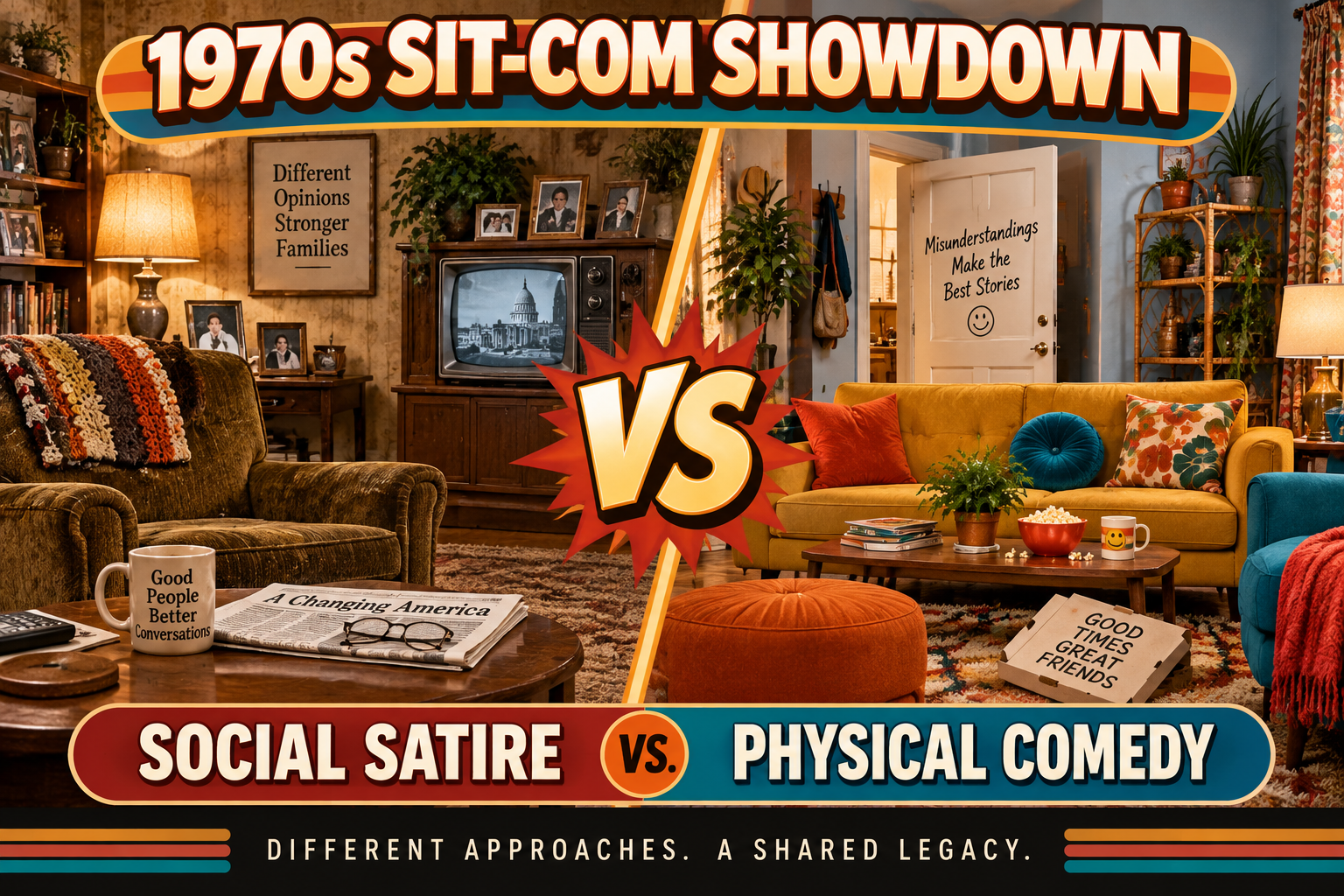
The opening round is behind us, and the 1970s bracket of Legacy Showdown: Sit-Com Showdown is getting tougher. Two television heavyweights now collide in a second-round matchup between All in the Family and Three’s Company – shows that became enormous hits while representing almost opposite approaches to sitcom comedy.
All in the Family entered television history by using the Bunker household as a battleground for arguments about politics, race, gender, class, generational change, and the rapidly shifting culture of the 1970s. Three’s Company took a lighter route, building its success around misunderstandings, physical comedy, romantic confusion, double meanings, and the irresistible chemistry of its central cast.
This creates a fascinating tournament question. Does the fearless social influence and historical importance of All in the Family overwhelm the pure comedic energy and replayability of Three’s Company? Or can Jack Tripper and company pull off a second-round upset against one of the most influential sitcoms ever made?
The Legacy Showdown Rules
- Comedy Quality
- Character Chemistry
- Cultural Impact
- Longevity & Replay Value
- Iconic Moments
- Supporting Cast
- Era Difficulty
- Legacy Endurance
Round 1: Comedy Quality
All in the Family used comedy as a weapon. Archie Bunker’s arguments, misunderstandings, stubborn opinions, and clashes with nearly everyone around him produced humor that could be sharp, uncomfortable, and surprisingly sophisticated. The show was often funniest when Archie was completely convinced he was right while the audience could see the flaws in his thinking. Its comedy also had the difficult job of carrying serious social commentary without allowing the series to become a lecture.
Three’s Company, however, was built almost entirely around making audiences laugh. John Ritter’s physical comedy was exceptional, and Jack Tripper could turn a simple misunderstanding into a full episode of escalating chaos. The series mastered mistaken identities, overheard conversations, romantic confusion, double entendres, slammed doors, and perfectly timed reactions. It may not have carried the same social weight as All in the Family, but in terms of consistent laugh-driven execution, Three’s Company was one of the strongest situation comedies of its era.
Winner: Three’s Company.
Round 2: Character Chemistry
Both shows depended heavily on chemistry, but they created it in very different ways. All in the Family thrived on friction. Archie and Edith Bunker were unforgettable together, while the generational battles between Archie, Gloria, and Mike gave the series much of its dramatic and comedic energy. The characters could argue fiercely and still feel like a believable family, which gave the show emotional depth beneath the conflict.
Three’s Company made chemistry the engine of nearly every episode. Jack’s relationships with Janet and Chrissy gave the original lineup an easy, playful rhythm that made the apartment feel like a genuine friendship rather than merely a sitcom setup. Later cast changes altered that dynamic, but John Ritter and Joyce DeWitt remained a dependable center. The landlords, neighbors, dates, and misunderstandings worked because the performers committed completely to the absurd situations around them. In a category centered specifically on ensemble chemistry, Three’s Company earns the narrow advantage.
Winner: Three’s Company.
Round 3: Cultural Impact
Three’s Company was unquestionably a major television hit and became an enduring symbol of late-1970s and early-1980s sitcom culture. Its premise challenged some television conventions of its time, and the show’s suggestive humor helped push the boundaries of what a mainstream network comedy could joke about. Jack Tripper became an iconic sitcom character, and the series remains instantly recognizable to generations of television fans.
But All in the Family changed the possibilities of the American sitcom on a much larger scale. It brought subjects such as racism, political division, women’s rights, economic anxiety, religion, sexuality, and generational conflict directly into prime-time family comedy. Archie Bunker became a cultural figure whose name could be invoked in conversations far beyond television. The show’s success also helped create a television universe that included major spinoffs and characters who became important in their own right. Three’s Company was a phenomenon; All in the Family helped redefine the medium.
Winner: All in the Family.
Round 4: Longevity & Replay Value
All in the Family remains historically important, and many of its arguments still feel surprisingly relevant because American society continues debating some of the same issues. Viewers interested in television history, social commentary, or character-driven comedy can still find enormous value in revisiting the Bunker household. At the same time, some episodes are intentionally uncomfortable, and the topical nature of the material can make the series feel closely connected to the era that produced it.
Three’s Company has a different replay advantage: its best episodes are easy to watch without much historical context. A misunderstanding involving Jack, Janet, a landlord, a date, and one badly timed conversation can still work because the comedy is built around timing and human confusion rather than a particular political debate. John Ritter’s physical performances remain especially enjoyable on repeat viewing. All in the Family may reward deeper analysis, but Three’s Company is the easier show to casually revisit again and again.
Winner: Three’s Company.
Round 5: Iconic Moments
Three’s Company created plenty of memorable television, particularly through Jack Tripper’s physical comedy and the constant misunderstandings surrounding the apartment. John Ritter could turn a fall, facial expression, overheard remark, or desperate attempt to maintain a lie into an unforgettable comedic sequence. The show’s opening, apartment setting, Regal Beagle, and revolving romantic disasters remain deeply nostalgic for fans.
All in the Family, however, produced moments that became part of television history. Archie and Edith singing at the piano is one of the most recognizable sitcom openings ever created. The series could move from explosive comedy to serious emotion within the same episode, creating confrontations and conversations that audiences remembered because they reflected real cultural tensions. Archie Bunker himself became larger than any individual scene, and major episodes are still discussed when examining turning points in American television. Three’s Company delivered classic comedy moments; All in the Family delivered moments that helped define an era.
Winner: All in the Family.
Round 6: Supporting Cast
Three’s Company surrounded its central trio with characters who added enormous comic value. Stanley and Helen Roper gave the early seasons a memorable landlord dynamic, and Ralph Furley later brought an entirely different style of eccentric comedy to the building. Larry Dallas became the perfect contrast to Jack, regularly encouraging questionable romantic ideas while adding another recognizable personality to the show’s world. The supporting players helped keep the central premise flexible even as the cast evolved.
All in the Family answers with one of the deepest collections of supporting characters and extensions in sitcom history. Edith was far more than Archie’s wife, developing into the emotional heart of the series. Mike and Gloria gave Archie constant generational opposition, while neighbors such as George and Louise Jefferson became so successful that they helped launch another landmark sitcom. The broader family of characters surrounding the Bunkers gave the show multiple perspectives and helped its world extend far beyond one living room. Three’s Company had excellent comic support, but All in the Family’s supporting cast had greater historical reach.
Winner: All in the Family.
Round 7: Era Difficulty
The 1970s were an extraordinary period for American sitcoms, with television becoming more willing to experiment with realism, social issues, unconventional families, adult humor, and new character types. Three’s Company entered that crowded environment and became a major ratings success by offering audiences fast, escapist comedy during a period filled with more socially conscious programming. Its ability to stand out through physical comedy and suggestive misunderstandings deserves real credit.
All in the Family faced an even more difficult challenge because it was helping create the new rules while television culture was changing around it. The series deliberately confronted controversial topics that could easily have alienated viewers, advertisers, or network executives. Instead of avoiding conflict, it made conflict central to the comedy and became one of the defining programs of the decade. Surviving controversy is impressive; becoming a television landmark because you were willing to create it is even more remarkable.
Winner: All in the Family.
Round 8: Legacy Endurance
Three’s Company has maintained a strong nostalgic legacy. John Ritter remains celebrated as one of television’s great physical comedians, the central cast is still beloved, and the show’s premise remains immediately identifiable to classic sitcom fans. Its episodes continue to work as comfort television because the misunderstandings are usually self-contained and the performances supply much of the entertainment. For many viewers, the series represents a specific kind of carefree, character-driven sitcom fun that television rarely attempts in quite the same way today.
All in the Family occupies another level of historical endurance. The series continues to appear in discussions about television’s greatest and most influential comedies because its impact reaches into writing, social commentary, character development, spinoff history, and the evolution of what network television was willing to discuss. Archie and Edith Bunker remain recognizable figures decades after the original run, while the issues explored by the series continue to inspire debate. Three’s Company has lasting affection; All in the Family has lasting importance.
Winner: All in the Family.
Final Verdict
This second-round matchup was much closer than the historical reputations of these two shows might suggest. Three’s Company proved exactly why it remains such a beloved comedy, taking Comedy Quality, Character Chemistry, and Longevity & Replay Value. Its greatest strength is simple but powerful: the show knew how to make people laugh, and John Ritter gave it a comedic weapon few sitcoms could match.
But All in the Family wins the matchup by taking Cultural Impact, Iconic Moments, Supporting Cast, Era Difficulty, and Legacy Endurance. Its combination of fearless writing, unforgettable characters, television innovation, and lasting cultural influence gives it too many advantages once the competition moves beyond pure comedy.
Three’s Company leaves the tournament with its reputation strengthened, but All in the Family advances deeper into the 1970s bracket. The Bunkers survive another challenge, and one of television history’s most influential sitcoms remains a serious threat to win the entire Sit-Com Showdown.
Audience Challenge
Do you agree with the decision? Did All in the Family earn its place in the next round, or should the nonstop laughs and unforgettable chemistry of Three’s Company have produced the upset? Cast your vote, make your case, and keep following the Legacy Showdown tournament as the 1970s bracket moves one step closer to crowning its champion.