
Affiliate Disclaimer: This post may contain affiliate links. If you make a purchase through one of these links, The Shopping Plaza may earn a commission at no additional cost to you.
Fear Is Part of the Human Experience
Halloween gives us an unusual opportunity to look directly at fear. For one season each year, people decorate their homes with ghosts, skeletons, monsters, dark hallways, spiderwebs, and other symbols normally associated with danger or discomfort. We tell scary stories, watch suspenseful movies, visit haunted attractions, and sometimes deliberately allow ourselves to be startled. Yet behind the costumes and decorations is a surprisingly useful lesson: fear does not always have to control us.
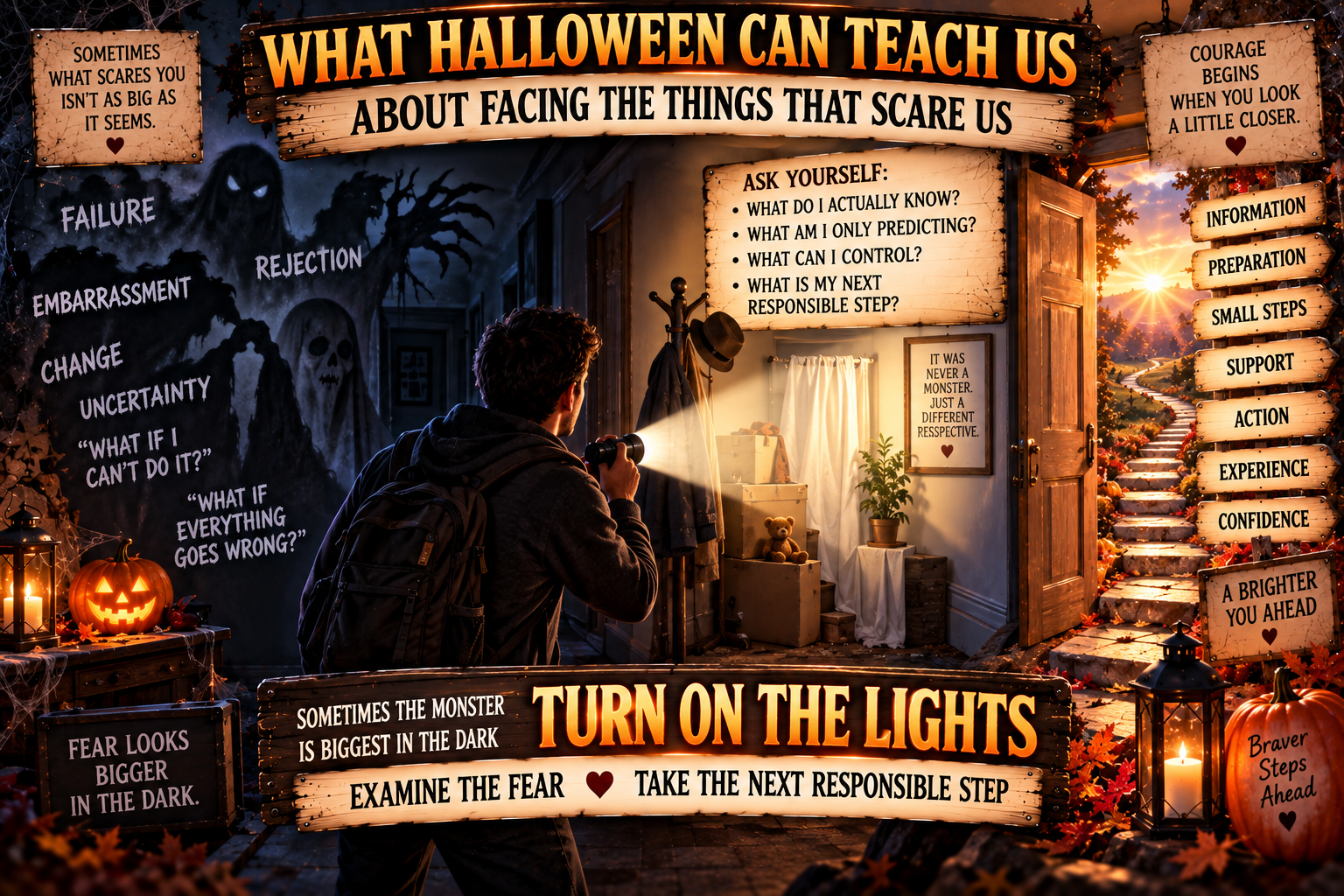
Everyone experiences fear. We may fear failure, rejection, embarrassment, uncertainty, change, loneliness, difficult conversations, or the possibility that our dreams will not work out. Some fears warn us about genuine danger and deserve to be taken seriously. Others become mental barriers that keep us from taking reasonable risks, trying something unfamiliar, or pursuing opportunities that matter to us.
The goal is not to become fearless. Fearlessness is neither realistic nor always wise. A stronger goal is to recognize fear, understand what it is telling us, and decide whether we should retreat or move forward carefully. Halloween reminds us that something can feel frightening without automatically being unbeatable. Sometimes the first step toward courage is simply admitting, “Yes, this scares me,” and then refusing to let that sentence become the end of the story.
Halloween Turns Fear Into Something We Can Approach
One reason Halloween is so interesting is that it often places fear inside boundaries. A haunted house may look threatening, but we know there is an exit. A scary movie can make our hearts race, but we know we are sitting safely in a room. A costume may transform someone into a monster, but beneath the mask is an ordinary person.
Those boundaries make it easier to approach something frightening. The same principle can help with real-life fears. A huge challenge can become less intimidating when we break it into a smaller, controlled experience. If public speaking scares you, your first step does not need to be addressing hundreds of people. You might practice alone, record yourself, speak to one trusted person, and gradually increase the audience. If changing careers feels overwhelming, you do not have to resign tomorrow. You can research possibilities, improve one skill, update your resume, or have one conversation with someone in the field.
Courage often grows through manageable exposure rather than one dramatic leap. We learn that we can experience discomfort and remain standing. We discover that anxiety can rise and eventually fall. Most importantly, we begin collecting evidence that fear is a feeling we can move through rather than a command we must obey.
The Monster in Our Imagination Can Be Bigger Than Reality
Halloween monsters thrive on imagination. A shadow becomes a creature. A creaking floor becomes footsteps. An unfamiliar shape in the darkness becomes whatever our minds fear most. Real life can work the same way. When we do not know what will happen, our minds often fill the empty space with worst-case scenarios.
Before applying for an opportunity, we may imagine being rejected and humiliated. Before starting a project, we may picture failure before completing the first step. Before having an important conversation, we may rehearse every possible negative response. The imagined future becomes so vivid that we begin reacting as though it has already happened.
A useful response is to separate what you know from what you are predicting. Ask yourself: What is the actual problem in front of me? What evidence do I have? What can I control? What is the next reasonable action? This does not mean pretending that everything will work perfectly. It means refusing to treat every frightening possibility as a guaranteed outcome. Sometimes the monster really is smaller when the lights come on. Information, preparation, experience, and action can illuminate fears that once seemed enormous.
Masks Remind Us That Appearances Can Be Misleading
Halloween is filled with masks. Someone can appear terrifying, mysterious, powerful, or completely different simply by changing what we see on the outside. In everyday life, fear also wears disguises.
Procrastination can sometimes be fear wearing the mask of “I’ll do it later.” Perfectionism can be fear wearing the mask of high standards. Constant preparation can become fear disguised as productivity when we keep learning but never begin. Saying “I don’t really want it” can occasionally be a way to protect ourselves from admitting that we want something badly and are afraid we might fail.
This is why self-awareness matters. When you repeatedly avoid something important, ask what is underneath the avoidance. Are you truly uninterested, or worried about being judged? Do you genuinely need more preparation, or are you waiting for a level of certainty that will never arrive? Are you protecting your time, or protecting yourself from disappointment? Naming the fear does not instantly eliminate it, but it removes part of its disguise. Once we understand what we are actually fighting, we can choose a more useful response.
Courage Usually Happens While Fear Is Still Present
Movies sometimes make courage look like a transformation in which fear disappears and the hero suddenly becomes completely confident. Real courage is usually less dramatic. We may still feel nervous while making the phone call. Our hands may still shake before the presentation. We may still question ourselves after submitting the application, publishing the work, starting the business, or setting a boundary.
Courage is often action taken in the presence of fear. That distinction matters because waiting to “feel ready” can become an endless delay. Confidence frequently comes after action, not before it. The first attempt gives us experience. Experience gives us information. Information helps us improve. Improvement gradually builds confidence.
Halloween offers a playful version of this process. A person may hesitate outside a haunted attraction, enter anyway, feel frightened throughout it, and walk out laughing because they completed something that initially intimidated them. Life’s challenges are more complicated, but the emotional lesson is useful: you do not have to eliminate every nervous feeling before taking a meaningful step. Sometimes progress begins when you say, “I am scared, and I am going to do the next reasonable thing anyway.”
We Become Stronger by Facing Fear in Small Steps
Not every fear should be confronted with a dramatic act. In fact, trying to overcome everything at once can make a challenge feel even more overwhelming. Small steps are often more sustainable.
Suppose you want to launch a creative project but fear criticism. Your first step could be showing the idea to one person you trust. Then you might share a small piece publicly. Later, you could publish a complete project. Each step teaches you something about the work and about your ability to tolerate other people’s reactions.
The same approach can apply to networking, learning technology, exercising, traveling, meeting new people, asking for help, or making a major life transition. Create a ladder rather than demanding one enormous jump. Put the least intimidating useful action on the first rung and gradually work upward. Small victories matter because they change the evidence available to your mind. Instead of repeatedly telling yourself, “I cannot handle this,” you begin building a history that says, “I was uncomfortable, but I handled the first step. Then I handled the next one.” Over time, that history can become more persuasive than the fear.
Preparation Is the Flashlight We Carry Into the Dark
There is a difference between healthy courage and unnecessary recklessness. Facing fear does not mean walking blindly into every situation. Preparation can make courage more effective.
Think of preparation as carrying a flashlight into a dark room. The flashlight does not remove everything that could go wrong, but it helps you see where you are stepping. Before an interview, research the organization and practice common questions. Before beginning a financial goal, understand your numbers. Before giving a presentation, know your material and test your technology. Before a difficult conversation, decide what you need to communicate and what outcome you hope to achieve.
Preparation becomes a problem only when it turns into permanent avoidance. There will always be another article to read, another adjustment to make, another scenario to consider, or another reason to wait. Eventually, preparation must hand responsibility to action. The question is not, “Am I completely certain?” Complete certainty is rare. A better question is, “Am I prepared enough to take the next responsible step?”
Some Fears Protect Us – and We Should Listen
A motivational message about facing fear should never suggest that every frightening situation must be challenged. Fear has a protective purpose. It can alert us to unsafe environments, dangerous behavior, unhealthy relationships, scams, physical hazards, or situations for which we are genuinely unprepared.
Courage includes judgment. If your fear is connected to a credible threat, the right response may be to leave, seek help, gather more information, create safeguards, or avoid the danger altogether. There is nothing admirable about ignoring legitimate warning signs simply to prove that you are brave.
The important skill is learning to distinguish protective fear from limiting fear. Protective fear says, “There is meaningful evidence that this situation could harm me.” Limiting fear often says, “I might fail, look foolish, hear no, feel uncomfortable, or discover that I have more to learn.” Those are very different messages. One may require protection. The other may require growth. Learning the difference allows us to become courageous without becoming careless.
Failure Is Often Less Frightening Once It Happens
One of the most powerful fears is the fear of failure because failure can feel like a judgment on who we are. We may avoid trying because an unfinished dream feels safer than a completed attempt that does not succeed.
But failure is usually information, not a final identity. A project that performs poorly can teach us what to change. A rejected application can lead us to strengthen our qualifications or pursue a better opportunity. A mistake in a new skill can reveal exactly what we need to practice. Even when disappointment hurts, the experience is often more concrete and manageable than the endless imagined catastrophe that existed beforehand.
This does not mean failure is pleasant or that every setback automatically produces success. Some failures are expensive, painful, or discouraging. The motivational lesson is that we can respond to them. We can evaluate what happened, keep what worked, change what did not, and decide whether to try again. Fear asks, “What if I fail?” Growth asks another question: “If I fail, what will I do next?” Having an answer to the second question reduces the power of the first.
You Do Not Have to Face Every Fear Alone
Halloween stories often become more frightening when a character wanders away from the group. There is a useful real-world lesson hidden in that familiar plot device: support matters.
Facing a difficult challenge does not require isolation. Friends, family members, mentors, teachers, colleagues, coaches, counselors, support organizations, and other trusted people can provide perspective that is difficult to create when we are trapped inside our own anxiety. They may help us prepare, challenge an unrealistic assumption, practice a skill, locate resources, or simply remind us that we do not have to carry everything by ourselves.
Asking for support is not surrendering responsibility. You still have to make decisions and take action, but there is no rule requiring you to do every difficult thing alone. Sometimes courage means stepping forward independently. Sometimes it means admitting, “I need help with this.” Both can be forms of strength.
Fear Can Point Toward What Matters to Us
Not every fear is an enemy. Sometimes fear is a clue. We often feel most vulnerable around things that matter deeply. We fear rejection because the opportunity matters. We fear criticism because the work matters. We fear losing because the goal matters. We fear change because something important is at stake.
Instead of only asking, “Why am I afraid?” try asking, “What does this fear tell me I care about?” The answer can transform the emotion. A nervous feeling before an important presentation may not mean you should escape; it may mean you want to do well. Anxiety before publishing creative work may reflect the fact that the work represents something personal. Fear before pursuing a dream may be evidence that the dream has real meaning.
This does not make the fear disappear. It gives it context. We can stop interpreting every nervous feeling as a stop sign and begin seeing some of them as evidence that we are approaching something meaningful.
Take Off the Costume Fear Has Been Wearing
Halloween eventually ends. Costumes come off, decorations return to storage, and haunted attractions turn the lights back on. The things that looked frightening are revealed for what they were.
Our personal fears deserve a similar examination. Some will turn out to be genuine warnings. Some will remain difficult challenges that require patience and preparation. Others may prove to be assumptions, old experiences, imagined judgments, or habits of avoidance that have been wearing frightening costumes for years.
Choose one fear that has been limiting you and examine it carefully. Name exactly what you are afraid will happen. Separate facts from predictions. Decide whether there is a real safety concern. If the fear is primarily about discomfort, rejection, uncertainty, or failure, identify one small responsible action you can take.
You do not need to conquer your entire future today. You only need enough courage for the next step. Halloween reminds us that fear can be approached, examined, understood, and sometimes even transformed into something we can laugh about later. The darkness may still feel uncomfortable. The strange noises may still make us hesitate. But we can carry a flashlight, bring support, move carefully, and keep going. Being brave does not mean nothing scares you. It means fear no longer gets to make every decision for you.