

Affiliate Disclaimer: This post may contain affiliate links. If you make a purchase through one of these links, The Shopping Plaza may earn a commission at no additional cost to you.
Halloween Can Feel Very Different to a Shy Child
For many children, trick-or-treating is one of the most exciting nights of the year. They put on a costume, race from house to house, ring doorbells, call out “trick or treat,” and proudly return home with a bag full of candy.
For a shy child, the same experience can feel very different.
Walking up to unfamiliar adults, speaking loudly enough to be heard, joining crowds of costumed children, and entering noisy or highly decorated spaces can create pressure. A child may be excited about Halloween while still feeling nervous about the social expectations surrounding trick-or-treating.
That does not mean the child is doing Halloween incorrectly.
Shyness is not something that needs to be defeated in a single evening. Parents and caregivers can help children participate at a pace that encourages confidence without turning the holiday into a test of personality.
The goal is not to transform a quiet child into the loudest trick-or-treater on the block. The goal is to help them feel safe enough to enjoy the experience and proud enough to recognize the courage they showed along the way.
Talk About the Experience Before Halloween Night
Preparation can make unfamiliar social situations feel much more manageable.
Several days before Halloween, explain what trick-or-treating will look like. Talk through the sequence: putting on the costume, walking to a house, waiting your turn, ringing the bell, receiving candy, saying thank you, and returning to the sidewalk.
Children often feel more confident when they know what comes next.
You can also discuss things they might encounter. Some houses will be crowded. Some people may be wearing costumes. Decorations may make noises or move unexpectedly. A porch may look spooky even though the people handing out candy are friendly.
Keep the conversation reassuring rather than frightening. The purpose is to make the evening predictable.
When children have a mental map of the experience, they spend less energy trying to understand what is happening and have more energy available for participating.
Practice the Routine at Home
A little rehearsal can turn an intimidating interaction into a familiar one.
Pretend that a bedroom or front door is a neighbor’s house. Let your child knock or ring an imaginary doorbell, say “trick or treat,” receive a small treat, and say thank you.
Then switch roles.
Keep the practice playful. Use stuffed animals, family members, or silly voices if that makes the activity more comfortable.
The goal is not to demand a perfect performance. It is to let the words and movements become familiar.
A child who has already practiced the sequence several times may feel less pressure when standing on a real porch.
Rehearsal is especially helpful because confidence often grows from familiarity. The child does not have to invent what to do while also managing nervousness.
Start With Familiar Houses
The first house can set the emotional tone for the evening.
If possible, begin with someone your child knows: a trusted neighbor, relative, or family friend. A successful first interaction provides evidence that the process is manageable.
After one or two familiar houses, try a nearby home that feels less familiar.
This creates a gradual transition instead of beginning with the most intimidating situation.
You can think of the evening as a series of small steps rather than one enormous social challenge.
Confidence often grows through manageable experiences. One comfortable porch can make the next porch feel slightly easier.
Let Your Child Stay Close to You
Some children want a parent beside them at the door, especially early in the evening.
That is okay.
You can walk to the porch together and gradually increase independence if the child becomes more comfortable. Perhaps at the first house you stand directly beside them. Later you stand a few steps behind. Eventually they may choose to approach with siblings or friends.
There is no prize for reaching independence fastest.
Support should be adjusted to the child rather than withdrawn simply because another child of the same age seems more outgoing.
Being nearby can provide the security that makes participation possible.
Over time, the child may naturally need less support because repeated success has replaced some of the uncertainty.
Do Not Force the Words
Adults sometimes become embarrassed when a child will not say “trick or treat” or “thank you.” The parent may repeatedly prompt them while everyone waits.
That pressure can make the child even more anxious.
Encourage politeness, but recognize that a shy child may temporarily freeze in an unfamiliar interaction. A smile, wave, nod, or quiet thank-you can still communicate appreciation.
You can model the words yourself: “Thank you. Happy Halloween.”
Later, when you are away from the porch, gently encourage the child to try speaking at the next house if they feel ready.
The purpose is to teach social skills, not publicly shame a child for struggling to use them.
A child who feels supported is more likely to attempt the words voluntarily as confidence grows.
Give Them a Simple Script
Knowing exactly what to say can reduce social uncertainty.
The script does not need to be complicated: “Trick or treat!” followed by “Thank you!”
Practice those two phrases.
If someone asks about the costume, you can prepare a simple response such as, “I’m a firefighter,” “I’m a princess,” or “I’m Spider-Man.”
Children do not need to have extended conversations at every house.
A short script provides structure and lets them know that the interaction has a clear beginning and ending.
For a shy child, that predictability can be reassuring.
Avoid Comparing Them With Other Children
Comparison is one of the fastest ways to turn nervousness into shame.
“Look how your sister does it.” “All the other kids are saying trick or treat.” “Why can’t you just go up there?”
These statements may be intended as motivation, but they can communicate that the child’s natural temperament is disappointing.
Instead, compare the child with their own earlier effort.
“You went up to that door even though you were nervous.” “You said thank you that time.” “You walked up without holding my hand.”
Personal progress is a much healthier measurement.
The goal is not to make every child behave identically. It is to help this child become a little more confident than they were before.
Let Them Skip a House
Not every house needs to become a challenge.
A porch may be extremely crowded, loudly decorated, filled with animatronic figures, or simply feel overwhelming to your child.
Letting them skip one house does not destroy the confidence-building process.
In fact, giving children some control can make them more willing to attempt the next one.
You can say, “We can skip this one and try the next house.”
That sentence communicates an important message: courage does not require ignoring every limit.
Over time, the child may choose to approach houses they previously avoided. But confidence grows more sustainably when participation includes some sense of choice.
Use a Buddy When It Helps
A sibling, cousin, or trusted friend can make trick-or-treating feel less intimidating.
Approaching a door beside another child reduces the feeling of being the center of attention. Your child can follow the rhythm of the group and participate without carrying the entire interaction alone.
Choose a buddy who is supportive rather than one who will tease or pressure them.
If the other child is extremely fast or outgoing, remind them to give your child enough time to keep up.
A good buddy can turn a social challenge into a shared adventure.
Keep the Group Small if Crowds Are Overwhelming
Large trick-or-treating groups can be exciting, but they can also create additional pressure.
Children may have to rush between houses, compete to reach the door, speak over one another, and keep pace with a group that does not want to slow down.
A shy child may do better with one or two companions and a trusted adult.
A smaller group gives the child more time to approach, speak, and recover between interactions.
You can always meet a larger group later if your child becomes comfortable.
Halloween does not have to be maximized to be successful. A quieter experience may produce more enjoyment.
Watch for Signs That They Need a Break
Shyness and ordinary nervousness can become more intense when a child is tired, cold, hungry, or overstimulated.
Watch for changes in behavior. A child who was gradually becoming more comfortable may suddenly stop speaking, become irritable, cling closely, or ask repeatedly to go home.
A short break may help.
Sit somewhere quiet, have some water, eat a small snack if appropriate, or simply step away from the crowd.
Ask how they are doing without turning the conversation into an interrogation.
Sometimes ten calm minutes are enough to reset the evening. Other times the child may truly be finished.
Ending earlier than planned is better than forcing another hour that turns a positive experience into an exhausting one.
Praise Courage, Not Candy Count
It is easy to measure trick-or-treating success by the size of the candy bag.
For a shy child, a more meaningful measure may be courage.
Maybe they approached five houses when last year they approached none. Perhaps they said “trick or treat” quietly for the first time. Maybe they answered a neighbor’s question about their costume.
Notice those moments.
Be specific: “I saw that you were nervous, and you still walked up to the door.”
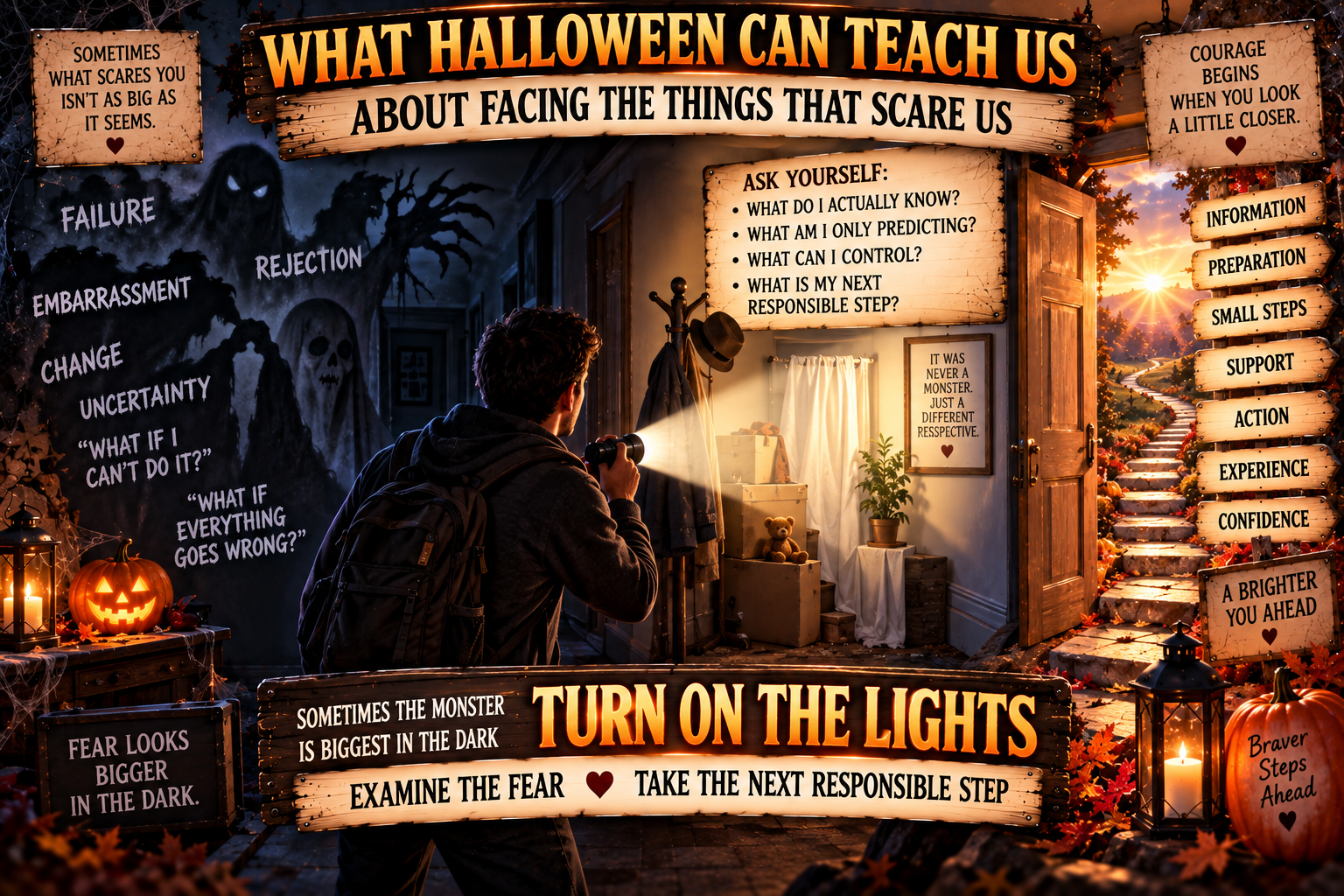
This teaches children that courage is not the absence of nervousness. It is taking a manageable step while nervousness is present.
That lesson can travel far beyond Halloween.
Do Not Make the Night a Secret Test
Parents sometimes enter Halloween with an internal goal: “Tonight I am going to make them come out of their shell.”
That pressure can quietly shape every interaction.
Instead, let Halloween be Halloween.
You can encourage growth without making the entire evening a behavioral project. If your child gains confidence, celebrate it. If they need more support than expected, provide it.
Personality develops over years, not during one night of trick-or-treating.
Children often become more socially confident when they repeatedly experience acceptance, preparation, and successful small challenges.
There is no need to force a dramatic transformation.
Offer Alternatives if Door-to-Door Trick-or-Treating Is Not Enjoyable
Traditional trick-or-treating is only one way to celebrate Halloween.
If your child genuinely dislikes going door to door, consider alternatives. A small family Halloween party, movie night, pumpkin decorating, scavenger hunt, neighborhood walk, school event, or carefully chosen community activity may be more enjoyable.
You can also hand out candy together at home. A shy child may feel more comfortable interacting with trick-or-treaters from the familiar environment of their own doorway.
The goal of Halloween is not completing a required activity. It is creating an experience your family can enjoy.
Trying traditional trick-or-treating is worthwhile if your child is interested, but there is no need to define the holiday by one tradition.
Let Confidence Grow One Porch at a Time
Shy children do not need to become different people to have a wonderful Halloween.
They may need more preparation, a slower pace, a familiar adult nearby, a smaller group, or permission to skip an overwhelming house. Those supports are not evidence of failure. They are tools that make participation more manageable.
As the evening continues, you may notice small changes. The child who whispered at the first house may speak a little louder at the fifth. The child who needed you directly beside them may eventually walk up with a friend. The child who initially wanted to go home may become proud of how many doors they approached.
Or progress may be smaller than that.
It still counts.
Halloween can offer a gentle lesson about courage: you do not have to stop feeling nervous before you take a step forward.
Help your child prepare. Let them know what to expect. Practice together. Respect reasonable limits. Encourage without embarrassing them. Celebrate effort instead of comparing performance.
Then allow the night to unfold.
The most important thing your child carries home may not be the candy. It may be the memory of discovering that they could feel shy, take one brave step anyway, and have someone they trusted walking beside them.