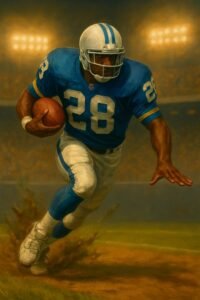
Few players in NFL history have ever transcended a position the way Marshall Faulk did.
Born February 26, 1973, in New Orleans, Louisiana, Faulk was more than a running back — he was a system unto himself.
He turned checkdowns into highlights, blitz pickups into art, and routine handoffs into symphonies of vision and balance.
From the chaos of New Orleans’ Ninth Ward to the bright lights of the NFL, Faulk forged a legacy built on versatility, intelligence, and relentless precision.
He didn’t just run football plays — he reinvented them.
Affiliate Disclosure: This post may contain affiliate links. If you purchase through these links, I may earn a small commission at no additional cost to you.
🌆 Ninth Ward Beginnings: Tough Streets, Tougher Dreams
Marshall Faulk’s story began in one of the most unforgiving neighborhoods in America.
The Ninth Ward of New Orleans was a place that demanded resilience. His mother, Cecilia Faulk, worked tirelessly to raise six sons on a modest income.
While many kids in the area gravitated toward trouble, Marshall gravitated toward structure — particularly football.
He often credited his mother’s discipline for shaping his focus:
“She didn’t let excuses live in our house. You either did it or you didn’t.”
Faulk’s early years weren’t just about escaping hardship — they were about finding purpose.
He sold popcorn at the Superdome as a teenager, watching NFL stars like Archie Manning from the stands. Every game fueled his dream.
And when he finally got his chance on the field at George Washington Carver High School, he made the most of it — dazzling crowds with vision and speed that seemed preordained.
By his senior year, he was one of Louisiana’s most gifted prospects, but academics and limited exposure meant few major schools pursued him. Then, San Diego State University took a chance — and the rest became football folklore.
🎓 San Diego State: From Obscurity to Instant Legend
When Faulk arrived at San Diego State in 1991, the Aztecs weren’t a powerhouse program.
But that only meant there was more room for him to stand out.
His breakout came in Week 2 of his freshman season against Pacific University, when he delivered one of the greatest single-game performances in NCAA history:
- 386 rushing yards
- 7 touchdowns
That day wasn’t just a record — it was a revelation.
A freshman had announced himself as a once-in-a-generation talent.
Over the next three seasons, Faulk became a national sensation:
- 4,589 rushing yards, 62 touchdowns
- Three-time All-American
- 1992 Heisman Trophy runner-up
Coaches described him as “a quarterback’s brain in a running back’s body.” He read defenses like a chess player reading an opponent’s next five moves.
Faulk himself said:
“Speed gets you noticed. Vision gets you paid.”
And by the time he declared for the NFL Draft, scouts agreed he was a can’t-miss talent.

🐴 Indianapolis Colts: The Arrival of a New Breed
In the 1994 NFL Draft, the Indianapolis Colts made Marshall Faulk the second overall pick, and he immediately validated the choice.
In his rookie season, Faulk erupted for:
- 1,282 rushing yards
- 11 total touchdowns
- 52 receptions
- And the Offensive Rookie of the Year award
He didn’t just thrive — he dominated.
Defenses had no blueprint for a back who could line up in the slot, pick up blitzes, and still carry 25 times a game.
By 1995, he was already among the NFL’s elite, pairing with young quarterback Jim Harbaugh to lead the Colts to the AFC Championship Game.
But as the team transitioned to Peyton Manning in 1998, differences in offensive philosophy and contract negotiations led to a stunning trade.
The Colts sent Faulk to the St. Louis Rams — a move that would not only change his career, but also change football forever.
⚡ The Greatest Show on Turf: Football Becomes Art
When the Rams acquired Faulk in 1999, they didn’t just add a star — they found their conductor.
Coach Dick Vermeil and offensive coordinator Mike Martz built a system that relied on spacing, timing, and unpredictability — and Faulk was its linchpin.
With Kurt Warner at quarterback and Isaac Bruce, Torry Holt, and Az-Zahir Hakim at wide receiver, the Rams offense became a spectacle.
But make no mistake — it all flowed through #28.
1999: The Transformation Year
- 1,381 rushing yards
- 1,048 receiving yards
- 2,429 total yards (NFL record at the time)
- NFL Offensive Player of the Year
- Super Bowl XXXIV Champion
The Rams captured the imagination of the football world with their speed, creativity, and precision.
They didn’t just score — they dazzled.
Faulk was the key that unlocked it all.
His ability to motion out wide, create mismatches, and dictate coverage forced defenses to play the Rams differently.
🏆 The MVP Years: Dominance Defined
From 1999 to 2001, Marshall Faulk’s production bordered on mythological:
| Year | Total Yards | Touchdowns | Award |
| 1999 | 2,429 | 12 | OPOY |
| 2000 | 2,189 | 26 | NFL MVP, OPOY |
| 2001 | 2,147 | 21 | OPOY |
In 2000, his MVP season, Faulk averaged 5.4 yards per carry and scored 26 total touchdowns, missing two games and still rewriting record books.
He became only the second running back in history (after Roger Craig) to top 1,000 yards rushing and 1,000 receiving in a season.
But unlike Craig, he did it while being the central focus of every defensive coordinator in the league.
Teams double-teamed him, bracketed him, spied him — none of it worked.
Even elite defenses couldn’t contain his versatility.
Mike Martz called him “the smartest player I ever coached,” adding:
“He understood defenses better than most quarterbacks.”

💪 The Warrior Behind the Stats
Behind the elegance of Faulk’s game was ferocity.
He was smaller than most featured backs — 5’10”, 211 pounds — but he hit holes like a cannonball and blocked like a linebacker.
He once pancaked Ray Lewis on a blitz pickup, prompting Lewis to tell reporters later,
“That little dude could hit.”
Teammates spoke of Faulk’s meticulous film study. He spent hours dissecting linebackers’ tendencies — from hand placement to pre-snap weight shifts.
He often predicted plays before the snap, whispering to Warner, “They’re coming right here,” seconds before the blitz arrived.
That awareness — not just talent — made him untouchable.
🏈 Super Bowl Glory and Pain
Faulk’s pinnacle came with the Super Bowl XXXIV victory over the Tennessee Titans, a game immortalized by “The Tackle” — Mike Jones stopping Kevin Dyson one yard short.
Faulk’s role in that offense was indispensable, not just as a runner, but as the chess piece who made every formation deadly.
The Rams returned to the big stage two years later in Super Bowl XXXVI, facing the underdog New England Patriots.
Bill Belichick’s defensive scheme centered around one mission: stop Marshall Faulk.
It worked. The Patriots held him to 76 rushing yards and 54 receiving yards, frustrating the Rams’ rhythm.
New England’s surprise win marked the dawn of the Brady-Belichick dynasty — and Faulk, ever the competitor, took it personally.
He later admitted:
“I still think about that game. They built their whole plan around me — that’s respect. But I wanted that ring more than anything.”
⚙️ The Final Years: Class Until the End
As injuries accumulated, Faulk transitioned into a mentor role for the Rams’ younger players.
Even as his carries decreased, his impact never did.
He retired after the 2005 season, finishing with:
- 12,279 rushing yards
- 6,875 receiving yards
- 136 total touchdowns
- 19,154 yards from scrimmage (4th all-time at retirement)
When he hung up his cleats, he did so as arguably the most complete running back in NFL history.

💬 What the Legends Said
- “Marshall could score from anywhere, doing anything. You couldn’t game-plan for him.” — Kurt Warner
- “He’s the father of the modern offensive weapon.” — LaDainian Tomlinson
- “He made it look easy, but what he did was revolutionary.” — Tony Dungy
- “If you played Madden in the 2000s, you know — he was unfair.” — Michael Strahan
🧠 The Faulk Formula: Intelligence Meets Instinct
Marshall Faulk’s brilliance wasn’t just physical — it was cerebral.
He anticipated defensive alignments, baited linebackers, and used subtle hesitation moves to freeze safeties mid-play.
He often described running as “reading language in motion.”
To him, football was about rhythm, not force.
“Everyone runs hard,” he said. “The great ones make the defense run wrong.”
That philosophy became gospel for generations of running backs that followed.
🕊️ Life After Football: The Teacher and the Philanthropist
Since retiring, Faulk has remained a presence in the game — first as an NFL Network analyst, and later as a mentor to young players.
He founded the Marshall Faulk Foundation, supporting youth education, after-school programs, and scholarships for underprivileged students.
He also established The 28 Way, a mentorship program focused on personal responsibility, leadership, and financial literacy for athletes.
Despite fame, Faulk’s approach remains grounded. He rarely talks about his own accomplishments — preferring to speak about the next generation.
“I was blessed with a gift. But it means nothing if I don’t help someone else find theirs.”
🧬 The Legacy: The Running Back Revolution
Every modern dual-threat running back — Alvin Kamara, Christian McCaffrey, Austin Ekeler, Le’Veon Bell — carries Marshall Faulk’s imprint.
He made versatility the new standard.
He made receiving out of the backfield not an add-on skill, but a requirement.
NFL scouts still compare young prospects to him — even 20 years after his retirement.
He’s not just part of football history — he’s part of its evolution.
🎉 Final Word
Marshall Faulk wasn’t loud, but his play spoke volumes.
He didn’t need theatrics — just timing, intelligence, and touch.
He was grace in motion, the ultimate hybrid weapon, and the foundation for the game we watch today.
From New Orleans playgrounds to Super Bowl confetti, his journey is proof that greatness isn’t about where you start — it’s about how completely you master your craft.
Happy Birthday, Marshall Faulk — the innovator, the champion, and the blueprint for greatness. 🏈✨🐏
Marshall Faulk Products:
Marshall Faulk Indianapolis Colts Nike Women’s Indiana Nights Alternate Game Jersey – Royal
Marshall Faulk Los Angeles Rams Nike Game Retired Player Jersey – Royal
Marshall Faulk St. Louis Rams Autographed Super Bowl XXXIV Pro Football
Signed Marshall Faulk Jersey – #28 Mitchell & Ness Jsa