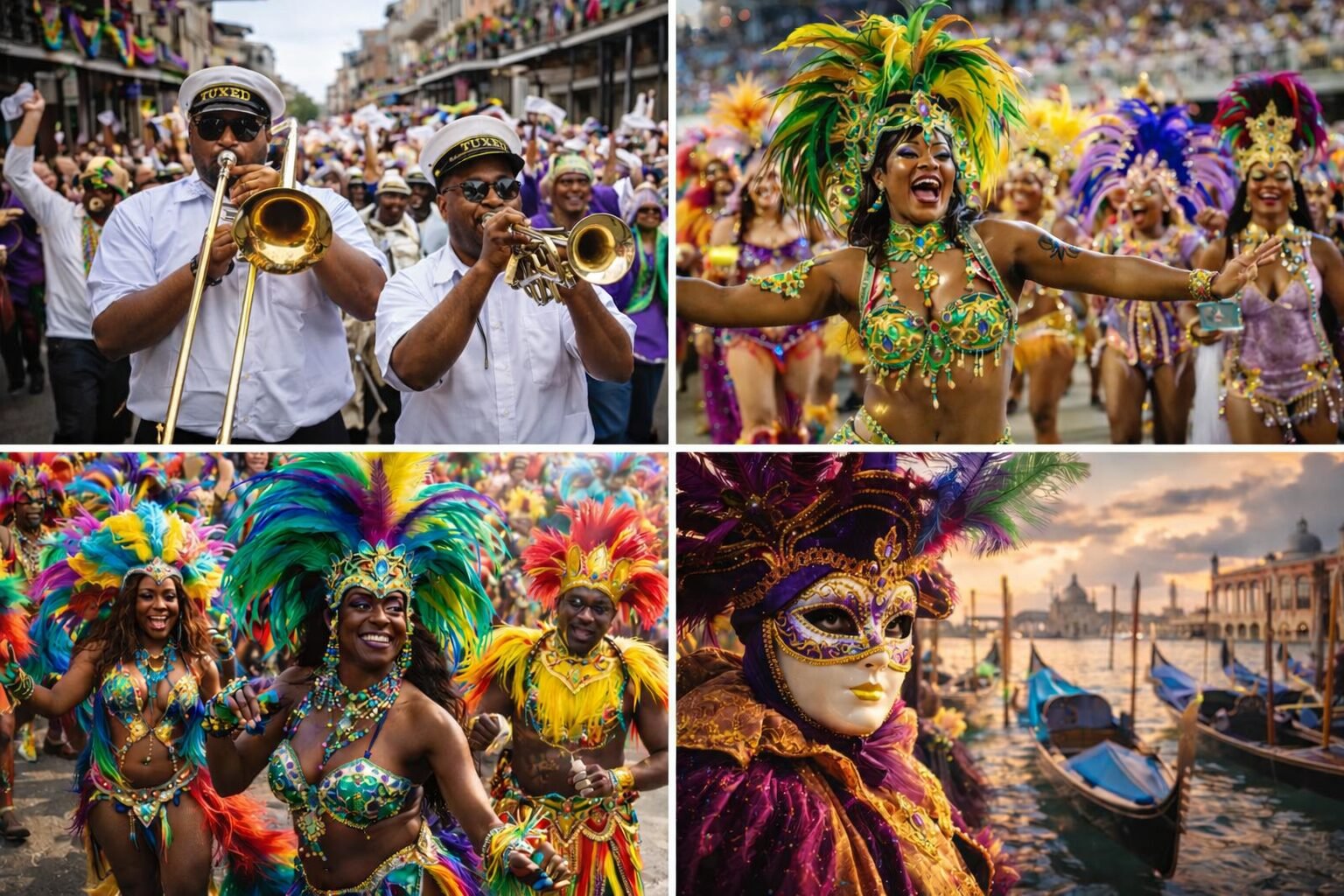


Mardi Gras may be most closely associated with New Orleans, but the celebration itself is truly global. Long before beads filled Bourbon Street, communities across Europe, the Americas, and beyond were marking the days before Lent with festivals of food, music, costumes, and tradition. While the name “Mardi Gras” is French, the spirit behind it—celebration before sacrifice—has taken many forms around the world.
From elegant masked balls in Europe to vibrant street parades in the Caribbean and family-friendly festivals in the United States, Mardi Gras reflects the cultures that celebrate it. Each region adds its own customs, flavors, and meaning, making Mardi Gras one of the most diverse holidays on the calendar.
Mardi Gras in France: The Birthplace of the Name
France is where the term “Mardi Gras” originated, and the celebration there remains closely tied to its historical roots. Traditionally, Mardi Gras marked the final day of feasting before Lent, with rich foods like meats, cheeses, pastries, and pancakes taking center stage.
In cities such as Nice, celebrations include parades featuring elaborate floats, floral battles where flowers are tossed to crowds, and masked performers. While modern French Mardi Gras celebrations are often more subdued than those in New Orleans, they retain a strong sense of elegance, artistry, and tradition.
Carnival in Italy: Masks, Mystery, and Grandeur
In Italy, Mardi Gras is known as Carnevale, a festival that dates back to the Roman era. The most famous Italian celebration takes place in Venice, where Carnival is defined by ornate masks, lavish costumes, and formal balls.
Venetian masks historically allowed people to move freely between social classes, creating a sense of equality and anonymity. Today, Carnival in Venice is as much a visual art form as it is a celebration, attracting visitors from around the world who dress in period costumes and participate in centuries-old traditions.
Germany’s Fasching and Karneval
Germany celebrates Mardi Gras under names like Fasching or Karneval, depending on the region. These celebrations often emphasize satire and humor, with parades that poke fun at politics, public figures, and social issues.
Cities such as Cologne, Düsseldorf, and Mainz host massive parades and street parties. Participants wear costumes, perform comedic acts, and engage in public revelry that blends tradition with contemporary commentary. German Carnival highlights Mardi Gras’s role as a space for expression and release.
Spain and Latin Europe: Carnival Takes Center Stage
In Spain and other parts of southern Europe, Carnival is the dominant pre-Lenten celebration. Cities like Cádiz and Tenerife are known for their energetic festivities, including music competitions, street performances, and elaborate costumes.
These celebrations often last several weeks, culminating in dramatic finales that symbolically mark the end of Carnival. In some regions, effigies are burned or mock funerals are held to represent the passing of indulgence before Lent begins.
Mardi Gras in the Caribbean: Rhythm and Resilience
The Caribbean has embraced Mardi Gras with unmistakable energy and cultural pride. Influenced by African, European, and Indigenous traditions, Caribbean Carnival celebrations are vibrant, rhythmic, and deeply expressive.
In Trinidad and Tobago, Carnival is one of the most significant cultural events of the year. Music genres like calypso and soca dominate the festivities, while dancers in elaborate costumes flood the streets. These celebrations often emphasize freedom, identity, and community, reflecting the region’s complex history.
Brazil’s Carnival: A Global Spectacle
While not always referred to as Mardi Gras, Brazil’s Carnival is one of the largest and most famous pre-Lenten celebrations in the world. Held in cities like Rio de Janeiro and São Paulo, Carnival features samba parades, massive street parties, and elaborate competitions between samba schools.
Brazilian Carnival blends African rhythms, Portuguese influences, and modern performance art. Though it has evolved into a global spectacle, its roots remain connected to the same pre-Lenten traditions that define Mardi Gras elsewhere.
Mardi Gras in the United States Beyond New Orleans
New Orleans may be the most famous American Mardi Gras destination, but it is far from the only one. Mobile, Alabama, boasts one of the oldest Mardi Gras traditions in the country, dating back to the early 1700s.
Cities along the Gulf Coast—including Biloxi, Galveston, and Pensacola—host parades and festivals that reflect local culture while honoring shared traditions. These celebrations are often more family-oriented, emphasizing community involvement and regional pride.
Mardi Gras in Latin America
Across Latin America, Carnival is celebrated with distinct regional flair. In countries like Colombia, Bolivia, and Peru, celebrations often include traditional dances, indigenous costumes, and religious symbolism.
These festivals highlight the blending of Catholic tradition with local heritage, creating celebrations that are deeply meaningful as well as festive. Carnival becomes a way to preserve cultural identity while participating in a global tradition.
Food Traditions Around the World
No matter where Mardi Gras is celebrated, food plays a central role. Pancakes in England, pastries in France, fried dough in Italy, and King Cake in Louisiana all serve the same purpose: using rich ingredients before Lent begins.
These foods are symbolic reminders of abundance, hospitality, and shared joy. They also reflect local tastes and culinary traditions, making Mardi Gras a feast that looks different in every country.
A Shared Spirit Across Cultures
Despite regional differences, Mardi Gras celebrations around the world share common themes. They mark transition, encourage community participation, and balance indulgence with reflection.
Masks, music, food, and parades appear again and again, even as their styles change. The holiday adapts to each culture it touches, proving its resilience and universal appeal.
Mardi Gras as a Global Tradition
Mardi Gras is not confined to one city or country. It is a global expression of humanity’s desire to celebrate together before embracing discipline and renewal.
Whether it’s a masked ball in Venice, a samba parade in Rio, or a neighborhood celebration in New Orleans, Mardi Gras connects people across borders and generations. It reminds us that celebration is a shared language—one that transcends geography while honoring local tradition.
In every corner of the world, Mardi Gras tells the same story in a different voice: life is meant to be celebrated, community matters, and joy has its place—especially before the quiet season begins.
Create your Global Mardi Gras tradition by shopping at Fat Tuesday Fashion.