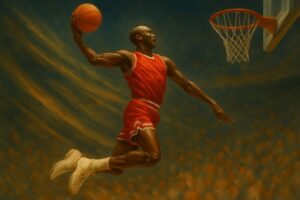
There are legends, and then there is Michael Jordan — the man who turned basketball into an art form, competition into theater, and victory into a personal mission.
Born February 17, 1963, in Brooklyn, New York, Michael Jeffrey Jordan didn’t just dominate basketball; he redefined human possibility.
His hang time became myth, his confidence unshakable, and his work ethic the stuff of folklore.
He was equal parts artist, assassin, and architect — painting the game with impossible grace while dismantling opponents with psychological warfare.
For generations, his name has stood not as a comparison, but as the standard.
Because there’s greatness — and then there’s Jordan Greatness.
Affiliate Disclosure: This post may contain affiliate links. If you purchase through these links, I may earn a small commission at no additional cost to you.
🌆 From Brooklyn Beginnings to North Carolina Grind
Jordan’s story began in Brooklyn but took shape in the quiet streets of Wilmington, North Carolina, after the family relocated.
His father, James, a U.S. Air Force mechanic, and his mother, Deloris, a banker and author, instilled the values of discipline and education.
In their home, success wasn’t handed down — it was earned, one effort at a time.
As a child, Michael was hyper-competitive, constantly dueling his older brother Larry in backyard basketball battles that often ended in fights.
He later said:
“I wanted to win so bad because I didn’t want Larry to have bragging rights at dinner.”
That sibling rivalry sharpened his edge.
But in high school, at Laney High, he faced a humbling setback: he was cut from the varsity team as a sophomore.
That moment became his first defining failure — and his lifelong obsession.
He returned the next year taller, faster, and more determined, earning varsity status and averaging 25 points per game.
He ended his high school career as a McDonald’s All-American, and his tenacity caught the eye of legendary coach Dean Smith at North Carolina.

🎓 UNC: The Blueprint of Greatness
At UNC, Jordan refined his natural talent into structure and poise.
Dean Smith’s system demanded selflessness and precision — traits that would later define Jordan’s ability to lead within a team of stars.
He wasn’t the best player on the roster when he arrived, but he was the hungriest.
He studied upperclassmen, spent hours after practice perfecting his jumper, and committed himself to mastering the fundamentals.
Then came the shot.
In the 1982 NCAA Championship, Jordan — just a freshman — hit the game-winning jumper with 17 seconds left to beat Georgetown.
That moment didn’t just win a title; it crystallized his identity.
He later reflected:
“That shot gave me confidence that I could take on the world.”
He would play three years at Carolina, win multiple national awards, and leave school not just as a star — but as a phenomenon in waiting.
🏀 1984 Draft: The Bulls’ Golden Ticket
In the 1984 NBA Draft, Jordan was selected third overall by the Chicago Bulls — behind Hakeem Olajuwon and Sam Bowie.
It was a decision that would haunt the league forever.
When Jordan stepped onto an NBA court, the energy shifted.
Every dribble felt urgent, every dunk looked poetic, and every jump seemed to defy gravity.
In his rookie season, he averaged 28.2 points, 6.5 rebounds, and 5.9 assists, winning Rookie of the Year and becoming the face of a struggling franchise overnight.
He sold out arenas, boosted television ratings, and revitalized the NBA’s image at a time when it needed a global hero.

👟 Air Jordan: The Birth of a Global Brand
When Nike signed Jordan in 1984, they expected modest returns.
Instead, the Air Jordan 1 sparked a revolution.
The black-and-red colorway violated NBA uniform rules, prompting a $5,000-per-game fine — which Nike gladly paid.
The “banned shoe” became a marketing goldmine.
Within a year, Air Jordan generated over $100 million in revenue, launching sneaker culture into the mainstream.
Jordan wasn’t just selling shoes — he was selling aspiration.
“It’s not the shoes. It’s what you do in them.”
By the early 1990s, Jordan Brand had evolved into an empire.
His Jumpman logo became a global symbol of excellence — from playgrounds to Paris runways.
🧠 The Mindset: Turning Pressure into Fuel
What truly separated Jordan wasn’t just his skill — it was his mind.
He treated every game as a test of willpower.
Every slight — real or imagined — became personal ammunition.
Teammates described him as relentless, sometimes ruthless. He’d trash talk rookies, challenge veterans, and demand the impossible from everyone around him.
Phil Jackson called it “controlled fury.”
Jordan called it standards.
“Winning has a price. Leadership has a price. I pushed people because I expected more from them.”
That intensity forged one of the greatest dynasties in sports.
🏆 The Bulls Rise: Six Rings, Endless Highlights
Between 1991 and 1998, the Chicago Bulls became a global phenomenon — and Jordan was the heartbeat.
The First Three-Peat (1991–1993)
- 1991: Defeated Magic Johnson’s Lakers, ushering in a new NBA era.
- 1992: Beat Clyde Drexler’s Blazers; hit six three-pointers in one half — the famous “Shrug Game.”
- 1993: Outdueled Charles Barkley’s Suns, averaging 41 points per game, still a Finals record.
Then, tragedy struck.

💔 The First Retirement: Grief and Baseball
In July 1993, Jordan’s father, James, was murdered in North Carolina — a loss that shattered him.
Overwhelmed, he retired from basketball at age 30, saying he had lost his desire to play.
He pursued baseball, honoring his father’s lifelong dream.
Signed by the Chicago White Sox, Jordan played for their Double-A affiliate, the Birmingham Barons.
While his numbers were modest (.202 batting average), his effort was legendary.
Teammates recalled 6 a.m. batting sessions and long hours in the cage — proof that his obsession for improvement never faded.
Coach Terry Francona later said:
“If he had stayed another year, he would have made the majors.”
🐂 The Comeback: “I’m Back.”
On March 18, 1995, the world received a fax that changed sports forever:
“I’m Back.”
In his first game, he dropped 19 points against the Pacers.
Two weeks later, he scored 55 against the Knicks in Madison Square Garden — a statement that the king had returned.
By the 1995–96 season, Jordan and the Bulls were unstoppable.
They finished 72–10, the best record in NBA history (at that time).
Jordan won MVP, All-Star MVP, Finals MVP, and his fourth championship.
He followed that with titles in 1997 (The “Flu Game”) and 1998 (The “Last Shot”).
That jumper over Bryon Russell in Game 6 of the 1998 Finals remains perhaps the most iconic image in sports: Jordan’s follow-through held high, the net snapping, the crowd silent.
🕊️ The Wizards Years: One Last Flight
After a second retirement, Jordan returned again in 2001, this time as player-president of the Washington Wizards.
Though older and slower, his competitiveness never dulled.
He averaged over 20 points at age 40 and dropped 43 in a single game — becoming the oldest player to do so.
His final game, April 16, 2003, ended in a standing ovation from both teams and fans.
He left the court in tears — and to the world, it felt like the end of an era.
💬 Voices of Greatness
- Larry Bird: “He’s God disguised as Michael Jordan.”
- Magic Johnson: “There’s Michael — and then there’s the rest of us.”
- Kobe Bryant: “I don’t get five championships without him showing me the way.”
- LeBron James: “He made the bar. We’re all just chasing it.”
- Charles Barkley: “He didn’t just want to beat you — he wanted to embarrass you.”
👔 Beyond the Game: The Business of Being Jordan
After retirement, Jordan’s influence only grew.
Jordan Brand Empire
His Nike partnership became a cultural revolution, transforming into a standalone brand that now exceeds $5 billion in annual revenue.
The Jumpman logo adorns shoes, schools, and even NFL and MLB uniforms.
Ownership and Philanthropy
In 2010, Jordan became the first Black majority owner in NBA history, purchasing the Charlotte Hornets.
He’s since donated millions to racial equity causes, health initiatives, and youth programs through the Jordan Wings Scholars Program.
Cultural Impact
He appeared in the blockbuster Space Jam (1996), merging basketball with pop culture.
His Gatorade “Be Like Mike” campaign became a generational anthem — “Sometimes I dream that he is me…”
Jordan didn’t just inspire athletes; he inspired ambition itself.
🌍 Global Influence: The Athlete Who Became a Planet
By the mid-1990s, Jordan’s face was recognized worldwide — more than any political leader or entertainer.
The 1992 Dream Team, featuring Jordan, Magic, and Bird, brought basketball to a global audience.
Kids in Tokyo, Paris, and Johannesburg wore Bulls jerseys and practiced fadeaways on cracked pavement.
His influence helped globalize the NBA — paving the way for international stars like Manu Ginóbili, Dirk Nowitzki, and Giannis Antetokounmpo.
Even today, in markets from China to Brazil, the Jumpman is a universal symbol of excellence.
🧩 The Philosophy of Greatness
Jordan’s approach to life transcended basketball. It was a belief system — one rooted in the pursuit of mastery.
“I failed over and over again in my life. And that is why I succeed.”
He viewed failure not as defeat, but as a requirement for progress.
He played every game like someone was watching for the first time — because, to him, someone always was.
That hunger to improve — to squeeze out every ounce of potential — became the cornerstone of the “Jordan Mentality.”
🕊️ Legacy: The Eternal Benchmark
Jordan’s influence touches every modern athlete — from Tom Brady’s obsession with preparation, to Serena Williams’s mental discipline, to Kobe Bryant’s “Mamba Mentality.”
He showed that greatness isn’t gifted — it’s earned daily.
That championships aren’t destinations — they’re expectations.
That talent opens doors, but work ethic kicks them down.
Every time a young athlete whispers “I want to be the best,” they’re chasing his ghost.
🎉 Final Word
Michael Jordan didn’t just change basketball — he became basketball.
He wasn’t chasing fame, endorsements, or approval.
He chased the moment — the perfect shot, the perfect game, the perfect standard that no one else could touch.
He taught us that greatness is lonely, that excellence demands sacrifice, and that the game rewards those who refuse to compromise.
In his prime, he didn’t just play in the air — he owned it.
And even now, decades later, the shadow he cast still stretches across every court, every athlete, every dream.
Happy Birthday, Michael Jordan — the icon, the inspiration, the eternal standard. 🏀👑 “Be Like Mike” was the wish. Being like Mike became the goal.
Micheal Jordan Products:
Micheal Jordan slam dunk T-Shirt
Michael Jordan North Carolina Tar Heels Jordan Brand Road Replica Basketball Jersey – Carolina Blue
MICHAEL JORDAN Autographed Bulls Original Champion Rookie Jersey UDA LE 21/50
Michael Jordan 1985 Air Jordan 1 Game Used Signed Sneakers Rookie MEARS, JSA COA
Incredible NBA Top 50 Greatest Players Signed Jersey Display Michael Jordan JSA